

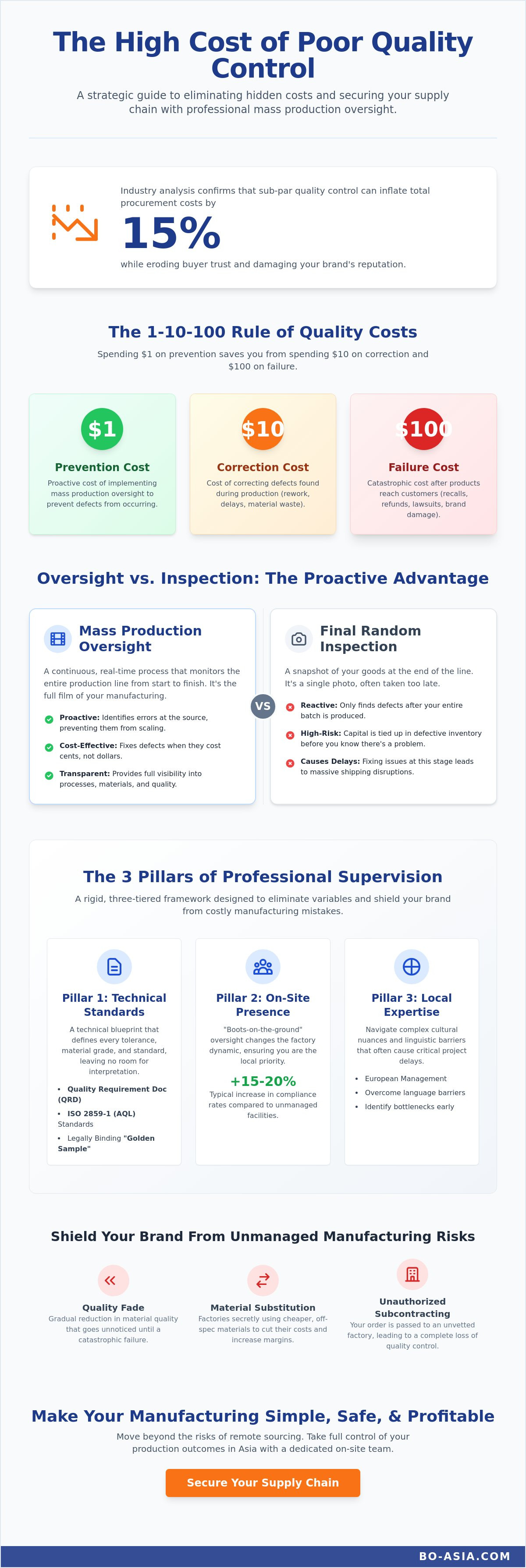
A 2023 industry analysis confirms that sub-par quality control can inflate total procurement costs by 15% while eroding buyer trust. You've likely dealt with the frustration of batch defects and the opaque communication that defines the traditional agent model. Implementing professional mass production oversight is the only way to eliminate these hidden costs and protect your brand from the reputational damage of faulty goods. We agree that your supply chain should be a source of competitive advantage, not a constant source of anxiety.
This guide provides the strategic framework to secure factory-direct pricing and achieve the peace of mind that comes with zero-defect shipments. You'll learn how to establish an on-site presence that ensures your specifications are met every single time. We're going to detail the specific mechanics of cost-efficiency and local accountability that make your manufacturing process simple, safe, and profitable. By the end of this article, you'll have a clear roadmap to move beyond the risks of remote sourcing and take full control of your production outcomes in Asia.
• Stop leaving money on the table by understanding the "cost of quality" and how continuous monitoring prevents catastrophic batch failures.
• Establish the three pillars of professional supervision to ensure every production run strictly adheres to your technical specifications and "Golden Samples."
• Replace the risks of remote management with on-site mass production oversight to eliminate the hidden margins and opaque practices of traditional sourcing agents.
• Follow a practical five-step implementation roadmap, beginning with critical pre-production meetings, to secure your supply chain from start to finish.
• Learn how European management combined with local expertise creates a simple, safe, and profitable manufacturing environment that shields your brand reputation.
Mass production oversight is the active, continuous monitoring of your production line to ensure every unit adheres to your exact specifications. It moves beyond the passive role of a traditional agent; it places a dedicated team on the factory floor to verify inputs, processes, and outputs in real time. For wholesalers and brand owners, this isn't just a technical requirement. It's a strategic shield against the hidden costs that erode profitability in overseas manufacturing. By maintaining a local presence, you transition from hoping for quality to demanding it through transparency.
Manufacturing quality follows the 1-10-100 rule. Spending $1 on prevention through mass production oversight saves $10 on corrective actions during production and $100 on total failure costs after a product reaches the customer. Without a local presence, you face three primary risks: quality fade, material substitution, and unauthorized subcontracting. Quality fade is particularly dangerous. It's a gradual reduction in material quality that often goes unnoticed until a catastrophic batch failure occurs. In 2023, global supply chain audits revealed a 15% increase in unauthorized subcontracting as primary factories struggled to meet deadlines. This lack of control leaves you vulnerable to reputational damage that takes years to repair. We act as your on-site eyes to ensure these risks never materialize.
Most buyers rely on a final random inspection. This is a snapshot of your goods at the end of the line. If the inspection fails, your capital is already tied up in defective inventory. It's often too late to fix errors without causing massive shipping delays. Mass production oversight acts as the entire film of the manufacturing process. It identifies errors at the source, such as a miscalibrated machine or a batch of off-spec raw materials, before they scale across thousands of units.
We focus on preventative management. By maintaining an on-site presence, we ensure your supply chain remains simple, safe, and profitable. You stop leaving money on the table by catching defects when they cost cents to fix, not dollars to recall. This proactive approach transforms your manufacturing from a source of anxiety into a reliable engine for growth. Effective mass production oversight means you're no longer at the mercy of a factory's internal reporting; you have the data you need to protect your brand's integrity.
Effective mass production oversight isn't a result of luck. It's the product of a rigid, three-tiered framework designed to eliminate the variables that lead to costly mistakes. You can't manage what you haven't defined, and you certainly can't control what you don't see. These pillars serve as your strategic shield against the common pitfalls of overseas procurement.
Success begins with a comprehensive Quality Requirement Document (QRD). This isn't a simple list of features; it's a technical blueprint that defines every tolerance, material grade, and finishing standard. Without a QRD, you're leaving the factory to interpret your quality needs, which often leads to "quality fade."
We utilize ISO 2859-1 (AQL) standards to determine sample sizes and 1.5/2.5 acceptance thresholds. This statistical rigor ensures your batch meets global compliance.
Before the first machine starts, the factory manager must sign off on a physical "Golden Sample." This sample serves as the legally binding benchmark for the entire production run.
Remote management through video calls or emails is insufficient for high-volume sourcing. It creates a vacuum where factory managers might prioritize other clients or cut corners on raw materials. A "boots-on-the-ground" representative changes the psychological dynamic on the factory floor. When workers know an expert is watching, compliance rates typically increase by 15% to 20% compared to unmanaged facilities.
Local expertise is your greatest asset. Our teams navigate the complex cultural nuances and linguistic barriers that often cause project delays. By having a physical presence, you're no longer a distant email; you're a local priority. This on-site approach allows us to identify bottlenecks before they snowball into missed deadlines. By partnering with a dedicated sourcing team, you ensure your interests are protected at the source.
You must move away from simple "pass/fail" results. Professional mass production oversight relies on Statistical Process Control (SPC) to track trends during the manufacturing cycle. If the defect rate climbs from 0.5% to 1.2% in three days, we intervene immediately rather than waiting for the final inspection.
Transparency means eliminating opaque middlemen who filter information to suit their own margins. You deserve direct communication and unedited evidence. Our reporting includes:
• Real-time photo and video evidence of the production line.
• Detailed measurement logs for critical components.
• Direct access to raw inspection data without "agent" interference.
This level of detail ensures you stop leaving money on the table through hidden defects or unverified claims. It's about creating a simple, safe, and profitable supply chain through relentless technical rigor.
Managing a factory in Shenzhen or Hanoi from an office in London or New York creates an immediate disadvantage. You lose control the moment the contract is signed. Without physical presence, you're relying on factory-sent photos that often hide structural defects or material substitutions. This distance is where quality fade thrives, potentially costing brands up to 15% of their total order value in unsalvageable inventory. Effective mass production oversight isn't something you can achieve via email or occasional Zoom calls. It requires a physical shield on the factory floor.
The most common objection we hear is, "I already have a sourcing agent." This perspective often ignores the inherent conflict of interest in the traditional agent model. Most agents operate on a commission basis, frequently collecting hidden kickbacks from the factory that range from 3% to 7% of the order value. When an agent's income is tied to the factory's payout, they're incentivized to overlook minor defects to ensure the shipment clears. They prioritize the transaction, not your long-term brand equity.
Commission-based agents serve two masters, but the factory is the one that stays in their backyard.
A retainer or flat-fee model ensures your oversight team is a direct extension of your office, loyal only to your specifications.
Finding a supplier is a one-time event; managing a production line is a daily battle for consistency.
By shifting to a dedicated procurement team, you stop leaving money on the table. You replace opaque middlemen with a transparent partner who treats your capital with the same rigor you do. This transition moves your supply chain from a high-risk gamble to a simple, safe and profitable operation.
Effective mass production oversight requires a hybrid leadership structure to eliminate the 6 to 8-hour time zone lag that often delays critical decisions. By maintaining a Helsinki HQ for strategic consulting and a Hong Kong office for operational execution, we provide 24/7 visibility into your supply chain. When a production bottleneck occurs at 9:00 AM in Ningbo, it's resolved before your European team even starts their first coffee.
We act as the Seasoned Insider, leveraging local dialect and deep-rooted networks to navigate factory politics and identify bottleneck risks before they stop your assembly line. This local presence allows us to monitor ESG compliance and technical specifications in real-time. You're no longer a distant customer; you're a local priority with a team that speaks the language of the factory floor and the language of your boardroom.
Effective mass production oversight isn't a single event. It's a series of strategic interventions that protect your margin and brand reputation. Use this five step roadmap to secure your next production run and eliminate the "black box" of overseas manufacturing.
Before the first machine turns on, verify raw materials against your golden sample. This is the time to confirm that the factory isn't substituting lower-grade components to save on their own costs.
Inspect the first 10% of the finished goods. If a machine is calibrated incorrectly, you'll catch the error before it ruins the entire batch.
Conduct this at the 50% completion mark to ensure the factory maintains the agreed-upon standards throughout the cycle.
Use statistical sampling to verify the quality of the total order. This is your last chance to stop a shipment before you've paid the final balance.
A local expert watches the actual loading process. This prevents "carton swapping" and ensures the container is packed to minimize transit damage.
The first 100 units are the most dangerous in any mass production run. In a 2023 analysis of manufacturing defects, 62% of systemic errors originated during the initial setup phase. An IPC identifies these failures immediately. Without it, you risk receiving 10,000 units with the same fundamental flaw.
As the run continues, DUPRO identifies "process drift." This occurs when quality slides over time due to tool wear, worker fatigue, or environmental changes in the factory. Your raw material checklist must include specific verification for moisture content, tensile strength, and Pantone color matching. Verifying these specs before they enter the assembly line is the only way to maintain a simple, safe and profitable supply chain.
Reading an FRI report requires a disciplined approach. You must look at the Acceptable Quality Limit (AQL) results based on current ISO 2859-1 standards. These standards provide the sampling plans and procedures for inspection by attributes. If the number of major or minor defects exceeds the AQL threshold, you must reject the batch. Do not accept excuses about "factory tolerances."
Finally, do not overlook the loading dock. Industry data suggests that roughly 15% of cargo damage occurs because of poor weight distribution or improper stacking inside the container. Supervising the loading ensures that the goods you paid for are the same goods that arrive at your warehouse. This on-site presence acts as a shield against the hidden costs of unmanaged sourcing.
Stop leaving your product quality to chance and start protecting your bottom line. Partner with our local experts to secure your next production run with professional oversight.
Managing overseas manufacturing shouldn't feel like a gamble. Buying Office Asia (BOA) removes the complexity by providing a framework that is simple, safe, and profitable. We don't just act as a contact point; we function as your dedicated sourcing team on the ground. By combining European strategic management from our Helsinki office with deep local expertise in Hong Kong, we bridge the cultural and operational gaps that often lead to costly errors.
Our model is built on the principle of 100% transparency. Unlike traditional agents who often obscure their margins, BOA ensures you receive factory-direct pricing. This approach eliminates opaque middlemen who drain your profits. We act as your shield in Asia, providing the same level of mass production oversight that global corporations utilize to protect their brand equity.
In a recent 2023 engagement, our on-site team identified a critical soldering flaw during a mid-production inspection for a high-volume electronics client. By catching this defect before the final assembly of 12,000 units, we prevented a potential 85% failure rate in the first batch. This intervention saved the client four weeks in potential shipping delays and protected them from a massive recall. Our presence ensures that "factory-direct" doesn't mean "unmanaged."
• European management standards for clear communication.
• Local Hong Kong expertise for real-time problem solving.
• Complete removal of hidden commissions and markups.
• On-site presence at every critical stage of the production cycle.
Many brands operate on "hope" when it comes to quality. They hope the factory follows the spec. They hope the materials are compliant. Secure production requires more than hope; it requires physical presence. Transitioning to a managed supply chain means you stop leaving money on the table through hidden costs and quality claims. It's about moving from a reactive state to a proactive one.
Effective mass production oversight allows you to scale your volume without proportionally increasing your risk. Whether you are moving from 5,000 to 50,000 units, our team ensures your standards remain consistent. We invite you to schedule a consultation to audit your current oversight process and identify vulnerabilities in your procurement strategy. Don't wait for a defective batch to realize your supply chain is exposed.
Leaving your production to chance is a risk your brand can't afford. Effective mass production oversight bridges the gap between remote expectations and factory floor reality. It's about shifting from reactive firefighting to proactive quality control. By focusing on the three pillars of supervision and implementing a structured five-step plan, you eliminate the threat of reputational damage and costly delays. You shouldn't have to settle for the opaque margins of traditional agents when professional transparency is available.
Buying Office Asia brings 15+ years of European leadership and on-the-ground experience directly to your supply chain. Our Hong Kong headquarters ensures immediate factory access whenever issues arise. We operate with a 100% transparent fee structure, removing the hidden margins that often plague overseas manufacturing. You get a dedicated team that acts as your shield in the market. Secure your manufacturing margins with professional oversight today. Your path to a simple, safe, and profitable production cycle is within reach. We're ready to protect your interests at every step.
Quality control is typically a final inspection of a finished batch, whereas mass production oversight involves a continuous physical presence on the factory floor throughout the manufacturing cycle. While a final QC check identifies errors after they've occurred, oversight allows your team to catch deviations in raw materials or assembly processes before they compromise the entire shipment. This proactive approach ensures that 100% of your order meets specifications rather than relying on a statistical sample.
Costs vary based on the project scope and duration. Industry reports from platforms like QIMA suggest that daily man-day rates for on-site inspections in Asia generally range between $200 and $350. You should measure this cost against the 25% loss in profit margins that typically occurs when defective goods reach your warehouse and trigger returns. Investing in a local team prevents these hidden costs from eroding your bottom line.
You shouldn't rely solely on a factory's internal team because their primary loyalty lies with the manufacturer's production targets, not your brand's reputation. Internal staff often face pressure to meet shipping deadlines, which leads to a 20% higher likelihood of overlooked defects compared to independent oversight. Utilizing a third-party team provides the transparency you need to ensure that "A-grade" standards are maintained without the bias of factory management.
Mass production oversight is essential for smaller orders because these often serve as the critical test for a new supplier relationship. Even a small batch of 500 units represents a significant capital risk if the quality fails to meet market standards. Implementing oversight on initial runs establishes a standard of excellence and signals to the factory that you won't accept sub-par output, protecting your growth from day one.
If the oversight team identifies major defects, production stops immediately to prevent further waste of raw materials. Your on-site team initiates a root cause analysis to determine if the failure stems from machine calibration or human error. We then manage the rework process to ensure that 100% of the affected units are corrected or replaced before the final shipment is cleared, acting as a shield against reputational damage.
Choosing between an agent and a dedicated procurement team depends on your need for transparency. Traditional agents often operate on "hidden margins" and kickbacks from factories, which can inflate your landed costs by 10% or more. A dedicated team acts as your local office in Asia, providing a direct connection to the factory and ensuring that mass production oversight is conducted with your specific profitability and compliance standards as the only priority.
While established hubs have mature systems, regions like Vietnam and the inland provinces of China often require more intensive mass production oversight. According to the 2023 World Bank Logistics Performance Index, infrastructure and labor skill gaps in emerging manufacturing zones can lead to a 12% increase in production delays. Having local, on-site personnel in these areas is the only way to manage these localized risks and ensure your supply chain remains stable.
The most common defects include unauthorized material substitutions, where a factory uses 15% cheaper components to save on costs, and inconsistent finishing on high-touch surfaces. Oversight teams also frequently catch packaging errors, such as incorrect SKU labeling or insufficient padding, which lead to a 5% damage rate during sea freight. Catching these issues on-site ensures your products arrive simple, safe, and profitable without the need for expensive domestic sorting.

What if the first clear sign of a production problem arrives after the goods are packed? Manufacturing risk management in Asia works best when controls are connected from the start, not left to a final inspection or occasional supplier update. You need visibility into factory activity, early warning...

What if the lowest unit quote isn’t the lowest-cost way to make your board game? Board game manufacturing costs depend on more than the number of boxes ordered. Component materials, custom tooling, assembly, packaging and delivery scope can all change what a quote covers, making headline prices diff...

What if the factory’s lowest quote isn’t the lowest-cost option? A lower unit price can hide differences in materials, tooling, packaging, quality checks or production terms. Understanding how sourcing agents negotiate factory prices starts with making those differences visible, not simply asking a...