


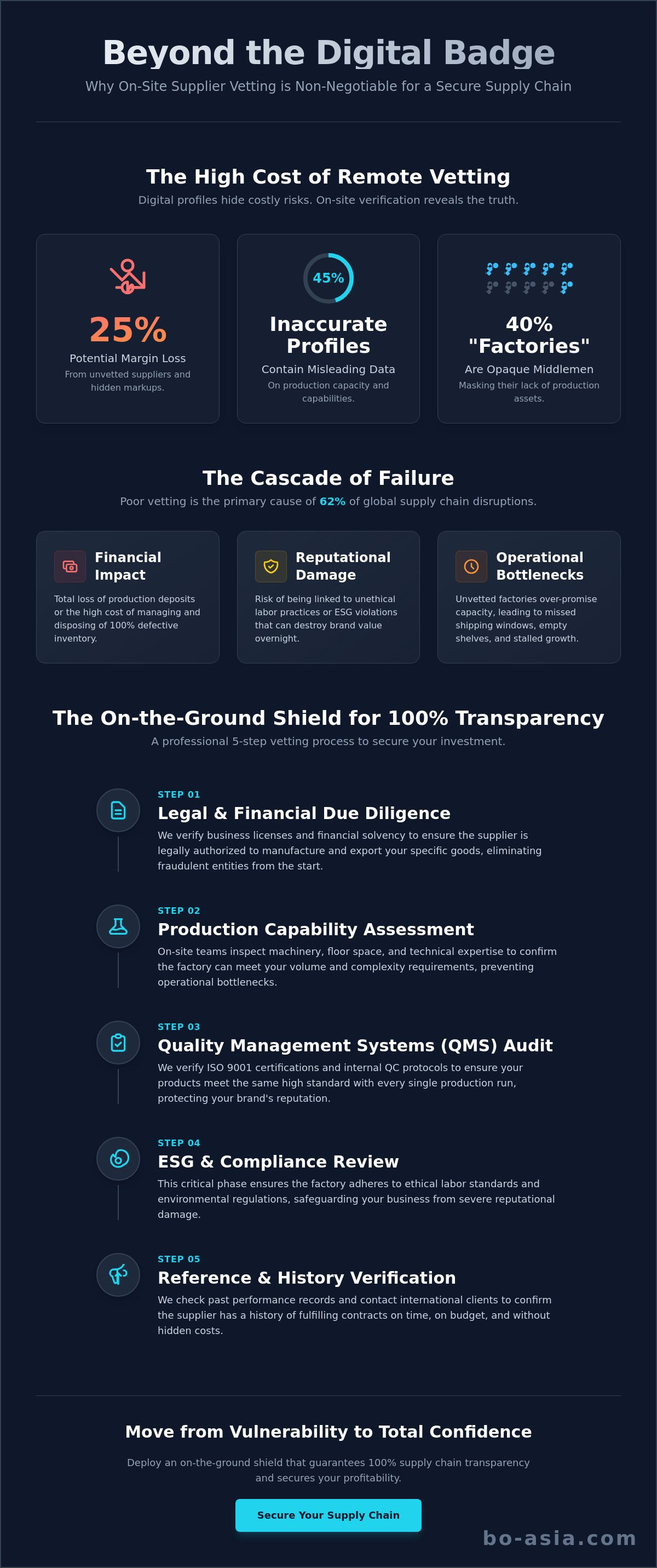
Your digital "verified" badge is often the very thing leaving your supply chain vulnerable to a 25% margin loss. Industry data from 2023 shows that 45% of factory profiles contain significant inaccuracies regarding their actual production capacity, yet many brands still rely on remote checklists. True supplier vetting requires a physical, on-site presence to see who is actually running the machines. You understand that overseas manufacturing is the engine of your growth, yet the constant threat of sudden quality drops or reputational damage from ESG non-compliance keeps you from scaling with total confidence.
It's frustrating to realize you're leaving money on the table because of opaque middlemen and hidden agent markups. This guide will show you how to move beyond basic digital checks and implement a rigorous, on-the-ground strategy that secures 100% transparency. You'll learn how to eliminate risk and build a reliable, long-term partnership directly with the manufacturing source. We'll examine the specific mechanics of physical site audits and capacity verification to ensure your sourcing remains simple, safe, and profitable.
• Discover why relying on B2B platform ratings is a strategic liability and how to look past digital facades to find genuine manufacturing partners.
• Master a rigorous five-step supplier vetting framework that verifies legal standing and production capacity before you commit capital.
• Learn the "Seasoned Insider" techniques for conducting on-site audits that expose operational red flags hidden by Zoom calls and PDF certificates.
• Identify the structural differences between opaque middlemen and dedicated sourcing teams to eliminate hidden margins and protect your bottom line.
• Position your business for simple, safe, and profitable growth by deploying an on-the-ground shield that guarantees 100% supply chain transparency.
In the complex landscape of Asian manufacturing, What is Supplier Vetting? It's the rigorous process of verifying a manufacturer's legal standing, financial health, and operational capacity before you commit capital. For many importers, this process begins and ends on a laptop. This is a mistake. Relying on digital profiles creates a dangerous information asymmetry where the supplier holds all the cards while you assume all the risk. You see a polished storefront; they see an opportunity to exploit your lack of local presence.
Effective supplier vetting isn't about ticking boxes on a screen. It's about closing the gap between a digital brochure and factory floor reality. When you source remotely, you're gambling on the honesty of a party thousands of miles away. A seasoned insider approach replaces this guesswork with local, on-site verification. This ensures your supply chain remains simple, safe, and profitable from day one. By placing a protective shield around your procurement, you move from a position of vulnerability to one of steady confidence.
B2B marketplaces often award "Gold" or "Verified" status based on membership fees rather than actual performance. These badges don't guarantee quality or ethical standards. In fact, roughly 40% of "factory" profiles on major platforms are actually opaque middlemen or trading companies using clever digital marketing to mask their lack of production assets. You risk a "Bait and Switch" where the high-quality sample you approved in March doesn't match the 10,000 units that arrive in August. Without a dedicated sourcing team on the ground, you won't know there's a problem until your capital is already gone.
The consequences of skipped due diligence are immediate and expensive. Industry data suggests that unvetted suppliers are the primary cause of the 62% of global supply chain disruptions reported by wholesalers in 2023. These failures lead to more than just lost deposits. They create a cascade of operational delays that stall your growth. Consider the following risks:
Total loss of production deposits or the cost of disposing of 100% defective inventory.
The risk of being linked to unethical labor practices or ESG violations that can destroy a brand's value overnight.
Unvetted factories often over-promise capacity, leading to missed shipping windows and empty shelves.
You can't afford to stop leaving money on the table by ignoring these risks. Proper supplier vetting acts as a stabilizing force, protecting your margins and your company's future from the volatility of unmanaged sourcing.
Rigorous supplier vetting is the only way to move beyond the "opaque middleman" model and secure a direct, transparent partnership with a manufacturer. We follow a framework aligned with the professional vetting process standards used by global organizations to mitigate supply chain risks. This methodology ensures that every dollar you invest is protected by data, not just promises. We break down the anatomy of a professional audit into five distinct phases.
We verify business licenses and financial solvency to ensure the entity is legally authorized to manufacture and export your specific goods.
Our teams inspect machinery, floor space, and technical expertise to confirm the factory can actually meet your volume and complexity requirements.
We verify ISO 9001 certifications and internal QC protocols to ensure your products meet the same standard every time.
This phase ensures the factory adheres to ethical labor standards and environmental regulations, protecting you from reputational damage.
We check past performance with international clients to confirm the supplier has a history of fulfilling contracts without hidden costs.
Verifying a Chinese business license requires looking past the digital file. You must cross-reference the Unified Social Credit Code with the National Enterprise Credit Information Publicity System. This process identifies shell companies that exist only to hide financial instability or mask a lack of manufacturing assets. The 'Scope of Business' is the primary legal filter for vetting, as it defines the specific activities a company is legally permitted to perform. In our 2023 audits, approximately 14% of potential suppliers were disqualified because their registered scope did not match the products they claimed to manufacture.
A factory's website might display advanced machinery, but our on-site inspections often reveal that those assets are leased or inactive. We evaluate whether the factory owns its tooling or if they outsource production to unvetted workshops, which is a leading cause of quality fade. We also assess the technical skill level of the workforce by observing real-time assembly line error rates. Verifying raw material supply chains is equally vital to prevent upstream disruptions. This boots-on-the-ground approach ensures your sourcing remains simple, safe, and profitable. If you want to stop leaving money on the table, having a dedicated sourcing team is the most effective way to gain total control. You can speak with our experts to start your next audit project.
Digital documentation only tells the story a factory wants you to hear. A high-resolution PDF or a curated Zoom tour can't replace the granular reality of a physical walkthrough. During a remote supplier vetting process, it's easy for a facility to hide disorganized assembly lines or outdated machinery. A 2023 analysis of Asian manufacturing audits revealed that 32% of factories provide certifications that are either expired or don't match the actual production facility. Physical presence is the only shield against these discrepancies and ensures your sourcing and procurement strategy is built on facts.
Seasoned insiders look for what isn't being shown. We don't just follow the guided path; we check the corners. If the raw material storage is damp or the fire exits are blocked, it’s a sign of a failing quality culture. These details directly impact your bottom line. An unorganized floor leads to a 12% higher defect rate on average. Being on-site also prevents shadow subcontracting. This occurs when a vetted factory takes your deposit but moves production to a cheaper, unvetted facility to increase their margin. In 2024, approximately 18% of reported quality failures in Asian exports were traced back to these unauthorized workshops. If we aren't there to verify the machines are actually running your order, you're at risk of receiving sub-standard goods from a ghost facility.
Safety and cleanliness are proxies for precision. We verify that production logs match the reported schedules in real time. If a factory claims 90% efficiency but the QC station is empty, there’s a transparency gap. We physically test the functionality of calibration tools and testing equipment. It’s not enough to see a machine; we must see it in operation, maintained, and manned by trained staff who follow documented protocols.
Navigating the nuances of a factory visit requires more than a translator. Local teams identify window dressing, such as temporary staff hired just for the audit or machines brought in to look busy. We understand the local business environment and can spot when a manager is being evasive. Our local presence ensures that negotiations are based on reality, not a performance staged for a foreign visitor. This boots-on-the-ground approach is what makes sourcing simple, safe, and profitable.
Many brands unknowingly leave money on the table by relying on traditional sourcing agents who operate on a commission-only basis. While this seems cost-effective at first, it creates a fundamental conflict of interest. These agents often prioritize the factories that offer them the highest kickbacks rather than the ones that provide you with the best quality or lowest price. Rigorous supplier vetting acts as a diagnostic tool to expose these hidden layers, ensuring your capital goes toward product quality instead of lining a middleman's pocket.
The "Commission Trap" is a common industry pitfall where an agent claims a flat 5% fee but secretly secures an additional 10% markup from the factory. Without direct access to the manufacturer, you'll never see the true cost of goods. Genuine transparency requires a shift to Factory Direct Price Negotiations. Factory Direct Pricing is the net cost achieved through verified direct relationships with manufacturers, stripped of all intermediary markups. By conducting deep-dive audits, you can identify exactly where costs are being inflated. This upfront investment in vetting typically yields a return of 15% to 30% in total cost of ownership savings by eliminating these undisclosed margins.
Effective supplier vetting changes the dynamic from a simple transaction to a strategic alliance. When you vet a supplier thoroughly, you demonstrate a level of professional rigor that earns mutual respect. Manufacturers prefer working with brands that understand their operations and value compliance. This transition from transactional buying to strategic sourcing ensures you aren't just another order number in a spreadsheet. It allows for better lead times, priority production slots, and collaborative problem-solving during market fluctuations. To achieve this level of control, you need Your Dedicated Sourcing Team on the ground to manage the relationship daily.
Stop guessing about your true manufacturing costs and start taking control of your supply chain today. Our team provides the local oversight needed to keep your production simple, safe, and profitable.
Buying Office Asia acts as your on-the-ground shield, protecting your capital and reputation where digital platforms fall short. We don't rely on remote promises or unverified certificates. Instead, our team provides a physical presence at the factory floor to ensure every claim is backed by reality. Our supplier vetting methodology is designed to eliminate the "black box" of Asian manufacturing, replacing uncertainty with data-driven confidence.
We've built our reputation on a commitment to 100% transparency. Unlike traditional sourcing agents who often rely on hidden margins and kickbacks from factories, we operate as your dedicated internal department. This model ensures that every dollar you save stays on your balance sheet. By following our "Simple, Safe, and Profitable" framework, wholesalers and brand owners can bypass the risks of opaque middlemen. You can gain deeper insights into this process by Mastering Sourcing and Procurement in Asia through our proven strategic channels.
Our "shield" approach involves three core pillars:
We visit the site to confirm the supplier isn't a trading company posing as a factory.
We analyze the supplier's fiscal health to prevent mid-production bankruptcies.
We evaluate their actual capacity against your specific order volume.
Our operational model bridges the gap between Western expectations and Eastern market dynamics. With leadership based in Helsinki and execution handled by our Hong Kong office, we provide a dual layer of protection. This structure allows us to offer the same level of rigorous oversight and compliance management that Fortune 500 companies demand. We focus on ESG standards and technical audits to ensure your supply chain is resilient against global scrutiny. You can see how we've reduced risk for diverse global brands in our Cases.
Securing your production doesn't require a total overhaul of your operations. We begin with an initial consultation to assess your current supplier risks and identify where your margins are being eroded. Whether you're looking to audit a new partner or optimize an existing relationship, our supplier vetting services integrate seamlessly into your procurement flow. We act as your eyes and ears, providing the local expertise you need to scale safely. It's time to stop leaving money on the table and secure your supply chain with a partner who prioritizes your bottom line.
Success in Asian manufacturing isn't found behind a computer screen. It's built through rigorous, on-site supplier vetting that exposes opaque middlemen and secures your bottom line. You've learned that desktop research alone leaves you vulnerable to hidden margins and quality failures. By implementing a professional audit process, you protect your brand from reputational damage and ensure every factory meets your exact standards for transparency and compliance.
Buying Office Asia acts as your shield in these complex markets. We're a European-managed firm with 15+ years of on-the-ground experience across the region. Our dedicated teams in Hong Kong and Helsinki provide a 100% transparency guarantee with zero hidden kickbacks. We don't just act as a bridge; we function as your local procurement department to make your supply chain simple, safe, and profitable. It's time to stop leaving money on the table and take full control of your production cycle.
Secure your supply chain and eliminate hidden margins with Buying Office Asia.
Your path to a more reliable and cost-efficient manufacturing future starts with a single strategic decision. We look forward to helping your business grow with confidence.
Supplier vetting is the holistic screening process used to verify a factory's legal and commercial legitimacy before you commit. A supplier audit is a technical deep-dive into specific production lines or quality management systems that occurs later. Effective vetting filters out 85% of unsuitable candidates by checking business licenses and export records. This ensures you don't waste time on companies that lack the capacity to deliver.
A thorough supplier vetting process in Asia typically takes 5 to 10 business days to complete. This timeframe allows our on-site teams to verify 100% of the factory's documentation and conduct a physical site visit. Rushing this stage often leads to overlooked risks. A 72-hour preliminary desktop review can identify immediate red flags, but the full physical inspection is what secures your investment.
You can use databases for basic background checks, but they can't replace on-the-ground verification. Software often relies on self-reported data which is 40% more likely to contain inaccuracies or outdated certifications. We've seen "gold-rated" suppliers on major platforms that turned out to be trading companies operating out of a 20-square-meter office rather than the 5,000-square-meter factory they claimed in their online profile.
ISO 9001 certification is a baseline requirement, but it doesn't guarantee your specific product's quality or the factory's current financial health. Industry reports suggest that up to 30% of certifications in certain regions are either expired or obtained through questionable third-party consultants. Vetting ensures the factory actually follows the processes described in their ISO manual during your specific production run rather than just keeping the paperwork for show.
Watch for signs of sub-contracting, such as 50% of the production line sitting idle or unmarked boxes from other factories in the shipping area. If you don't see specialized machinery required for your specific product, they're likely outsourcing your order to unmanaged workshops. Another major red flag is the absence of a dedicated Quality Control lab with calibrated testing equipment. This suggests they rely on visual inspection alone.
Professional vetting costs significantly less than the 25% to 40% loss businesses typically face from a single rejected shipment. While we don't set fixed market prices, industry data shows that supply chain disruptions cost global firms an average of $184 million annually. Investing in a local, protective partner helps you avoid these hidden margins. It prevents the reputational damage caused by defective goods or total production failure.
Comprehensive vetting includes ESG and ethical labor assessments to protect your brand from modern slavery risks. We verify that 100% of workers are of legal age and that the facility complies with local environmental regulations. Since the 2021 implementation of stricter global supply chain laws, these checks have become mandatory for any brand owner looking to avoid customs seizures or significant legal penalties in their home markets.
We can intervene at any stage of the production cycle to stabilize your supply chain. If you've started with an unvetted partner, we deploy an on-site team to perform a mid-production inspection and verify the factory's actual capacity. This immediate oversight often uncovers 10 to 15 hidden issues before the final payment is made. It allows us to implement corrective actions before the goods leave the factory floor.

A technical drawing isn't just an engineering reference; it's your primary legal baseline against cost-driven supplier compromises. When sourcing abroad, vague manufacturing product specification sheets inevitably invite unauthorized material substitutions, delayed timelines, and sudden quotation in...

The traditional commission-based sourcing agent in India is no longer an asset; they're often your greatest financial risk in a market rapidly scaling toward a $2 trillion export target. You likely recognize the inherent conflict when an agent's income rises alongside your factory costs, or the anxi...

If your current sourcing agent claims their services are free, you're likely paying a hidden tax of 10% to 30% through inflated unit prices and factory kickbacks. This lack of transparency doesn't just erode your margins; it creates a dangerous barrier between you and the factory floor. Finding a re...