


What if the sourcing agent you hired to save you money is actually the one inflating your costs through hidden markups? When you're evaluating what to expect from a procurement service in 2026, the answer shouldn't be a simple list of contacts; it should be a robust defensive strategy for your supply chain. Most business owners feel a legitimate sense of anxiety when production starts thousands of miles away. You've likely dealt with inconsistent quality, communication gaps, or the exhaustion of managing factories across time zones without a physical presence on the ground.
It's time to move past the traditional intermediary model that thrives on obscured costs and lack of accountability. This guide outlines the essential deliverables, transparency standards, and operational safeguards you must demand from a professional Asia-based partner. We will examine how a dedicated team provides factory-direct pricing and on-site quality control while navigating new 2026 regulatory shifts and the publication of ISO 9001:2026. You'll learn how to transform your procurement from a risky transaction into a strategic advantage that protects your financial health and brand reputation.
• Understand the fundamental shift from transactional sourcing agents to strategic procurement partners who act as a physical extension of your business.
• Learn how to identify rigorous supplier vetting processes that replace surface-level reviews with deep-dive factory audits and direct price negotiations.
• Discover the critical role of multi-stage on-site inspections, from pre-production to final random checks, in maintaining consistent quality throughout mass production.
• Identify exactly what to expect from a procurement service regarding financial transparency, specifically the move toward flat-fee models that eliminate hidden markups.
• Gain insights into the "integrated team" model, which provides the regional presence and European-managed oversight necessary to manage 2026 supply chain risks.
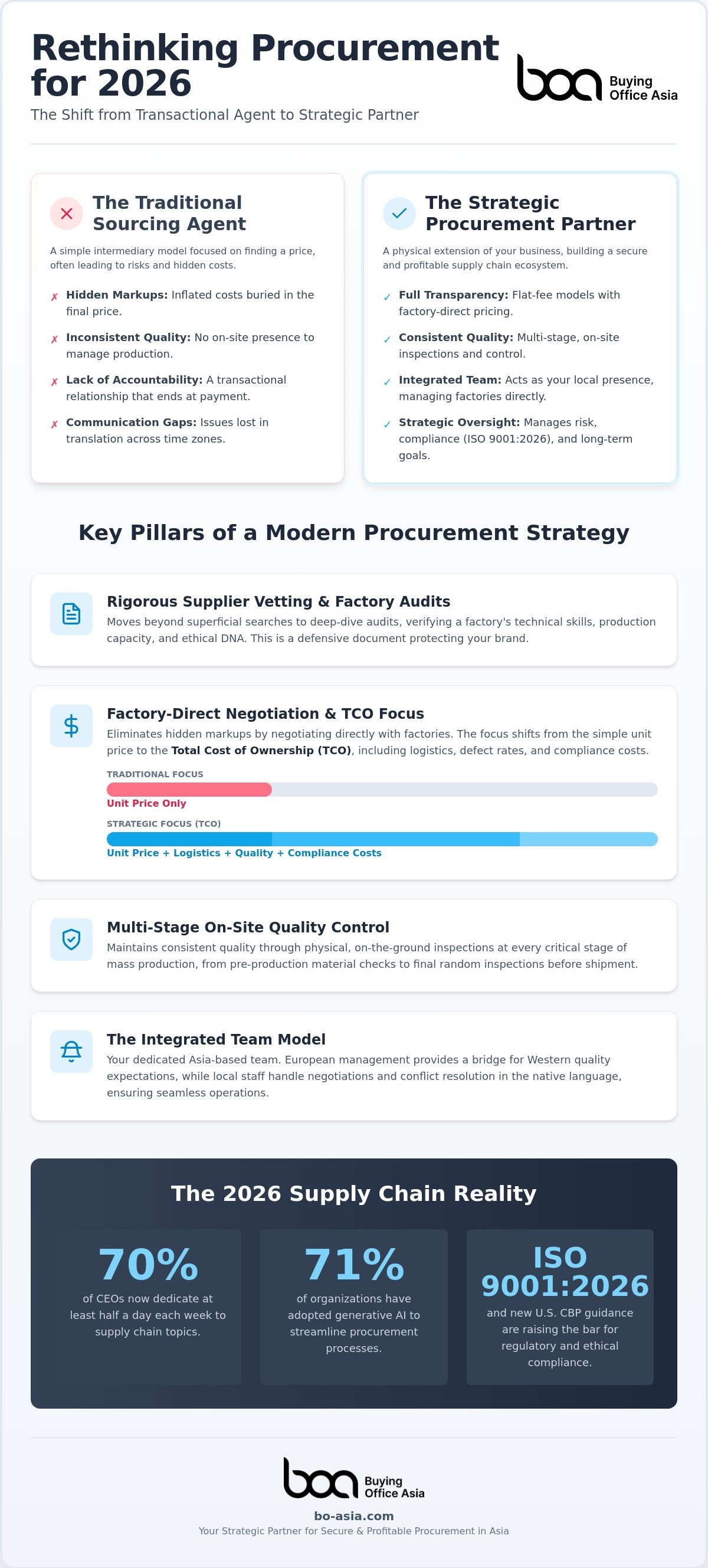
A modern Procurement service is no longer just a middleman with a Rolodex. It's the end-to-end management of your entire supply chain. In 2026, the global market has become too volatile for simple transactional relationships. Understanding what to expect from a procurement service means recognizing the fundamental difference between a sourcing agent and a strategic procurement partner. A sourcing agent finds you a price; a procurement partner builds you a secure, profitable, and ethically compliant ecosystem. This shift is driven by the reality that 70% of CEOs now dedicate at least half a day each week to supply chain topics, reflecting how critical these operations have become to business survival.
The core objective remains simple: reduce risk while improving profitability through direct factory access. By 2026, 71% of organizations have adopted generative AI to streamline these processes. However, technology alone cannot replace the defensive oversight required to manage mass production. Your partner should act as a stabilizing force, ensuring that Environmental, Social, and Governance (ESG) criteria are treated as contractual obligations rather than optional extras. This is particularly vital as updated U.S. CBP Forced Labor Enforcement Guidance and the upcoming ISO 9001:2026 publication raise the bar for regulatory adherence.
Purchasing is the act of buying goods. It's transactional, focused on the short-term, and often ends once the invoice is paid. Procurement is a strategic lifecycle that encompasses everything from initial market research to final delivery. This involves a comprehensive "Source-to-Pay" (S2P) framework, which is vital when manufacturing in Asia. If you want to scale without losing control, you need a system that manages supplier development and long-term financial optimization. For a deeper look at these mechanics, you can explore our guide on Mastering Sourcing and Procurement in Asia.
Digital-only sourcing is a high-risk strategy in 2026. While digital trade tools can save ASEAN buyers a full week on every order cycle, they don't replace physical accountability. You can't verify a factory's ethical standards or production capacity through a screen. Having a team that speaks the local language and understands regional business culture is essential for resolving conflicts before they delay your shipment. European management provides the necessary bridge, translating western quality expectations into Asian production reality. This physical presence is your primary defense against the operational setbacks that plague unmanaged supply chains.
When you evaluate what to expect from a procurement service, the first deliverable must be a move away from superficial search results toward Strategic Sourcing. A professional partner doesn't just find a supplier; they build a comprehensive profile of a factory's technical and ethical DNA. This process begins with identifying candidates that align with your specific production volume and quality requirements. In a market where 10% increases in workload are meeting only 1% budget growth, the efficiency of your initial sourcing phase determines your long-term financial health. You aren't just looking for a vendor; you're looking for a verified manufacturing asset.
Negotiation in 2026 has evolved beyond simple unit price haggling. A sophisticated procurement partner focuses on the Total Cost of Ownership (TCO). This includes logistics, potential defect rates, and the cost of regulatory non-compliance. By leveraging regional presence, your team can negotiate from a position of strength, ensuring that the contract you sign is based on factory-direct reality rather than an agent's inflated quote. This level of detail is the only way to protect margins in a landscape where global procurement software is becoming the standard for managing complex supply flows.
A professional audit report is a defensive document. It should provide granular data on a factory's actual production capacity, technical skill sets, and social compliance records. This goes far beyond checking a business license. You need to know if the machinery is maintained and if the staff possesses the specific expertise required for your product. We maintain rigorous supplier vetting standards to ensure every partner meets these benchmarks. Furthermore, as sustainability becomes a contractual mandate, ensuring ESG compliance during the vetting stage is non-negotiable for protecting your brand from modern supply chain risks.
The most common drain on profitability is the "ghost middleman"—an intermediary who adds no value but inflates costs through hidden markups. Your procurement service must provide 100% transparency, showing you exactly where every dollar goes. This allows you to eliminate unnecessary layers and secure pricing that reflects the actual cost of production. This transparency is a core part of what to expect from a procurement service that prioritizes your financial viability over transactional commissions. Securing these direct relationships is the only sustainable way to insulate your business against shifting tariffs and regional price fluctuations. If you're ready to secure your supply chain with on-the-ground expertise, you can connect with our team today to discuss your specific requirements.
Sampling support provides the final safeguard before mass production begins. It's not enough for a factory to produce a perfect prototype; they must prove they can replicate that quality at scale. A dedicated team oversees the sampling process to ensure that the materials and methods used in the "golden sample" are the exact same ones used when the machines start running for your full order. This prevents the "quality fade" that often occurs when western buyers manage production from a distance.
Managing a production run from a different continent is a recipe for expensive errors. When you consider what to expect from a procurement service, on-site quality control is the most critical safeguard for your capital. It isn't enough to hope the factory follows your specifications; you need physical eyes on the ground at every stage. Professional entities, such as Colorado State University Procurement Services, emphasize that balancing cost, quality, and timeliness is the foundation of any ethical sourcing strategy. In the context of Asian manufacturing, this balance is maintained through a rigorous, multi-stage inspection process.
Your procurement partner should conduct three essential types of inspections. Pre-production checks verify that the raw materials and components match your requirements before the machines start. During Production (DUPRO) inspections occur when about 20% of the goods are finished, allowing the team to catch and correct systemic defects early. Finally, a Final Random Inspection (FRI) ensures the entire batch meets your standards before it's packed. This systematic approach prevents the "quality fade" that often occurs when a factory tries to cut costs mid-run. It's a proactive defense against the financial disaster of receiving a container full of unsellable goods.
One common pitfall is relying on factory-provided photos. Photos are a liability in international trade. A factory can easily send images of a few hand-picked units while the rest of the batch suffers from critical defects. Digital oversight is easily manipulated. A physical presence allows your team to verify the reality of the production floor, ensuring that what you see is exactly what will arrive at your warehouse.
Production delays can destroy your retail schedule and cash flow. A local team doesn't wait for an email; they walk onto the factory floor to identify bottlenecks in real time. This immediate access allows them to resolve issues before they escalate into weeks of lost time. Central to this oversight is the Golden Sample. The Golden Sample is the finalized, approved prototype that serves as the legally binding quality benchmark for every unit produced during the mass production run. It ensures that the factory has no excuse for deviations in material, color, or function.
What happens when a batch fails inspection? A true procurement partner doesn't just report the failure; they manage the corrective action. They work with the factory to identify the root cause and oversee the rework process to ensure the final product meets the original standards. This relationship management is vital for ensuring the factory prioritizes your order over others. For businesses developing custom products, this level of oversight is even more critical during OEM manufacturing, where specialized tooling and unique specifications increase the risk of production errors. This defensive posture is a core part of what to expect from a procurement service dedicated to your long-term growth.
Financial clarity is the bedrock of any professional B2B partnership. When determining what to expect from a procurement service, your first inquiry should focus on the fee structure. A legitimate partner operates on a clear, flat-fee or percentage-based model. This ensures their interests align with yours; they're paid to protect your capital, not to extract hidden margins from your suppliers. In a market where procurement technology spend is projected to grow by 6.1% in 2026, the value of manual, human-verified transparency remains the ultimate safeguard against obscured costs.
Open-book accounting is a non-negotiable standard. You should have full visibility into the exact price the factory is charging for production. Demanding this level of detail is a core part of what to expect from a procurement service that functions as an extension of your own office. If a service provider refuses to show you the original factory invoices, they're likely operating as a traditional agent rather than a strategic partner. This distinction is vital because any lack of transparency in the supply chain directly erodes your long-term profitability and your ability to scale operations.
The "free" sourcing model is one of the most dangerous traps in international trade. If a service claims to be free for the buyer, they're almost certainly taking a commission from the factory. This "commission on both sides" model creates a massive conflict of interest. The agent is incentivized to keep factory prices high to increase their own kickback. By contrast, a transparent partner works to drive unit prices down through direct negotiation. You can see the impact of this approach in our pricing and savings examples, which demonstrate how eliminating hidden markups protects your bottom line.
Transparency extends beyond the factory floor to the landed cost of your goods. High-volume sourcing requires expert coordination to optimize shipping routes and consolidate containers. Your procurement team should manage the complex documentation and customs requirements that often cause expensive port delays. This is especially critical given the 2026 shifts in U.S. Section 232 tariffs and new administrative fees in various jurisdictions. Effective logistics management ensures that your products move efficiently through the global supply chain without unforeseen expenses. If you're looking for a partner who prioritizes financial integrity, contact our procurement specialists to review your current supply chain costs.
Moving from a transactional mindset to a strategic partnership is the final step in professionalizing your supply chain. When you understand what to expect from a procurement service in 2026, you realize it isn't about hiring a vendor; it's about integrating a dedicated Asia procurement team into your own corporate structure. This model replaces the chaotic, unmanaged sourcing of the past with a stable, European-managed presence that acts as your own regional headquarters in Hong Kong or mainland China. You gain the steady confidence of an established expert without the administrative burden of managing a remote office yourself.
This integration allows for long-term supplier development and the achievement of complex ESG goals. Instead of jumping from one factory to another in search of the lowest price, your team builds deep relationships that prioritize reliability and ethical standards. This defensive oversight is what separates elite enterprises from businesses that remain vulnerable to market shocks. By 2026, approximately 70% of CEOs are spending significant time on supply chain topics because they recognize that a regional presence is a prerequisite for financial stability. Your procurement partner ensures this attention translates into measurable performance.
The principle of having a dedicated representative to protect your financial interests applies beyond manufacturing; for those seeking expert guidance in the real estate sector, visit Your Australian Property Buyers Agents to ensure your property investments are handled with the same level of strategic rigor.
The financial logic is clear. Establishing an in-house office in Asia requires massive capital, legal navigation, and local HR management. A managed procurement service provides the same level of on-the-ground proximity at a fraction of the overhead. This setup offers immediate scalability, allowing you to grow your product line without increasing your headcount. You can see the measurable results of this model in our Dedicated Asia Procurement Team Case Study. It demonstrates how physical proximity and regional expertise translate into documented savings and risk reduction, proving that strategic integration is a profit center rather than a cost.
Professionalizing your procurement begins with a structured onboarding phase. Before your initial consultation, you should prepare detailed technical specifications, projected annual volumes, and your current target pricing. This data allows your team to conduct a "proof of concept" phase, where we identify potential factory-direct partners and audit their capacity. This methodical approach ensures that your transition to an integrated model is based on data rather than guesswork, providing a clear picture of what to expect from a procurement service that prioritizes your growth. If you're ready to secure your production and eliminate hidden costs, you can Partner with Buying Office Asia for 100% Transparent Procurement.
Professionalizing your Asian operations requires moving beyond the limitations of digital-only sourcing and opaque intermediary models. You now understand that what to expect from a procurement service involves a transition to a dedicated team that provides 100% transparency, factory-direct pricing, and on-site defensive oversight. By prioritizing comprehensive factory audits and multi-stage quality control reporting, you eliminate the risks that typically stall international growth. This strategic shift transforms your supply chain from a source of anxiety into a reliable engine for profitability.
Buying Office Asia serves as a stabilizing force in this complex global market. As a European-managed firm with over 15 years of on-the-ground experience, we provide the regional expertise and networks necessary to protect your brand's financial health. Our model is built on absolute transparency, ensuring you never face hidden markups or compromised quality. We act as your physical presence in Asia, providing the same level of oversight usually reserved for major enterprises.
Take the next step toward a resilient, scalable supply chain. Schedule a Strategic Consultation with Our Asia Procurement Team to discuss your 2026 production goals. We're ready to help you turn your procurement process into a long-term competitive advantage.
Professional procurement services typically utilize a transparent flat-fee or percentage-based structure that aligns with your financial interests. This model explicitly rejects the hidden markups and factory kickbacks common in traditional sourcing. You should receive open-book accounting that shows the exact price the factory is charging. This clarity allows you to calculate accurate landed costs and protect your margins as you scale your manufacturing operations.
Yes, a comprehensive procurement service provides essential support for custom product development and OEM projects. This involves managing the sampling process, overseeing the creation of specialized tooling, and ensuring the final prototype is replicable at scale. Your partner acts as the technical bridge between your design team and the factory's production capabilities. This ensures that unique specifications are met without compromising the quality of the mass-produced goods.
Protecting your intellectual property involves a multi-layered approach that includes rigorous supplier vetting and enforceable on-site oversight. A professional service ensures that your designs and proprietary processes are only shared with audited factories that have a documented history of compliance. By maintaining a physical presence on the factory floor, your team can monitor production and ensure that your tooling is not used for unauthorized runs or competitors' products.
If a batch fails a quality inspection, your procurement service manages the corrective action process directly with the factory management. This includes identifying the root cause of the defect and overseeing the necessary rework to bring the goods up to the standard of your Golden Sample. The service ensures the factory prioritizes these corrections so your shipping schedule isn't destroyed. You are protected from paying for or receiving sub-standard inventory.
A firm with European management offers a significant advantage by bridging the gap between western quality expectations and Asian production realities. While local agents understand the regional language, they often lack the consultative mindset required to defend a western brand's interests. European leadership provides the accountability and professional rigor you need to manage complex supply chains. This combination of regional expertise and western business standards creates a more secure environment for your capital.
Factory audits should be performed during the initial vetting process and then repeated at regular intervals, typically every twelve to eighteen months. However, more frequent audits are necessary if there are changes in factory ownership, significant production delays, or a decline in quality. In 2026, continuous monitoring is becoming the standard for predictive risk management. Regular site visits ensure the factory maintains the technical skills and ethical compliance standards required for your brand.
Yes, managing logistics and shipping is a core deliverable when you consider what to expect from a procurement service. Your partner coordinates container consolidation, manages complex customs documentation, and optimizes shipping routes to reduce your total landed cost. This end-to-end oversight prevents expensive port delays and ensures that your goods move efficiently from the factory floor to your warehouse. It's a comprehensive approach that removes the logistical burden from your internal team.

What if the first clear sign of a production problem arrives after the goods are packed? Manufacturing risk management in Asia works best when controls are connected from the start, not left to a final inspection or occasional supplier update. You need visibility into factory activity, early warning...

What if the lowest unit quote isn’t the lowest-cost way to make your board game? Board game manufacturing costs depend on more than the number of boxes ordered. Component materials, custom tooling, assembly, packaging and delivery scope can all change what a quote covers, making headline prices diff...

What if the factory’s lowest quote isn’t the lowest-cost option? A lower unit price can hide differences in materials, tooling, packaging, quality checks or production terms. Understanding how sourcing agents negotiate factory prices starts with making those differences visible, not simply asking a...