


With Vietnam's trade surplus with the EU hitting $18.1 billion in the first half of 2026, the region has matured into a critical manufacturing powerhouse that demands more than just a transactional approach. If you're still relying on traditional trading companies, you're likely paying for layers of obscured costs and risking the quality inconsistencies that plague unmanaged mass production. Sourcing from Vietnam to Europe in the current market requires a sophisticated strategy that treats your supply chain as a competitive advantage rather than a logistical headache.
You understand that the potential for 0% preferential duty rates under the EVFTA is a game changer for your landed costs, yet the path to direct-to-factory transparency often feels blocked by communication barriers and complex local regulations. This 2026 strategic guide promises to bridge that gap. We'll dismantle the middleman model and show you how to leverage the latest tariff advantages while maintaining 100% oversight on the factory floor. We'll cover everything from managing the impact of January 2026 minimum wage increases to implementing the rigorous ESG reporting now required for European market entry.
• Capitalize on the EVFTA's duty eliminations to lower your landed costs and secure a competitive edge.
• Eliminate hidden middleman markups by transitioning to a direct-to-factory model that ensures total financial transparency.
• Master the complexities of Sourcing from Vietnam to Europe by integrating a dedicated Asia procurement team to handle on-site quality inspections.
• Navigate the 2026 European ESG reporting standards with verifiable factory data and ethical compliance oversight directly from the floor.
• Strengthen your "China + 1" strategy with a European-managed partner that bridges the gap between Helsinki leadership and Vietnamese production.
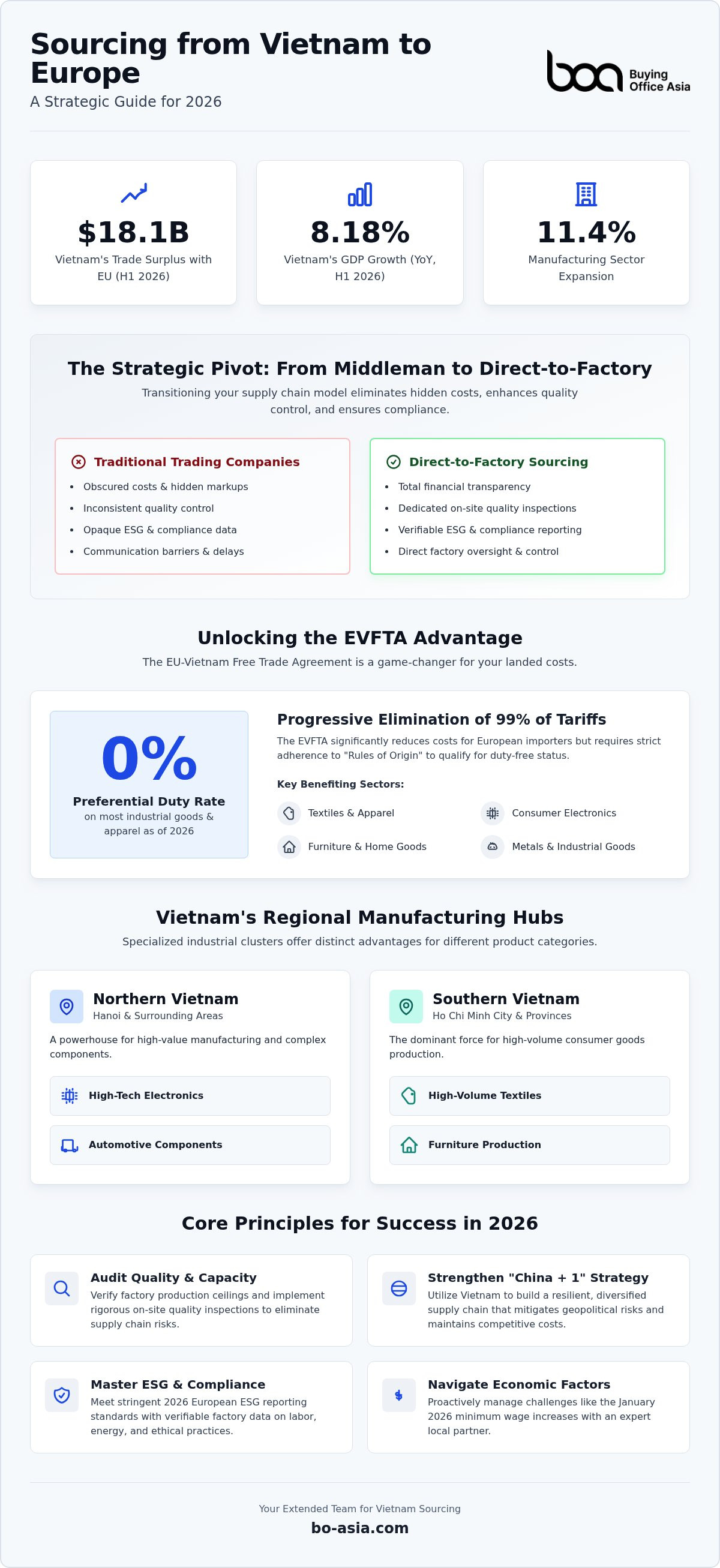
European supply chains face a volatile global environment where over-reliance on a single market is no longer a viable risk. The "China + 1" strategy has evolved from a defensive backup plan into a primary driver of procurement logic. In the first half of 2026, Vietnam's GDP grew by 8.18% year-on-year, powered by a manufacturing sector that expanded by 11.4%. This growth isn't just about volume; it represents a fundamental shift. Vietnam is rapidly transitioning from a low-value assembly site into a sophisticated hub for chemicals, metals, and motor vehicle manufacturing. Sourcing from Vietnam to Europe provides the stability your brand needs to maintain competitive landed costs while diversifying your operational footprint.
The EU-Vietnam Free Trade Agreement (EVFTA) serves as the commercial backbone of this trade corridor. It progressively eliminates 99% of tariffs, but accessing these benefits requires a deep understanding of "Rules of Origin." You must ensure that your products meet specific local content requirements to qualify for duty-free status. Categories like textiles, consumer electronics, and furniture see the most significant benefits from this agreement. Under the current phase of the EVFTA, the majority of industrial goods and apparel from Vietnam enter the European market at a 0% preferential duty rate as of 2026. This financial advantage allows European enterprises to reinvest savings into product development or market expansion rather than losing capital to customs duties.
Diversification is about more than just avoiding geopolitical friction; it's about tapping into specialized industrial clusters. Northern Vietnam, particularly the areas surrounding Hanoi, has emerged as a powerhouse for high-tech electronics and automotive components. Meanwhile, Ho Chi Minh City and its neighboring provinces remain the dominant force for high-volume textiles and furniture production. These established clusters offer the infrastructure and skilled labor necessary for complex manufacturing. Deciding between nearshoring vs offshoring is a strategic supply chain choice for 2026 that depends on your specific volume requirements and lead time sensitivities. Sourcing from Vietnam to Europe offers a unique balance of massive production scale and tariff-free access that many nearshoring locations cannot currently match.
Protecting your brand reputation in a transparent market requires more than a signed contract. European ESG regulations are becoming increasingly stringent, demanding verifiable data from the factory floor. Relying on opaque trading companies makes it nearly impossible to track energy consumption or labor standards accurately. A local presence is essential for ensuring that ethical standards are practiced, not just promised. It's the only way to build a supply chain that is both financially viable and compliant with the rigorous expectations of the European consumer.
Vietnam's industrial landscape is defined by its rapid specialization in high-growth categories. While electronics and footwear dominate the export charts, the structure of these industries differs significantly from the massive factory towns found in Mainland China. Vietnamese facilities are often more nimble but may have limited "installed capacity." For high-volume European buyers, verifying a factory's actual production ceiling is a critical step in the procurement process. If you're planning on Sourcing from Vietnam to Europe, you must look beyond the showroom and audit the physical floor to ensure the supplier can meet your projected demand.
The European Commission's official data on EU-Vietnam trade underscores the scale of this shift, with billions in trade value now flowing through these specialized hubs. Sustainability has also become a non-negotiable requirement. Vietnam is responding with eco-friendly industrial parks that prioritize renewable energy and waste reduction, aligning with the 2026 ESG expectations of the European market. This focus on green manufacturing is a strategic defense against future regulatory hurdles in the EU.
The northern provinces surrounding Hanoi and Bac Ninh have become the epicenter for electronics. This region hosts a dense network of tier-1 suppliers, allowing for efficient component sourcing. We're seeing a decisive move away from simple "screw-driver" assembly toward sophisticated OEM manufacturing. Managing this transition requires rigorous oversight, especially when your project involves custom tooling or proprietary product development. Without a dedicated team on-site, the risk of technical drift during the sampling phase increases significantly. Precision matters here; a minor error in tooling can lead to thousands of units of wasted inventory.
Vietnam remains the primary alternative for European fashion brands seeking to diversify away from traditional hubs. The region offers a growing availability of recycled fabrics and sustainable material certifications, which are essential for navigating current EU regulations. However, the industry still faces a local raw material shortage, often relying on imported yarns and fabrics. This dependency can impact lead times if not managed through proactive supplier development. Successful Sourcing from Vietnam to Europe in the textile sector depends on securing a factory that has both the technical skill for high-end apparel and a stable, transparent sub-supplier network.
If you're unsure whether a factory's stated capacity matches their actual output, you can request a professional factory audit to verify their operational reality and secure your production timeline.
Trading companies often present themselves as the "easy button" for Asian procurement, but they frequently function as a barrier to true financial transparency. When Sourcing from Vietnam to Europe, these intermediaries often layer hidden markups onto the unit price, which can inflate your landed costs by 15% or more without adding any tangible value. The OECD Economic Outlook for Vietnam highlights a market that's increasingly sophisticated, yet many European firms still fall into the trap of unmanaged, opaque procurement models. You shouldn't settle for a transactional relationship that obscures your true production costs and limits your long-term profitability.
The fundamental difference lies in the business model. A commission-based agent's interests are rarely aligned with yours because their income is often tied to the total transaction value or undisclosed kickbacks from the manufacturer. In contrast, a procurement partner functions as an integrated extension of your own team. This model prioritizes 100% transparency in fee structures, ensuring that every cent saved during negotiation stays in your pocket rather than being siphoned off by a middleman.
Opaque agents often lack accountability when quality issues arise during mass production. Because they don't own the relationship with the factory floor, they're often unable or unwilling to defend your interests if a batch fails inspection. Professional supplier vetting is the only way to ensure that the entity you're paying actually owns the production lines they claim to operate. Without this, you risk your orders being secretly subcontracted to unvetted workshops, which is a primary cause of quality inconsistency and ethical compliance failures.
Achieving factory-direct pricing requires more than a simple email request; it demands on-the-ground negotiation expertise and a physical presence. You need to move past the "agent" model and establish a dedicated Asia procurement team that acts as a direct link between your European headquarters and the factory floor. This structure facilitates factory direct price negotiations where costs are dismantled and analyzed at the material and labor level. On-site audits verify that the factory's stated capacity is real and that they have the technical capability to handle high-volume Sourcing from Vietnam to Europe. This level of oversight isn't just a safety measure; it's a strategic defense against the operational setbacks that affect unmanaged supply chains.
Moving high-volume orders from Vietnam's deep-sea ports to European hubs requires more than just booking a container. Northern exports typically flow through Hai Phong, while southern production centers utilize Cat Lai in Ho Chi Minh City. In 2026, ocean freight rates for a 40-foot container to Northern Europe fluctuate between $2,500 and $4,000, making logistics coordination essential for protecting your margins. By optimizing shipping routes and consolidating shipments, you can significantly reduce landed costs and avoid the bottlenecks that often delay unmanaged supply chains.
Sourcing from Vietnam to Europe also involves a complex layer of mandatory EU standards. Whether it's REACH compliance for chemical safety or CE marking for electronics, you must ensure that every product meets the technical requirements of the destination market. Failure to document this compliance can result in seized shipments and heavy fines. Professional oversight at the point of origin is the only way to guarantee that your goods don't just leave the factory, but actually clear customs without friction.
Preventing batch defects starts long before the goods reach the port. We implement on-site inspections at critical stages, including During Production Inspections (DPI) and Final Random Inspections (FRI). This level of mass production oversight ensures that any deviations from the approved sample are corrected immediately. You should never release final payment without a detailed inspection report that verifies the quality of the entire lot. It's a protective measure that eliminates the risk of receiving substandard inventory thousands of miles away.
The 2026 regulatory landscape for European importers is defined by strict transparency. Regulations like the EU Corporate Sustainability Due Diligence Directive (CSDDD) require brands to have a deep, documented understanding of their entire supply chain. Conducting ESG-focused audits is no longer optional; it's a core requirement for maintaining your brand's reputation and legal standing. We vet suppliers for ethical labor practices and environmental compliance, providing the verifiable data you need for mandatory reporting. This proactive approach ensures your supply chain remains a stabilizing force in an increasingly scrutinized global market.
If you need to verify your supplier's compliance with the latest EU standards, contact our team in Vietnam for a comprehensive factory audit and logistics assessment.
Buying Office Asia functions as the critical bridge between European corporate strategy and the operational realities of Vietnamese manufacturing. We don't act as a third-party agent; we operate as an integrated extension of your own team. With our leadership based in Helsinki and our operational hubs in Hong Kong and Vietnam, we eliminate the communication barriers and cultural misalignments that often derail high-volume Sourcing from Vietnam to Europe. This unique structure allows you to maintain the steady confidence of a European partner while benefiting from the deep regional expertise and factory networks we've cultivated since 2010.
Our commitment to 100% transparency is a direct rejection of the conventional intermediary model. We dismantle the middleman markup by providing you with factory-direct pricing and a clear, service-based fee structure. This approach has allowed us to scale European brands by providing the on-the-ground oversight usually reserved for major multinational enterprises. By removing obscured costs and identifying hidden risks, we ensure your supply chain is a driver of financial health rather than a source of unforeseen expenses. Our presence in the region isn't just about making connections; it's about providing a defense against the operational setbacks that affect unmanaged supply chains.
A Finnish-managed firm provides the steadiness and professional rigor that European businesses require when navigating complex foreign markets. You gain the ROI of a dedicated Asia procurement team without the overhead of establishing your own local entity. We manage the entire supply chain from sourcing to shipping, ensuring that every stage of production aligns with your specific quality and ESG requirements. This end-to-end oversight means you have a single point of accountability for your high-volume manufacturing projects.
Initiating a secure procurement strategy begins with professional supplier vetting and a comprehensive factory audit. These steps are essential for verifying that a potential partner has the technical capability and ethical standards to support your brand. If you're looking to optimize your current costs, you can request a savings example tailored to your specific product category. This analysis provides a clear picture of the financial viability of Sourcing from Vietnam to Europe using our direct-to-factory model. Contacting our Helsinki or Hong Kong offices for a strategic procurement briefing is the first step toward building a transparent, resilient, and highly profitable supply chain.
Successfully Sourcing from Vietnam to Europe in 2026 requires more than a casual connection; it demands a defensive strategy rooted in physical proximity and absolute financial transparency. By leveraging the EVFTA's tariff eliminations and moving toward a direct-to-factory model, you eliminate the hidden markups that erode B2B profitability. As European ESG regulations become more stringent, having a partner who can provide verifiable data from the factory floor is no longer optional. It's the only way to protect your brand from the operational risks and compliance failures inherent in unmanaged supply chains.
Buying Office Asia has been a stabilizing force in the regional market since 2010. With our European-managed structure and leadership based in Helsinki, we offer the professional rigor and 100% transparency your business requires to scale safely. We don't just act as a liaison; we function as your dedicated procurement team on the ground, ensuring every unit meets your exact standards before it leaves the port.
Contact our European leadership team to start your Vietnam sourcing strategy and build a resilient, high-volume supply chain today. We look forward to securing your manufacturing future.
Vietnam often provides lower labor costs, with Region I minimum wages reaching VND 5,310,000 as of January 2026. However, the true cost advantage comes from the EVFTA's 0% duty rates. While China offers more mature infrastructure, the combination of lower wages and tariff exemptions makes Vietnam a more financially viable option for high-volume orders. You must account for total landed costs rather than just the ex-factory price to see the real savings.
The EVFTA progressively eliminates 99% of import duties on Vietnamese goods entering the European market. By 2026, most industrial goods and apparel categories benefit from a 0% preferential duty rate. To qualify, your products must strictly adhere to specific "Rules of Origin" documentation. This agreement is a central pillar for any company Sourcing from Vietnam to Europe, providing a significant competitive edge over non-treaty manufacturing hubs.
The primary risks include opaque middleman markups and a lack of accountability during mass production. Without a dedicated team on the ground, you're vulnerable to undisclosed subcontracting and quality inconsistencies that aren't discovered until the goods arrive in Europe. Communication barriers often lead to technical drift during the sampling phase. These unmanaged risks can result in unforeseen expenses and brand damage that far outweigh the perceived savings of a hands-off approach.
Verifying capacity requires a physical on-site factory audit to inspect the machinery, labor force, and production logs. You shouldn't rely on digital certificates or showroom presentations alone. We check "installed capacity" to ensure the facility can handle your volume without secretly outsourcing the work to unvetted workshops. Examining the factory's sub-supplier network and their history of high-volume exports to Europe provides a realistic assessment of their operational reliability.
Typical ocean freight transit from deep-sea ports like Cat Lai or Hai Phong to Northern European hubs ranges from 30 to 42 days. When planning your supply chain, you must also factor in production lead times, which vary by sector. For example, high-volume apparel orders might require 60 to 90 days for manufacturing. Coordinating these timelines requires a professional on-the-ground presence to prevent delays at the factory floor from disrupting your European inventory cycles.
Yes, Vietnam has established a robust high-tech manufacturing hub, particularly in the northern provinces surrounding Hanoi and Bac Ninh. This region hosts numerous tier-1 suppliers for major global brands. Sourcing from Vietnam to Europe for electronics is increasingly common as factories transition from simple assembly to full OEM manufacturing. These facilities are capable of handling complex product development and custom tooling, provided you have the technical oversight to manage the initial sampling stages.
Buying Office Asia performs rigorous on-site quality control and inspections at every critical stage of production. Our team conducts During Production Inspections (DPI) and Final Random Inspections (FRI) to ensure your goods match the approved sample. We provide detailed inspection reports before you release final payment, acting as your defense against batch defects. This hands-on oversight is managed by our European leadership to ensure the highest level of accountability and transparency.
Products must meet mandatory EU standards such as REACH for chemical safety and CE marking for electronics and toys. Additionally, the 2026 regulatory landscape requires compliance with the EU Corporate Sustainability Due Diligence Directive (CSDDD). This means your suppliers must pass ESG-focused audits to verify ethical labor practices and environmental standards. Documenting this compliance at the source is essential for clearing customs and protecting your brand's reputation in the European market.

What if the first clear sign of a production problem arrives after the goods are packed? Manufacturing risk management in Asia works best when controls are connected from the start, not left to a final inspection or occasional supplier update. You need visibility into factory activity, early warning...

What if the lowest unit quote isn’t the lowest-cost way to make your board game? Board game manufacturing costs depend on more than the number of boxes ordered. Component materials, custom tooling, assembly, packaging and delivery scope can all change what a quote covers, making headline prices diff...

What if the factory’s lowest quote isn’t the lowest-cost option? A lower unit price can hide differences in materials, tooling, packaging, quality checks or production terms. Understanding how sourcing agents negotiate factory prices starts with making those differences visible, not simply asking a...