

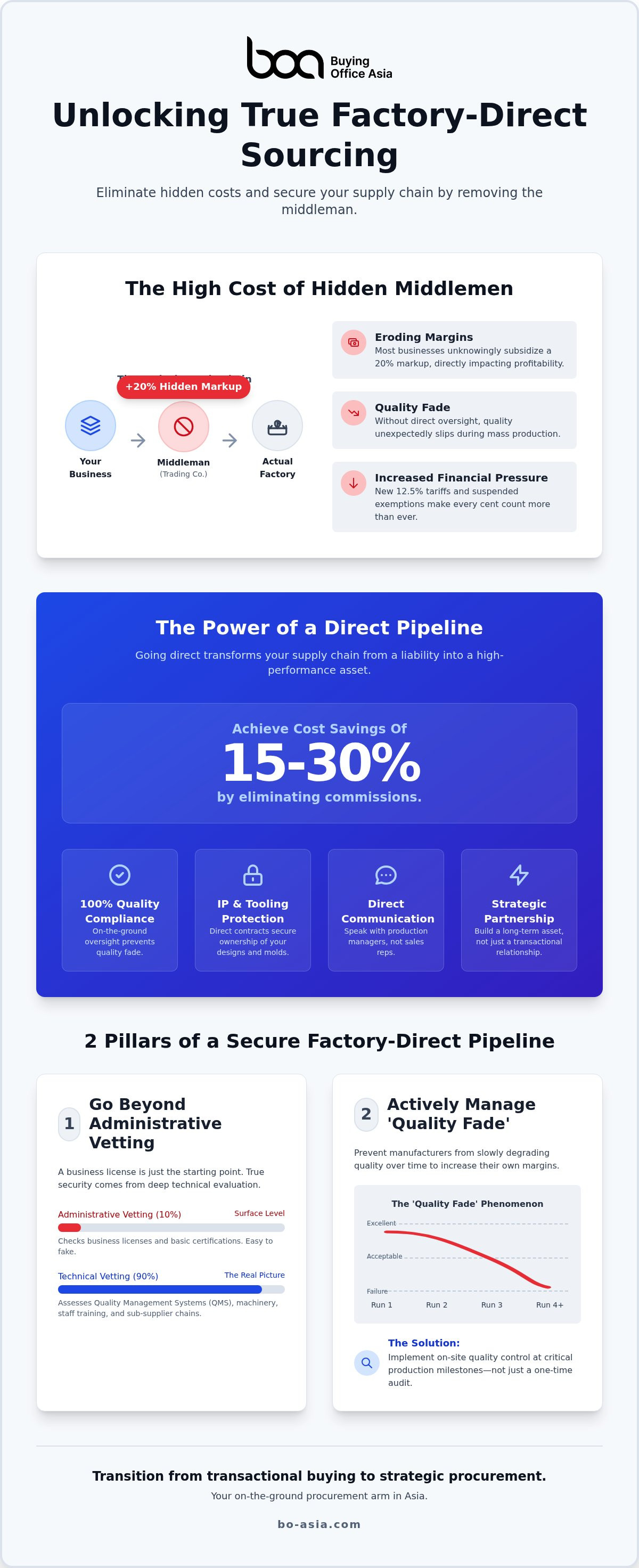
Most businesses paying for what they believe is factory-direct pricing are actually subsidizing a hidden 20% markup for a middleman they don't even know exists. You've likely felt the frustration of watching your margins erode while quality unexpectedly slips during mass production. It's a common anxiety in international trade, especially as the 12.5% Section 301 tariffs introduced in July 2026 and the suspension of the $800 de minimis exemption make every cent count. Achieving true factory direct sourcing from China requires more than a digital handshake; it demands a physical seat at the production table to enforce accountability where online platforms fail.
We understand that the complexity of the current manufacturing landscape, with its shifting VAT rebates and high-tech growth, requires a stabilizing force. This guide will show you how to eliminate hidden commissions and secure 15-30% cost savings through transparent, on-the-ground oversight. You'll learn the mechanics of middleman-free procurement, from vetting the entire sub-supplier chain to ensuring 100% quality compliance. We'll outline the strategies needed to transform your supply chain into a secure, high-performance asset that prioritizes your financial health and long-term growth.
• Eliminate hidden markups and achieve 15-30% cost savings by removing intermediaries and negotiating directly with manufacturers.
• Understand that factory direct sourcing from China is a physical process that requires on-site audits to verify technical capacity beyond a website listing.
• Secure 100% quality compliance through physical, on-the-ground oversight during mass production to prevent the risk of quality fade.
• Protect your intellectual property and maintain full control over product designs by establishing direct contracts with the actual factory owners.
• Transition from a transactional relationship to a strategic partnership by integrating an Asia-based procurement team as a protective extension of your own business.
The manufacturing ecosystem in China is no longer the low-cost assembly line of the past decade. By 2026, the sector has pivoted toward high-tech equipment manufacturing and advanced OEM specialization. High-tech manufacturing grew by 9.4% in 2025, signaling a move away from simple labor-intensive goods. For international buyers, this shift means that factory direct sourcing from China isn't just about saving money; it's about securing technical competency. With new 12.5% Section 301 tariffs and the total suspension of the $800 de minimis exemption, your margins can't absorb unnecessary layers. Removing the 10-20% middleman tax is now a financial necessity for any scalable brand.
Digital platforms are often crowded with trading companies posing as manufacturers. These intermediaries use professional photography and borrowed business licenses to simulate a production environment they don't actually own. You can spot red flags during initial outreach by requesting specific technical drawings or asking about the sub-supplier chain for raw materials. If the response is vague or delayed, you're likely talking to an agent. The Middleman Trap occurs when an intermediary obscures the true source of production to protect their commission, leaving you without direct recourse when quality fades or delays occur.
True direct relationships offer returns that go far beyond a lower unit price. When you work directly with the factory, you secure ownership of your custom tooling and molds. This protects your intellectual property and ensures you aren't held hostage by an agent who claims ownership of your designs. Communication is faster because you're speaking with production managers, not sales reps. This direct line is essential for implementing Sustainable procurement in China, as it allows for real-time monitoring of environmental standards and labor practices.
Eliminating the middleman enables you to establish a dedicated Asia procurement team that functions as an extension of your own company. You gain the scalability needed for high-volume mass production without the risk of hidden markups or rebate schemes from sub-suppliers. This transition from transactional buying to strategic procurement is what separates market leaders from those struggling with unpredictable supply chains.
Securing a middleman-free supply chain isn't a one-time event; it's a continuous operational discipline. When you move toward factory direct sourcing from China, you must replace an agent's vague promises with a rigorous four-pillar framework. This structure ensures that your cost savings don't come at the expense of product integrity or brand reputation. By focusing on technical capacity and financial transparency, you create a stable foundation for high-volume growth.
Administrative vetting typically focuses on business licenses and basic certifications. While these are necessary, they only represent about 10% of a thorough evaluation. Technical vetting goes much deeper, assessing a factory's internal Quality Management System (QMS) and their actual ability to execute complex OEM projects. You need to know if their machinery is properly maintained and if their staff is specifically trained on your production requirements. For a deeper look at this process, see our guide on Supplier Vetting in Asia. A factory with an impressive showroom but a disorganized shop floor is a high-risk partner that will eventually cause delays.
Quality fade is a specific challenge where a manufacturer incrementally substitutes cheaper materials or simplifies processes to boost their own margins over time. It's the reason the third or fourth production run often fails even when the first two were perfect. To prevent this, you must implement on-site quality control at critical production milestones. Relying on a 'one-and-done' audit is a mistake that leads to unforeseen expenses and brand damage. True oversight means having eyes on the factory floor during mass production to ensure every batch meets the original specifications. If you want to protect your margins from these hidden risks, you can discuss your procurement strategy with our team.
Transparent pricing serves as the final pillar of a secure pipeline. This involves understanding the Bill of Materials (BOM), which breaks down the cost of every component and raw material. When you know the factory's actual costs, your negotiations are based on hard data rather than guesswork. This level of transparency eliminates the hidden commissions typically buried in a trading company's quote. To maintain a secure pipeline, you should focus on these key areas:
Evaluating machinery, social compliance, and sub-supplier management.
Negotiating based on a clear, documented cost-breakdown model.
Ensuring consistent quality across every single batch.
By enforcing these pillars, you ensure that your factory direct sourcing from China remains both profitable and predictable. This hands-on approach removes the layer of ambiguity that often plagues unmanaged supply chains.
Choosing between a trading company and a direct factory relationship is a choice between perceived convenience and total operational control. Trading companies often present themselves as one-stop shops, but this convenience comes with a high price tag. When you transition to factory direct sourcing from China, you're removing the middleman tax that typically inflates unit costs by 15-25%. This financial recovery is essential for maintaining competitive margins in a market where tariffs and logistics costs continue to fluctuate.
Trading companies rarely disclose their actual margins. They bake their commission into the unit price or receive kickbacks from sub-suppliers that you never see. This lack of transparency makes it nearly impossible to verify ethical standards or implement rigorous environmental policies. If you don't have direct access to the factory floor, you can't guarantee that your production meets global compliance requirements. You can see the financial impact of these obscured costs by reviewing our Pricing and Savings Examples. Beyond the unit price, intermediaries often lack the technical depth to manage complex product development, leading to expensive errors that they may attempt to hide from you.
Control and intellectual property are equally at risk in a trading model. Who actually owns your molds and custom tooling? In many cases, the intermediary holds the contract with the manufacturer. If you decide to switch partners, you might find your custom assets are legally tied to the agent rather than your brand. Direct-to-factory access ensures you own your assets, your designs, and your production data. It also eliminates the danger of filtered information, where an agent might soften bad news about delays or ignore technical specs they don't fully understand.
Intermediaries can be useful for low-volume, off-the-shelf purchases where the cost of a full audit outweighs the potential savings. If you're buying small quantities of generic goods, the trading company's consolidation services might offer temporary value. However, the threshold for moving direct is lower than most businesses realize. Once your project requires custom OEM development or high-volume mass production, the trading model becomes a strategic liability. Factory direct sourcing from China becomes a financial necessity when your procurement spend reaches a level where a 20% markup represents a significant loss of capital. Serious brands don't rely on transactional agents; they integrate a dedicated procurement team to manage the factory relationship as a protective extension of their own business.
Transitioning to a middleman-free model is a strategic evolution that requires a structured roadmap. To succeed in factory direct sourcing from China, you need to move beyond the superficial interactions common on B2B platforms and adopt an engineering-led approach. This process ensures that your cost savings are backed by operational security and technical precision. You aren't just looking for a vendor; you're building a scalable production pipeline.
The first phase involves strategic sourcing and shortlisting based on technical capability. You don't just look for a supplier; you look for a production partner whose machinery and certifications align with your specific product requirements. Once you've identified potential partners, you move to factory-direct price negotiations. Unlike transactional buying, this involves a transparent cost-breakdown model where every component is accounted for. You can leverage our Sourcing and Procurement Services to manage this transition effectively. The third step, product development and sampling, locks in your specifications before you move to on-site auditing and contract finalization. Finally, production oversight and logistics coordination ensure that your goods are delivered according to the agreed standards.
Effective negotiation in 2026 isn't about aggressive price-haggling. It's about moving from "What is your price?" to "Let's discuss the raw material costs." When you understand the underlying commodity prices, you negotiate from a position of authority. You should also leverage local market knowledge to secure better payment terms, such as moving from a 100% upfront payment to a 30/70 split. This preserves your cash flow and provides leverage if production issues arise.
The bridge between a prototype and a finished product is where most procurement projects fail. This is why the "Golden Sample" is your most important legal and quality benchmark. It represents the exact standard the factory must maintain throughout the entire production run. You must ensure that custom tooling and OEM development remain under your control, preventing the factory from using your designs for other clients. A signed Quality Agreement must be executed before mass production begins to serve as a legally binding reference for all quality inspections.
Establishing these five steps creates a defense against the operational setbacks that affect unmanaged supply chains. By enforcing these protocols, you ensure that your factory direct sourcing from China remains a high-performance asset for your business. If you're ready to establish a more secure, direct pipeline, contact our team to begin your supplier vetting process.
Buying Office Asia (BOA) functions as the essential link between your strategic goals and the operational realities of factory direct sourcing from China. We don't operate as a traditional intermediary; we act as your integrated Asia procurement team. This distinction ensures that your interests are always prioritized over transactional commissions. Our 100% transparency model means that every factory we audit is a partner you own the relationship with directly. You're buying from the source with our technical expertise serving as your defense against quality fade and unmanaged risk.
Our dual presence in Helsinki and Hong Kong provides a unique tactical advantage. The Helsinki headquarters ensures that your business is protected by European standards and a commitment to transparent business ethics. This alleviates the common anxieties regarding contract security and intellectual property. Simultaneously, our Hong Kong operational HQ places our team just two hours away from the primary manufacturing hubs. This physical proximity allows us to respond to production issues in real-time. You can learn more about how this structure protects your margins by exploring Why Buying Office Asia is the preferred choice for high-volume brands.
Our involvement doesn't end once the contract is signed. We provide comprehensive oversight that covers everything from initial sampling to logistics and shipping coordination. This includes managing the complexities of OEM projects where custom tooling and precise specifications are non-negotiable. By maintaining a physical presence at the factory, we ensure that your quality compliance is never compromised during mass production.
We also prioritize ESG and ethical supplier management, ensuring that your supply chain meets the increasingly rigorous global standards for sustainability. This approach allows you to scale your operations with the confidence that your brand reputation is secure. Our service delivery is defined by three core values:
Physical presence on the factory floor to enforce your standards.
A 100% open-book model with no hidden commissions or markups.
European management providing a stabilizing force in a complex market.
For concrete evidence of how this model delivers measurable financial results, you can review real-world ROI examples of our direct sourcing model. By removing the layers of unmanaged risk, we empower you to focus on growth while we handle the complexities of factory direct sourcing from China. We aren't just a third-party entity; we're a protective extension of your own team.
Transitioning to a middleman-free model is the only way to protect your margins against rising tariffs and hidden markups. By establishing factory direct sourcing from China, you regain control over your intellectual property and ensure that every production run meets your exact standards. True procurement success in 2026 isn't found on a digital platform; it's built through on-site accountability and technical vetting that goes deep into the sub-supplier chain.
Buying Office Asia provides the stabilizing force your supply chain needs. As a European-managed firm with over 15 years of Asia expertise, we offer a 100% transparent pricing model and a constant on-site presence in the heart of China's manufacturing hubs. We act as a protective extension of your team, managing the risks so you can focus on scaling your business with confidence. If you're ready to eliminate the middleman and secure true factory-direct pricing, Book a Consultation with our Helsinki or Hong Kong Team today. Your path to a more profitable and secure supply chain starts with a single strategic partnership.
You should start by reviewing the business license to check the registered business scope. Look for terms like "manufacturing" or "production" rather than "trading" or "consulting." Requesting a video tour of the production line or asking for specific technical drawings often reveals an intermediary's lack of depth. Physical factory audits remain the only definitive way to confirm that the production site matches the address provided on official documentation.
The primary risks include quality fade, communication barriers, and a lack of accountability without a local presence. Without a middleman to absorb operational friction, you're responsible for vetting the sub-supplier chain and managing production delays. Achieving successful factory direct sourcing from China requires active oversight to prevent manufacturers from substituting cheaper materials during high-volume production runs, which can lead to unforeseen expenses and brand risks.
It's often not the most cost-effective choice for small purchases. Most factories have high Minimum Order Quantities (MOQs) to cover the setup costs of machinery and raw materials. For low-volume orders, a trading company might offer better value by consolidating your order with others. Direct sourcing becomes a financial necessity only when your volume justifies the cost of on-site audits to recover the 15-25% markup typically charged by agents.
We perform on-site quality control and inspections at critical milestones, including during the production process and before final shipment. Our team issues detailed inspection reports to verify compliance with your specific requirements. By maintaining a physical presence in the heart of China's manufacturing hubs, we catch quality issues before they result in expensive shipping errors. This protective oversight ensures that your mass production meets every technical standard.
Yes, you can secure ownership if you pay for the tooling separately and include specific ownership clauses in your contract. Direct sourcing ensures that the legal agreement is between you and the actual manufacturer, not an agent. This transparency prevents intermediaries from claiming ownership of your custom designs. You should always verify that physical moulds are marked with your company name during on-site factory audits to protect your assets.
A Hong Kong office serves as a strategic operational HQ that bridges European business ethics with local expertise. In 2026, it provides a tactical advantage by being only hours away from major manufacturing hubs. This proximity ensures accountability in a digital world. It also facilitates easier logistics management and legal protection under a sophisticated regulatory environment while managing the complexities of factory direct sourcing from China for global clients.
Protection begins with a China-centric NNN agreement drafted by legal professionals rather than a standard Western NDA. You must also register your trademarks and patents within China, as international registrations aren't always recognized locally. Working directly allows you to monitor the factory floor to ensure your designs aren't being used for unauthorized production. This direct line of sight prevents your proprietary technology from leaking through unvetted sub-suppliers.
Sourcing agents often operate on hidden commissions and provide transactional support with limited transparency. A procurement partner, like Buying Office Asia, acts as an integrated extension of your own team with a 100% transparent fee structure. We prioritize long-term partnership and provide end-to-end management, from factory vetting to logistics coordination. This model ensures that your financial health and quality standards are protected at every stage of the supply chain.

What if the first clear sign of a production problem arrives after the goods are packed? Manufacturing risk management in Asia works best when controls are connected from the start, not left to a final inspection or occasional supplier update. You need visibility into factory activity, early warning...

What if the lowest unit quote isn’t the lowest-cost way to make your board game? Board game manufacturing costs depend on more than the number of boxes ordered. Component materials, custom tooling, assembly, packaging and delivery scope can all change what a quote covers, making headline prices diff...

What if the factory’s lowest quote isn’t the lowest-cost option? A lower unit price can hide differences in materials, tooling, packaging, quality checks or production terms. Understanding how sourcing agents negotiate factory prices starts with making those differences visible, not simply asking a...