


Once your goods clear the port in Shanghai or Shenzhen, your leverage as a buyer effectively evaporates. You've likely spent months perfecting samples and negotiating terms, yet the anxiety of "quality fade" during mass production remains a constant threat to your margins. It's a justified concern. With non-compliance rates for online retail goods hitting 19.1% in 2025, the risk of receiving a container full of defects is higher than many realize. Conducting a rigorous pre-shipment inspection China process isn't just a box to tick. It's the point of no return where you either secure your capital or inherit a logistical nightmare.
We understand that you need more than just a checklist; you need a defense against operational setbacks. This definitive guide for 2026 will teach you how to secure your supply chain and eliminate defect risks before your goods leave the factory floor. We'll break down the updated ISO 2859-1:2026 sampling standards and the mandatory CCC certification shifts that could stall your shipments. You'll learn how to gain 100% transparency into your production batch. This provides the documented proof you need to justify final payment and minimize customer returns.
• Understand why a professional pre-shipment inspection china process is your final opportunity to protect your capital before goods leave the factory floor.
• Learn the specific components of a rigorous assessment, including how to verify quantities and assess workmanship against your approved golden samples.
• Discover why an integrated procurement team provides more reliable protection than transactional third-party agencies that lack deep context of your supplier history.
• Master the defect classification framework to effectively distinguish between minor aesthetic issues and critical safety hazards that require an immediate fail.
• Gain a strategic roadmap for managing failed inspections through expert-led negotiations and supervised factory rework to ensure your standards are met.
A Pre-shipment inspection (PSI) is a systematic onsite verification of your goods conducted when production is between 80% and 100% complete and packed. This is the final barrier between your capital and a potential inventory disaster. Unlike an Initial Production Check (IPC), which examines raw materials, or a During Production Inspection (DPI), which monitors the active assembly line, the PSI focuses on the finished batch as it will arrive at your warehouse. It's your last opportunity to identify defects before the factory closes the container door.
We define this stage as the "Point of No Return" because your leverage as a buyer evaporates the moment the goods leave the factory floor. Once the shipment is on the water, the logistical costs of rework, returns, or disposal become yours to bear. A rigorous pre-shipment inspection china protocol ensures that any deviations from your specifications are caught while the goods are still physically accessible and the supplier is still financially motivated to correct them.
Most international manufacturing follows a 30/70 payment structure; you pay a 30% deposit to initiate production and the remaining 70% balance upon completion. In this framework, the inspector acts as your financial gatekeeper. By withholding the final balance until a successful PSI report is issued, you maintain control over the transaction. Quality fade often occurs in the final 20% of production when a factory might rush to meet a shipping deadline or substitute materials to preserve their own margins. A pre-shipment inspection china service functions as the ultimate safeguard for international B2B procurement, ensuring you only pay for what you actually ordered.
Relying on a factory’s internal quality control team is a systemic risk that many buyers realize too late. Internal staff face immense psychological and financial pressure to ship on time. Their performance is often measured by production volume and meeting delivery windows rather than defect rates. This creates an inherent conflict of interest where defects might be overlooked or "smoothed over" to avoid delays or costly rework. An independent, third-party perspective is essential to obtain a transparent view of the batch. Our dedicated Asia procurement team operates as an integrated extension of your own office, providing the unbiased oversight that internal factory reports simply cannot offer.
A professional pre-shipment inspection china report provides a granular view of your order's health before it leaves the source. It aligns with the European Commission's definition of pre-shipment inspection, which emphasizes the verification of goods against contractual specifications. This isn't a cursory glance; it's a deep dive into four critical areas that determine your shipment's viability.
Quantity verification is the first line of defense. Factories occasionally hide incomplete units in sealed cartons or short-ship to compensate for production losses. We verify the total carton count and the units per carton to ensure your inventory levels match your invoice. Workmanship assessment follows, where we perform a visual audit for surface defects, scratches, or assembly errors. Every finding is measured against your approved golden sample to eliminate subjectivity. If you have specific concerns about your batch, you can discuss your quality requirements with our team to ensure they're prioritized during the visit.
On-site functionality tests are equally vital. We simulate real-world conditions to ensure the product actually works. Whether it's a power-on test for electronics or a drop test for fragile items, we verify performance on the factory floor. Finally, we scrutinize packaging and labeling. Incorrect barcodes, missing shipping marks, or flimsy retail boxes are common fail points that lead to rejected shipments at major distribution centers. We catch these errors while they're still fixable.
A comprehensive report rests on five pillars: Quantity, Workmanship, Style/Color, Field Tests, and Packaging. Our inspectors use golden samples as a physical baseline of truth. This prevents the "quality fade" that often creeps in during high-volume runs. To ensure the inspected goods are the ones actually loaded into the container, we recommend Container Loading Supervision (CLS) as a critical follow-up to the pre-shipment inspection china process. This prevents the factory from swapping out passed goods for inferior stock after the inspector leaves.
We utilize the ISO 2859-1:2026 standard to determine sample sizes. This statistical framework categorizes defects into three distinct levels based on their impact on your business:
0% tolerance. These include safety hazards or regulatory non-compliance that could trigger a recall.
Typically a 2.5% threshold. These are functional failures that make the product unsellable to your end customer.
Typically a 4.0% threshold. These are aesthetic imperfections that don't affect the product's primary function.
Setting these thresholds correctly is vital for high-volume procurement. It balances your financial risk against the factory's production capabilities, providing a clear "Pass" or "Fail" result based on data rather than intuition.
Choosing how to execute your pre-shipment inspection china often defines the security of your entire supply chain. Most importers default to the standard agency model. While these agencies provide a PDF report, the interaction is purely transactional. The inspector typically has no prior knowledge of your supplier's history or the specific nuances of your product development. They check boxes against a generic list. This approach often misses the subtle signs of quality fade that a seasoned partner would spot immediately.
Managed sourcing oversight offers a protective alternative. By positioning your inspection within a broader procurement strategy, you gain an integrated defense. Our team doesn't just visit the factory; we manage the relationship. This depth of involvement effectively eliminates the risk of corruption. The "red envelope" culture remains a reality in some manufacturing hubs, but our European-managed leadership ensures 100% transparency. You aren't just receiving a report; you're seeing the factory floor through the eyes of a partner who understands your financial stakes.
Physical proximity to major manufacturing hubs like Shenzhen, Ningbo, and Guangzhou is a signature promise of accountability. When your Dedicated Asia Procurement Teams are located near the source, they can react to production delays or quality issues in real time. This regional presence allows for a level of oversight that remote portals and one-off inspectors simply can't match. For a deeper look at how this fits into a comprehensive strategy, see our guide on Mastering Sourcing and Procurement in Asia.
Smart procurement professionals view quality control as capital protection rather than a line-item expense. The "Cost of Poor Quality" (COPQ) extends far beyond the price of the goods. It includes wasted shipping fees, paid duties on defective stock, and the irreparable damage to your brand reputation. A rigorous PSI actually strengthens your position during factory-direct price negotiations. When a supplier knows their output is subject to elite-level scrutiny, they're less likely to cut corners on materials. At Buying Office Asia, we've documented numerous cases where our on-site presence identified batch-wide defects that would have otherwise bankrupted the client's project. Investing in oversight isn't just about catching errors; it's about ensuring the financial viability of your global trade operations.
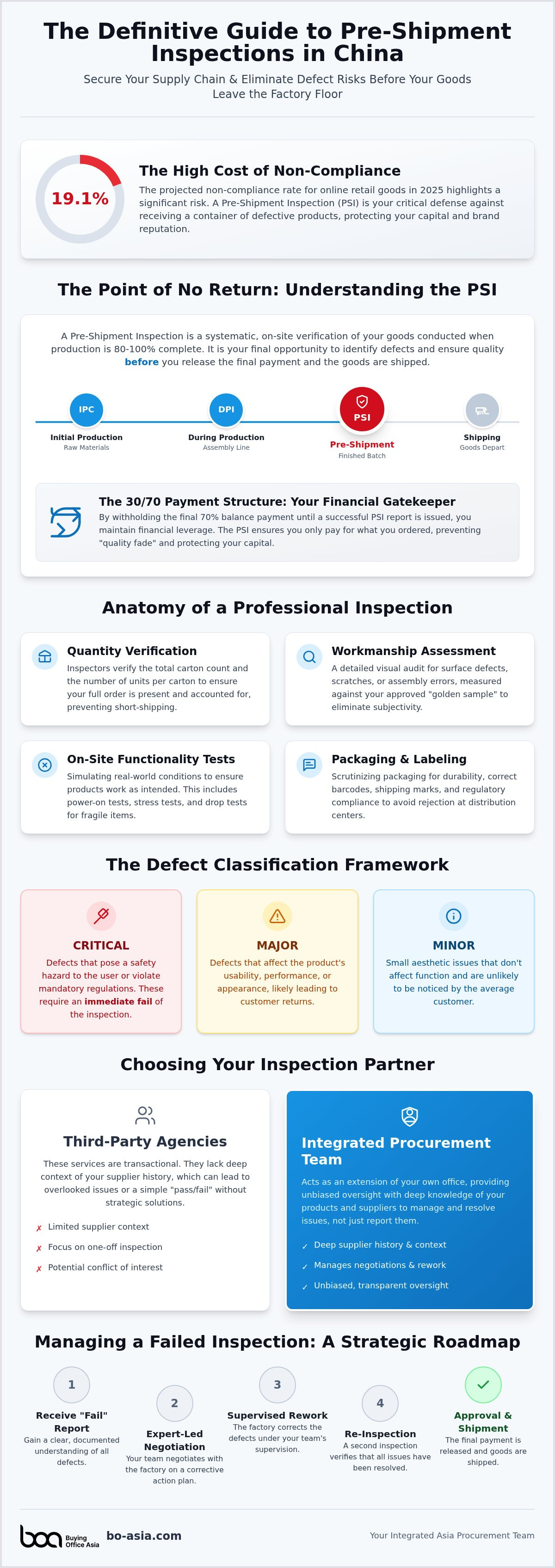
A professional pre-shipment inspection china report categorizes every finding into a hierarchy of severity. This framework allows you to make informed decisions about your capital before the goods leave the factory. Critical defects represent an immediate fail. These include safety hazards, sharp edges, or regulatory non-compliance that could trigger legal action or expensive recalls. Major defects are functional failures or significant aesthetic issues that make the product unsellable to your end user. Minor defects are small imperfections, such as slight color variations or minor surface scuffs, that don't affect function but might annoy a premium customer. Occasionally, an inspection results in a 'Pending' status. This occurs when the data is inconclusive or a specific finding requires your direct intervention to move forward.
Understanding these distinctions is vital because it moves the conversation from subjective "quality" to objective data. When we present you with a report, we aren't just giving you a pass or fail; we're providing a risk assessment of your inventory. If you need help defining your specific defect thresholds, reach out to our senior consultants for a strategy briefing.
Your tolerance levels shouldn't be static across every project. A B2B industrial part requires different AQL thresholds than a high-end B2C retail electronics item. Successful procurement starts with communicating these standards to the factory before production begins. This baseline is established during Product Development and Sampling, where the 'golden sample' defines exactly what is acceptable. By setting these expectations early, you eliminate the factory's ability to claim that a major defect is "standard" for their production line.
Photographic evidence is the backbone of transparency in any pre-shipment inspection china process. A report without at least 50 high-resolution images is incomplete. We look beyond the product itself; the background of these photos reveals factory conditions, cleanliness, and whether other orders are being prioritized over yours. We also verify the 'Carton Drop Test' through sequential photos or video. This ensures your packaging meets the rigors of international transit, protecting your goods from the moment they leave the loading dock until they reach your customer's hands. Seeing the factory floor through a partner's eyes provides the calm assurance that your standards are being met in real-world conditions.
A failed pre-shipment inspection china report often triggers panic in unmanaged supply chains. For our clients, it marks the beginning of a strategic negotiation. A "fail" isn't the end of the project; it's the moment where our on-site presence becomes most valuable. We don't just deliver the news and exit. We stay to manage the rework process. This ensures the factory actually addresses the root cause of the defects rather than simply hiding them behind better packaging.
Managing rework requires a firm hand to prevent "malicious compliance." This occurs when a supplier agrees to fix the issues but does so in a way that creates new problems or only addresses the items specifically tagged in the sample. By acting as an extension of your team, we oversee the sorting and repair stages to guarantee the entire batch meets the original specifications. Accountability for these failures must be established early. We ensure your Procurement Contract explicitly states that the factory bears the cost of any necessary second inspections. This financial penalty incentivizes the supplier to get it right the first time.
We use the data from a failed report as leverage. If the defects are minor but exceed the AQL threshold, we might negotiate price discounts or demand replacement units for the next order. This is where Factory Direct Price Negotiations intersect with quality control. Instead of a transactional pass/fail, we turn the event into a supplier development opportunity. We analyze the failure with the factory management to prevent the same issues in future production runs; this builds a more resilient partnership over time.
In the post-2025 manufacturing landscape, 100% transparency is the only viable path forward. Modern pre-shipment checks now frequently include ESG and ethical audits to ensure your brand isn't exposed to social or environmental risks. As global regulations tighten, having a European-managed team on the ground provides the stabilizing force you need. We move beyond the checklist to offer a total defense for your capital. To secure your next production run and eliminate the anxieties of international sourcing, contact Buying Office Asia today.
Navigating the complexities of international trade requires more than just luck; it demands a rigorous defense against operational setbacks. A professional pre-shipment inspection china protocol is your final opportunity to verify quality, quantity, and compliance before your goods leave the factory floor. By moving beyond transactional reports and adopting a managed oversight model, you eliminate the risks of quality fade and hidden factory commissions. This integrated approach ensures your financial leverage remains intact until the very last unit is packed and verified.
Our European-managed leadership team in Helsinki and Hong Kong acts as a protective extension of your own office. We specialize in high-volume OEM/ODM manufacturing, providing 100% transparency and the regional expertise needed to manage supplier relationships effectively. Don't leave your brand's reputation to chance at the loading dock. Secure your supply chain with our on-the-ground inspection team and gain the calm assurance that your production meets the highest standards. We're ready to help you stabilize your global operations and drive long-term growth.
You should aim to book your pre-shipment inspection china at least 3 to 5 business days before your proposed date. This window allows our dedicated Asia procurement team to coordinate with the factory and review your specific quality standards. During peak seasons, such as the weeks leading up to Chinese New Year, we recommend scheduling two weeks in advance. Early booking ensures our team can synchronize the visit with the 80% completion milestone.
Conducting a pre-shipment inspection china via video call is not a viable substitute for physical presence. Video feeds can be manipulated to hide defects or skip critical tests. A professional assessment requires hands-on verification of workmanship, weight, and functionality. We prioritize on-site inspections because they provide 100% transparency. Our European-managed team physically handles the goods to ensure the data in your report reflects the actual quality of the entire batch.
A factory's refusal to allow an on-site inspector is a critical red flag that usually indicates hidden quality issues or production delays. You should address this immediately by referencing your procurement contract. Since you haven't paid the final 70% balance, you hold the financial leverage. We manage these confrontations by reiterating that payment is contingent on a successful, independent inspection. This firm stance usually resolves access issues and protects your capital from being tied to defective goods.
The cost for a pre-shipment inspection is typically calculated based on man-days rather than the size of the container. A complex product or a high-volume order may require multiple inspectors or extra days to reach a statistically significant sample size. Factors influencing the total include the factory location and the depth of functionality testing required. We provide a transparent breakdown of these requirements as part of our end-to-end supply chain management to ensure your budget is optimized.
A PSI report is a powerful piece of evidence in payment disputes, though it isn't a legal judgment in itself. Most international sales contracts specify that the final payment is triggered only after the issuance of a "Passed" report. If a dispute reaches arbitration, the documented findings, high-resolution photos, and AQL data serve as objective proof of non-compliance. Using these reports as a contractual gatekeeper is the most effective way to prevent financial loss before the goods ship.
The difference between AQL 1.5 and AQL 2.5 lies in your tolerance for major defects. An AQL of 1.5 is a stricter standard, allowing fewer defective units in a sample before the entire batch fails. We typically recommend AQL 1.5 for high-value electronics or premium goods where precision is paramount. AQL 2.5 is the standard for most consumer goods. Your choice depends on your market positioning and the financial risk associated with customer returns or functional failures.
For high-volume sourcing, inspecting 100% of the goods is usually cost-prohibitive and logistically impossible without delaying your shipment. Instead, we utilize the ISO 2859-1 sampling standard. This statistical method allows us to draw a random, representative sample that provides a high degree of confidence in the quality of the entire batch. If a pre-shipment inspection china report reveals a high defect rate, we may then recommend a 100% sort of the affected cartons to isolate defective units.
A passed PSI confirms the goods were in acceptable condition and packed correctly at the factory. It doesn't guarantee against damage caused by poor carrier handling or environmental factors during transit. To mitigate this risk, we recommend Container Loading Supervision (CLS) as a follow-up. This ensures the goods are loaded securely and that the container itself is structurally sound. While the inspection verifies product quality, proper logistics management protects that quality until it reaches your warehouse.

What if the first clear sign of a production problem arrives after the goods are packed? Manufacturing risk management in Asia works best when controls are connected from the start, not left to a final inspection or occasional supplier update. You need visibility into factory activity, early warning...

What if the lowest unit quote isn’t the lowest-cost way to make your board game? Board game manufacturing costs depend on more than the number of boxes ordered. Component materials, custom tooling, assembly, packaging and delivery scope can all change what a quote covers, making headline prices diff...

What if the factory’s lowest quote isn’t the lowest-cost option? A lower unit price can hide differences in materials, tooling, packaging, quality checks or production terms. Understanding how sourcing agents negotiate factory prices starts with making those differences visible, not simply asking a...