


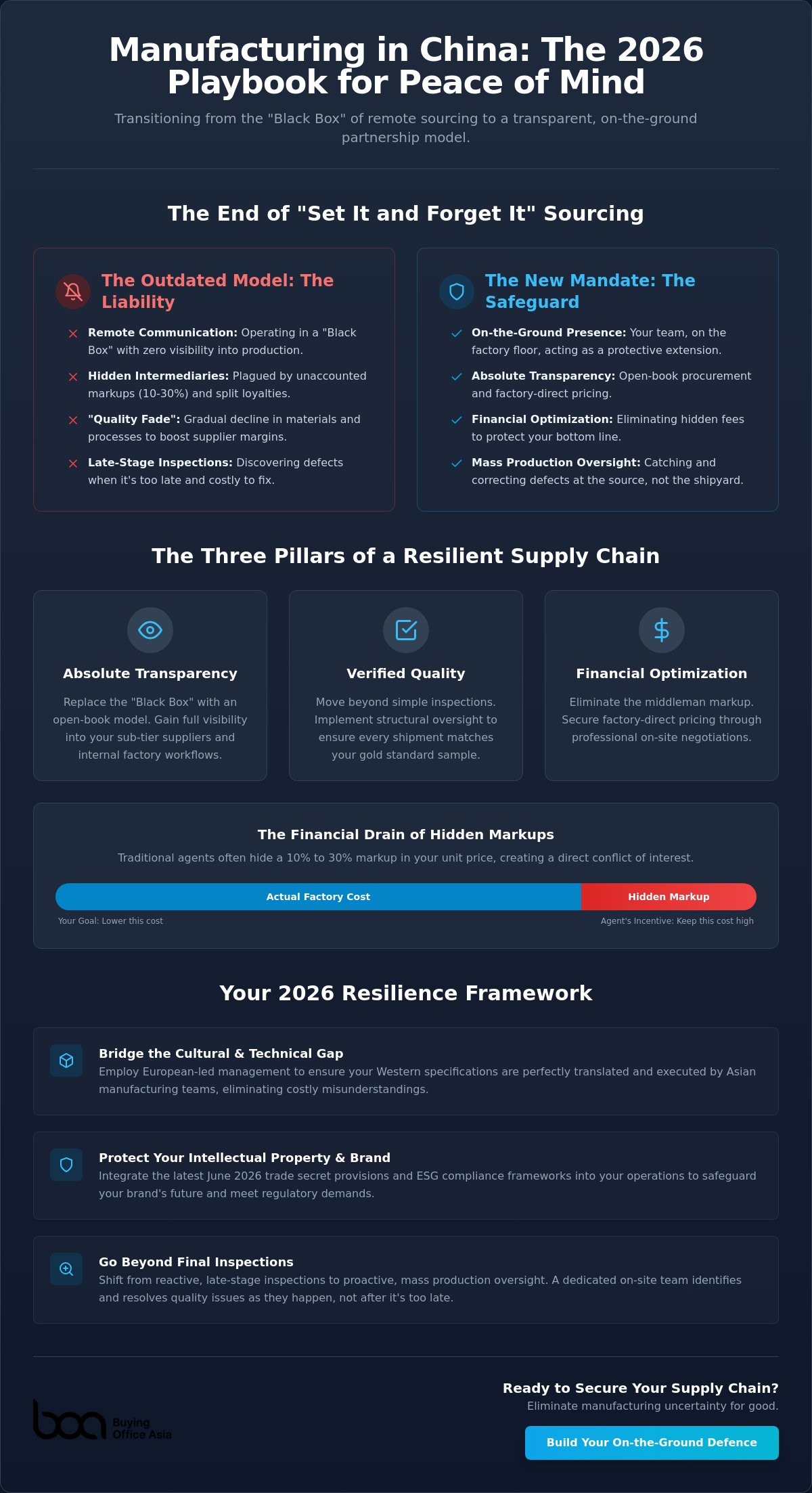
In 2026, the traditional "set it and forget it" sourcing model isn't just outdated; it's a direct liability to your company's bottom line. With China's Producer Price Index rising 3.9% in May and new Industrial and Supply Chain Security regulations now in full effect, the margin for operational error has vanished. Learning how to get peace of mind when manufacturing in China now requires more than a signed contract. It demands a physical, on-the-ground presence that functions as a protective, hands-on extension of your own team.
We recognize the anxiety that comes with losing control over production timelines or discovering hidden markups from intermediaries. It's a common challenge in a complex global market, but it's one we can solve through strategic oversight and calm assurance. This guide provides the structural safeguards and regional expertise required to eliminate manufacturing uncertainty for good. You'll discover how to secure factory-direct pricing, leverage the June 2026 trade secret provisions to protect your IP, and implement a quality control system that ensures every shipment matches your gold standard sample. We'll show you how to build a supply chain defined by three core pillars: absolute transparency, verified quality, and financial optimization.
• Identify the financial drain of hidden intermediary markups and secure transparent, factory-direct pricing through professional on-site negotiations.
• Master how to get peace of mind when manufacturing in China by replacing the "Black Box" of remote communication with a dedicated, on-the-ground procurement team.
• Move beyond the limitations of late-stage inspections by implementing mass production oversight to catch quality defects at the source.
• Protect your brand’s future by integrating the latest 2026 IP protection strategies and ESG compliance frameworks into your sourcing operations.
• Bridge the cultural and technical gap between Western specifications and Asian manufacturing through a European-led management structure.
Manufacturing anxiety isn't just a byproduct of international trade; it's a specific, structural risk. We define this anxiety as the operational gap between your technical specifications and the factory floor's interpretation. When you operate from thousands of miles away, this gap widens with every email sent. You aren't just managing production; you're managing the uncertainty of whether your vision is being executed. Understanding how to get peace of mind when manufacturing in China begins with acknowledging that distance is your greatest adversary. It's the psychological weight of knowing that a single misunderstanding can lead to a container full of unsellable inventory.
Many businesses fall into the trap of believing in the "Perfect Factory." They find a supplier with impressive certifications and a sleek showroom, assuming that past performance guarantees future results. This is a dangerous fallacy. Even the most reputable suppliers can fail without consistent, on-the-ground oversight. As China continues to progress under the Made in China 2025 strategic plan, factories are moving toward higher technical complexity. Without a physical presence to verify these advanced processes, you're essentially gambling on the factory's internal management. Transitioning from a transactional mindset to a strategic partnership model is the only way to secure your investment.
Relying on Alibaba or basic email communication creates a "Black Box" effect. You feed orders and payments into one end, and products emerge from the other, but you have zero visibility into the process in between. Information is often filtered through third-party agents who prioritize their own ease of operation over your brand's integrity. This lack of transparency leads to "quality fade," where a supplier gradually substitutes cheaper materials or simplifies processes to increase their margins over long-term production runs. Black Box Manufacturing is the lack of visibility into sub-tier suppliers and the internal factory workflows that determine your product's final quality.
Traditional sourcing agents often present a conflict of interest that undermines your quality standards. Most operate on commission-based models, meaning their loyalty is split between you and the factory. It's a poorly kept secret in the industry that many agents receive "kickbacks" from manufacturers to overlook minor defects or push through price increases. This transactional approach leaves your brand vulnerable. To protect your interests, you need a partner that functions as an integrated extension of your own team. For a deeper look at navigating these partnerships, see our insights on choosing a China sourcing company in 2026. By eliminating these hidden incentives, you regain control over your supply chain and ensure that your standards are never compromised for an agent's bonus.
Financial transparency is the only reliable antidote to the "Middleman Trap." While most businesses understand that intermediaries require compensation, few realize the true extent of the costs buried within their unit prices. Traditional sourcing agents frequently claim to offer "free" services or low commissions, yet they often bake a 10% to 30% markup into every product you purchase. This lack of clarity is a primary reason why how to get peace of mind when manufacturing in China remains such a persistent challenge for independent brands. To secure your supply chain, you must move toward an open-book procurement model where every cent is accounted for and every margin is visible.
Intermediaries thrive in the shadows of the unit price. By obscuring the true factory cost, they prevent you from seeing the actual margins and create a fundamental misalignment of interests. In these hidden commission models, the agent's profit increases when the factory price stays high, which is the exact opposite of your business goals. We advocate for a transparent service fee model that removes these conflicting incentives. When you pay for Sourcing & Procurement Services as a distinct, professional line item, your procurement team's interests align perfectly with your own. You gain the steady confidence that comes from knowing every negotiation is focused entirely on your financial health rather than a hidden markup.
Effective price negotiation requires physical proximity and regional expertise. Having a dedicated team based in a strategic hub like Hong Kong changes the dynamic from a transactional interaction to a professional partnership. It allows for real-time adjustments based on verified market data. For example, China's Producer Price Index (PPI) accelerated to 3.9% year-on-year in May 2026, marking the fastest increase since July 2022. Without on-the-ground advocates to verify these cost increases at the factory level, you're forced to accept the supplier's word at face value.
Strategic negotiations also involve securing your legal and operational standing. While discussing pricing, our teams ensure that contracts include robust provisions for Protecting Intellectual Property in China. This integrated approach defends your brand against both financial leakage and long-term operational risk. You can see the measurable impact of this strategy by reviewing our documented Factory Direct Price Negotiations and performance history. If you're ready to audit your current supply chain costs for hidden inefficiencies, reach out to our consultants for a transparent assessment.
For many brands, the standard quality control process is reactive rather than proactive. You wait until the production run is complete, send an inspector for a day, and hope for the best. This reliance on a single Pre-Shipment Inspection (PSI) is a high-stakes gamble. If the inspector finds a systemic defect, your entire shipment is delayed, or worse, the factory attempts a "quick fix" that compromises the product's longevity. True security comes from building a "Quality Gate" system that catches errors before they become unfixable. This is the foundation of how to get peace of mind when manufacturing in China; you stop being a passenger in the production process and start acting as the director.
A resilient supply chain requires more than just checking boxes at the end of a line. As highlighted in Harvard Business Review's research on building resilient supply chains, risk assessment must be integrated into the physical production flow. This starts with on-site factory audits conducted before the first purchase order is signed. You must verify the supplier's technical capacity and management rigor in person to ensure they can actually meet your specifications. For a deeper look at our rigorous selection criteria, you can explore how we vet our suppliers to ensure they meet international standards.
We implement a four-tier oversight model to eliminate the risk of batch-wide failures. This begins with Pre-production, where we verify raw materials and approve the "golden sample" on-site. During the DUPRO (During Production) phase, our team identifies issues while they can still be corrected without scrapping the entire run. The Final Random Inspection (FRI) serves as the last line of defense, followed by Container Loading Supervision. This final step ensures that the specific goods we inspected are the exact goods that get on the ship, preventing any last-minute substitutions.
Simple inspections tell you what went wrong after the fact, but mass production oversight prevents those errors from occurring in the first place. By having staff physically present in the factory during the run, we provide an "on-the-ground" advantage that remote management cannot match. When non-compliance is detected, our teams handle it immediately. We don't just report the problem; we work with the factory management to implement a corrective action plan without stopping your entire supply chain. This protective, hands-on approach transforms quality control from a point of anxiety into a measurable strategic advantage for your brand.
The 2026 landscape for international procurement is defined by a new level of legal and ethical scrutiny. It's no longer enough to produce a high-quality item; you must also ensure your supply chain adheres to a complex web of new regulations. The Regulations on Industrial and Supply Chain Security, which took effect on April 7, 2026, have fundamentally changed the risk profile for Western brands. These rules establish a unified framework for supply chain oversight, meaning your commercial decisions are now under direct regulatory review. Understanding how to get peace of mind when manufacturing in China today requires a proactive compliance strategy that balances Western ethical expectations with these local legal realities.
Building a resilient supply chain means preparing for geopolitical shifts before they disrupt your inventory. With the average US tariff on Chinese goods sitting at approximately 33% as of May 2026, financial viability depends on your ability to navigate trade barriers and regulatory hurdles simultaneously. This framework isn't just about defense; it's about creating a stable, transparent foundation that allows your business to scale without the constant threat of legal or ethical setbacks. By integrating compliance into your daily operations, you transform a potential liability into a significant competitive advantage.
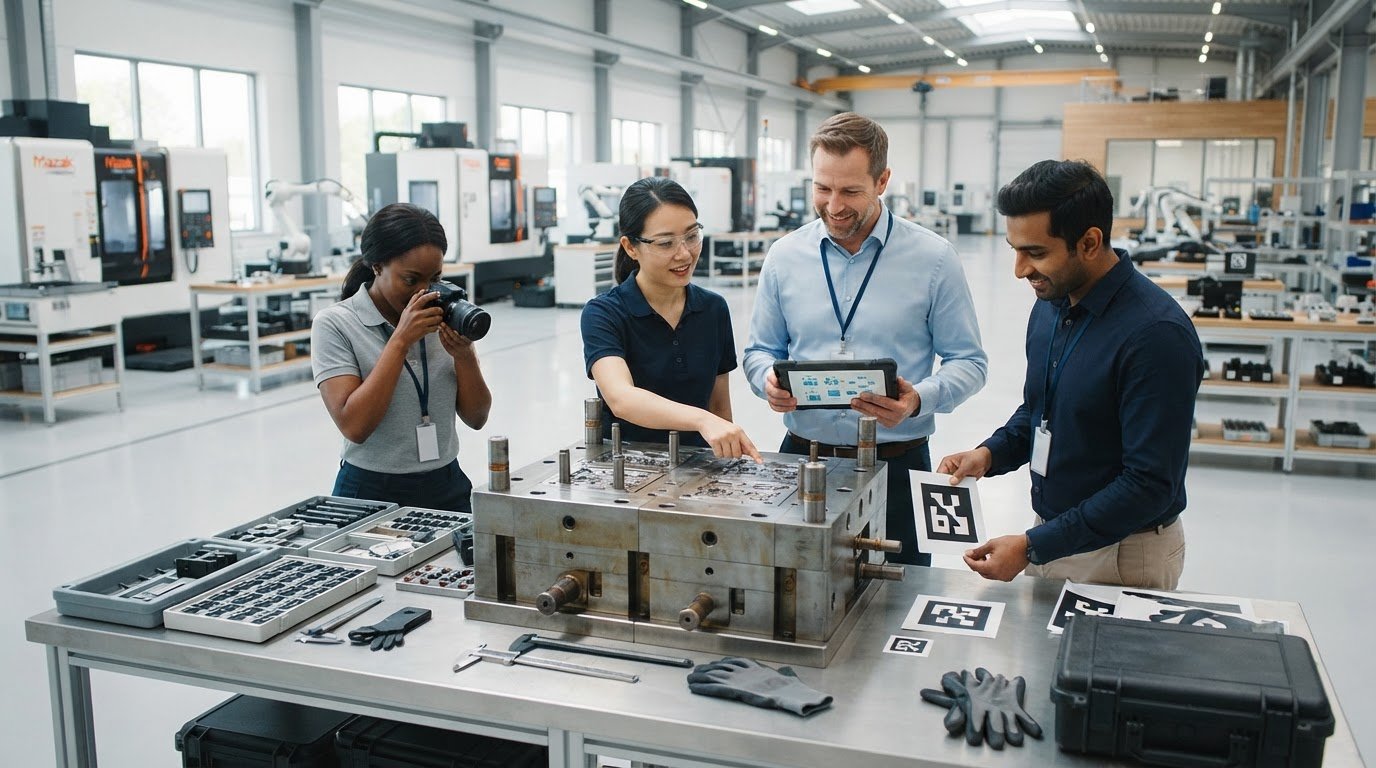
Traditional Non-Disclosure Agreements (NDAs) are often unenforceable in a Chinese court. To secure your innovations, we implement NNN Agreements, which cover Non-use, Non-disclosure, and Non-circumvention. This ensures a factory cannot use your designs for their own products or bypass you to sell directly to your customers. The new Provisions on the Protection of Trade Secrets, effective as of June 1, 2026, provide even stronger mechanisms for market regulatory authorities to intervene in IP disputes. We also emphasize that tooling ownership is the ultimate form of security; if you own the physical molds, you maintain the power to move production if a supplier relationship sours. For brands developing proprietary designs, our OEM & ODM Contract Manufacturing services provide the legal and physical safeguards necessary to protect your intellectual capital.
Environmental, Social, and Governance (ESG) standards have moved from the marketing department to the procurement office. Modern consumers and regulators demand proof of ethical labor and sustainable practices. We've found that "staged" audits, where factories prepare specifically for an inspection day, are a common pitfall for unmanaged brands. Our on-the-ground presence allows for unannounced visits and genuine verification of working conditions. By aligning with our Buying Office Asia ESG Policy, you ensure your brand isn't exposed to the reputational risks of forced labor or environmental negligence. If you need to verify your current supplier's compliance with the latest 2026 standards, contact our compliance team for a comprehensive factory audit.
Distance is more than a logistical hurdle; it's a primary source of misinterpretation. Even with the best specifications, your vision can be lost in translation without a leadership bridge that understands both Western market expectations and Asian industrial realities. Successfully mastering how to get peace of mind when manufacturing in China requires a management structure that doesn't just pass messages along, but actively translates your standards into factory-floor execution. Our Helsinki-based leadership provides this vital connection, ensuring that your quality requirements, ethical standards, and delivery timelines are never compromised by cultural or linguistic gaps.
Operating from a Hong Kong headquarters offers a distinct logistical advantage for regional oversight. This physical proximity allows our teams to be inside a factory within hours, not days. This rapid response capability is a cornerstone of a defensive supply chain strategy. It transforms your procurement from a remote, hands-off transaction into a managed operation where you have a protective ally on the ground. By positioning our experts at the heart of the manufacturing hub, we provide the steady confidence of an established insider who can navigate local business nuances while maintaining a strict adherence to European professional rigor.
A dedicated procurement team shouldn't be viewed as an added expense, but as a strategic investment in risk mitigation. When you compare the cost of professional management against the catastrophic financial impact of a failed production run or a total shipment rejection, the value is clear. In 2026, the margin for error is slimmer than ever due to rising raw material costs and increased regulatory scrutiny. We provide measurable outcomes by eliminating hidden markups and preventing costly quality defects at the source. You can review our documented performance history and see how our clients optimize their spend through our Pricing and Savings Examples. This data-driven approach proves that managed sourcing pays for itself by securing your margins and protecting your brand's reputation.
Moving from manufacturing anxiety to a managed supply chain is a methodical process. We begin by auditing your current supplier relationships to identify vulnerabilities in quality control, IP protection, and financial transparency. Our onboarding process is designed to be an integrated extension of your own team, taking the weight of daily operational management off your shoulders. We handle the technical complexities of factory vetting, price negotiation, and mass production oversight so you can focus on growing your business. If you're ready to secure your 2026 supply chain with a partner that prioritizes your financial health, book a consultation with our European leadership team to discuss your specific procurement needs.
The 2026 manufacturing landscape demands a shift from reactive hope to a structural, managed defense. We've analyzed the necessity of eliminating hidden markups, implementing multi-stage quality gates, and adhering to the latest IP and ESG regulations. You now understand that how to get peace of mind when manufacturing in China isn't about finding a "perfect" factory; it's about establishing a physical presence that functions as your dedicated advocate on the ground.
By partnering with a team that offers European-managed leadership and over 15 years of regional experience, you bridge the cultural gap that often leads to operational failure. Our 100% transparent, open-book pricing model ensures your capital is invested in product quality rather than intermediary fees. With our on-the-ground presence in Hong Kong and Mainland China, we provide the elite oversight required to navigate the modern global trade environment. Your supply chain should be a predictable engine for growth, not a source of constant anxiety.
Secure Your Supply Chain with Buying Office Asia
We're ready to help you build a more resilient, profitable, and transparent future.
Yes, you can manage production remotely, but it requires a trusted, on-the-ground team to act as your physical advocate. Relying solely on digital platforms or email often leads to a lack of visibility into the actual production process. By employing a professional procurement team to conduct on-site audits and inspections, you ensure your standards are met without the logistical burden of frequent international travel.
Secret commissions are typically hidden within an inflated unit price or presented as "free" sourcing services. If an agent isn't providing an open-book accounting model, there is a high risk they are receiving a hidden markup from the factory. To ensure your financial interests are protected, you should work with partners who charge a transparent service fee, aligning their goals directly with your own savings.
The most robust defense is a combination of NNN agreements and physical ownership of your production tooling. While contracts provide a legal basis for protection, owning the physical molds ensures you can move production immediately if a supplier violates your trust. The June 2026 trade secret provisions have also strengthened the ability of market regulatory authorities to intervene in cases of intellectual property theft.
Costs for on-site inspections are determined by the complexity of your product and the depth of the oversight required at each "Quality Gate." Rather than viewing these as a standalone expense, it's more accurate to see them as essential risk mitigation. Investing in structural oversight is the most reliable way to get peace of mind when manufacturing in China, as it prevents the catastrophic financial loss of a rejected shipment.
In 2026, ESG compliance has transitioned from a corporate preference to a strict regulatory mandate for Western brands. New carbon border adjustments and ethical labor audits are now standard components of a resilient supply chain. Factories are under increased pressure to provide verifiable data on their environmental and social impact, making unannounced on-site audits a vital tool for maintaining your brand's global reputation.
Yes, medium-sized businesses can secure factory-direct pricing by removing traditional intermediaries that obscure true production costs. This transparency is a core part of how to get peace of mind when manufacturing in China. By using a dedicated procurement team to negotiate directly with factory owners, you eliminate the 10% to 30% markups often added by sourcing agents, ensuring you pay the same rates as major enterprises.
If mass production deviates from your approved sample, your on-site team must trigger a corrective action plan before the goods leave the factory floor. This is why "During Production" oversight is critical; it catches defects while they are still fixable. A professional partner ensures the factory reworks the non-compliant items at their own expense, preventing you from ever paying for or receiving sub-standard inventory.
A Hong Kong-based headquarters offers a sophisticated legal and financial bridge that mainland offices often lack. It provides a familiar legal framework for Western contracts while maintaining immediate physical proximity to mainland factories. This structure allows for European-led management to apply high-level professional rigor to local operations, ensuring your supply chain is both legally secure and operationally efficient.

A supplier listing can open a door, but it can’t show whether a factory is right for your order. Choosing a ningbo sourcing agent means looking beyond access to local suppliers: you need clear oversight of supplier vetting, production follow-up, and quality checks. Without defined responsibilities,...

What if the supplier with the strongest online profile isn’t the factory best suited to your shoes? In footwear manufacturing in China, a directory listing can start your search, but it can’t confirm who will make your product, whether the factory can handle its construction and materials, or how cl...
What if the mold you paid to develop couldn’t be released when you needed to change suppliers? Managing tooling and molds with a foreign factory means more than tracking where production equipment is stored. Payment alone may not establish clear ownership, access, or transfer rights. Without visibil...