


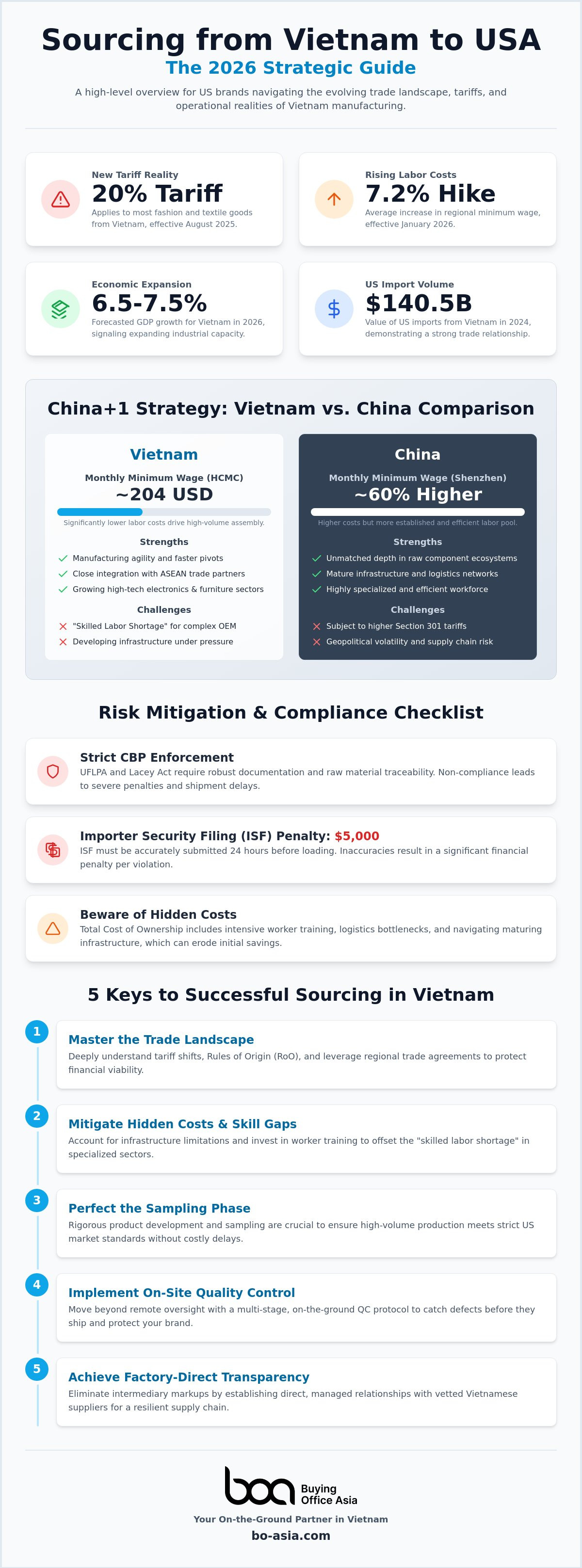
While many US brands rushed to Southeast Asia to escape Section 301 penalties, they now face a new reality where a 20% tariff applies to most fashion and textile goods imported from Vietnam. You've likely realized that simply moving production isn't enough to protect your margins. Successfully sourcing from Vietnam to USA in 2026 requires more than a laptop and an email address; it demands a sophisticated, on-the-ground strategy to navigate a 7.2% minimum wage hike and increasingly strict CBP enforcement of the UFLPA and Lacey Act.
We understand the anxiety of managing a supply chain from thousands of miles away, especially when hidden infrastructure costs and logistics delays threaten your delivery timelines. This guide provides a strategic roadmap to master these complexities, focusing on rigorous supplier vetting and factory-direct transparency. You'll learn how to mitigate new regulatory risks, leverage the latest customs amendments from February 2026, and implement a "China plus one" strategy that actually lowers your total cost of ownership. We'll break down the essential steps for maintaining physical oversight and building a resilient, diversified procurement network that stands up to global volatility.
• Navigate the 2026 trade landscape by understanding how specific tariff shifts and the China+1 strategy redefine the financial viability of sourcing from Vietnam to USA.
• Identify and mitigate hidden infrastructure costs and labor skill gaps that often undermine the perceived savings of Southeast Asian manufacturing.
• Master the sampling and product development phase to ensure your high-volume production meets strict US market standards without costly delays.
• Protect your brand reputation by moving beyond remote oversight to a multi-stage, on-site quality control protocol that captures defects before they leave the factory floor.
• Achieve true supply chain transparency by eliminating intermediary markups and establishing direct, managed relationships with vetted Vietnamese suppliers.
• The 2026 Landscape: Why US Brands are Sourcing from Vietnam
• Economic Realities: Labor Costs vs. Infrastructure Investment
• High-Volume Transition: A Roadmap for US Importers
• Risk Mitigation: Quality Control and Factory Audits
• Buying Office Asia: Your On-the-Ground Partner in Vietnam
US companies are no longer just exploring alternatives; they're committing to Vietnam as the cornerstone of their "China+1" strategy. In 2024, US imports from Vietnam reached $140.5 billion, and with a forecasted GDP growth of 6.5% to 7.5% for 2026, the nation's industrial capacity continues to expand. Sourcing from Vietnam to USA has transitioned from a tactical cost-saving move into a strategic necessity for brands looking to diversify away from the volatility of the Chinese market. This shift is driven by a need for stability, even as the regulatory environment becomes more complex.
While textiles still account for roughly 40% of Vietnam's exports to the US, the 2026 procurement landscape shows significant growth in high-tech electronics and furniture manufacturing. This transition is fueled by Vietnam's export-oriented economy, which has prioritized infrastructure and regulatory reforms to attract high-value manufacturing. US brands must now balance these opportunities against rising operational costs, including a 7.2% average increase in the regional minimum wage that took effect in January 2026.
Success in 2026 requires a sophisticated understanding of the current tariff environment. Effective August 7, 2025, the US imposed a 20% tariff on most fashion and textile goods from Vietnam. While this adds pressure, it remains a competitive alternative to the Section 301 tariffs applied to Chinese goods. However, you must prioritize strict adherence to Rules of Origin (RoO). US Customs (CBP) is strictly enforcing the UFLPA and Lacey Act in 2026, requiring robust documentation and raw material traceability. Failure to maintain accurate records can lead to a $5,000 penalty for inaccurate Importer Security Filings (ISF), which must be submitted 24 hours before loading. Leveraging Vietnam's regional trade agreements can reduce secondary costs, but only if your supply chain is transparent enough to withstand rigorous audits.
High-volume manufacturers are increasingly moving assembly to hubs like Hai Phong and Ho Chi Minh City to capitalize on Vietnam's agility. While China still offers an unmatched depth in raw component ecosystems, Vietnam's rapid industrialization allows for faster pivots and closer integration with ASEAN trade partners. The challenge for US importers lies in managing the transition without sacrificing quality. You aren't just looking for a factory; you're looking for a compliant partner that fits into a broader strategy for Mastering Sourcing and Procurement in Asia. By focusing on physical proximity and regional presence, you can bridge the gap between China's established depth and the emerging efficiencies of sourcing from Vietnam to USA in 2026.
Calculating the true financial viability of sourcing from Vietnam to USA requires looking far beyond the face value of a proforma invoice. While the unit price at a Vietnamese factory often appears lower than its Chinese counterpart, the Total Cost of Ownership (TCO) includes variables that can quickly erode your margins if left unmanaged. Official U.S. trade statistics with Vietnam highlight a massive surge in bilateral trade, but this volume places immense pressure on a developing industrial framework. You must account for the "hidden" costs of production, such as the necessity for intensive worker training and the logistics of navigating a maturing infrastructure.
The 2026 labor market in Vietnam presents a dual reality of cost-efficiency and skill scarcity. Following the January wage adjustments, the monthly minimum in industrial hubs like Ho Chi Minh City (Region I) reached approximately 204 USD. This remains a powerful incentive for high-volume assembly, yet the "Skilled Labor Shortage" is a genuine hurdle for complex OEM projects requiring specialized technical expertise. As of 2026, the monthly minimum wage in Shenzhen remains nearly 60% higher than in Ho Chi Minh City, providing a clear baseline advantage for labor-intensive assembly. However, you'll likely face higher retention costs and training investments to reach the efficiency levels found in more established manufacturing regions. We help our partners bridge this gap by vetting factories that prioritize workforce development and stable management structures.
Infrastructure bottlenecks remain the most significant threat to your delivery timelines. While northern hubs like Hai Phong have seen massive upgrades, southern ports like Cat Lai often operate near peak capacity, leading to potential congestion during peak shipping seasons. Managing the "Last Mile" from a factory in a newly developed industrial zone to the port can involve unpredictable road transport lead times. Effective Strategic Logistics & Shipping Management is no longer optional; it's a core component of your procurement strategy. You need a partner who understands the local terrain and can secure space on US-bound vessels at least 24 hours before loading to avoid the 5,000 USD ISF penalty. If you're concerned about how these variables affect your specific product category, you can request a preliminary TCO analysis from our regional experts to ensure your transition remains profitable.
Transitioning to high-volume production in Vietnam isn't just about finding a factory; it's about building a scalable system that can withstand the pressures of a global supply chain. Many US importers fall into the "middleman trap," where unmanaged intermediaries obscure the true factory-direct costs through hidden commissions or marked-up material fees. When you're sourcing from Vietnam to USA, transparency is your greatest defense against margin erosion. You need to decide early if your project requires Original Equipment Manufacturing (OEM) for custom designs or Original Design Manufacturing (ODM) for faster market entry using existing factory templates. This choice dictates your level of control over the final product and your long-term cost structure.
The sampling process serves as your first major KPI for evaluating a potential partner. In the competitive 2026 market, prototype speed often dictates your window of opportunity for seasonal launches. If a factory takes weeks to iterate on a simple sample, they'll likely struggle with the complexities of mass production. Scalability isn't just about floor space or the number of machines; it's about the factory's ability to maintain quality consistency as volume increases from 1,000 to 100,000 units. You need to see evidence of their internal quality management systems before the first deposit is paid.
Custom tooling is where your intellectual property is most vulnerable. You must ensure that your partner has the internal engineering capabilities to handle complex development without outsourcing critical components to unvetted sub-contractors. This "sub-contracting leak" is a common source of IP theft and quality degradation. Protecting your designs during this phase is essential for long-term security and market exclusivity. For a deeper look at managing these technical requirements and navigating the nuances of production, consult our OEM Manufacturing Guide.
Relying on digital marketplaces like Alibaba or Global Sources is insufficient for high-volume, enterprise-level procurement. You need on-the-ground factory audits to verify a supplier's actual capacity, machinery condition, and financial health. In 2026, vetting includes checking for the liquidity required to fund raw materials for mass production, as many smaller factories are struggling with credit constraints. Additionally, as U.S.-Vietnam Trade Relations continue to evolve, ESG and ethical standards have become mandatory compliance hurdles. Your factory must provide detailed proof of origin for all raw materials to satisfy CBP's strict enforcement of the UFLPA and the Lacey Act, ensuring strategic success when sourcing from Vietnam to USA in 2026.
Remote quality control is a recipe for disaster when sourcing from Vietnam to USA. You can't effectively manage a factory's output from a laptop in Los Angeles or New York. By the time a traditional third-party inspector arrives for a Final Random Inspection (FRI), the entire production run is already finished and packed. If critical defects are discovered at this stage, your only options are expensive rework, significant shipping delays, or accepting sub-standard goods that jeopardize your brand reputation. We advocate for a proactive, multi-stage inspection protocol that identifies issues while they're still fixable on the assembly line.
Implementing a rigorous oversight strategy means moving beyond reactive inspections. You need a system that integrates During Production (DUPRO) checks to catch systematic errors when only 15% to 20% of the order is complete. This allows for immediate corrective action before the bulk of the materials are consumed. Navigating international ISO standards and AQL (Acceptable Quality Level) benchmarks requires more than just a checklist; it demands an authoritative presence on the factory floor to ensure these benchmarks are actually met, not just promised on paper.
Building a secure supply chain requires a three-step verification process before any capital is deployed. First, conduct a comprehensive factory audit to evaluate technical capacity and social compliance. Second, verify business licenses and export permits in person to ensure the entity you're paying is the one actually manufacturing your goods. Scanned documents are insufficient in a high-stakes environment. Third, establish a clear Quality Agreement (QA) in the local language. This eliminates the "lost in translation" excuse and provides a legally recognized framework for your quality expectations. For a detailed breakdown of these protective measures, consult our Supplier Vetting in Asia guide.
A dedicated team on the factory floor is your best defense against batch defects and unauthorized sub-contracting. This physical proximity allows you to manage production schedules tightly, especially when navigating the "Vietnam Holiday" delays associated with the Lunar New Year. During these periods, worker turnover can spike, leading to a temporary influx of unskilled labor on your production line. On-site oversight ensures that your specific quality standards remain consistent regardless of seasonal labor fluctuations. This level of hands-on management is essential for maintaining the financial viability of sourcing from Vietnam to USA in a competitive 2026 market.
Don't leave your production quality to chance or remote promises. Contact our on-the-ground team in Vietnam to secure your supply chain with a professional inspection protocol.
Buying Office Asia operates as a stabilizing force for US enterprises navigating the complexities of Southeast Asian procurement. While many agencies act as mere intermediaries, we provide European-led management with a permanent physical presence in the heart of Vietnam's industrial hubs. This proximity is the only way to eliminate the "Middleman Trap," a common industry pitfall where unmanaged agents obscure factory-direct pricing with hidden commissions and opaque material markups. When you're sourcing from Vietnam to USA, you need a partner that functions as an integrated extension of your own procurement team, providing the same level of oversight you'd expect from your domestic operations.
Our history includes successful high-volume transitions for brands shifting production from China to Vietnam. We don't just facilitate a connection; we manage the entire lifecycle of the production run. By maintaining 100% transparency, we ensure that the cost savings identified in your initial TCO analysis are actually realized at the port of delivery. We bridge the gap between your US headquarters and the factory floor, ensuring your strategic requirements are met without the typical anxieties of international manufacturing.
We specialize in direct factory negotiations to secure the most competitive pricing without compromising on ethical or regulatory standards. Our team handles everything from the initial product development and custom tooling phases to final logistics and shipping management. This end-to-end oversight means you aren't juggling multiple third-party vendors who lack accountability. By choosing Your Dedicated Sourcing Team, you gain an ally that understands local business nuances while prioritizing your financial health and brand security.
Professional oversight is a strategic investment that significantly reduces the Cost of Poor Quality (COPQ). In an environment where a single batch defect can wipe out your annual margins, the value of on-site mass production oversight cannot be overstated. We replace the risks of unmanaged sourcing from Vietnam to USA with a transparent, performance-based fee structure. This approach dismantles the objections typically associated with international manufacturing by providing documented outcomes and a clear path to ROI. Our regional expertise ensures that your supply chain remains resilient against global volatility and regulatory shifts. To see how our regional expertise can optimize your supply chain, you can get a custom quote for your Vietnam sourcing project today.
The 2026 trade landscape demands more than just shifting production; it requires a defensive strategy against rising minimum wages and strict US Customs enforcement. You've seen that success hinges on moving past reactive inspections to a model of proactive, on-site oversight. By eliminating hidden intermediary costs and prioritizing raw material traceability, you can finally achieve the diversified, high-volume supply chain your brand requires for long-term financial viability.
To ensure your business has the strategic financial leadership required to navigate these complex global transitions and maintain profitability, find out more about PCFO's outsourced CFO services.
Successfully sourcing from Vietnam to USA shouldn't be a gamble on remote promises. Buying Office Asia offers a European-managed on-the-ground presence that acts as a physical shield for your interests. We provide a 100% Transparency Guarantee and specialize in high-volume mass production oversight to ensure your margins remain protected from operational setbacks. You don't have to navigate these infrastructure bottlenecks alone. Our team is ready to serve as the stabilizing force your global operations need to thrive in a complex market.
Partner with Buying Office Asia for Transparent Vietnam Sourcing and secure your manufacturing future today.
Vietnam generally offers a more favorable duty environment than China because it avoids high Section 301 tariffs. While a 20% tariff was implemented in August 2025 for most Vietnamese textiles and fashion, this remains competitive compared to the combined duties on Chinese imports. You must ensure strict compliance with Rules of Origin and provide robust documentation to US Customs to maintain these financial advantages in the 2026 trade climate.
Navigating infrastructure bottlenecks and a skilled labor shortage are the primary hurdles for US businesses. While labor costs remain lower than in China, the 7.2% minimum wage hike in January 2026 and increased social insurance contributions have placed new pressure on margins. Additionally, importers often face longer lead times and the need for more intensive on-site quality oversight to manage the risks associated with a maturing manufacturing ecosystem.
Physical factory audits and in-person verification of business licenses are the only reliable methods for vetting suppliers. You should look for a Certificate of Business Registration and Investment Certificate that match the factory's physical address. Legitimate factories will have dedicated production lines and internal quality control staff; middlemen often lack these assets and will hesitate to provide the raw material traceability documentation required for 2026 US regulatory compliance.
Textiles, furniture, and increasingly complex electronics remain the most viable categories for sourcing from Vietnam to USA. Vietnam currently accounts for roughly 40% of US fashion and textile imports. The country is also rapidly moving into higher-value manufacturing, particularly in the electronics sector, as brands seek to diversify their supply chains away from traditional manufacturing hubs while navigating the 2026 regulatory landscape.
Vietnam's infrastructure is expanding but still faces congestion at major ports like Cat Lai and Hai Phong. While the government has implemented data-driven regulatory reforms in 2026 to enhance efficiency, high-volume shippers must plan for potential delays. Strategic logistics management is鋪 essential to secure vessel space and ensure that Importer Security Filings are submitted 24 hours before loading to avoid the 5,000 USD penalty for late submissions. Additionally, protecting your shipments with Cargo Insure Online ensures that your global logistics operations are covered against unforeseen transit issues.
Production lead times vary by sector, but ocean transit to the US East Coast typically averages 35 to 45 days. When you include factory lead times and potential port congestion, you should budget for a total window of 90 to 120 days. It's critical to factor in seasonal disruptions, such as the Lunar New Year, which can halt production and cause significant backlogs in the shipping schedule for US-bound goods.
Maintaining a physical presence is vital for high-volume mass production oversight and risk mitigation. An on-the-ground team acts as a protective extension of your company, managing factory-direct negotiations and conducting multi-stage inspections. This proximity is essential when sourcing from Vietnam to USA, as it allows you to address systematic defects during production rather than discovering them after the goods arrive at a US port, which is a common disaster for unmanaged supply chains.
IP protection begins with robust, locally enforceable contracts and strict control over custom tooling. You should register your trademarks and patents through the National Office of Intellectual Property (NOIP) before starting production. Additionally, vetting your suppliers for integrity and ensuring they don't outsource critical components to unvetted sub-contractors provides a defense against the unauthorized reproduction of your designs. This proactive approach is a cornerstone of safe international procurement.

Article by
Christian Wülfing
Christian is COO and Co-Founder of Buying Office Asia

A supplier listing can open a door, but it can’t show whether a factory is right for your order. Choosing a ningbo sourcing agent means looking beyond access to local suppliers: you need clear oversight of supplier vetting, production follow-up, and quality checks. Without defined responsibilities,...

What if the supplier with the strongest online profile isn’t the factory best suited to your shoes? In footwear manufacturing in China, a directory listing can start your search, but it can’t confirm who will make your product, whether the factory can handle its construction and materials, or how cl...
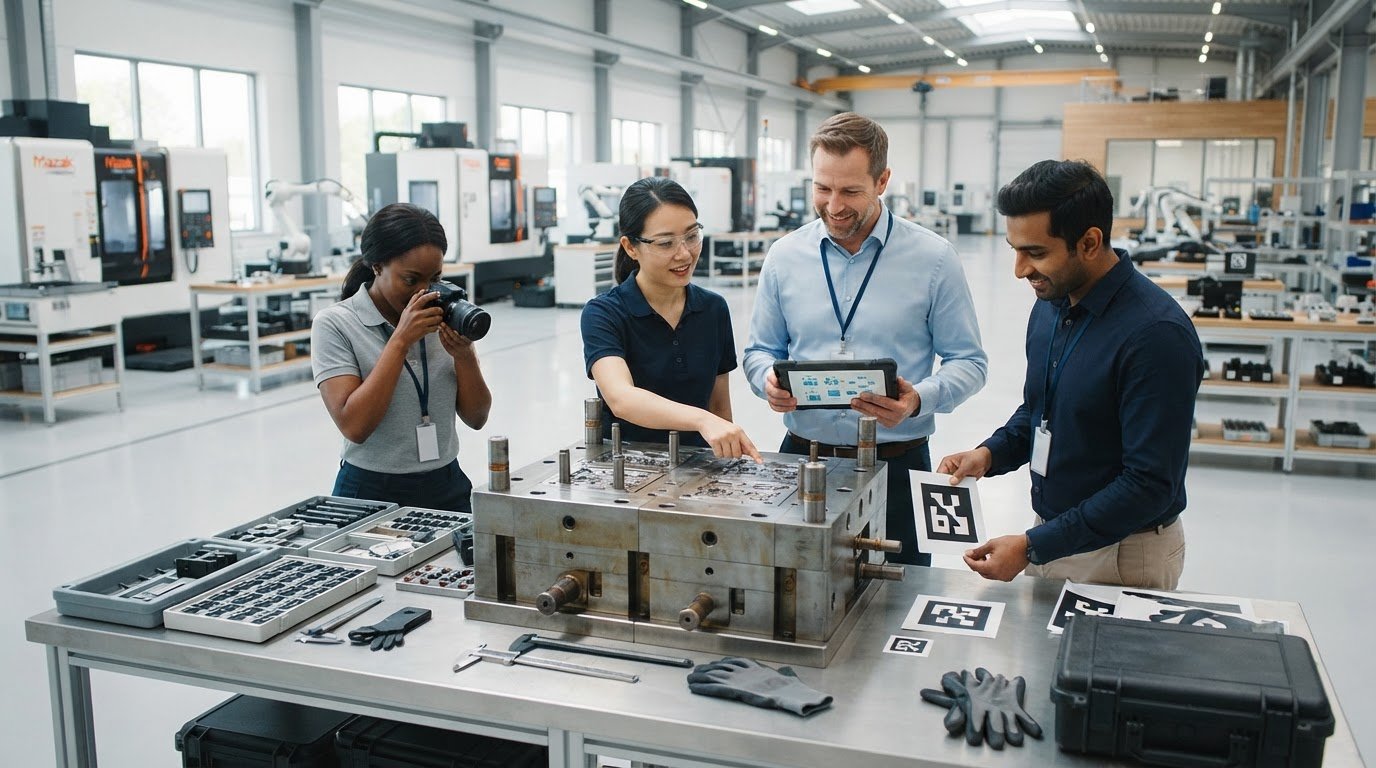
What if the mold you paid to develop couldn’t be released when you needed to change suppliers? Managing tooling and molds with a foreign factory means more than tracking where production equipment is stored. Payment alone may not establish clear ownership, access, or transfer rights. Without visibil...