


Your manufacturing transition isn't a logistics project; it's a high-stakes defense against operational sabotage. You likely feel the weight of potential downtime or the very real threat of your current supplier holding tooling hostage the moment they sense a departure. In a 2026 climate where goods from China face a 24% effective tariff rate and global surcharges fluctuate monthly, you can't afford a single day of lost productivity. We understand that the anxiety of vetting a new partner from across the globe is often what keeps businesses tied to inefficient, high-risk suppliers.
This article serves as your strategic blueprint for how to move production to a new factory with the precision of a seasoned insider. You'll master a risk-mitigation framework specifically designed for the complexities of the Asian market, ensuring your intellectual property remains secure and your margins improve. We'll walk through a methodical process that prioritizes on-site accountability and physical proximity, moving you toward a seamless transition with zero quality drop. From navigating the 2026 Harmonized Tariff Schedule to embedding AI into your new workflow, we'll show you how to transform a volatile move into a stabilizing force for your long-term supply chain.
• Treat your relocation as a strategic pivot to mitigate geopolitical risks and cost escalations rather than a simple operational change.
• Implement a rigorous vetting process that looks beyond digital profiles to find partners with verified category expertise and volume capacity.
• Secure your critical assets with a "silent exit" plan designed to prevent old factories from withholding your tooling or intellectual property.
• Discover the essential steps for how to move production to a new factory while maintaining quality through Golden Samples and controlled pilot runs.
• Leverage a dedicated on-ground team to manage local relationships and eliminate the high failure rates associated with remote oversight.
Relocating your manufacturing isn't just a change of address; it's a critical recalibration of your business's financial health. In 2026, the global trade environment has become increasingly volatile. With the U.S. average effective tariff rate hitting 11% earlier this year and goods from China facing a 24% rate as of April, the financial argument for staying with a legacy supplier often collapses under the weight of new duties. Assessing the Strategic Necessity of Moving Production requires looking beyond immediate unit costs to evaluate long-term viability and risk exposure. It's about securing a competitive edge in a market where the *de minimis* exemption has been suspended and trade agreements are subject to annual reviews.
Primary triggers for a move include persistent quality drift, sudden cost escalations, or the urgent need for geopolitical de-risking. Many leaders hesitate, choosing the "known bad" of a current supplier over the perceived risks of a new one. However, staying with a partner who lacks transparency or fails to meet ethical standards is a silent margin killer. A successful transition must achieve two non-negotiable benchmarks: zero production downtime and 100% retention of your intellectual property. Learning how to move production to a new factory starts with acknowledging that your current supply chain may no longer be fit for purpose in this decade's regulatory climate.
You must decide if this move is a defensive play for cost-optimization or an offensive strategy for capability-enhancement. Set rigid KPIs for the new facility, focusing on lead time reduction and defect rates that outperform your current baseline. Calculating the Total Cost of Transition (TCOT) is vital. This includes the cost of new tooling, travel for audits, and the temporary overlap of production to ensure safety stock. This level of oversight is why Buying Office Asia positions itself as an integrated extension of your team, providing the steady confidence needed for such a high-stakes pivot.
The manufacturing center of gravity is shifting. While China remains a powerhouse, the "China Plus One" strategy has matured, making hubs like Vietnam, India, and Thailand highly competitive for high-volume procurement. The recent suspension of the de minimis exemption and the annual review process for USMCA have made regional diversification a necessity rather than an option. In 2026, supply chain resilience is defined as the ability to maintain operational continuity and price stability through a decentralized, multi-regional manufacturing footprint. Understanding how to move production to a new factory in this landscape requires a partner who possesses the regional networks you lack to navigate these emerging markets safely.
Vetting a manufacturing partner requires more than a digital handshake. While platforms like Alibaba provide a starting point, they're often populated by trading companies posing as factories. To truly understand how to move production to a new factory, you must look at the operational reality behind the profile. This involves a deep-dive supplier vetting process that scrutinizes financial stability and category-specific experience. A factory might produce excellent electronics but struggle with your specific high-volume requirements. You don't want a partner that collapses mid-transition because they over-leveraged their capacity.
Protecting your brand reputation is equally vital. In the current trade environment, ESG and compliance standards aren't optional. Verify that your new partner adheres to international labor laws and environmental regulations. This due diligence ensures your supply chain remains stable and ethical, shielding you from future regulatory crackdowns or brand-damaging scandals. If you're unsure how to begin this vetting process, you can speak with our regional experts to gain a clearer picture of your options.
On-site inspections are the only way to verify a factory's true capabilities. You need eyes on the ground to inspect machinery maintenance, workforce conditions, and raw material storage. Don't take a PDF at face value. Verify business licenses and export permits directly with local authorities to confirm the entity you're dealing with is legitimate. Review their internal Quality Management System (QMS) and ensure ISO certifications are current and applicable to the specific production line you'll be using. This physical proximity is the only real guarantee of accountability.
Securing the right partner is only half the battle. You must then engage in factory direct price negotiations to ensure your margins reflect the direct relationship. The contract must be airtight. It should explicitly define your ownership of molds, tooling, and intellectual property. This proactive approach is as important as securing tooling and IP from the old factory, as it prevents the new supplier from ever gaining undue leverage over your assets. Understanding how to move production to a new factory requires this level of contractual foresight to avoid the pitfalls of unmanaged moves.
The most critical phase of learning how to move production to a new factory is the one you never discuss with your current supplier. The primary risk during a relocation isn't logistical delay; it's the "hostage tooling" scenario. In many Asian manufacturing hubs, a factory may withhold your molds or dies the moment they receive a termination notice, viewing your assets as collateral for lost future revenue. To counter this, you must develop a "silent exit" plan. This involves securing your physical assets under the guise of routine maintenance or a quality audit before any formal announcement of your departure is made. You don't want to find yourself in a position where your production is paralyzed because your former partner refuses to release the equipment you paid for.
Before initiating the move, conduct a comprehensive audit of your Bill of Materials (BOM). You must verify that you own the design rights for every component and have direct contact information for all sub-suppliers. If your current factory manages these relationships behind a "black box" model, they can easily disrupt your supply chain even after you've moved. Implementing a phased transition is your best defense. Build a safety stock of 3-4 months of inventory to cover the transition period. This buffer protects your brand from downtime if the move takes longer than expected or if you encounter the temporary 10% Section 122 global surcharge during the relocation process.
Physical verification is non-negotiable. You must inspect the condition of your molds and dies before they leave the facility. It's common for disgruntled suppliers to "accidentally" damage specialized equipment during the packing process. Arrange for secure, third-party transport to move these assets to the new site. In some cases, it's safer to invest in custom product and tooling development at the new facility rather than risking the sabotage of legacy equipment. Having a secondary set of tools also provides long-term supply chain redundancy.
Your IP is your most valuable asset, and it's most vulnerable during a transition. Ensure that your Non-Disclosure, Non-Use, and Non-Circumvention (NNN) agreements are updated and enforceable in the new factory's jurisdiction. Don't transfer sensitive design files or proprietary software until the new partner has passed a final, on-site audit. Local trademark registration is your only defense against a former partner filing for your brand name in their own jurisdiction to block your exports. This level of legal rigor is essential when determining how to move production to a new factory without losing control of your brand's future.
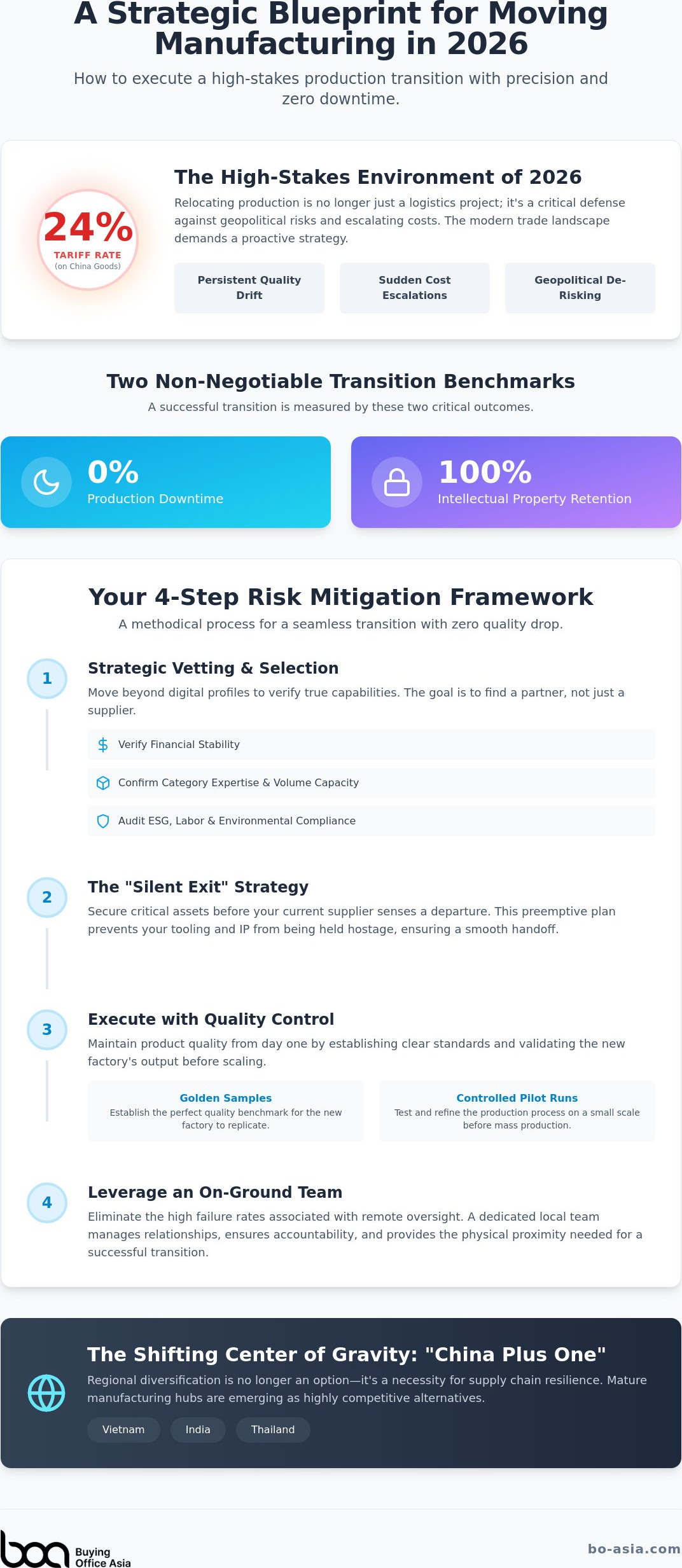
Execution is the most vulnerable phase of your manufacturing relocation. You've secured your tooling and vetted the partner; now you must prove the new facility can replicate your standards without compromise. The process of how to move production to a new factory requires a "Golden Sample" to serve as the immutable benchmark for all future output. This sample isn't just a prototype; it's a contractually binding physical record of the quality you expect. Without it, you leave the door open for quality fade before the first container even leaves the dock.
Once the Golden Sample is approved, you must initiate a small-scale pilot run. This isn't just to test the product; it's to test the factory's adherence to your specific manufacturing instructions. It's during this phase that you'll identify hidden bottlenecks or material deviations that weren't apparent in the initial samples. Implementing on-site quality control at this stage is the only way to ensure these issues are corrected before they're scaled into mass production. This physical presence acts as a defense against the operational setbacks that often plague unmanaged supply chains.
Your new factory's samples must be measured against your original OEM manufacturing standards to ensure total continuity. It's common to find subtle variations in raw material grades or finishing techniques when switching suppliers. You must correct these deviations immediately during the prototyping phase. We recommend documenting detailed "work instruction" sheets for the new production line. These sheets serve as a visual and technical guide for factory workers, reducing the risk of human error during high-volume assembly. This level of granular detail is what separates a successful move from a costly failure.
Mass production requires a different level of scrutiny than sampling. You can't manage this phase via email; you need to deploy a dedicated team to monitor the first high-volume run in person. This ensures that the speed of production doesn't compromise the integrity of the product. Set up a real-time reporting system to track defect rates and production milestones as they happen. This allows you to pivot if quality starts to slip. Finally, finalize your logistics and shipping documentation early. With the June 2026 Manufacturing PMI® registering at 53.3%, indicating steady expansion, port congestion remains a tangible risk. For companies handling bulk industrial materials, sourcing reliable packaging through Container Authority is essential to prevent delays caused by substandard storage vessels during transit. Ensuring your paperwork is airtight prevents your goods from sitting in a warehouse while you rack up storage fees.
If you're ready to secure your first production run with on-ground expertise, contact our procurement team today to discuss your transition plan.
Managing a factory move remotely is the primary driver of project failure. When you're thousands of miles away, you're blind to the subtle shifts in factory morale or the quiet substitution of raw materials. You can't see the signs of a partner struggling with your volume until it's too late. A dedicated Asia procurement team functions as an extension of your own office, providing the physical proximity needed to manage local relationships effectively. This on-ground presence ensures that the strategic advantages you've negotiated are actually implemented on the production line.
Transparency is our core currency. Conventional middlemen often obscure costs to protect their own margins, creating a "black box" that breeds inefficiency. We operate with 100% transparency, eliminating hidden fees and ensuring every dollar spent contributes to your financial health. Understanding how to move production to a new factory requires this level of clarity. We act as the bridge between your leadership's vision and the operational reality of the Asian market, moving you away from high-risk, unmanaged sourcing toward the steady confidence of an expert partnership.
Maintaining this financial transparency also requires diligent oversight of your corporate accounts and tax obligations; for businesses coordinating regional operations through hubs like Singapore, you can learn more about how DNA Accounting provides the professional support needed to manage compliance effectively.
Our dual-presence model is designed to alleviate the anxieties of international manufacturing. With a Helsinki-based leadership team, you benefit from shared cultural values and seamless communication. You don't have to navigate language barriers or time-zone delays when making high-stakes decisions. Simultaneously, our Hong Kong headquarters provides the regional legal and financial oversight required for complex trade environments. This structure offers a unique vocal signature that prioritizes accountability in a digital world, reducing risk for international manufacturers who demand elite oversight.
A successful transition doesn't end with the first shipment. You must move from the act of "moving" to a mindset of "managing" for continuous improvement. Ongoing factory audits are your best defense against the quality fade that often occurs months after a move is completed. By maintaining a consistent on-site presence, you signal to your new partner that your standards are immutable. This is the final phase of learning how to move production to a new factory while securing your long-term stability. Protect your production and margins with Buying Office Asia and turn your supply chain into a stabilizing force for your business.
Mastering how to move production to a new factory is a strategic pivot that requires a defense-first mindset. You've seen that success depends on securing your intellectual property before an exit and maintaining physical oversight during the transition from pilot runs to mass production. In a volatile trade environment, the difference between a seamless move and a supply chain collapse is the presence of an ally who understands the regional operational reality. Buying Office Asia provides that steady confidence through a partnership built on accountability and financial viability.
As a European-managed firm with over 15 years of on-the-ground experience in Asia, we offer a 100% transparency model that eliminates hidden markups and unmanaged risks. Our proven track record in managing complex OEM/ODM transitions for high-volume brands ensures your margins remain protected. We function as an integrated extension of your team, providing the elite oversight usually reserved for major enterprises. Don't leave your transition to chance or remote management. Request a Strategic Sourcing Consultation with Buying Office Asia and secure your manufacturing future today.
A secure transition typically requires four to nine months to execute without risking supply chain collapse. This timeline accounts for supplier vetting, tooling transfer, and the creation of a "Golden Sample" to establish quality benchmarks. You must also factor in the time needed to build a safety stock of three to four months of inventory to prevent downtime during the move.
The primary risk is operational sabotage or the withholding of your physical assets by the legacy supplier. When a factory senses a departure, they may hold tooling hostage or leak proprietary designs to competitors as a retaliatory measure. This is why a "silent exit" strategy is essential to protect your intellectual property and maintain production continuity.
You must verify your contractual ownership of all assets and execute a physical recovery before notifying the factory of your termination. Arrange for a third-party audit or a "maintenance" pickup to move the molds to a neutral location. This proactive approach prevents the factory from using your equipment as leverage during the final stages of the relationship.
No, you should never notify a current supplier until a new partner is fully vetted and ready for mass production. Early notification invites production delays, quality fade, and the potential for asset seizure. You need a confirmed alternative in place to ensure you don't find yourself without a manufacturing source if the relationship sours prematurely.
Hidden costs often include tooling duplication, travel for on-site audits, and shifting regulatory fees. When calculating how to move production to a new factory, you must also account for the 10% Section 122 global surcharge implemented in early 2026. These unforeseen expenses can erode your margins if your transition plan doesn't include a comprehensive total cost of transition analysis.
Verification requires an on-site audit of the facility's machinery, workforce, and raw material storage. You should verify business licenses directly with local authorities and ensure the name on the export permit matches the factory's legal entity. Middlemen often lack a robust Quality Management System or the ability to provide real-time production milestones, which are standard for legitimate manufacturers.
You can manage the transition without traveling if you have a dedicated Asia procurement team on the ground to act as your eyes and ears. Remote management from Europe or the U.S. is the primary cause of relocation failure because it lacks physical accountability. Having a team with regional expertise allows you to maintain oversight of the production line while focusing on leadership from your home office.
You need enforceable NNN agreements, a comprehensive manufacturing agreement, and local trademark registrations in the new jurisdiction. These documents protect your designs and prevent a former partner from blocking your exports by filing for your brand name locally. Understanding how to move production to a new factory requires this level of legal rigor to ensure long-term supply chain stability.

A supplier listing can open a door, but it can’t show whether a factory is right for your order. Choosing a ningbo sourcing agent means looking beyond access to local suppliers: you need clear oversight of supplier vetting, production follow-up, and quality checks. Without defined responsibilities,...

What if the supplier with the strongest online profile isn’t the factory best suited to your shoes? In footwear manufacturing in China, a directory listing can start your search, but it can’t confirm who will make your product, whether the factory can handle its construction and materials, or how cl...
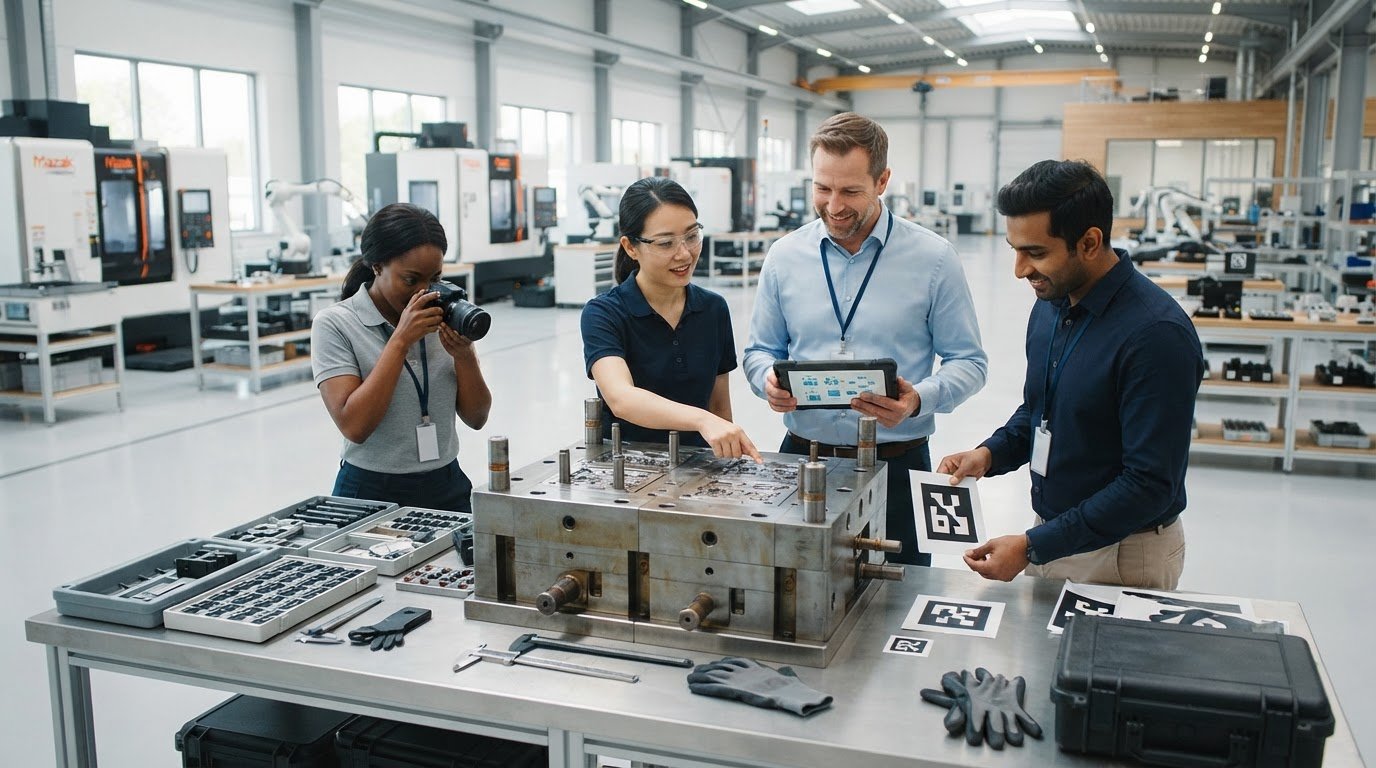
What if the mold you paid to develop couldn’t be released when you needed to change suppliers? Managing tooling and molds with a foreign factory means more than tracking where production equipment is stored. Payment alone may not establish clear ownership, access, or transfer rights. Without visibil...