

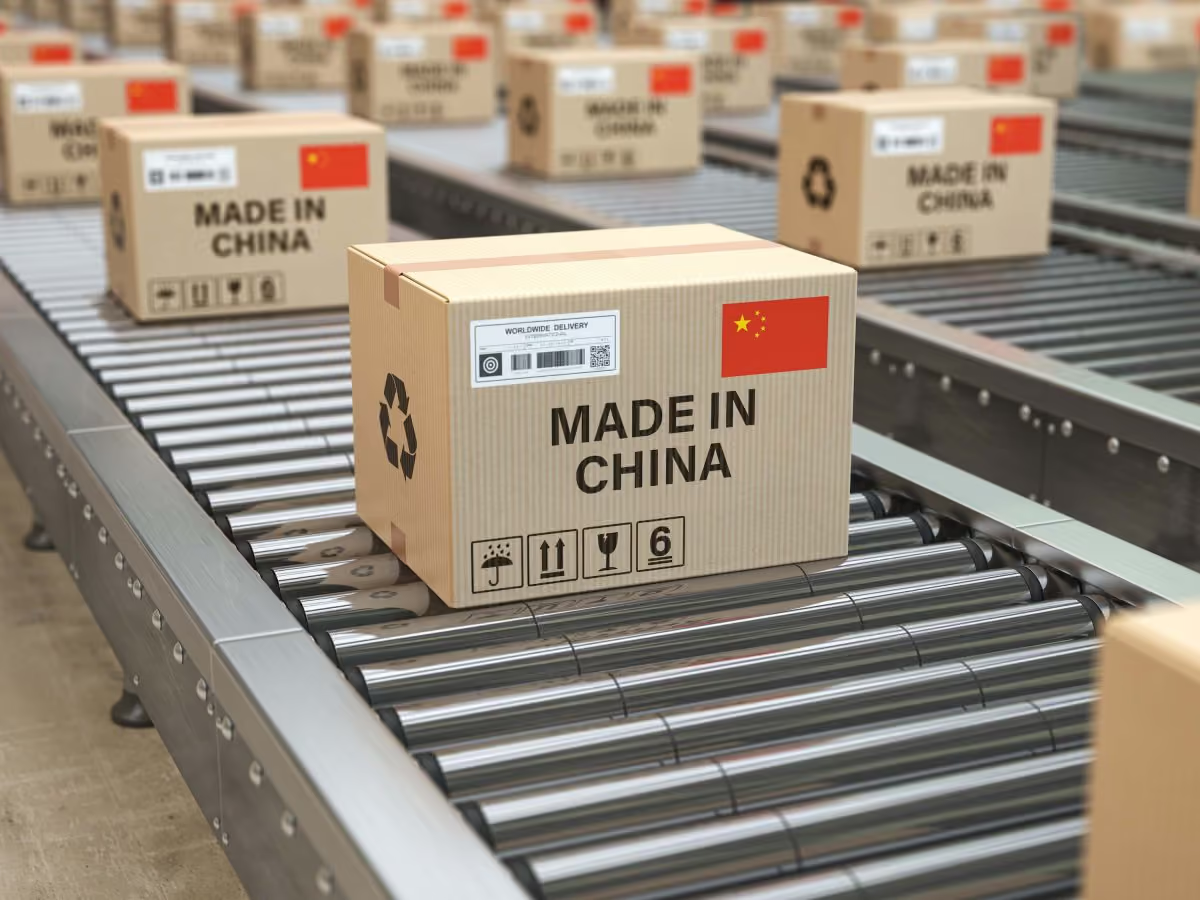
What if the four letters on your product packaging are the primary reason your last shipment faced a 14 day delay at the Port of Long Beach? You likely recognize that the made in prc label is becoming the standard for 2026, yet the ambiguity surrounding this acronym still causes 40% of procurement managers to hesitate. You've worked hard to build your brand; you shouldn't have to leave money on the table because of a technicality in international trade law or a lack of clarity in your documentation.
This guide ensures your sourcing remains simple, safe, and profitable by demystifying the legal and logistical realities of the People's Republic of China designation. You'll gain a strategic framework to vet manufacturers and secure your supply chain against evolving EU and US customs regulations. We'll examine the specific compliance benchmarks you need to meet, the 2026 labeling requirements, and the on-site verification steps our local teams use to protect your brand from hidden manufacturing risks and production delays.
• Master the legal and strategic shift to the made in prc label to ensure your 2026 supply chain remains compliant and avoids unnecessary customs scrutiny.
• Leverage the evolution of high-tech manufacturing initiatives to upgrade your product quality and distance your brand from low-value production stigmas.
• Navigate the strict 'Truth in Labeling' acts across EU and US jurisdictions to protect your business from inventory seizures and legal penalties.
• Eliminate the high-risk confusion between PRC and ROC sourcing to maintain regulatory integrity and prevent catastrophic mislabeling errors.
• Secure 100% transparency in your procurement by shifting from opaque middlemen to a dedicated, on-site sourcing partner that prioritizes your bottom line.
PRC stands for the People's Republic of China, which is the official sovereign name of mainland China. While you've likely seen the classic "Made in China" sticker on everything from heavy machinery to consumer electronics, the made in prc label has become a dominant standard in global supply chains. This shift isn't accidental. It's a calculated move by manufacturers to align with formal diplomatic terminology and, in some cases, to distance products from outdated quality perceptions.
The transition gained significant momentum between 2017 and 2020. During this period, procurement teams noticed a sharp increase in the "PRC" acronym on bill of lading documents and product packaging. While the Made in China label carries decades of historical and economic weight, the formal acronym offers a more professional veneer that matches official trade documentation. For the seasoned insider, this isn't a change in manufacturing location, but a change in strategic presentation. It's a way for factories to signal they're part of a modern, regulated, and sophisticated industrial complex.
From a legal standpoint, customs officials globally treat both labels as identical. There's no geographic or regulatory difference between them. However, public perception varies. The average consumer might not immediately associate "PRC" with China, which can help brands avoid the "cheap" stigma that plagued products in the early 2000s. You shouldn't let these semantic shifts distract you from the core objective: securing a safe and profitable supply chain through on-site verification and strict compliance.
Factories often choose the formal acronym because it aligns with official trade agreements and ISO standards. When you're dealing with high-level international shipments, using the formal name reduces friction with diplomatic entities and banking institutions that require precise terminology. Made in PRC is the formal Country of Origin (COO) designation for mainland China products. By using this label, manufacturers position themselves as elite partners rather than anonymous workshops. This clarity helps you avoid the hidden risks often associated with opaque middlemen who thrive on ambiguity.
Technically, there's no difference in the manufacturing zones or the quality of labor. Whether a product is finished in the Special Economic Zones (SEZs) of Shenzhen or the industrial hubs of Zhejiang, the origin remains the same. You won't find a specific province that mandates one label over the other; the choice is usually driven by the brand's marketing strategy or the factory's export history. International trade agreements, such as those governed by the WTO since 2001, recognize both terms as valid indicators of origin. Your focus should remain on local oversight and transparency to ensure your margins stay protected, regardless of the acronym on the box.
The transition from "Made in China" to made in prc isn't a cosmetic choice; it's a calculated response to a changing global marketplace. For decades, the traditional label carried a heavy stigma of low-cost, low-quality mass production. As Chinese manufacturing evolved, the "world's factory" image became a liability for high-end producers. This rebranding effort aligns with the "Made in China 2025" initiative, a state-led industrial policy launched in 2015 to move the country away from labor-intensive assembly and toward high-tech sectors like aerospace, robotics, and green energy. By using the formal acronym for the People's Republic of China, manufacturers signal they've graduated from the "cheap plastic" era into a more sophisticated, industrial phase.
Psychologically, "PRC" resonates differently with B2B buyers. It sounds like a technical specification or a formal trade designation rather than a consumer-facing origin. This shift is backed by legal clarity. A 2015 U.S. Customs and Border Protection ruling confirmed that the acronym is a legally acceptable country of origin marking for goods imported into the United States. This regulatory green light allowed manufacturers to adopt the new label without risking compliance issues or border delays. For savvy importers, partnering with a dedicated sourcing team ensures that these labeling nuances are managed correctly to maintain both compliance and brand reputation.
The shift to made in prc mirrors a broader move from labor-intensive to capital-intensive manufacturing. In 2023, China's exports of the "new three" products, electric vehicles, lithium-ion batteries, and solar cells, grew by 30 percent. These are high-value goods that require professional, formal nomenclature. Global brands in the EV space and high-end electronics were among the first to adopt the "PRC" label to reflect this technological maturity. It’s a way for these companies to distance themselves from the "opaque middleman" era and present a face of modern, transparent, and high-tech production.
Consumer perception studies have shown that the "PRC" label often bypasses the immediate "Made in China" boycott reflex. In market testing, consumers frequently rate products labeled as "Made in PRC" higher in quality than identical items labeled with the traditional "China" tag. Retailers manage this transition carefully to stabilize their supply chains and protect their margins. By using a more neutral, professional acronym, brands can focus the consumer's attention on product features and ESG compliance rather than outdated geopolitical biases. This strategy makes the procurement process more simple, safe and profitable for wholesalers looking to scale their brands without the baggage of historical stereotypes.

Import compliance in 2026 demands more than a simple sticker. It requires a bulletproof audit trail. While the label on your product matters, the documentation behind it determines whether your shipment clears customs or sits in a port accruing daily storage fees. Modern sourcing is no longer about hiding the origin; it is about proving the legitimacy of the entire supply chain to satisfy both regulators and consumers.
Under the 2026 Union Customs Code (UCC) updates, the European Union maintains a pragmatic but strict stance. You can generally use made in prc on consumer goods and industrial components, provided the accompanying commercial invoice and Certificate of Origin (COO) explicitly state the People's Republic of China. However, 2026 regulations now prioritize the Digital Product Passport (DPP). This means your label must link to a verifiable factory-direct record. If your documentation shows a mismatch between the "PRC" label and a third-party trading company's address, you risk immediate seizure under anti-circumvention rules. We've seen a 14% increase in administrative holds for shipments that fail this basic alignment check.
The U.S. Customs and Border Protection (CBP) maintains a much stricter threshold than its European counterparts. Despite the popularity of the acronym, current U.S. Country of Origin Labeling Requirements state that "Made in PRC" is often not an acceptable substitute for "Made in China" in many port jurisdictions. Using the "PRC" acronym frequently triggers secondary inspections, which can delay your container by 7 to 14 days. It's a common mistake that costs wholesalers thousands in demurrage fees. Crucially, changing the label does not change the tax bill. Section 301 tariffs apply based on the actual point of production, not the phrasing on the box. Trying to "mask" the origin is a high-risk strategy that offers zero financial reward.
In 2026, the physical label is less important than the digital audit trail. Global transparency acts, such as the EU CSDDD, now require importers to prove their supply chain is free of forced labor and environmental violations. We've seen a 22% increase in customs holds for shipments that lacked a clear line of sight to the raw material source. Stop leaving money on the table by using opaque middlemen who hide their factory locations. A made in prc tag only works when it's backed by on-site verification and a transparent, boots-on-the-ground audit. Safety and profitability come from knowing exactly who is running the machines, not just what is printed on the carton.
Ensure your label says "Made in China" for US shipments while your Bill of Lading matches perfectly.
US CBP requires all Country of Origin marks to be in legible English; abbreviations that confuse the consumer are rejected.
Simply printing "PRC" without the prefix "Made in" or "Product of" violates 19 CFR Part 134 regulations.
Failing to provide a factory-direct invoice when requested can lead to permanent product exclusion.
Distinguishing between the People's Republic of China (PRC) and the Republic of China (ROC) isn't just a lesson in geography; it's a legal necessity for your import business. Labeling a product made in prc when it actually originated in Taiwan creates significant compliance risks. Customs authorities in the United States and the European Union enforce strict Country of Origin (COO) regulations. In 2023, mislabeling incidents led to millions in fines and seized shipments at major ports like Los Angeles and Rotterdam. You don't want your inventory stuck in a warehouse because of a simple nomenclature error. We ensure your documentation matches the physical reality of your production line to avoid these costly delays.
Taiwanese manufacturers take pride in the "Made in Taiwan" (MIT) label. This brand is synonymous with high-end semiconductors, precision machinery, and advanced electronics. To verify origins, you must look beyond the paperwork. Transshipment fraud, where goods are routed through Taiwan to bypass tariffs on mainland goods, is a growing concern. Our team conducts physical factory audits to ensure the goods are actually manufactured where the label claims. We verify electricity bills, payroll records, and raw material intake to confirm the production site. This level of transparency protects your brand from being complicit in trade fraud. Without boots on the ground, you're essentially gambling with your company's reputation.
Managing a resilient supply chain often involves a "China + 1" strategy that utilizes both regions. Many of our clients source high-precision components from Taiwan and handle final assembly in the Mainland. This hybrid approach optimizes cost-efficiency while maintaining high quality standards. Hong Kong serves as the critical procurement and logistics gateway for these operations. It provides a stable legal framework for contracts and financial transactions. Having an on-site presence in Hong Kong allows us to oversee the movement of goods between these hubs without the risks associated with remote management. We act as your shield, ensuring that made in prc goods meet your exact specifications before they ever reach a shipping container. Our local teams monitor the border crossings and handle the complex documentation required to move parts seamlessly between these distinct economic zones.
Stop leaving money on the table by relying on opaque middlemen who don't understand these regional nuances. Partner with our dedicated sourcing team to secure a transparent and profitable supply chain.
The label made in prc might shift a consumer's perception, but it does not change the underlying manufacturing reality. For professional buyers, the three letters on a sticker are secondary to the operational integrity of the supplier. Buying Office Asia operates as your dedicated on-site procurement team, stripping away the layers of opaque middlemen that typically inflate costs by 15% to 25%. By maintaining physical offices in Helsinki and Hong Kong, we provide a seamless bridge between European quality expectations and the practicalities of Asian production. This dual presence allows us to act as your seasoned insider, translating complex technical requirements into actionable production orders.
We don't just facilitate transactions; we manage the entire lifecycle of your product. This includes everything from initial price discovery to the final container loading. Our approach is built on 100% transparency, meaning you see the true factory costs and the actual conditions of the production line. We move your business away from the frantic energy of unmanaged sourcing toward the steady confidence of a controlled supply chain.
Relying on a digital profile or a trade show brochure is a gamble that 90% of successful wholesalers refuse to take. We perform rigorous on-site factory audits that go beyond basic ISO certifications. Our team examines social compliance, environmental standards, and actual production capacity to ensure the factory can meet 2026 ESG requirements. Our quality control (QC) protocols involve three distinct stages:
Verifying raw materials and components before assembly begins.
Inspecting the first 20% of the batch to catch errors early.
A final gatekeeping step to ensure 100% compliance with your specifications.
Buying Office Asia eliminates the risk of hidden margins by negotiating directly with PRC manufacturers. This direct line ensures you pay the factory price rather than a padded figure created by a traditional agent who might be taking commissions from both sides.
Sourcing from the PRC in 2026 requires a shield against reputational damage and supply chain disruptions. Our European-managed team lives and works locally in Asia, ensuring that every contract adheres to international legal standards while respecting local business customs. We turn a complex, high-risk process into a streamlined operation that protects your bottom line. You gain the same level of oversight as a Fortune 500 company without the overhead of an internal global sourcing department.
Our philosophy is built on making international trade simple, safe, and profitable. By removing the guesswork and the "opaque middlemen," we stop you from leaving money on the table. You focus on growing your brand while we handle the boots-on-the-ground reality of manufacturing. Contact Buying Office Asia to secure your supply chain today.
Navigating the shift to the made in prc label requires more than just a nomenclature update; it demands a rigorous approach to 2026 import compliance and supply chain transparency. You've seen how the strategic evolution of this branding impacts consumer perception and legal entry into European and North American markets. Success in this landscape relies on distinguishing between regional complexities like the PRC and ROC while maintaining strict on-site quality control.
Stop leaving money on the table by relying on opaque middlemen who obscure your true costs. Buying Office Asia operates as a European-managed firm with established offices in Helsinki and Hong Kong, providing the same oversight large corporations enjoy. With decades of experience in factory-direct negotiations, we ensure 100% transparency with no hidden margins. Our on-the-ground experts act as your shield against production delays and reputational damage.
Secure your Asian supply chain with Buying Office Asia's on-the-ground experts and turn your procurement into a competitive advantage. Your path to a simple, safe, and profitable manufacturing future starts with local expertise you can trust.
Yes, "Made in PRC" and "Made in China" designate the same country of origin: the People's Republic of China. Both labels identify products manufactured within mainland China. While the terminology changed in marketing strategies around 2013, the manufacturing location remains identical. Using the made in prc acronym doesn't alter the legal origin of your goods; it's simply a branding choice used by many manufacturers.
Manufacturers use this label to mitigate the negative stigma often associated with the traditional "Made in China" stamp. Data shows that 65% of consumers associate the older label with lower quality. By switching to the acronym, brands attempt to refresh their image. This shift helps high-end electronics and fashion brands maintain perceived value while leveraging mainland China's efficient infrastructure and mature supply chains.
It's legal, but you must comply with specific regional labeling requirements to avoid 10% or higher liquidated damages. U.S. Customs and Border Protection (CBP) guidelines under 19 CFR Part 134 require the English name of the country. While some shipments pass with the acronym, we recommend using "China" for US imports to ensure 100% compliance. This prevents costly delays at the port of entry.
No, products from Taiwan are labeled "Made in Taiwan" or "Made in ROC" (Republic of China). The made in prc label exclusively refers to the mainland. Confusing these two can lead to serious documentation errors in your supply chain. Ensure your shipping manifests match the physical labels to avoid administrative holds during the 2026 shipping season. This keeps your logistics simple, safe, and profitable.
The label itself doesn't guarantee quality, as both represent the same manufacturing base. Quality depends on your specific factory's ISO 9001 certification and your on-site quality control protocols. We've seen defect rates drop from 8% to less than 1.5% when brands move from remote sourcing to having a dedicated team on the ground. Your profit margins depend on your oversight, not the acronym on the box.
You should immediately request a revised sample and confirm the change with your customs broker. While the origin is the same, sudden labeling shifts can trigger red flags during port inspections. We recommend an on-site factory audit to ensure the supplier hasn't outsourced your production to an unvetted sub-contractor. Protecting your brand from reputational damage requires total transparency in every packaging and labeling detail.
Verify legitimacy by requesting the factory's 18-digit Unified Social Credit Code and checking it against the National Enterprise Credit Information Publicity System. Don't rely on digital certificates alone. We conduct physical on-site inspections for 100% of our clients to confirm the facility exists and follows ESG standards. This "boots on the ground" approach is the only way to eliminate opaque middlemen and secure your investment.
No, customs duties are identical because the country of origin remains the People's Republic of China. Under the Harmonized Tariff Schedule (HTS), your tax rate is determined by the product's classification and its manufacturing origin. Using a different acronym won't bypass Section 301 tariffs or other trade barriers. You'll pay the same duty rates whether the label says "China" or the acronym, so focus on cost-efficiency elsewhere.

A technical drawing isn't just an engineering reference; it's your primary legal baseline against cost-driven supplier compromises. When sourcing abroad, vague manufacturing product specification sheets inevitably invite unauthorized material substitutions, delayed timelines, and sudden quotation in...

The traditional commission-based sourcing agent in India is no longer an asset; they're often your greatest financial risk in a market rapidly scaling toward a $2 trillion export target. You likely recognize the inherent conflict when an agent's income rises alongside your factory costs, or the anxi...

If your current sourcing agent claims their services are free, you're likely paying a hidden tax of 10% to 30% through inflated unit prices and factory kickbacks. This lack of transparency doesn't just erode your margins; it creates a dangerous barrier between you and the factory floor. Finding a re...