


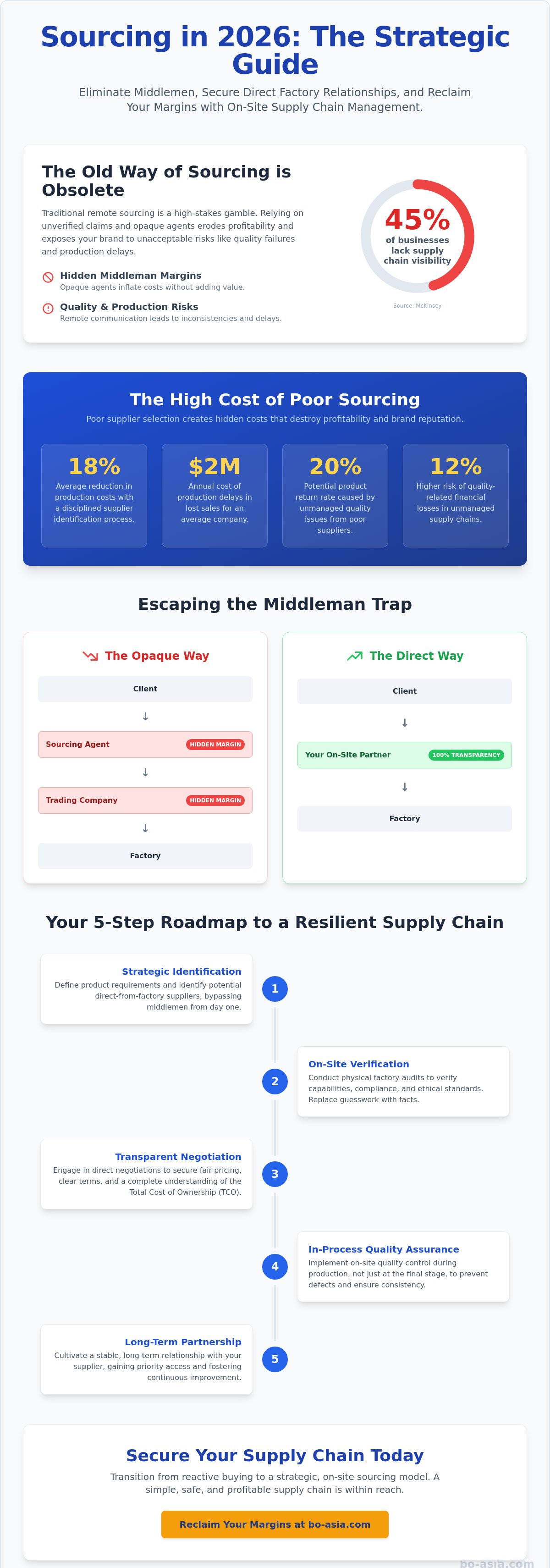
By 2026, the traditional sourcing agent will be an obsolete relic, replaced by on-site partners who refuse to let hidden middleman margins erode your profitability. If you're still relying on remote communication and unverified factory claims, you're likely among the 45% of businesses that McKinsey identifies as lacking visibility beyond their immediate suppliers. In a market defined by rapid shifts, sourcing is no longer a back-office task; it's a high-stakes strategic operation that requires local, boots-on-the-ground oversight to prevent quality inconsistencies and production delays.
You've likely felt the frustration of opaque supply chains where costs climb while control slips away. We're here to change that dynamic. This guide provides the exact framework you need to eliminate middlemen, secure direct factory relationships, and reclaim your margins. We'll examine the transition toward a simple, safe and profitable supply chain that utilizes the same professional rigor as large corporations to protect your reputation and your revenue.
• Understand why the initial stage of supplier identification is the definitive "make or break" factor for your product’s long-term profit margin.
• Transition from basic procurement to a sophisticated global sourcing strategy that secures a competitive edge for modern wholesalers.
• Learn to navigate the "Middleman Trap" and stop leaving money on the table by bypassing opaque agents and misleading digital ratings.
• Implement a rigorous 5-step roadmap that replaces remote guesswork with physical factory audits and on-site verification of supplier integrity.
• Discover how dedicated on-site leadership ensures your supply chain remains simple, safe, and profitable through 100% transparent procurement.
This strategic process involves identifying, evaluating, and engaging suppliers to acquire goods. It’s the first link in your supply chain and the most critical. In 2026, the global market has moved beyond the hunt for the "lowest cost." Today, 74% of supply chain executives prioritize resilience and transparency over unit price alone. This shift is driven by the need to avoid the opaque middlemen who inflate margins without adding value. Global Sourcing now requires a sophisticated understanding of local markets and compliance standards. If you fail at this stage, you're building your business on a fractured foundation. This initial selection is the "make or break" stage for your product’s profit margin. If you get the origin wrong, no amount of marketing can save your bottom line. We act as your on-site partner to ensure that the factories you engage are not just capable, but also compliant with modern ESG standards. By focusing on long-term stability rather than short-term savings, you protect your brand from the reputational damage that often follows unmanaged overseas production.
Distinguishing between these two functions is vital for operational efficiency. The identification phase is tactical. It’s the search for the right factory, the initial audit, and the negotiation of terms. Procurement is the overarching management of the entire acquisition cycle. Many businesses implement complex procurement software but neglect their supplier identification strategy. This leads to a "garbage in, garbage out" scenario. You’ll find yourself managing a failing supplier with high-tech tools. One process finds the partner; the other manages the transaction.
The initial acquisition strategy directly dictates your Cost of Goods Sold (COGS). A disciplined identification process can lower production costs by 18% on average. However, the impact goes beyond the invoice. Poor supplier choices lead to "hidden costs" like production delays. These delays cost companies an average of $2 million annually in lost sales according to recent industry benchmarks. Quality issues can result in a 20% return rate, destroying your brand reputation. You shouldn't settle for "good enough" when your profit margin is at stake. Proper supplier vetting acts as a shield against global market volatility.
Stop leaving money on the table by treating procurement as a series of disconnected, tactical tasks. Success in 2026 requires a shift from reactive buying to a sophisticated sourcing strategy. Modern brands no longer rely on opaque middlemen who hide margins; they implement models that prioritize transparency and direct oversight. Moving your operations toward a strategic framework ensures that every dollar spent contributes to long-term stability and growth. It's about building a supply chain that functions as a competitive advantage rather than a constant source of anxiety.
Deciding between insourcing and outsourcing is the first step in optimizing your supply chain. Recent data from 2024 indicates that 62% of high-growth wholesalers now outsource their procurement to specialized local teams to avoid the heavy overhead of a foreign office. Global sourcing remains the gold standard for competitive pricing, particularly when leveraging the established manufacturing infrastructure in Asia. While nearshoring to regions like Mexico or Eastern Europe can reduce lead times by 10 to 15 days, offshoring to Asia typically maintains a 25% cost advantage on high-volume production runs. You must balance these geographic trade-offs against your specific inventory turnover requirements to maintain healthy margins.
Strategic sourcing is replacing the outdated, price-focused approach that often leads to reputational damage and production delays. A value-focused model looks beyond the initial factory quote. It utilizes a Total Cost of Ownership (TCO) analysis to account for hidden variables. These include freight volatility, import duties, and the potential cost of quality rejections. Industry benchmarks from 2023 show that unmanaged supply chains face a 12% higher risk of quality-related losses compared to those with on-site oversight.
Building long-term partnerships is safer than engaging in transactional relationships with random factories. When you treat a supplier as a partner, you gain priority during peak seasons and better transparency into their cost structures. This protective approach ensures your production remains steady even during market fluctuations. To begin optimizing your supply chain, you can partner with a dedicated team that acts as your boots-on-the-ground representative in Asia. This shift makes your entire procurement process simple, safe and profitable while eliminating the risks of remote management.
Digital marketplaces have created a dangerous illusion of simplicity. Many procurement officers believe a "Gold Supplier" badge or a high rating on a platform like Alibaba guarantees factory-direct pricing and quality. This is the Alibaba Myth. In reality, these badges are often paid memberships costing between $3,000 and $5,000 USD annually. They don't certify manufacturing excellence; they certify a marketing budget. When you rely on these platforms, you frequently engage with trading companies masquerading as factories, which adds unnecessary layers to your supply chain.
Armchair sourcing from an office in Europe or the US leaves you blind to the physical realities of production. You see a polished digital storefront, but you don't see the "factory switching" that occurs after you approve a sample. Without a physical presence, you can't verify if your goods are made in a compliant facility or a sub-standard workshop around the corner. On-the-ground oversight is the only way to ensure your sourcing strategy remains simple, safe, and profitable.
Opaque middlemen thrive on your lack of local presence. Traditional agents often claim to work for a flat fee, yet they quietly secure kickbacks from the factory. These undisclosed commissions typically range from 3% to 7% of the total order value. This practice inflates your procurement costs and creates a conflict of interest where the agent protects the factory instead of your brand. You can spot unvetted suppliers by looking for red flags like generic stock photos, a lack of ISO 9001 documentation, or a refusal to provide a specific factory address for a third-party audit.
Transparency in factory-direct negotiations is the unrestricted access to the manufacturer’s actual cost breakdown and the elimination of all undisclosed third-party markups.
Navigating Asian manufacturing requires more than a translation app. Cultural nuances and "face-saving" communication styles often lead to a "yes" when the real answer is "maybe" or "no." Local experts interpret these signals before they turn into production delays. Boots-on-the-ground oversight prevents mass production defects by catching errors at the raw material stage, rather than at the shipping port when it's too late to pivot.
The impact of local vetting is best illustrated by a 2023 electronics order. A client was ready to wire funds to a "verified" supplier for a high-volume component run. Our on-site audit revealed the facility lacked the specialized testing equipment promised in their digital profile, which would have resulted in a 22% failure rate across the shipment. By identifying this gap before the deposit was paid, we protected the client from a potential $180,000 loss and a significant hit to their market reputation. This level of protection is impossible to achieve through a laptop screen.
Sourcing in Asia requires more than a laptop and an internet connection. It demands a boots-on-the-ground strategy that eliminates guesswork and secures your bottom line. You can't rely on digital profiles alone; you need a verified path from the initial search to the final container loading. This roadmap focuses on data-driven decisions and physical presence to ensure your supply chain remains simple, safe, and profitable.
Don't just settle for the first page of search results. Match your production volume to factory size. A 2023 industry report indicated that 35% of production delays occur when small orders are placed in massive facilities that prioritize larger clients.
Move past the digital facade. Verify the factory's actual ownership and operational history.
Secure the real cost of goods. Opaque middlemen often inflate unit prices by 15% to 20% while claiming to be the manufacturer. We target the true factory price to stop you from leaving money on the table.
Use this phase to validate quality before any major deposit is paid. This is your opportunity to refine specifications and set clear expectations.
Consistent on-site presence ensures the 10,000th unit is as good as the first. It's about maintaining control when you aren't physically there.
A professional factory audit must go deeper than a business license check. It includes a comprehensive review of social compliance, actual production capacity, and ESG standards. It's vital to distinguish between a trading company and a true manufacturer. Trading companies often lack direct control over the production floor, which increases your risk of "quality fade." You can learn more about our on-site protocols on our Supplier Vetting page.
Don't wait for the goods to reach your warehouse to find a defect. We implement a three-tier inspection strategy to protect your investment. Pre-production checks verify raw materials. During-production (DUPRO) inspections catch errors when only 20% of the order is finished. Finally, pre-shipment inspections confirm the batch matches your "Golden Sample." This third-party oversight acts as a shield against reputational damage and costly returns.
Stop leaving your margins to chance with unmanaged supply chains. Contact our on-site sourcing team today to secure your production and scale with confidence.
Buying Office Asia operates as your own regional headquarters, bridging the gap between European strategic standards and the realities of Asian manufacturing. With our leadership based in Helsinki and our operational hub in Hong Kong, you gain the stability of Western business ethics alongside the agility of local experts. This structure allows high-volume brands to scale production without the overhead of opening a foreign subsidiary. We provide a simple, safe, and profitable path to market by acting as your eyes and ears on the factory floor. Our presence ensures that your sourcing strategy remains resilient against the volatility of global trade.
Traditional agents often hide their margins within your unit prices, a practice that obscures the true cost of your goods. This lack of clarity means you're likely leaving money on the table through inflated quotes and kickbacks. Our 100% transparent fee-for-service model changes this dynamic entirely. You get direct access to factory names, locations, and raw material costs. There are no hidden markups on your unit prices. Instead, you pay for professional oversight and expertise.
Our team provides comprehensive reporting that leaves nothing to chance. This includes:
• Rigorous factory audits to verify compliance and ESG standards.
• In-depth quality control reports during mid-production.
• Final loading inspections to ensure the right quantity and quality reach the container.
By eliminating opaque middlemen, we ensure your capital goes directly into product quality and supply chain efficiency. This transparency acts as a shield, protecting your brand from the reputational damage often caused by unmanaged vendors.
Moving from simple buying to strategic procurement requires a shift in mindset. It's about more than just finding a vendor; it's about building a resilient, end-to-end supply chain that can scale with your ambitions. Buying Office Asia manages the entire lifecycle of your product. We handle everything from initial sample development and price negotiations to final logistics and shipping coordination. This level of oversight is why 95% of our clients report improved control over their manufacturing timelines within the first six months of partnership.
You don't have to manage dozens of vendors through a computer screen or hope for the best with remote sourcing. Our on-site team handles the complexity so you can focus on sales and brand growth. We treat your business with the same level of professional rigor that large corporations enjoy, making the process predictable and efficient. It's time to stop guessing and start growing with a partner who is physically present at the source.
Ready to secure your supply chain? Schedule a consultation with our sourcing experts to see how we can optimize your Asian operations.
The landscape of global procurement in 2026 demands more than just a digital interface; it requires a physical shield against market volatility. You've seen how relying on opaque middlemen or unmanaged platforms creates unnecessary risk and erodes your margins. Success now hinges on direct oversight and 100% transparency within your supply chain.
Buying Office Asia provides the professional rigor your brand needs to thrive. As a European-managed firm with leadership headquartered in Helsinki and dedicated teams on the ground in Hong Kong and Mainland China, we eliminate the distance between your office and the factory floor. We operate with a strict policy of zero hidden commissions and no factory markups, ensuring your procurement is simple, safe, and profitable. It's time to move past the uncertainty of traditional agents and secure the same level of oversight that Fortune 500 companies utilize daily.
Stop leaving money on the table; partner with Buying Office Asia for transparent sourcing.
Your supply chain should be your greatest asset, not a source of anxiety. We're ready to help you build it.
A sourcing agent is typically an individual operating on a commission basis, while a sourcing company provides a full team of experts and structured infrastructure. Agents often lack the bandwidth for complex compliance and might hide margins within the unit price. A dedicated sourcing team offers transparency and on-site oversight, ensuring your production stays on track without hidden fees. This professional structure acts as a shield against the risks of unmanaged supply chains.
Sourcing from Alibaba in 2026 remains a viable starting point for discovery, but it doesn't replace physical due diligence. Data from 2024 indicates that over 70% of listed manufacturers are actually trading companies. You shouldn't send capital without a third-party factory audit first. Physical presence on the ground is the only way to confirm a supplier meets the ESG and quality standards required for modern global trade and profitable outcomes.
Professional partners typically utilize a transparent fee structure based on a monthly retainer or a percentage of the total procurement value. While specific fees vary, industry reports from the Chartered Institute of Procurement and Supply suggest that professional oversight can reduce total landed costs by 15% to 20%. This model eliminates the opaque middlemen found in traditional agent relationships. It aligns the partner’s goals with your bottom line and ensures you stop leaving money on the table.
The primary risks include quality fade during mass production and the loss of intellectual property. A 2023 supply chain survey found that 45% of businesses experienced delays due to poor sub-tier supplier management. You can mitigate these risks by implementing strict on-site quality control inspections and ensuring all contracts are enforceable under local laws. Without a local ally, your brand faces potential reputational damage and production delays that plague unmanaged supply chains.
Yes, a professional sourcing company manages the entire lifecycle of custom product development, including technical drawings and 3D prototyping. They oversee the creation of specialized tooling and molds to ensure your design remains proprietary and protected. By having a dedicated team on the factory floor, you avoid the common communication gaps that lead to expensive 30% re-tooling costs. This hands-on approach ensures the final product matches your exact specifications every time.
Strategic sourcing focuses on long-term value and supply chain resilience, whereas tactical buying is a short-term, price-only transaction. Tactical approaches often leave money on the table because they ignore total cost of ownership and risk mitigation. Strategic partnerships prioritize compliance and cost-efficiency over the long haul. This method ensures your supply chain is simple, safe, and profitable. It moves you away from the frantic energy of sales toward the steady confidence of an established expert.
You verify a supplier by reviewing their business license and conducting an on-site factory audit. Opaque middlemen often use stock photos or borrowed certifications to appear as manufacturers. Check the business scope on their Chinese registration; if it includes trading but not manufacturing, they're a middleman. Physical verification is the only way to guarantee you're working directly with the source. This prevents the hidden margins that often inflate your procurement costs.
Hong Kong serves as the critical legal and financial gateway for global trade, offering a robust common law system for contract enforcement. It remains a premier logistics hub, handling over 14 million TEUs annually as of 2023. Many professional sourcing firms maintain their headquarters here to provide clients with a secure legal framework while managing operations across Mainland China. This setup provides the same level of oversight that large corporations enjoy while protecting your interests.

A technical drawing isn't just an engineering reference; it's your primary legal baseline against cost-driven supplier compromises. When sourcing abroad, vague manufacturing product specification sheets inevitably invite unauthorized material substitutions, delayed timelines, and sudden quotation in...

The traditional commission-based sourcing agent in India is no longer an asset; they're often your greatest financial risk in a market rapidly scaling toward a $2 trillion export target. You likely recognize the inherent conflict when an agent's income rises alongside your factory costs, or the anxi...

If your current sourcing agent claims their services are free, you're likely paying a hidden tax of 10% to 30% through inflated unit prices and factory kickbacks. This lack of transparency doesn't just erode your margins; it creates a dangerous barrier between you and the factory floor. Finding a re...