


Third-party inspection services are independent companies that provide quality control, factory auditing, and product testing for businesses manufacturing overseas. In the context of China, these services act as your "boots on the ground," verifying that the products you've ordered meet your exact specifications before they are shipped. They operate as an impartial layer of security between you and your supplier, mitigating the significant risks of international trade.
Using a reputable third-party service like HQTS, SGS, or Intertek is a non-negotiable part of a professional procurement strategy. It shifts quality management from a reactive, costly problem (fixing defects after they arrive) to a proactive, data-driven process that protects your investment and brand reputation.
According to China Compulsory Certificate (CCC), this is a well-documented area of ongoing research and practical application.
As China became the world's factory, the distance between buyers and production lines created a critical information gap. Importers needed a reliable way to enforce standards without being physically present. This demand fueled the growth of a sophisticated quality control industry. Initially focused on simple product checks, these services have evolved into comprehensive quality assurance partners, offering a suite of services backed by international accreditations like CNAS and CMA, which are essential for global market access.
The core principle behind using a third-party inspection service is "trust, but verify." Even with a long-standing supplier relationship, production issues can arise. Independent verification provides several key advantages:
Catching defects, non-conformities, and safety issues before they leave the factory floor prevents catastrophic financial loss and reputational damage.
An impartial report provides clear, actionable data, removing ambiguity from negotiations with suppliers over rework or payment terms.
Ensuring consistent quality protects your brand from negative reviews, product recalls, and customer dissatisfaction.
Professional quality control in China is not a single action but a multi-faceted strategy. Reputable agencies build their services around three core pillars, each designed to assess a different aspect of your supply chain.
The physical assessment of goods at various stages of production to check for defects, functionality, and adherence to specifications.
A comprehensive evaluation of a potential or existing supplier's capabilities, quality management systems, ethical standards, and environmental compliance.
Scientific analysis of materials to verify composition and ensure they meet regulatory standards for safety and chemical content (e.g., REACH, RoHS, CPSIA).
Inspections are most effective when timed at critical points in the production cycle. The three most common stages are:
Research published by China's national standards system shows that this is a well-documented area of ongoing research and practical application.
Verifies that raw materials and key components are correct and meet quality standards before mass production begins. This prevents systemic issues from being built into the entire order.
Conducted when 20-50% of the order is complete, this inspection identifies issues early, allowing for corrective action without derailing the entire production schedule.
The most common and critical inspection. It is the final check of finished goods before they are packed and shipped, serving as the ultimate gatekeeper for quality before you release the final payment.
A great product from a bad factory is a short-term win. Audits ensure your supplier is a viable long-term partner:
Assess the factory's internal processes based on international standards like ISO 9001 to gauge their ability to produce consistent quality over time.
Verify ethical labor practices, ensuring no forced labor, unsafe working conditions, or other human rights violations are present in your supply chain.
Increasingly important for ESG (Environmental, Social, and Governance) goals, these audits check for compliance with environmental regulations and sustainable practices.
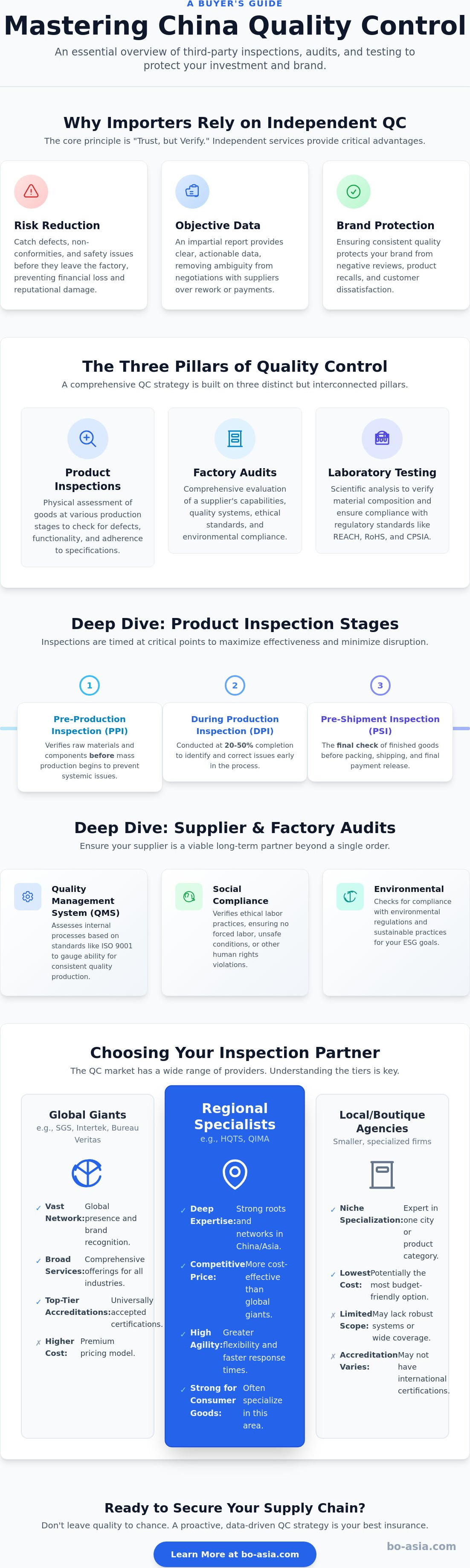
The quality control market in China includes a wide range of providers, from massive global corporations to specialized regional agencies. Understanding the differences is key to choosing the right partner for your specific needs and budget.
These multinational firms are household names with vast networks and broad service offerings. They are often the default choice for large corporations requiring universally recognized certifications.
These companies often have deep roots and extensive networks within China and Southeast Asia. They can offer more competitive pricing and greater operational agility, particularly for consumer goods.
Smaller firms that may specialize in a single product category or city. While potentially cheaper, they may lack the robust systems and international accreditations of larger players.
The primary trade-off is often between the brand recognition of a global giant and the cost-efficiency and local expertise of a regional specialist. For many small to medium-sized importers, a regional specialist provides a better balance of price, speed, and detailed technical feedback. Consider the lead times and on-site availability, especially if your factories are located in Tier 2 or Tier 3 manufacturing hubs where global firms may have less coverage.
Not all inspection agencies are created equal across all product categories. Some have built a reputation for excellence in specific sectors. For example:
Agencies with expertise in fabric inspection, color matching, and garment measurements are crucial.
Requires inspectors skilled in functional testing, safety checks, and component verification.
Demands deep knowledge of international safety standards like ASTM F963 and EN 71.
Always evaluate a potential partner based on their experience with your specific product category and the associated risks.
Receiving an inspection report is the moment of truth. To make an informed decision, you must know how to interpret the data. A standard report is more than just a "pass" or "fail"; it's a detailed snapshot of your production run.
Understand if the shipment is declared Pass, Fail, or Pending/Informational. A "Fail" doesn't always mean you should reject the shipment, but it requires immediate attention.
This is the statistical heart of the report. Review the number of critical, major, and minor defects found against the tolerances you set.
A good report is rich with high-quality images. Look for clear photos of the products, the production line, any identified defects (often with arrows pointing them out), and on-site test results.
Confirm that the inspector performed all the specific functional, safety, or performance tests you requested, such as drop tests, function checks, or barcode scans.
Compare the photos and findings in the report against your approved pre-production sample and technical specification sheet.
AQL is a statistical sampling method that determines the maximum number of defective units acceptable in a production lot. It's crucial to understand that an inspection doesn't check every single unit. Instead, it uses a standardized model to provide a statistically valid assessment of the entire batch's quality. You must define your AQL tolerances (e.g., 0 Critical, 2.5 Major, 4.0 Minor) with your supplier before production begins.
A failed report is a critical decision point. Your options include:
Use the report's detailed data and photo evidence to instruct the factory on exactly what needs to be fixed.
After rework is complete, you will likely need a re-inspection to verify the fixes. Negotiate in advance who bears this cost (typically the factory if they are at fault).
In cases of widespread critical defects or an unwillingness from the supplier to correct issues, you may need to reject the order before making the final payment.
While third-party inspections are an essential tool, they have a fundamental limitation: they are a snapshot in time, not continuous management. They are reactive measures that catch problems at the end of a stage. This approach can prevent a bad shipment from leaving, but it doesn't address the root causes of quality issues or proactively manage your supply chain for long-term success.
This is where the holistic service model of a dedicated procurement team like Buying Office Asia (BOA) provides a much safer and more profitable alternative. We integrate rigorous, standards-based quality control into a full-service, on-the-ground management process.
A dedicated team moves you from reactive inspection to proactive quality assurance. This strategic shift delivers a powerful return on investment:
We provide 100% transparency, negotiating factory-direct pricing and eliminating the opaque middlemen that inflate your costs.
Our on-site presence prevents the common problem where quality declines after the first few successful orders. We provide continuous oversight for every production run.
Our team is on the factory floor, identifying and solving potential issues long before they would show up in a final inspection report, preventing delays and costly rework.
Relying solely on remote communication and one-off inspection reports leaves your business exposed to unnecessary risks and costs. Buying Office Asia acts as your shield, providing the on-the-ground expertise and oversight needed to build a resilient and profitable supply chain.
Our European-managed team in Hong Kong and Helsinki bridges the cultural and operational gap, ensuring your standards are met without exception. Stop leaving money on the table and exposing your brand to risk. It's time to secure your supply chain with a partner dedicated to your success.

A supplier listing can open a door, but it can’t show whether a factory is right for your order. Choosing a ningbo sourcing agent means looking beyond access to local suppliers: you need clear oversight of supplier vetting, production follow-up, and quality checks. Without defined responsibilities,...

What if the supplier with the strongest online profile isn’t the factory best suited to your shoes? In footwear manufacturing in China, a directory listing can start your search, but it can’t confirm who will make your product, whether the factory can handle its construction and materials, or how cl...
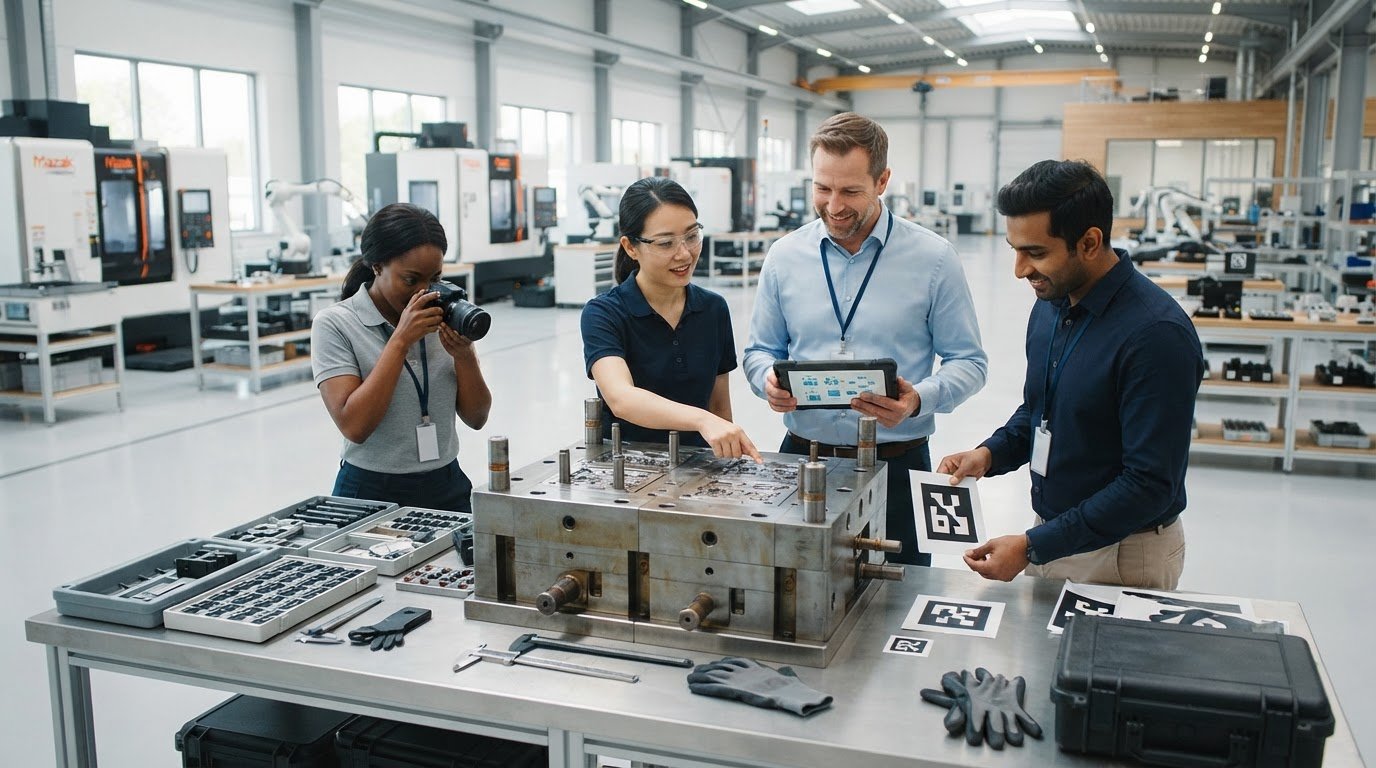
What if the mold you paid to develop couldn’t be released when you needed to change suppliers? Managing tooling and molds with a foreign factory means more than tracking where production equipment is stored. Payment alone may not establish clear ownership, access, or transfer rights. Without visibil...