


With the General Plastics Index sitting at a five-year low of 631 points, the financial opportunity in plastic product manufacturing in China has never been more significant, yet many businesses are still losing their margins to 47% tariffs and high defect rates. You've likely felt the frustration of receiving a mass production shipment only to find that your custom tooling was used for another client or that hidden sourcing fees have eroded your factory-direct savings. Success in this market isn't a sourcing problem; it's a management problem that requires on-the-ground technical oversight and a rejection of traditional intermediary models.
It's understandable to feel a lack of control when your supply chain is thousands of miles away and operating under complex new 2026 national standards. This guide provides a professional framework to help you secure European-level oversight and 100% transparency without sacrificing the competitive pricing of the Chinese market. We'll examine how to transition from unmanaged sourcing to a strategic partnership that ensures zero-defect production, protects your intellectual property, and leverages the current expansion cycle from 2026 to 2029 for your financial health. You'll learn to navigate the shift toward high-value modified plastics while maintaining a lean, optimized procurement strategy.
• Identify why China's polymer sourcing infrastructure remains the global leader for high-precision engineering and how to navigate the 2026 regulatory shift.
• Discover how a "Tooling First" mindset in plastic product manufacturing in China protects your custom moulds from unauthorized use by other clients.
• Uncover the transparency deficit in traditional sourcing and learn to secure factory-direct pricing through direct invoice verification.
• Implement a 5-step roadmap for scaling production that replaces generic emails with on-site technical audits and rigorous sampling oversight.
• Eliminate the risk of "Quality Fade" by establishing a physical presence that bridges the communication gap during complex moulding cycles.
The ecosystem for plastic product manufacturing in China has undergone a fundamental transformation. As of June 2026, the market is characterized by a transition from a "big and fast" production model to one of stable, high-value growth. While the General Plastics Index sits at a low of 631 points, the sector is currently in its second major expansion cycle, which is expected to last through 2029. This means that while raw material costs remain relatively low, the technical capabilities of factories are reaching new heights. You're no longer just sourcing cheap components; you're accessing a sophisticated network of high-precision engineering.
China's infrastructure for polymer sourcing remains unmatched because of its massive vertical integration. In 2026, production capacity for polyethylene is projected to increase by 27.31%, while polypropylene and ABS are seeing growth rates exceeding 10%. This surge in capacity ensures that the global plastics industry continues to rely on Chinese hubs for both volume and specialized material availability. For businesses looking to scale, this translates to a more resilient supply chain that can absorb global demand spikes without the lead-time volatility seen in smaller markets.
The evolution of OEM and ODM models in the plastic sector now favors the client who demands technical depth. While traditional OEM focuses on simple replication, the 2026 landscape is shifting toward modified plastics to meet the needs of new energy vehicles and advanced electronics. Currently, plastic modification in China accounts for about 25% of applications. This is well below the global rate of 50%, signaling a massive opportunity for brands to leverage Chinese factories for high-value product development before the market reaches full saturation. Additionally, the implementation of nine new national standards on February 1, 2026, has created a rigorous regulatory framework for recycled plastics, ensuring your mass production meets modern ESG requirements.
The dominance of Chinese manufacturing isn't just about price; it's about physical proximity and integration. Factories in the Greater Bay Area are situated within hours of the world's largest automotive and electronics assembly hubs. This geographic advantage reduces logistics friction and allows for rapid iteration. Tier 1 and Tier 2 facilities have also invested heavily in advanced automation. By integrating robotic arms and automated material feeding systems, these plants maintain consistent cycle times that manual operations simply can't match. This level of automation is your best defense against the rising labor costs that affect less developed manufacturing regions.
The "Made in China" label has evolved to represent high-tech polymer science. Leading factories have now adopted European and Japanese moulding standards to compete for high-end medical and aerospace contracts. They utilize high-speed CNC and Electrical Discharge Machining (EDM) to create precision moulds with tolerances measured in microns. This technical leap allows you to achieve complex geometries and superior surface finishes that were previously only available from high-cost Western toolmakers. When you partner with a factory that understands these standards, you eliminate the "Quality Fade" that plagues unmanaged supply chains.
Successful plastic product manufacturing in China begins with a "Tooling First" mentality. Your mould is the single most important capital asset in your supply chain. If the tooling is poorly engineered, no amount of quality control during mass production can fix the resulting defects. We prioritize the development of high-quality steel moulds that ensure dimensional stability over hundreds of thousands of cycles. This proactive approach prevents the common "Quality Fade" where parts begin to drift from specifications as the tool wears down prematurely.
Material selection for 2026 requires navigating a shifting regulatory landscape. With the implementation of new national standards for recycled plastics in February 2026, choosing between ABS, Polycarbonate (PC), or Polypropylene (PP) now involves evaluating both technical performance and environmental compliance. Understanding China's plastic legislation is essential for brands targeting global markets that demand sustainable material chains. We integrate Design for Manufacturing (DFM) at the earliest stage to optimize wall thickness, gate locations, and draft angles. This technical rigor reduces unit costs by minimizing cycle times and material waste. If you're unsure which resin suits your specific application, our team can provide a detailed technical assessment of your product design.
The journey from a 3D CAD file to a finished part involves critical milestones: T0 (the first shot) and T1 (refined samples). These stages are where we identify and resolve sink marks, warping, or flash issues. Protecting your intellectual property is a core priority. We ensure your custom moulds are physically secured and contractually protected to prevent unauthorized use for other clients. A high-grade hardened steel mould should reliably produce over 500,000 shots, providing the long-term financial viability your business requires.
While injection moulding is the gold standard for high-volume scalability and complex geometries, other technologies offer specific advantages. Blow moulding is the logical choice for hollow components like bottles or tanks, though it requires careful management of wall thickness consistency. Extrusion serves continuous profiles such as tubing or window frames, where managing cooling rates is vital for maintaining tolerances. Selecting the right process depends entirely on your part's function and expected production volume. We help you vet these technical choices to ensure your production method aligns with your budget and quality requirements.
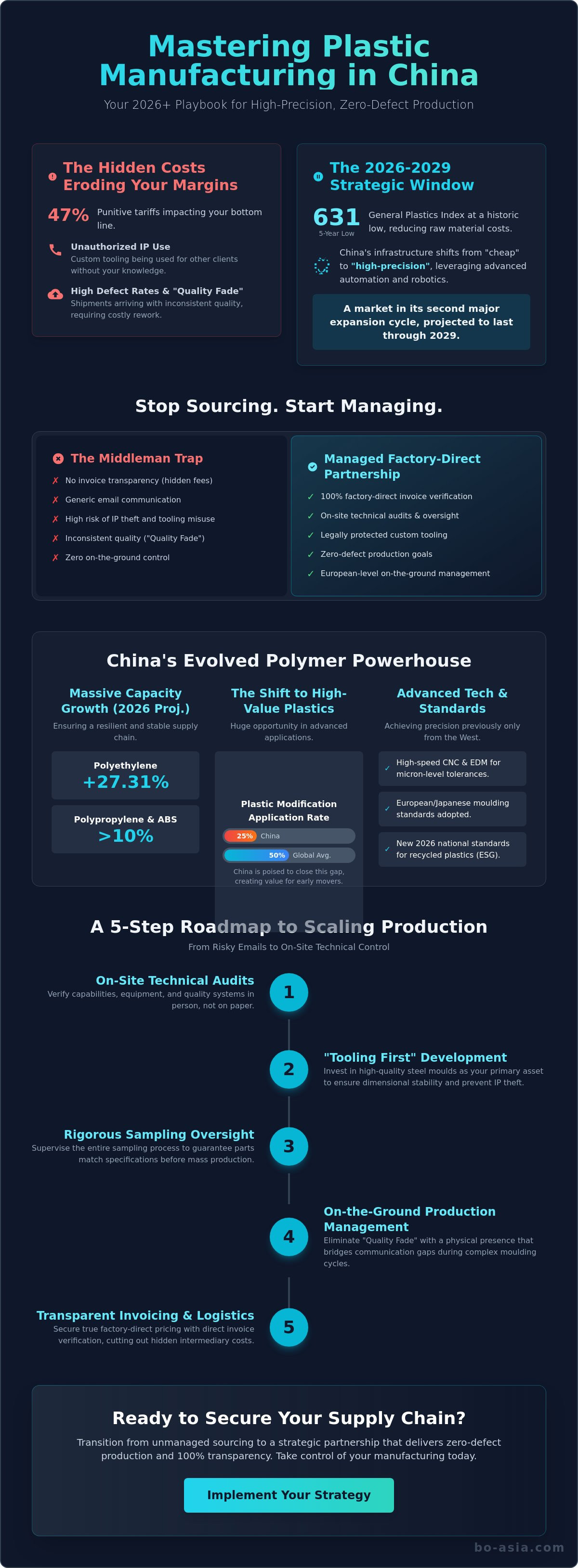
Many executives believe they're securing a competitive advantage by using a local agent or a trading company. In reality, these intermediaries often obscure the true costs of plastic product manufacturing in China. They typically operate on hidden commissions from the factory, which means your interests and theirs are fundamentally misaligned. When a quality issue arises, a commission-based agent is incentivized to protect the factory relationship to keep their kickback, rather than advocating for your brand's financial health. This transparency deficit is why you rarely see the real factory invoice or the true cost of raw materials.
A managed approach replaces these opaque intermediaries with a dedicated procurement team that acts as an integrated extension of your own company. Direct contact with a factory via email is not the same as factory-direct sourcing. Without on-site mass production oversight, you're vulnerable to the factory cutting corners on resin quality or cycle times to boost their own margins. True factory-direct sourcing requires a physical presence to verify every step of the process, ensuring that the savings negotiated at the start actually reach your bottom line.
Digital platforms are useful for initial market research, but they shouldn't be the final word in your supply chain. A "Gold Supplier" badge isn't a certificate of quality; it's a paid subscription. Relying on digital profiles without on-site vetting is a gamble with your capital. Verified status on a website doesn't guarantee that the facility has the technical capacity for high-precision moulding or the ethical standards your brand requires. For a deeper look at vetting strategies, read The Definitive Guide to Choosing a China Sourcing Company.
Our model rejects the traditional commission-based structure in favor of a transparent management fee. This ensures our goals are perfectly aligned with yours. With European leadership based in Helsinki and operational teams in Hong Kong, we provide the regional expertise you need with the corporate accountability you expect. You get direct access to factory management and raw material data, allowing for genuine factory-direct price negotiations. We don't just connect you to a supplier; we defend your margins and ensure your specifications are met without compromise.
Scaling your plastic product manufacturing in China requires a shift from transactional buying to a structured operational framework. This isn't about simply placing an order; it's about building a managed ecosystem that eliminates the risks of unmanaged sourcing. This roadmap moves your production from a theoretical design to a high-volume reality while protecting your financial interests at every stage. By following these five steps, you replace uncertainty with a professional procurement strategy.
We conduct a comprehensive on-site evaluation of the facility to ensure their machinery and workforce can meet your specific tolerances.
This phase focuses on sampling oversight to ensure the T1 and T2 samples match your approved "Golden Sample."
We maintain a physical presence on the factory floor to oversee the initial production run and implement in-line quality control.
We verify that the finished goods meet international standards like REACH and the latest 2026 ESG requirements.
Our team manages the final handover and shipping management to ensure your goods are correctly documented and loaded.
Verifying a supplier's business license and export permit in the PRC is the bare minimum. You must also verify that the factory's actual capacity matches your production volume needs. Many factories outsource orders to smaller, unvetted workshops when they're over capacity, which is where quality usually fails. For a deeper look at protecting your supply chain, see our guide on Supplier Vetting in Asia. We ensure that the facility you audit is the same facility that produces your goods.
The "Golden Sample" serves as your contractual benchmark. It's the physical evidence of what the factory has promised to deliver. In-line inspections are vital because they catch defects before an entire batch is ruined. We utilize Final Random Inspections (FRI) based on international AQL standards to provide a statistical guarantee of quality. As of February 1, 2026, China's nine new national standards for recycled plastics are now in effect, making ESG compliance a technical requirement for modern exports. If you're ready to secure your production line, get a professional audit of your current supplier today.
Physical proximity is the only reliable defense against the "Quality Fade" phenomenon. In the competitive landscape of plastic product manufacturing in China, factories often face intense pressure to maintain margins despite rising operational costs. This pressure can lead to a gradual reduction in quality that is nearly impossible to detect through a computer screen. A factory might quietly substitute a certified resin with a lower-grade alternative or reduce cooling times by a few seconds to squeeze out more parts per hour. These small changes lead to brittle components and dimensional instability that only become apparent once the shipment reaches your warehouse.
Email is insufficient for technical moulding. When a production issue occurs, you can't rely on a static PDF report to explain why a part is warping or why the surface finish has suddenly changed. You need a partner who can stand on the factory floor, inspect the injection parameters in real-time, and demand immediate corrections. Our physical presence ensures that your production schedule is respected. Factories are less likely to bump your order in favor of a larger client when they know your dedicated representatives are on-site to monitor progress and verify output daily.
We provide a unique bridge between Western quality expectations and Chinese industrial reality. Our European-managed leadership in Helsinki establishes the ethical and technical framework, while our Hong Kong operational teams provide the "boots-on-the-ground" accountability. This model offers you real-time reporting and total transparency throughout the production cycle. You're never left wondering about the status of your capital. You can see how other brands have successfully mitigated risk and achieved high-volume growth in our case studies on scaling production with BOA expertise.
Reducing financial risk requires more than just a good contract; it requires active supplier management. As China moves through its second expansion cycle from 2026 to 2029, staying ahead of the curve is vital. We help you prepare for the February 2026 regulatory changes in plastic exports, ensuring your products meet the newest national standards for traceability and material safety. By facilitating factory-direct negotiations and providing continuous oversight, we protect your brand from the operational setbacks that affect unmanaged supply chains. It's time to move beyond transactional sourcing and secure a long-term partnership. Build your dedicated Asia procurement team today and take full control of your manufacturing future.
Success in plastic product manufacturing in China requires moving beyond digital platforms and commission-based agents. You've seen how the 2026 expansion cycle and new national standards demand a more rigorous, on-site approach to protect your brand from quality fade and intellectual property theft. By prioritizing a "Tooling First" mindset and implementing a structured five-step roadmap, you convert manufacturing risks into a stable, high-yield asset for your business. Physical proximity remains the only true guarantee of accountability in a complex global market.
Securing your margins depends on 100% transparency and the steady confidence of an established expert. We provide European-managed oversight with a local Hong Kong presence, ensuring you receive factory-direct pricing without the hidden costs of traditional intermediaries. Our specialized expertise in custom tooling and OEM/ODM development acts as a protective defense for your supply chain. It's time to stop managing the complexities alone and start scaling with precision. Partner with Buying Office Asia for your plastic manufacturing needs and secure the financial viability of your next production run. We're ready to act as the integrated extension of your team.
You verify a manufacturer's license by requesting their official business license (Yingye Zhizhao) and cross-referencing the Unified Social Credit Code on the National Enterprise Credit Information Publicity System. This digital check confirms the company's legal scope, registered capital, and operational status. You should also verify their specific export permits to ensure they're legally authorized to ship goods out of the PRC. Physical on-site audits remain the only way to confirm that the license belongs to the actual facility producing your goods.
Typical lead times for custom plastic tooling range from 30 to 45 days to reach the T0 sample stage. This timeline depends on the complexity of the mould design and the grade of steel selected for the tool. High-precision moulds requiring multiple cavities or complex slides may extend this period to 60 days. We manage this process by setting strict milestones for design approval, machining, and initial sampling to ensure your production schedule remains on track.
A buying office is more financially viable because it operates on a transparent management fee rather than hidden commissions. While a sourcing agent might appear cheaper upfront, they often obscure the real factory price to secure kickbacks from the supplier. This lack of transparency leads to higher unit costs over time. Our model ensures you receive factory-direct pricing, which results in significant long-term savings for high-volume plastic product manufacturing in China.
You protect your intellectual property by utilizing NNN (Non-use, Non-disclosure, Non-circumvention) agreements drafted under Chinese law. Physical protection is equally important. We ensure your custom moulds are clearly marked with ownership plates and stored securely when not in production. Our on-site presence prevents the factory from using your proprietary tooling to produce parts for unauthorized third parties. This combination of legal and physical oversight provides a robust defense for your capital assets.
Common quality issues include sink marks, warping, and flash, which often result from inconsistent cycle times or improper cooling. Another major risk is resin substitution, where a factory uses regrind or lower-grade polymers to save costs. These defects are often the result of unmanaged production lines trying to boost margins. We stop these issues by conducting in-line inspections and verifying that the raw material matches the technical specifications of your approved sample.
Minimum order quantities for custom plastic products are generally determined by the minimum batch size of the raw material required to start the machine. For standard injection moulding, this often ranges between 3,000 and 5,000 units per run. MOQs are negotiable based on the total value of the contract and the complexity of the part. We work directly with factory management to find a balance between your inventory needs and the factory's operational efficiency.
We handle quality inspections through a three-tier process: on-site vetting, in-line production monitoring, and Final Random Inspections (FRI). Our teams use international AQL standards to verify dimensional accuracy, surface finish, and material integrity before any goods leave the factory. This hands-on approach ensures that 100% of the shipment meets your approved specifications. We provide detailed digital reports so you have full visibility into the quality of your mass production.
You can manufacture biodegradable plastics in China, and capacity is expanding as the industry moves into its second expansion cycle. As of February 1, 2026, nine new national standards for plastics and recycled plastics have taken effect, providing a clear regulatory framework for sustainable materials. These standards cover the entire chain of production, collection, and reuse. We help you source suppliers who are already compliant with these 2026 regulations to ensure your plastic product manufacturing in China meets global ESG requirements.
What if the first clear sign of a production problem arrives after the goods are packed? Manufacturing risk management in Asia works best when controls are connected from the start, not left to a final inspection or occasional supplier update. You need visibility into factory activity, early warning...

What if the lowest unit quote isn’t the lowest-cost way to make your board game? Board game manufacturing costs depend on more than the number of boxes ordered. Component materials, custom tooling, assembly, packaging and delivery scope can all change what a quote covers, making headline prices diff...

What if the factory’s lowest quote isn’t the lowest-cost option? A lower unit price can hide differences in materials, tooling, packaging, quality checks or production terms. Understanding how sourcing agents negotiate factory prices starts with making those differences visible, not simply asking a...