


Did you know that while most businesses have mapped over half of their supplier network, only 18% actually possess complete end-to-end visibility? In a 2026 trade environment defined by new 12.5% tariffs and the total elimination of EU customs exemptions, choosing the right sourcing agent vs buying office model is no longer just about convenience; it's about survival. You likely feel the constant pressure of rising landed costs and the persistent anxiety of hidden commissions eroding your margins. It's frustrating to realize that the person supposed to protect your interests might actually be a gatekeeper for the factory, obscuring the very transparency you need to scale.
This article provides a professional briefing on the critical operational differences between transactional intermediaries and dedicated procurement teams. You'll discover how to secure your Asian supply chain by eliminating hidden markups and implementing on-site quality oversight that actually sticks. We'll show you how to transform your procurement model into a strategic extension of your own company, ensuring every dollar spent is a documented investment in your brand’s stability and long-term financial health. It's time to move away from unmanaged sourcing and toward the steady confidence of an established expert.
• Identify the fundamental operational differences between a sourcing agent vs buying office to ensure your procurement strategy aligns with your 2026 financial goals.
• Uncover the hidden risks of commission-based intermediaries, including obscured factory pricing and the lack of contractual accountability during quality disputes.
• Gain 100% supply chain transparency by utilizing a dedicated buying office that functions as a regional extension of your own company.
• Determine the specific volume and complexity triggers that signal when your business should transition from a freelance agent to a structured procurement team.
• Secure your brand’s reputation through on-site mass production oversight and factory-direct negotiations that eliminate unnecessary middleman markups.
Understanding the fundamental procurement process starts with identifying who holds the keys to your factory relationships. The debate over a sourcing agent vs buying office isn't merely a semantic one; it's a choice between two fundamentally different risk profiles. A sourcing agent typically functions as a transactional intermediary, while a buying office operates as a strategic extension of your own company. In a year where only 18% of businesses report complete end-to-end visibility in their supply chains, the model you choose determines whether you own your data or remain locked behind a gatekeeper.
Most sourcing agents operate as freelance individuals or small, agile agencies. They provide a valuable service for entry-level procurement, primarily acting as a bridge between a buyer and a contact list on a platform like Alibaba. Their involvement is usually project-based, focusing on the immediate goal of finding a supplier and securing a quote. However, this model often lacks the formal infrastructure required for mass production oversight. Because agents frequently work on a commission basis, their loyalty can become divided. You might find that communication is managed well, but factory-direct transparency is often sacrificed to protect the agent's position as the sole point of contact.
A buying office is a structured, regional branch of your own business. It doesn't just find suppliers; it manages them as your dedicated sourcing team. This model provides a legal and operational presence in manufacturing hubs like Hong Kong or Vietnam, offering the same level of oversight usually reserved for major enterprises. Instead of focusing on a single transaction, a buying office prioritizes the total cost of ownership (TCO). This includes long-term supplier development, rigorous factory audits, and on-site quality control that happens during production, not just after it's finished. It’s a partnership defined by 100% transparency where you own the factory relationship and the pricing remains direct.
The global trade environment in 2026 has become too volatile for unmanaged sourcing. With the elimination of the €150 customs duty exemption in the EU and the introduction of new 10% to 12.5% tariffs on goods from dozens of countries, margins are under unprecedented pressure. Relying on a simple contact list is no longer a viable strategy. You need a team that can navigate these regulatory shifts and rising shipping costs with the steady confidence of a seasoned insider. Transitioning from a transactional agent to a strategic buying office provides the financial viability and security required to defend your brand against the operational setbacks of a complex global market.
While a sourcing agent might offer a low-barrier entry into Asian markets, this model often conceals structural flaws that can compromise your financial viability. When evaluating a sourcing agent vs buying office, you must look beyond the surface level "introduction" fee. Many agents operate on a commission-based revenue model, typically charging between 3% and 10% of the FOB order value. However, the real danger lies in the lack of transparency regarding back-end incentives that are never disclosed to the buyer.
It's a common industry practice for agents to accept "rebates" or kickbacks from the factory, effectively taking payment from both sides of the transaction. This creates an immediate conflict of interest. If a quality dispute arises, the agent's loyalty is often compromised because their primary relationship is with the local supplier, not your brand. If the dispute escalates, a freelance agent can simply disappear, leaving you with a container of unsellable goods and no legal recourse. This lack of contractual accountability is a significant risk for businesses moving beyond the sampling phase.
A significant risk in the agent model is the deliberate obscuring of factory identities. By acting as a "black box" between you and the manufacturer, agents prevent you from conducting independent audits or verifying factory-direct claims. This lack of visibility often masks the practice of sub-contracting, where your order is passed to a lower-tier, unvetted workshop to increase the agent's margin. Research into global sourcing strategies highlights that integrated collaboration is essential for long-term success, yet the agent model often thrives on information asymmetry. In fact, "free" sourcing services usually hide 10-20% markups within the unit price, making them significantly more expensive over the life of a production run.
As your business grows, the "one-man show" becomes a liability. A single agent cannot physically oversee mass production across multiple provinces or manage complex OEM product development cycles effectively. Their quality control is often inconsistent, relying on quick visual checks rather than rigorous, on-site testing. This model also struggles with logistics coordination. Without a structured team, consolidating shipments from multiple suppliers becomes a chaotic process prone to delays and unforeseen expenses. To avoid the "Agent Trap," it's vital to discuss your specific procurement needs with a partner who prioritizes your total cost of ownership over a quick commission.
While the agent model relies on information asymmetry, the buying office model is built on the principle of radical transparency. When comparing a sourcing agent vs buying office, the most significant advantage is direct factory access. You aren't just receiving a quote; you're owning the relationship with the manufacturer. This eliminates the "black box" dynamic where a middleman controls the flow of information. By moving to a fixed fee structure, you align your partner’s incentives with your own. Their goal isn't to maximize a hidden commission, but to optimize your total cost of acquisition.
In the complex trade environment of 2026, ethical and ESG compliance are no longer optional. A dedicated office ensures that your supply chain meets rigorous international standards, protecting your brand from the reputational risks associated with unmanaged sub-contracting. This systematic approach transforms procurement from a series of risky transactions into a stable, scalable business function.
A buying office provides your business with a physical, regional presence without the significant overhead and legal complexity of establishing a foreign subsidiary. This dedicated Asia procurement team acts as a bridge between your headquarters and the factory floor. The presence of European management is vital here. It ensures that the professional and cultural gap is bridged by leaders who understand Western quality expectations and transparency requirements. It’s a protective layer that offers the same level of oversight usually reserved for major multinational corporations.
The most effective way to reduce landed costs is to negotiate from a position of data-driven strength. Local experts in a buying office use their regional networks to uncover the "real" manufacturing cost, stripping away the markups that agents often bake into the unit price. When your brand is represented by a formal office, you benefit from high-volume leverage that a freelance individual simply cannot replicate. You can review specific pricing and savings examples to see how this model systematically reduces expenses through direct negotiation and consolidated logistics management.
Reliable quality isn't an accident; it's the result of standardized inspection protocols managed by people on your payroll. Unlike agents who might perform a cursory check at the end of a run, a buying office implements "during-production" inspections. This allows for the correction of errors before an entire batch is ruined. By following strict AQL (Acceptable Quality Level) standards, your team ensures that every shipment meets your specifications. For a deeper look at protecting your interests, consult our guide on supplier vetting in Asia. Deciding on hiring a sourcing agent vs. a buying office often comes down to this level of on-the-ground accountability.
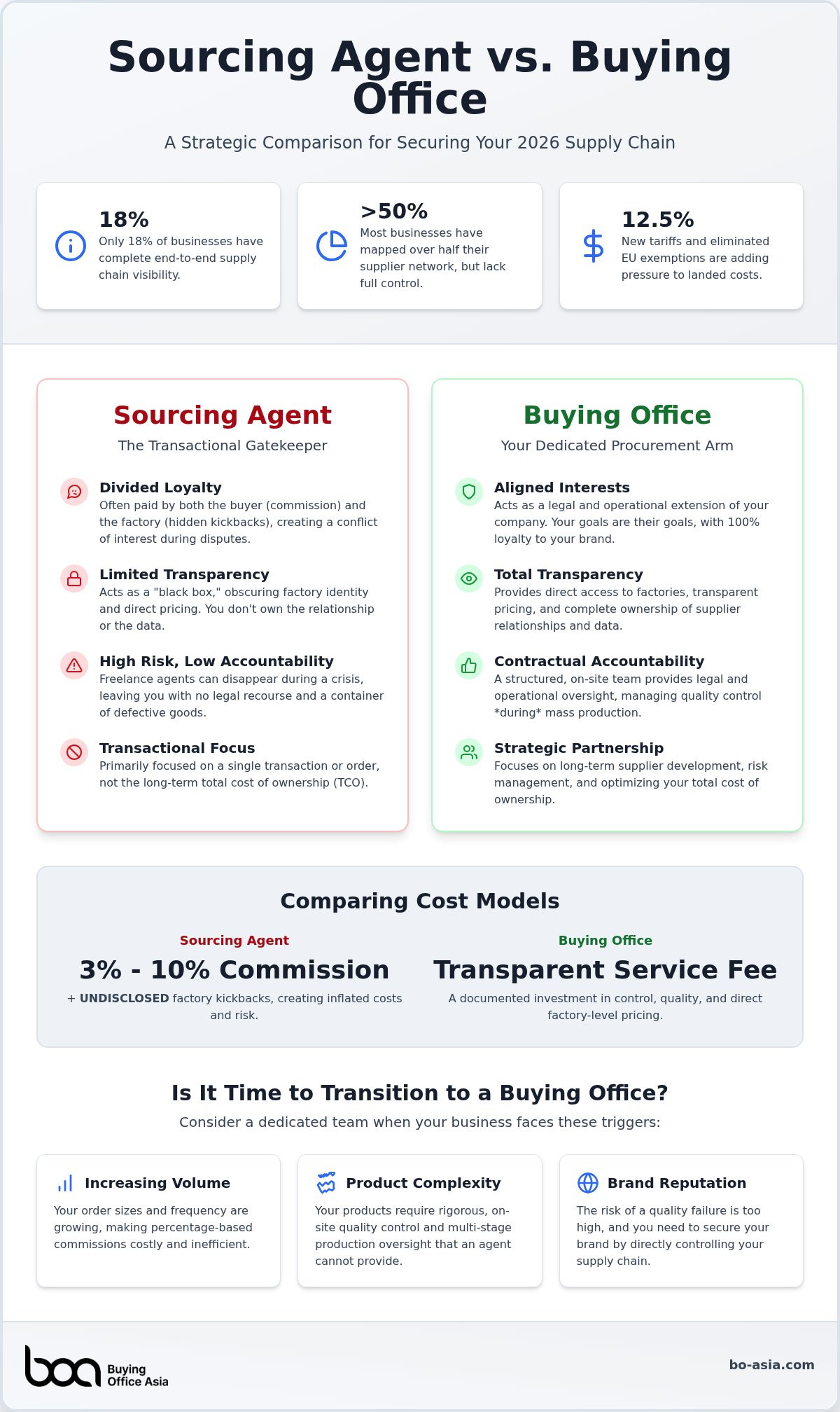
Deciding between a sourcing agent vs buying office requires a shift from viewing procurement as a series of tasks to seeing it as a strategic business function. The fundamental difference lies in the alignment of interests. A sourcing agent is a transactional partner whose revenue often depends on the volume of orders, which can lead to a focus on speed over long-term stability. In contrast, a buying office is a contractual extension of your company, designed to prioritize your financial health and supply chain resilience. This distinction is most visible when comparing how these models handle visibility and risk.
The financial viability of your procurement model becomes clear when you analyze the total cost of ownership over a 12-month period. Sourcing agents typically charge a commission of 3% to 10% of the FOB order value. While this seems straightforward, the "hidden" cost often resides in the lack of transparency regarding the factory's base price. If an agent secures a "rebate" from the manufacturer, your unit price is artificially inflated. A buying office eliminates this conflict of interest by utilizing a fixed service fee or retainer model. This "open-book" transparency ensures that 100% of the negotiation savings stay with your brand. By investing in professional Sourcing & Procurement Services, you replace unpredictable commissions with a predictable, high-ROI procurement strategy that yields lower landed costs over time.
Operational friction is a silent margin killer. Many businesses struggle with the "24-hour delay" that occurs when relying on a freelance agent who operates in a different time zone and cultural context. A buying office solves this by providing a dual-layered management structure. For European clients, having leadership based in Helsinki ensures that strategic discussions happen in your own time zone and professional language. Simultaneously, on-the-ground management in Hong Kong provides immediate, real-time oversight of factory operations.
This model moves beyond simple supplier searching and focuses on comprehensive supplier development. Your team doesn't just find a vendor; they work to improve factory efficiency, ensure regulatory adherence, and manage complex logistics. This integrated approach creates a stable defense against the volatility of the 2026 global market. Instead of managing a third-party intermediary, you gain a regional department that possesses the expertise and networks you currently lack. To learn how a dedicated team can stabilize your international manufacturing, connect with our procurement experts.
Commission-based (Agent) vs. Service-fee/Retainer (Buying Office).
Personal trust (Agent) vs. Corporate contractual accountability (Buying Office).
Information gatekeeping (Agent) vs. 100% open-book transparency (Buying Office).
Transactional savings (Agent) vs. End-to-end supply chain resilience (Buying Office).
Selecting the right procurement partner is a decision that dictates your long-term financial viability. The choice between a sourcing agent vs buying office often depends on the current maturity of your supply chain and the complexity of your product line. If you're in the early stages of market testing with low-volume, one-off samples or low-complexity "off-the-shelf" products, a sourcing agent might provide the quick entry point you need. However, the moment your brand moves into high-volume production, custom tooling, or multi-supplier consolidation, the transactional agent model begins to show its limitations.
When your brand reputation is at stake, you must evaluate your risk tolerance. In the 2026 trade environment, where supply chain resilience is prioritized over the lowest possible labor cost, "middleman" models are rapidly being replaced by direct-to-factory partnerships. Businesses that succeed in this volatile market are those that secure 100% transparency and end-to-end visibility. They don't just search for suppliers; they build an integrated regional presence that protects their margins against rising shipping costs and shifting tariff landscapes.
Before committing to a long-term partnership, use this checklist to verify the professional rigor of your potential procurement team. If a partner cannot provide clear, documented answers to these questions, they likely lack the infrastructure to support a growing brand.
Does the partner allow you to visit the manufacturing site and speak with the owners directly, or do they act as an information gatekeeper?
How does the partner handle quality failures? Is there a clear, contractual process for managing re-work costs and supplier disputes?
Is the fee structure fully documented, or are there hidden markups buried within the unit price?
Does the partner have on-site teams for mass production oversight, or do they rely on third-party freelancers for inspections?
Buying Office Asia represents the logical evolution for brands that require enterprise-level oversight without the overhead of a foreign subsidiary. We combine European business standards and leadership from our Helsinki office with local Asian execution through our Hong Kong headquarters. This dual presence provides the steady confidence of a seasoned insider, offering a defense against the operational setbacks that affect unmanaged supply chains. By acting as an integrated extension of your own team, we provide the infrastructure needed to scale safely in a complex global market. It's time to move beyond transactional interactions and secure your future with a partner focused entirely on your financial health. Contact us for a supply chain audit to see how we can optimize your Asian procurement.
Choosing the right sourcing agent vs buying office model is a strategic pivot that moves your business from reactive crisis management to proactive supply chain control. You've seen how a dedicated office eliminates the gatekeeper risk, replacing hidden commissions with 100% transparency and factory-direct price negotiations. By prioritizing on-site mass production oversight, you ensure that quality standards remain consistent and your brand reputation stays protected.
As a European-managed firm with leadership in Helsinki, we provide the steady confidence and regional expertise needed to stabilize your procurement in a volatile market. We act as your eyes and ears on the factory floor, ensuring your interests are always the primary focus. It's time to replace transactional uncertainty with the protective oversight of a partner that functions as an extension of your own team.
Get Started with Your Dedicated Asia Procurement Team today. Your growth in 2026 starts with a supply chain built on reliability, financial viability, and absolute truth.
The fundamental difference between a sourcing agent vs buying office lies in the nature of the partnership. An agent acts as a transactional gatekeeper, often managing a single project for a commission. A buying office functions as your dedicated Asia procurement team. This model provides long-term supplier development and 100% transparency, ensuring your interests are protected by a partner who acts as an internal department rather than a third-party intermediary.
Sourcing agents typically charge a commission between 3% and 10% of the FOB order value. This can create a conflict of interest because their earnings increase as your costs rise. Buying offices generally utilize fixed service fees or retainers. This structure aligns your partner's goals with your own, focusing on reducing your total cost of ownership rather than maximizing a transactional payout on every shipment.
We ensure factory-direct pricing by removing the hidden markups that often obscure the true manufacturing cost in the sourcing agent vs buying office comparison. You gain direct access to the manufacturer and own the relationship. This open-book approach allows for transparent negotiations where you see the raw material and labor costs. By eliminating middleman rebates, we ensure your brand benefits from the most competitive prices available.
Absolutely. A buying office provides comprehensive support for custom product and tooling development. Our team manages the technical requirements and mass production oversight needed for complex OEM projects. Unlike agents who primarily source existing products, we ensure your custom specifications are met exactly. We also verify that the factory has the necessary machinery and quality protocols to handle specialized tooling and unique production runs.
For low-volume orders or one-off samples, a sourcing agent may be the cheaper initial option. Their commission-based model is suited for businesses that don't require ongoing management or high-volume leverage. However, as your volume increases, the lack of transparency and on-site oversight in the agent model often leads to hidden expenses. A buying office provides better long-term ROI through strategic negotiations and a reduced risk of quality failures.
Transparency is the foundation of a secure supply chain. It prevents the common industry practice of unvetted sub-contracting, where an agent passes your order to a lower-tier factory to increase their own margin. Knowing exactly who is making your products allows you to verify ethical standards and ESG compliance. In a volatile trade market, 100% visibility into your factory-direct pricing is essential for maintaining your financial viability.
Buying Office Asia implements on-site quality control inspections at multiple stages of production. Agents often rely on a final, pre-shipment check that happens when it's already too late to fix errors. We use standardized AQL protocols and during-production inspections to identify defects early. This proactive approach reduces the risk of receiving unsellable goods and ensures that every batch meets your brand's specific quality and safety requirements.
A Hong Kong-based team provides the regional expertise and physical proximity required for real-time supplier management. This location bridges the gap between Western business standards and Asian manufacturing execution. It eliminates the 24-hour communication delays common with offshore agents. By having a team on the ground, you gain immediate accountability and a protective presence that can respond quickly to any operational challenges or regulatory shifts in the region.

A technical drawing isn't just an engineering reference; it's your primary legal baseline against cost-driven supplier compromises. When sourcing abroad, vague manufacturing product specification sheets inevitably invite unauthorized material substitutions, delayed timelines, and sudden quotation in...

The traditional commission-based sourcing agent in India is no longer an asset; they're often your greatest financial risk in a market rapidly scaling toward a $2 trillion export target. You likely recognize the inherent conflict when an agent's income rises alongside your factory costs, or the anxi...

If your current sourcing agent claims their services are free, you're likely paying a hidden tax of 10% to 30% through inflated unit prices and factory kickbacks. This lack of transparency doesn't just erode your margins; it creates a dangerous barrier between you and the factory floor. Finding a re...