


A technical drawing isn't just an engineering reference; it's your primary legal baseline against cost-driven supplier compromises. When sourcing abroad, vague manufacturing product specification sheets inevitably invite unauthorized material substitutions, delayed timelines, and sudden quotation increases. If an overseas factory has room to interpret your requirements, shop-floor managers will default to whatever is fastest and cheapest to produce.
You likely know the frustration of opening a pre-production shipment only to discover off-spec materials, unacceptable cosmetic blemishes, or components that deviate from your approved prototypes. Worse, vague documentation allows suppliers to slip in unexpected price hikes under the guise of technical complexity that was never clearly defined upfront.
You can prevent these costly operational setbacks. In this guide, you'll learn how to engineer bulletproof manufacturing product specification sheets that eliminate production misunderstandings, lock in accurate factory-direct quotes, and protect your margins. We'll break down the exact dimensional tolerances, chemical compliance protocols, and bilingual inspection criteria needed to give your on-site quality teams an airtight pass/fail standard.
• Learn how engineering precise manufacturing product specification sheets eliminates factory guesswork and locks in reliable direct pricing before production starts.
• Identify the core structural components and Bill of Materials protocols needed to prevent unauthorized sub-tier material substitutions.
• Master the step-by-step method for converting subjective design concepts into objective, measurable tolerances that overseas floor managers can execute.
• Avoid common documentation errors by replacing ambiguous descriptive language with verifiable testing criteria and surface finish standards.
• Enforce line-level production compliance by linking your technical documentation to signed golden samples and ISO 2859-1 inspection checklists.
A manufacturing product specification sheet is the definitive technical blueprint that governs how your product is built, evaluated, and priced. Unlike conceptual sketches, it translates subjective design intents into measurable engineering criteria. In cross-border procurement, comprehensive technical product specifications serve as the binding operational baseline between your team and an offshore manufacturing facility.
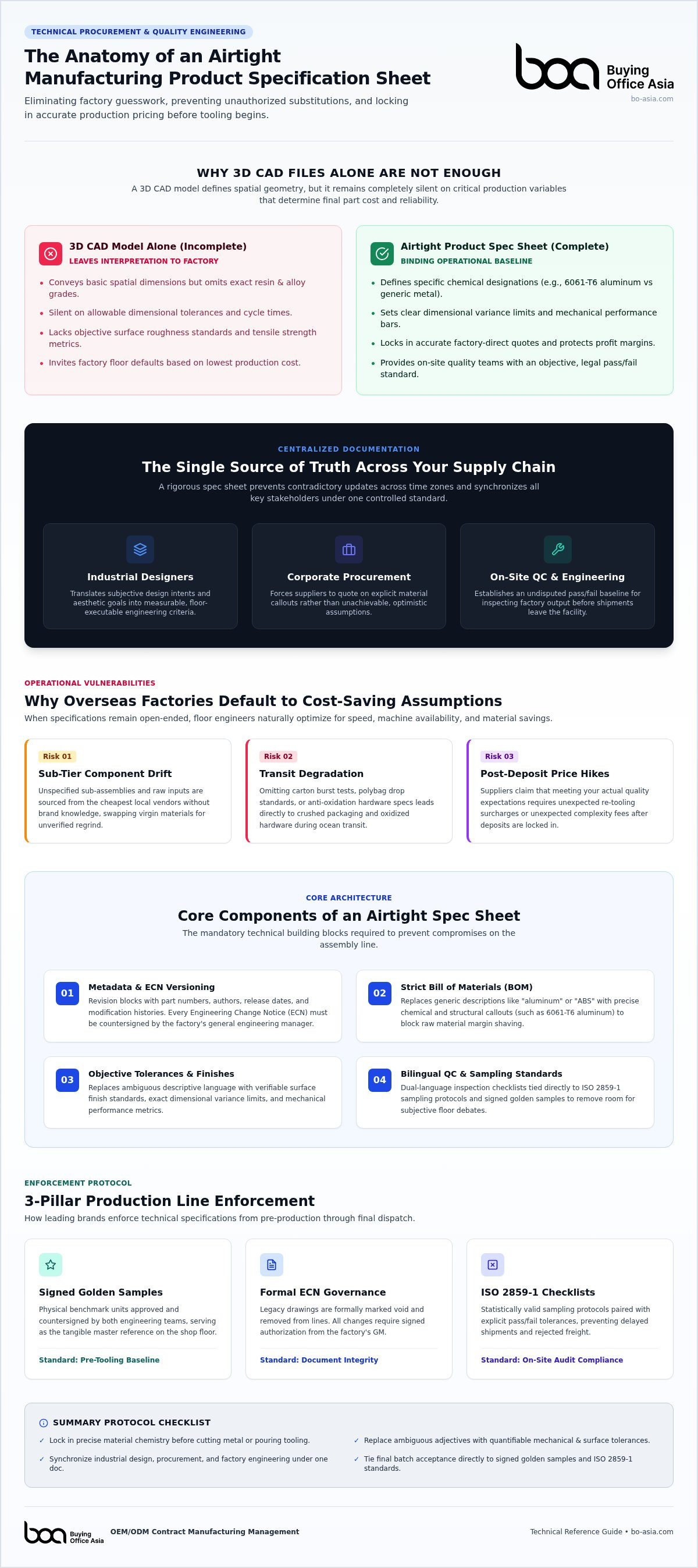
Relying solely on 3D CAD models or photorealistic renderings is a dangerous mistake. CAD files convey spatial geometry, but they remain silent on critical production variables: resin grades, tensile strengths, cycle times, surface roughness, and allowable dimensional variances. When these details are omitted, manufacturing product specification sheets lose their teeth, transforming formal production into an expensive exercise in factory guesswork.
Beyond engineering, this document establishes your legal benchmark for quality control. When an inspection team arrives at an assembly plant, your spec sheet dictates the exact parameters of acceptable performance. Without measurable criteria, identifying defects becomes an impossible debate, frequently leading to delayed shipments, rejected sea freight, or completely scrapped inventory.
Modern hardware production fractures quickly without centralized documentation. A detailed spec sheet synchronizes internal industrial designers, corporate procurement officers, and third-party engineering teams under one controlled standard. It prevents purchasing managers and product designers from delivering contradictory updates across time zones. Critically, it forces factory sales representatives to calculate quotations based on explicit material callouts rather than optimistic, unachievable production assumptions.
Leave a requirement unstated, and an offshore supplier will invariably choose the path of least resistance. This reaction isn't necessarily malicious; overseas contract manufacturers operate on razor-thin margins and aggressive production schedules. When a specification remains open-ended, floor engineers optimize for speed, machine availability, and raw material savings. They might swap virgin polycarbonate for unverified regrind, or utilize generic zinc hardware that oxidizes during transit.
The cost of this ambiguity compounds rapidly down the line:
Unspecified sub-assemblies are sourced from the cheapest local vendors without your knowledge.
Omitting carton burst tests or polybag drop standards leads directly to crushed packaging and high retail return rates.
Factories claim that achieving your actual requirements requires unexpected re-tooling surcharges.
Managing these risks requires rigorous oversight. Through specialized OEM/ODM contract manufacturing management, brands preserve full design integrity by locking down every physical variable before metal is cut or tooling is poured.
Unlike consumer goods that rely on basic recipe lists, industrial manufacturing product specification sheets demand mechanical, chemical, and structural clarity. An effective technical package leaves zero room for interpretation. It serves as your primary defense against component downgrades, ensuring the finished unit consistently matches your performance and safety requirements.
Document control begins with clear metadata. Every sheet requires a revision block displaying the part number, author, release date, and line-item modification history. When production updates occur, legacy drawings must be officially marked void and removed from the assembly line. Every Engineering Change Notice (ECN) must be countersigned by the factory's general engineering manager to remain binding.
A detailed Bill of Materials prevents suppliers from quietly shaving margins on raw inputs. Don't settle for generic descriptions like "aluminum" or "ABS plastic." Specify precise chemical designations, such as 6061-T6 aluminum or Sabic Cycolac resin, alongside approved sub-tier component brands. When coordinating complex OEM manufacturing programs, locking down approved component vendors ensures proprietary tooling operates within exact thermal and mechanical boundaries.
Dimensional control requires unambiguous numerical limits. Define general tolerances using international standards like ISO 2768-m, while assigning explicit unilateral or bilateral tolerances to critical mating surfaces. If an injection-molded housing requires a ±0.1 mm clearance to prevent assembly rattle, state it directly on the technical mechanical drawing.
Surface treatments must be equally objective. Rather than requesting a "matte black" finish, specify Pantone PMS 419C or a textured Mold-Tech MT-11010 standard. Segment the product into Class A (primary visible surfaces), Class B (secondary surfaces), and Class C (internal areas) zones with distinct scratch and pinhole limits. Aligning these standards with NIST guidance on quality management systems provides your on-site inspection team with repeatable pass/fail metrics.
Finally, mandate packaging criteria, such as ISTA 1A drop-test compliance, to prevent transit crushing. If you're building a new hardware line and need an audit of your technical documentation, consider speaking with our procurement team to lock down your specifications before tooling begins.
Engineering effective manufacturing product specification sheets requires converting abstract design intent into concrete, verifiable data. Overseas assembly workers rely on definitive metrics, not stylistic guidelines. If a parameter cannot be measured with a caliper, durometer, or colorimeter, it won't be maintained during high-volume production runs.
Eliminate descriptive adjectives from your drafts entirely. Replace phrases like "heavy-duty plastic" with specific material grades, such as high-impact polycarbonate with a minimum tensile yield strength of 60 MPa. If a surface needs a specific texture, specify an exact surface roughness value, such as Ra 1.6 μm, rather than calling for a "satin texture."
Every dynamic part requires a quantifiable mechanical threshold:
Define push-button resistance precisely (e.g., 2.5 N ± 0.3 N).
Mandate minimum durability limits, such as hinges rated for 15,000 continuous opening cycles without structural failure.
State performance parameters across specific environments, such as continuous operation between -10°C and 55°C at 90% relative humidity.
To bridge the operational divide, build dual-language sheets that map English terms directly to Simplified Chinese technical phrasing. Translating these critical tolerances avoids shop-floor misunderstandings before initial tooling runs start.
Transit durability must be engineered with the same rigor as the product itself. Define master carton specifications, including double-wall corrugated cardboard ratings (such as 200 lb/sq in burst test or 32 ECT), desiccant pouch weights, and strict container palletization patterns. Clearly layout label placement, minimum font heights for suffocation warnings, and machine-readable GS1 barcode standards. Managing these logistics parameters early is standard practice when executing end-to-end sourcing and procurement frameworks.
Never treat your spec sheet as a one-sided mandate. Review the draft alongside the factory's tooling engineers during a structured Design for Manufacturability (DFM) phase. This collaborative audit highlights overly tight dimensional tolerances that spike scrap rates without adding functional value, allowing you to widen non-critical boundaries while fiercely defending functional mating points.
Confirming factory tooling capabilities during DFM reviews aligns directly with comprehensive supplier vetting protocols. Once both parties agree on achievable tolerances, freeze the documentation. Your locked specifications then provide the baseline criteria used during on-site quality audits to verify that mass-produced units match your signed engineering release.
A single vague sentence in a technical drawing can scrap an entire production run. When buyers rely on informal descriptions, offshore suppliers interpret that ambiguity in favor of lower manufacturing costs. Drafting bulletproof manufacturing product specification sheets requires converting casual design phrases into legally enforceable, measurable engineering thresholds.
| Ambiguous Specification | Production Risk | Enforceable Technical Phrasing |
|---|---|---|
| "Scratch-resistant clear cover" | Factory uses untreated PMMA; clouds quickly under light abrasion | "Optical-grade polycarbonate with hard-coat surface pencil hardness ≥ 3H per ASTM D3363" |
| "Tight snap-fit assembly" | Tabs snap under low cycles or fit too loosely, causing audible rattle | "Retention force 18 N ± 2 N; mating clearance 0.15 mm bilateral tolerance; zero rattle under 50 Hz vibration test" |
| "Rust-proof exterior hardware" | Supplier buys cheap electro-galvanized screws that corrode in ocean transit | "Grade 316 stainless steel fasteners passing 72-hour neutral salt spray test per ASTM B117 without red rust" |
| "Standard drop-resistant packaging" | Crushed master cartons and broken display windows upon warehouse delivery | "Five-ply double-wall corrugated master carton passing ISTA 1A drop-test sequence (1 corner, 3 edges, 6 faces) from 76 cm" |
Assuming factory common sense regarding cosmetic blemishes or mechanical friction is another costly pitfall. If your documentation omits Critical-to-Quality (CTQ) flags on primary dimensions, third-party inspection teams won't know which features demand 100% caliper verification and which can follow standard lot sampling. This oversight leads directly to assembly line disputes while completed inventory sits locked inside factory warehouses.
Never rely on broad marketing claims like "food grade," "medical grade," or "commercial grade." These terms have no legal standing during overseas factory disputes. Instead, reference specific compliance mandates, such as FDA 21 CFR 177.2600 for repeated-use rubber articles, EU RoHS 2011/65/EU maximum concentration limits for electronics, or the EU REACH SVHC candidate list (restricting substances to less than 0.1% weight by weight). Explicit regulatory callouts eliminate factory excuses and protect your business from customs rejections.
While ambiguity creates defects, over-specifying every dimension is equally hazardous. Assigning tight tolerances (such as ±0.05 mm) to non-functional aesthetic enclosures forces suppliers to account for massive scrap rates, needlessly driving up your unit price and wearing out tooling steel prematurely.
Distinguish between high-precision functional mating surfaces and non-critical exterior features. Broadening non-essential clearances to general standards like ISO 20457 lowers piece-part expenses and extends mold tool longevity.
If you suspect gaps in your technical documentation or need help locking down CTQ parameters before mass production, reach out to our engineering specialists today for a professional specification review.
A technical document remains purely theoretical until you establish physical benchmarks and enforce compliance on the factory floor. Even meticulously detailed manufacturing product specification sheets fail if overseas suppliers treat them as loose suggestions rather than binding commitments. Maintaining quality at scale requires translating your digital specifications into sealed counter-samples and structured factory inspection regimens.
Enforcement starts with the "Golden Sample" triad protocol. During pre-production validation, produce three identical sets under actual mass-production tooling conditions. Both buyer leadership and factory general management must sign, date, and tamper-seal each unit. Distribute them strategically:
Serves as the master reference for internal engineering and procurement teams.
Kept in a locked cabinet at the supplier's facility to guide operators and shift supervisors.
Serves as the physical benchmark against mass production during line audits.
To eliminate subjective arguments during high-speed assembly, attach signed limit sample tags to these physical units. Defining acceptable cosmetic ranges directly on the product clarifies the exact line between an approved minor variation and a rejected defect.
Your on-site quality control checklists must mirror your spec sheet parameters, evaluated through recognized sampling systems like ISO 2859-1. Applying General Inspection Level II establishes rigorous mathematical baselines: critical defects carry zero tolerance (AQL 0.0), major functional flaws face strict limits (AQL 2.5), and minor cosmetic issues remain tightly capped (AQL 4.0). Standard protocols require that at least 80% of an order be fully finished and packaged into master cartons before a pre-shipment audit begins.
Managing this process remotely introduces significant operational vulnerability. Digital messages can't verify raw material authenticity before processing begins, nor can they detect unauthorized sub-tier vendor swaps. Having a dedicated Asia procurement team physically present inside the plant ensures line operators adhere strictly to your locked drawings.
Rigorous, continuous specification governance protects unit margins and supports long-term supplier development. Discover how Buying Office Asia provides the regional presence and technical oversight needed to validate manufacturing product specification sheets directly inside Asian production facilities.
Engineering detailed manufacturing product specification sheets is the single most effective way to eliminate costly factory guesswork, prevent unauthorized material substitutions, and protect your margins. When you convert subjective brand expectations into measurable physical tolerances and back them up with signed golden samples, you retain complete authority over your production run.
Maintaining that discipline across borders requires direct, on-the-ground accountability. Backed by European engineering management in Helsinki alongside operational teams stationed in Hong Kong and China, Buying Office Asia bridges the distance between your digital files and the factory floor. Our teams provide hands-on oversight to verify BOM compliance and tolerance adherence inside the plant, operating under a 100% transparent fee structure that protects your brand from hidden intermediary markups.
Eliminate factory miscommunication with on-the-ground procurement and technical oversight from Buying Office Asia, and secure a resilient supply chain that delivers uncompromised quality on every production run.
A product spec sheet focuses primarily on hard engineering parameters, material grades, mechanical tolerances, and testing protocols for hard goods or electronics. A tech pack is traditionally used in apparel and soft goods, focusing on cut-and-sew patterns, measurement grading charts, trim placements, and stitch types. While both function as single sources of truth, manufacturing product specification sheets emphasize dimensional verification and material testing baselines over flat pattern grading.
The buying brand's product development or engineering team is ultimately responsible for creating and owning the specification document. Relying on an offshore supplier to draft your technical requirements surrenders control over sub-tier components and material pricing. While factories provide input during Design for Manufacturability (DFM) reviews, your team or on-the-ground technical partner must author, version-control, and lock the document to protect your intellectual property and profit margins.
Overseas factories can provide manufacturing feedback, but they shouldn't draft your baseline specifications. Suppliers will naturally specify raw materials and sub-assemblies that suit their existing supply chains, tooling setups, and profit margins. A collaborative Design for Manufacturability review helps adjust tolerances for efficient production, but your own engineering or sourcing partner should write the final document to preserve strict quality standards and pricing leverage.
Initial manufacturing product specification sheets should specify general dimensional tolerances using established standards like ISO 2768-m, while detailing tight tolerances only on critical mating features. Over-specifying non-functional surfaces drives up mold machining costs and causes artificial scrap rates. Focus your precision callouts on Critical-to-Quality dimensions such as snap fits, PCB mounting bosses, and moving joints, leaving cosmetic non-mating exterior surfaces within standard manufacturing capabilities.
Deliver your final locked specification sheets as vector-based, password-protected PDF files alongside native 2D engineering drawings (DWG/DXF) and 3D neutral step files (STEP/STP). Avoid distributing unlocked spreadsheets or editable presentation decks, as these invite accidental formula deletions or unrecorded shop-floor modifications. Ensure all critical dimensions and notes appear in both English and Simplified Chinese to prevent translation errors during production line setup.
Prevent unauthorized material substitutions by explicitly listing chemical grades and certified resin brands in your Bill of Materials, backed by incoming raw material testing certificates. Pair these written requirements with signed golden samples and unannounced on-site factory audits before mass assembly begins. Contractually stipulate that any unapproved material swap constitutes a non-negotiable defect, requiring the supplier to scrap and reproduce the affected lot at their sole expense.
An Engineering Change Notice (ECN) is a formal document that tracks and authorizes any revision to an approved product specification or tooling setup. You should issue an ECN whenever you adjust material formulations, widen tolerances, swap electronic components, or revise packaging artwork. To maintain legal and operational control, both your engineering lead and the factory's general manager must countersign the ECN before modifications take effect on the line.

The traditional commission-based sourcing agent in India is no longer an asset; they're often your greatest financial risk in a market rapidly scaling toward a $2 trillion export target. You likely recognize the inherent conflict when an agent's income rises alongside your factory costs, or the anxi...

If your current sourcing agent claims their services are free, you're likely paying a hidden tax of 10% to 30% through inflated unit prices and factory kickbacks. This lack of transparency doesn't just erode your margins; it creates a dangerous barrier between you and the factory floor. Finding a re...

A perfect golden sample is often the most dangerous document in your supply chain. If a prototype is handcrafted by a master technician rather than built using scalable factory processes, your sample development phase isn't a success; it's a liability. This gap between a one-off masterpiece and a hi...