


In 2026, the cost of a failed partnership in China is no longer measured just in lost deposits; it's measured in millions of euros in regulatory fines and blocked shipments at the border. You likely understand that securing factory-direct pricing is essential for your margins, yet the anxiety of sub-par quality or falling foul of the latest EU transparency requirements often hinders your growth. Vetting Chinese suppliers for European market entry has evolved from a simple background check into a high-stakes exercise in regulatory survival.
You need a supply chain that's both lean and legally bulletproof. We'll show you how to build a secure, transparent operation that meets every stringent European quality, safety, and ESG standard without sacrificing your bottom line. This strategic guide details the mechanics of on-site audits, the impact of the €75.28 CBAM certificate price, and the precise steps to ensure your partners are fully compliant with the evolving European landscape. By the end of this briefing, you'll have the framework needed to eliminate the risks of unmanaged sourcing and position your business for long-term financial viability.
• Move beyond basic business license checks to understand why rigorous vetting is now a fundamental survival requirement for European firms.
• Execute a multi-step audit when vetting Chinese suppliers for European market standards, ensuring VAT status and export permits are verified at the source.
• Close the "Trust Gap" by identifying why digital ratings often mask quality fade and how to verify factory reality against paper certificates.
• Secure your compliance with 2026 ESG mandates, including the Corporate Sustainability Reporting Directive and chemical safety regulations like REACH and RoHS.
• Shift from transactional vetting to a managed supply chain model that utilizes local oversight to drive long-term price and quality stability.
The era of transactional sourcing is over. In 2026, the definition of success in global supply chain management has shifted from securing the lowest unit price to ensuring the lowest operational risk. Vetting Chinese suppliers for European market entry no longer starts and ends with a business license check. It's now a forensic process designed to protect your capital from the volatile "China Shock 2.0" climate. With the EU-China trade deficit surpassing $1 billion per day as of June 2026, European regulators have intensified their scrutiny. De-risking isn't just a political buzzword; it's a mandatory procurement strategy for any firm that intends to stay profitable under new trade barriers.
Geopolitical shifts have made transparency your only effective hedge against rising costs. New regulations, including the Carbon Border Adjustment Mechanism (CBAM) and stricter due diligence requirements, are estimated to increase the cost of Chinese exports by 5% to 20% depending on your industry. If your supplier isn't prepared to provide granular data on their carbon footprint or labor practices, you aren't just looking at a quality issue. You're looking at a shipment that might never clear customs. Professional sourcing and procurement in 2026 requires a partner who treats your supply chain as a financial asset to be protected, not just a series of orders to be placed.
Unmanaged sourcing creates three distinct threats to your business health:
Middlemen often obscure factory-direct pricing, adding 15-30% in hidden margins that drain your profitability.
A single batch that fails to meet EU safety standards can result in total product recalls and permanent brand damage.
Without on-site oversight, "quality fade" becomes inevitable, leading to mass production delays that miss critical seasonal windows.
You can't manage a 2026 supply chain from a laptop in Helsinki or Berlin. Digital ratings and "Gold Supplier" badges have become marketing tools rather than indicators of capability. Many entities appearing as massive manufacturers online are actually small trading companies masquerading as factories to inflate their margins. They lack the technical infrastructure to meet stringent European requirements. True due diligence requires a physical, on-site presence. Our dedicated sourcing team provides the regional expertise needed to verify factory reality against digital claims, ensuring your partners are actually capable of delivering what they promise.
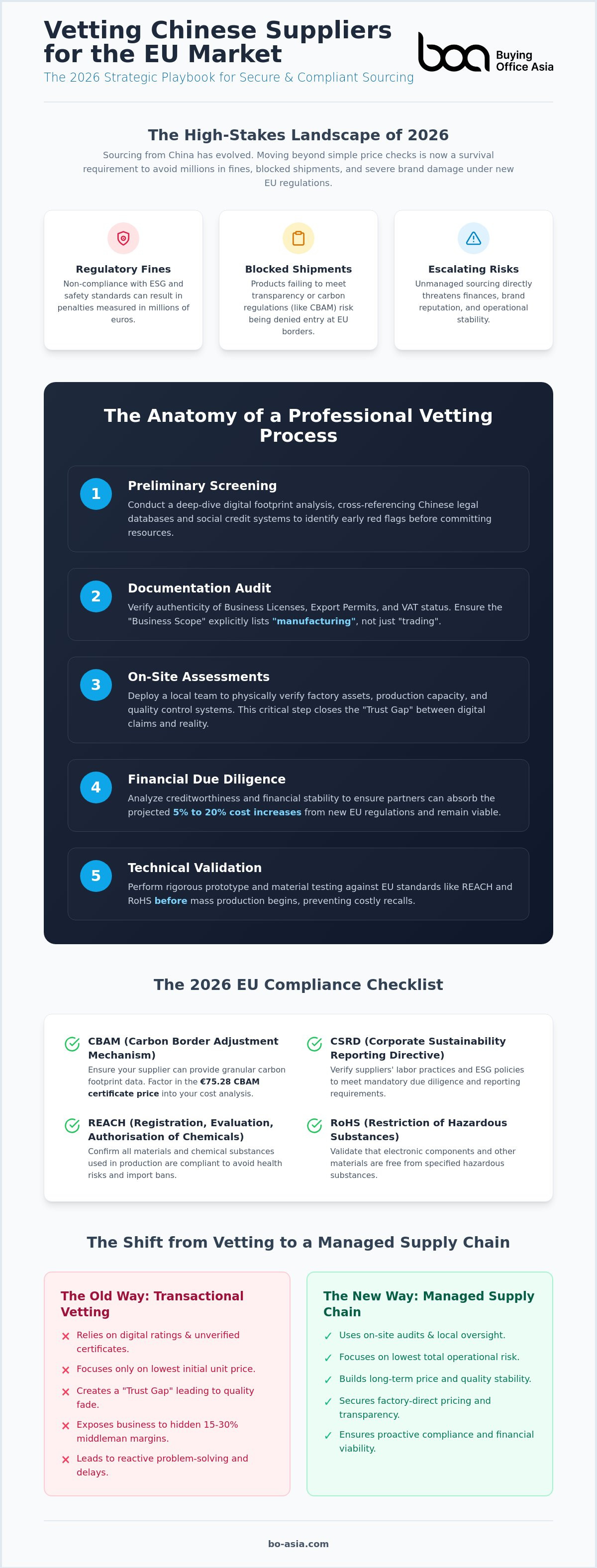
Executing a rigorous methodology for vetting Chinese suppliers for European market success requires moving beyond surface-level observations. You can't rely on digital self-reporting or unverified PDFs. A professional audit program transforms your procurement from a gamble into a calculated business operation. By following a structured five-step framework, you eliminate the "Trust Gap" that often leads to financial loss or regulatory non-compliance.
We perform a deep-dive digital footprint analysis, cross-referencing Chinese legal databases and social credit systems to identify red flags before you invest significant time.
You must verify the authenticity of Business Licenses, Export Permits, and VAT status. We ensure the "Business Scope" explicitly includes manufacturing, not just "trading" or "consulting."
This is the critical phase where we deploy our dedicated Asia procurement team to verify that the factory's physical assets match their digital claims.
We analyze creditworthiness to ensure your partner can withstand the 5% to 20% cost increases projected for 2026 due to new EU carbon and compliance regulations.
This involves rigorous prototype testing against EU standards, ensuring every material used is compliant with REACH and RoHS before mass production begins.
Physical proximity is your greatest defense against "ghost" factories entities that outsource your order to smaller, unvetted workshops. During an on-site quality control inspection, we measure actual production capacity against claimed output. We scrutinize machinery maintenance logs and tooling development capabilities. A dusty machine or a lack of organized maintenance schedules is a leading indicator of future quality fade. We look for robust Quality Management Systems (QMS) that function in practice, rather than just an ISO 9001 certificate hanging on a wall.
Hidden intermediaries are the primary source of obscured costs and operational friction. To secure the financial health of your supply chain, you must identify and eliminate these "middlemen" during the vetting phase. We utilize factory direct price negotiations to ensure 100% transparency in your cost structure. This includes a granular analysis of the Bill of Materials (BOM), which allows you to understand exactly what you're paying for raw materials versus manufacturing labor. If you want to secure your margins against 2026's rising tariffs, you can request a preliminary factory assessment to identify hidden inefficiencies in your current sourcing model.
Digital verification is a snapshot; vetting is a documentary. Many European importers fall into the trap of equating a "Gold Supplier" badge or a high transaction level on a digital marketplace with actual manufacturing competence. These ratings are often marketing assets that don't reflect a factory's ability to meet stringent EU safety or ESG requirements. When you rely on a static PDF certificate, you're essentially betting your brand's reputation on a document that may have been altered or issued to a different legal entity entirely. This "Trust Gap" between digital claims and factory reality is where most sourcing failures begin.
The vetting process must be viewed as a continuous lifecycle rather than a one-time gate. A common phenomenon known as "quality fade" occurs when a supplier gradually substitutes cheaper, non-compliant materials after the initial sample is approved. This isn't just an operational headache; it's a legal liability for European firms under the latest supply chain transparency rules. Integrating on-site quality control into your vetting strategy is the only way to detect these shifts before the goods leave the port. Unlike a transactional third-party inspector who follows a generic checklist, dedicated on-the-ground management ensures your technical requirements are upheld through every production cycle.
Identifying a high-risk supplier early saves your business from catastrophic financial loss. You should be prepared to walk away if you encounter these specific warning signs:
Any supplier refusing unannounced visits or on-site audits usually has something to hide, such as unauthorized sub-contracting.
Inconsistent bank account names, such as being asked to pay a Hong Kong entity when the factory is in Mainland China, often signal an obscured intermediary.
If a supplier can't or won't disclose the origins of their raw materials, they're likely non-compliant with EU REACH or RoHS standards.
The allure of "free" sourcing agents is a dangerous illusion. These agents typically collect kickbacks from the factory, which are then baked into your unit price. This lack of transparency often results in you paying 20% to 30% more in the long run while receiving zero protection against quality issues. Relying on a dedicated Asia procurement team removes these hidden layers, providing you with factory-direct pricing and honest reporting. For example, a Finnish brand we partnered with recently saw a significant boost in profitability simply by eliminating these obscured margins and gaining direct control over their tooling and material costs. By choosing transparency over transactional convenience, you protect both your margins and your brand's integrity.
Vetting Chinese suppliers for European market viability requires a fundamental shift in your procurement mindset. It's no longer enough to ask "can they build it?". In 2026, the question is "can they prove how they built it?". Compliance has become your primary license to operate. The General Product Safety Regulation (GPSR) is now fully enforced across all member states, mandating that every product sold in the EU has a designated economic operator and a comprehensive technical file. If your supplier cannot provide verifiable traceability data, your goods risk being seized at the border before they ever reach a customer.
Your 2026 vetting checklist must prioritize these four pillars of regulatory adherence:
While the CSDDD compliance deadline for large firms has moved to 2029, the Corporate Sustainability Reporting Directive (CSRD) already requires you to gather granular data from your supply chain. Suppliers must be vetted for their ability to report on labor practices and environmental impact.
REACH and RoHS compliance are non-negotiable. Vetting must include batch-specific testing protocols to ensure no restricted substances enter your production line.
To mitigate forced labor risks, you must verify social compliance through on-site SA8000 or BSCI audits. A paper certificate is insufficient; you need to see the working conditions for yourself.
Every partner must demonstrate a clear understanding of European harmonized standards and the technical requirements for CE marking.
Preparing for the Carbon Border Adjustment Mechanism (CBAM) is a financial necessity. With CBAM certificates priced at €75.28 per tonne in the second quarter of 2026, your procurement strategy must include audits of factory energy efficiency and waste management. We help you link ESG standards directly to your brand value, ensuring your supply chain isn't just a cost center but a stabilizing force for your reputation with European consumers.
Protecting your intellectual property starts during the vetting phase. Robust OEM/ODM contract manufacturing agreements are meaningless if you don't verify who actually owns the tooling on the factory floor. We vet for custom product development expertise, ensuring your factory can execute complex technical requirements while maintaining the high-volume output your growth demands. To ensure your partners meet these updated 2026 requirements, book a comprehensive compliance audit with our regional experts today.
A secure supply chain requires more than just a list of verified partners. It requires a permanent bridge between European strategic leadership and Asian operational reality. The "Helsinki-Hong Kong" model represents the gold standard for modern procurement. By combining European expertise in compliance and legal standards with a physical presence in Hong Kong, you gain the regional oversight necessary to protect your interests in real time. This dual-presence approach ensures that your strategic requirements aren't lost in translation or ignored during the pressures of mass production.
The transition from vetting Chinese suppliers for European market entry to active supplier development represents the final stage of procurement maturity. Vetting tells you if a factory is capable today; development ensures they remain competitive and compliant tomorrow. By moving away from transactional interactions, you build a resilient partnership that prioritizes long-term growth over short-term gains. This model eliminates the "middleman tax" entirely, providing you with 100% transparency and direct access to factory pricing and technical data.
Physical proximity is the only way to effectively manage lead times and prevent production bottlenecks. When your team is on the factory floor, you aren't waiting for an email update that might be days late. You're getting live data that allows for immediate course correction. This proactive oversight prevents mass production defects before they ship, saving you the catastrophic costs of air-freighting replacements or managing EU-wide recalls. Our dedicated Asia procurement team also optimizes your logistics strategy, identifying the most efficient routes to Europe to mitigate the impact of fluctuating freight costs.
Moving from unmanaged sourcing to a professional procurement model is a strategic shift that pays dividends in both security and financial health. You don't have to navigate the complexities of the 2026 regulatory landscape alone. Your next step should be an objective evaluation of your current partners to identify hidden risks and cost-saving opportunities. You can begin by evaluating the savings potential of a managed supply chain compared to your current intermediary model. To secure your brand's future and ensure full compliance with EU market entry requirements, contact Buying Office Asia for a professional briefing on your China sourcing strategy.
The 2026 regulatory environment leaves no room for ambiguity in your procurement strategy. By moving beyond digital ratings and embracing a physical, on-site audit methodology, you protect your brand from the financial and legal risks of non-compliance. Vetting Chinese suppliers for European market entry is now a continuous process of verification and development that ensures your partners meet every ESG and safety standard required by the EU. Success in this landscape requires a shift from transactional buying to a managed supply chain model that prioritizes transparency over convenience.
You don't have to manage this complexity from a distance. With European leadership based in Helsinki and a permanent on-the-ground presence in Hong Kong and Mainland China, we provide the regional accountability your business demands. We eliminate the hidden margins of traditional intermediaries, offering 100% transparency and factory-direct control over your production. It's time to transform your supply chain from a source of anxiety into a stable engine for long-term growth.
Secure your supply chain with a dedicated Asia procurement team today and gain the steady confidence of a managed, compliant, and cost-efficient operation. We're ready to help you build a resilient future.
You identify a factory by examining the "Business Scope" on their official Chinese business license. Manufacturers will explicitly list "production" or "processing," whereas trading companies are restricted to "wholesale" or "distribution." Verify the registered address; a legitimate factory operates in an industrial zone rather than a central business district office. Physical on-site verification is the only way to confirm these assets exist.
Mandatory documentation includes the Declaration of Conformity (DoC), technical files for CE marking, and batch-specific REACH and RoHS test reports. Under the 2026 General Product Safety Regulation (GPSR) updates, you also need to confirm the manufacturer has a designated economic operator within the EU. Failure to produce these documents during a customs audit will result in immediate shipment seizure and potential fines.
Trade Assurance is a transactional safeguard for payment, but it's not a substitute for vetting Chinese suppliers for European market compliance. It doesn't verify that a product meets EU chemical safety or ESG standards. While it offers protection against non-delivery, it provides zero defense against regulatory non-compliance or quality fade. You should treat it as a payment tool, not a due diligence strategy.
A factory audit assesses the supplier's systemic capability, while a quality inspection focuses on a specific production batch. You use an audit to evaluate machinery maintenance, labor practices, and quality management systems during the vetting phase. Inspections happen before shipment to ensure the final goods match your approved prototype and safety specifications. Both are essential for a secure supply chain.
The CSRD forces SMEs to become data-transparent to satisfy the reporting requirements of their larger European enterprise clients. Even if your company falls below the employee threshold, your buyers will demand granular ESG data from your Chinese suppliers. This shift makes vetting for environmental impact and social compliance a commercial necessity for SMEs wanting to remain part of major European distribution networks.
Remote vetting is insufficient for vetting Chinese suppliers for European market viability. Digital certificates and video calls are easily manipulated to hide unauthorized sub-contracting or poor working conditions. On-site presence allows for unannounced visits and direct verification of raw material origins. This physical oversight is the only way to ensure your supplier actually possesses the technical infrastructure they claim to have online.
Red flags include a mismatched business scope, a very low registered capital, or an inconsistent legal representative name. If the license was issued or significantly changed within the last six months, it may indicate a "phoenix company" designed to bypass previous debts or legal issues. You must cross-reference these licenses with the National Enterprise Credit Information Publicity System to ensure the data is current and accurate.
You protect your IP by executing NNN agreements (Non-use, Non-disclosure, Non-circumvention) governed by Chinese law before sharing tooling designs. During the vetting process, you must verify that the factory doesn't have a history of IP litigation. Ensuring that your contract manufacturing agreement explicitly defines tooling ownership is critical to preventing your designs from being sold to competitors or used without your authorization.

What if your signed OEM agreement protects the product on paper but leaves the factory unclear about what to make, when to deliver it, or how quality will be judged? That gap is where an oem manufacturing agreement china project can lose control: responsibilities blur between buyer, sourcing interme...

What if the safest payment deal isn’t the one that delays the most cash, but the one that releases it only when progress is verifiable? Payment terms negotiation with Asian suppliers is about balancing your working capital with the supplier’s need for confidence, not simply pushing for a smaller dep...

What if your biggest supply chain risk isn’t the supplier you chose, but what you can’t see after the order is placed? Asia procurement services can connect supplier selection with factory follow-through, giving you clearer visibility into production, product quality, and responsibilities along the...