


For many US enterprises, the transition to sourcing from Vietnam to USA is no longer an optional experiment but a survival mandate. You're likely feeling the pressure of escalating Section 301 tariffs and rising labor costs in traditional manufacturing hubs, yet the prospect of managing a new territory from several time zones away often creates more anxiety than it solves. Relying on unmanaged local agents or digital platforms often leads to a lack of transparency that puts your margins at risk. We understand that your priority isn't just finding a factory; it's securing a predictable, high-quality production line that withstands regulatory scrutiny.
This guide provides the tactical blueprint you need to master the complexities of the 2026 trade landscape. You'll learn how to navigate the latest USTR investigations into intellectual property and labor practices while maintaining factory-direct quality through on-the-ground expertise. We'll preview the essential steps for supplier vetting, tariff mitigation strategies, and the logistical frameworks required to turn Vietnam into your most reliable competitive advantage. By the end of this briefing, you'll have the tools to replace uncertainty with a controlled, professional procurement strategy.
• Diversify your supply chain strategically to hedge against Section 301 tariffs and the rising labor costs currently impacting traditional manufacturing hubs.
• Focus your sourcing from Vietnam to USA on high-value sectors like electronics and apparel to maximize your competitive advantage in the 2026 market.
• Master the "Rules of Origin" and regulatory compliance standards to secure preferential trade status and avoid the financial risks of illegal transshipment.
• Replace the uncertainty of digital-only platforms with a dedicated on-the-ground presence to ensure 100% transparency and eliminate hidden intermediary costs.
• Leverage European-managed procurement expertise to maintain total control over factory-direct negotiations and mass production quality.
US enterprises are currently facing a pivotal moment in global procurement. The decision to expand sourcing from Vietnam to USA is driven by more than just immediate savings. It represents a fundamental restructuring of supply chain resilience in response to geopolitical volatility and the persistent weight of Section 301 tariffs. By 2026, Vietnam has matured from a mere alternative to a sophisticated manufacturing powerhouse that offers a stabilizing force for your operations. This shift isn't a temporary trend; it's a strategic realignment intended to protect long term financial viability.
The "China Plus One" approach has evolved from a defensive backup plan into a standard operating requirement for high-volume producers. Diversifying your manufacturing footprint reduces over-reliance on a single geographic source, effectively neutralizing the "single point of failure" risks that crippled many businesses in previous years. Using Vietnam as a secondary hub for your core production lines ensures that your supply chain remains operational even when trade tensions or logistics bottlenecks strike other regions. It's a calculated move to protect your margins and your brand's reputation for reliability.
Vietnam's strategic position is bolstered by its extensive network of free trade agreements. While the US isn't a member of the CPTPP, Vietnam’s participation in this pact and the EVFTA with Europe has forced a rapid modernization of its regulatory and environmental standards. This elevates the overall quality of the industrial ecosystem you'll be entering. Understanding the history of U.S.-Vietnam trade reveals a trajectory of increasing cooperation that provides a more predictable environment for long term investment compared to high-tariff jurisdictions.
The labor cost trajectory remains a significant draw for US firms. Vietnam’s labor force reached approximately 53.6 million people in early 2026, offering a deep pool of talent at a competitive price point. This advantage is amplified by the government's "Industry 4.0" roadmap, which is narrowing the technology gap with China by integrating automation and digital oversight into local factories. By 2026, the complexity of sourcing from Vietnam to USA requires more than just a search on a B2B platform; it demands a deep understanding of these local industrial shifts. Successful transition requires a dedicated Asia procurement team to vet these emerging high-tech facilities and ensure they meet your specific technical requirements.
Vietnam isn't a one-size-fits-all solution for every product line. Success in sourcing from Vietnam to USA requires matching your product category with the specific regional industrial clusters that have the infrastructure to support your volume. Official U.S.-Vietnam trade statistics show a diversified export portfolio, but apparel, electronics, and furniture remain the dominant pillars for US buyers. Understanding these regional strengths is the first step in de-risking your procurement strategy.
The northern provinces of Bac Ninh and Thai Nguyen, often called the "Hanoi Hub," have become a global epicenter for consumer electronics and automotive components. Major investments from tech giants have created a sophisticated ecosystem of tier-1 and tier-2 suppliers. For US enterprises, the challenge lies in identifying facilities capable of high-level OEM manufacturing that meet Western intellectual property standards. These clusters offer the technical precision required for complex assembly, but you need on-site vetting to confirm that a factory's internal quality controls align with your brand's requirements. It's about finding the right balance between technical capability and regulatory adherence.
Vietnam's garment industry is projected to reach nearly $50 billion in exports by 2026, with the US market consuming over 40% of that output. While the north handles heavy tech, the south, particularly around Ho Chi Minh City, remains the premier destination for textiles and accessories. This region hosts the established infrastructure used by global brands like Nike and Lululemon. However, the 2026 landscape demands more than just capacity. You must navigate increasingly strict ESG and sustainability standards. Managing these textile mills requires a hands-on approach to ensure that your supply chain is free from the labor risks that trigger modern trade penalties. If you're unsure which regional cluster best fits your specific product category, it's worth speaking with a regional expert to map your procurement strategy.
US retailers are also increasingly moving high-volume furniture and home goods orders to Vietnam to capitalize on the country's mature woodworking and upholstery sectors. The shift is particularly visible in outdoor furniture and home decor, where Vietnamese factories have surpassed traditional hubs in both cost efficiency and design flexibility. This sector is a prime example of where sourcing from Vietnam to USA offers a direct hedge against the volatility of other high-tariff jurisdictions. By leveraging these established sectors, you can secure a more stable and financially viable production base for the years ahead.
Executing a successful strategy for sourcing from Vietnam to USA requires more than just finding a capable factory. You must master the regulatory and logistical framework that governs the movement of goods across the Pacific. While Vietnam offers a significant escape from the heavy Section 301 duties levied on many Chinese imports, it's not a tariff-free vacuum. Your margins depend on your ability to prove "substantial transformation" and adhere to strict US Customs and Border Protection (CBP) requirements.
The trade landscape is shifting. In May 2026, the USTR initiated a Section 301 investigation into Vietnam's intellectual property practices, and a proposed 12.5% tariff related to forced labor concerns is currently under review. These developments mean that "Made in Vietnam" labels are under higher scrutiny than ever before. You must ensure your products qualify for preferential trade status by meeting specific Rules of Origin. Minor assembly of Chinese-made components won't suffice; CBP is actively auditing for illegal transshipment. Professional supplier vetting is your primary defense, ensuring your partners maintain the transparent documentation required to survive a government audit.
Logistics in Vietnam are defined by two primary gateways. The port of Hai Phong in the north serves the electronics clusters near Hanoi, while the ports around Ho Chi Minh City handle the massive volume of textiles and furniture. Because the key manufacturing sectors in Vietnam are geographically concentrated, your choice of port is usually decided by your product category. Transit times to the US West Coast typically range from 18 to 28 days, but reaching the East Coast can take up to 45 days. You'll need to factor these timelines into your inventory planning to avoid stockouts.
Managing the "hidden costs" of international shipping is where many enterprises stumble. Beyond the base freight rate, you must account for the Merchandise Processing Fee (MPF), currently 0.3464%, and the Harbor Maintenance Fee (HMF) at 0.125% for ocean arrivals. These expenses, combined with customs bond fees and documentation charges, can erode your projected savings if they aren't modeled upfront. This level of detail is why logistics management is a non-negotiable part of end-to-end sourcing. It's about creating a predictable, financially viable pipeline that removes the anxiety of unforeseen expenses. By 2026, the complexity of sourcing from Vietnam to USA demands a partner who manages these moving parts with the precision of a seasoned insider.
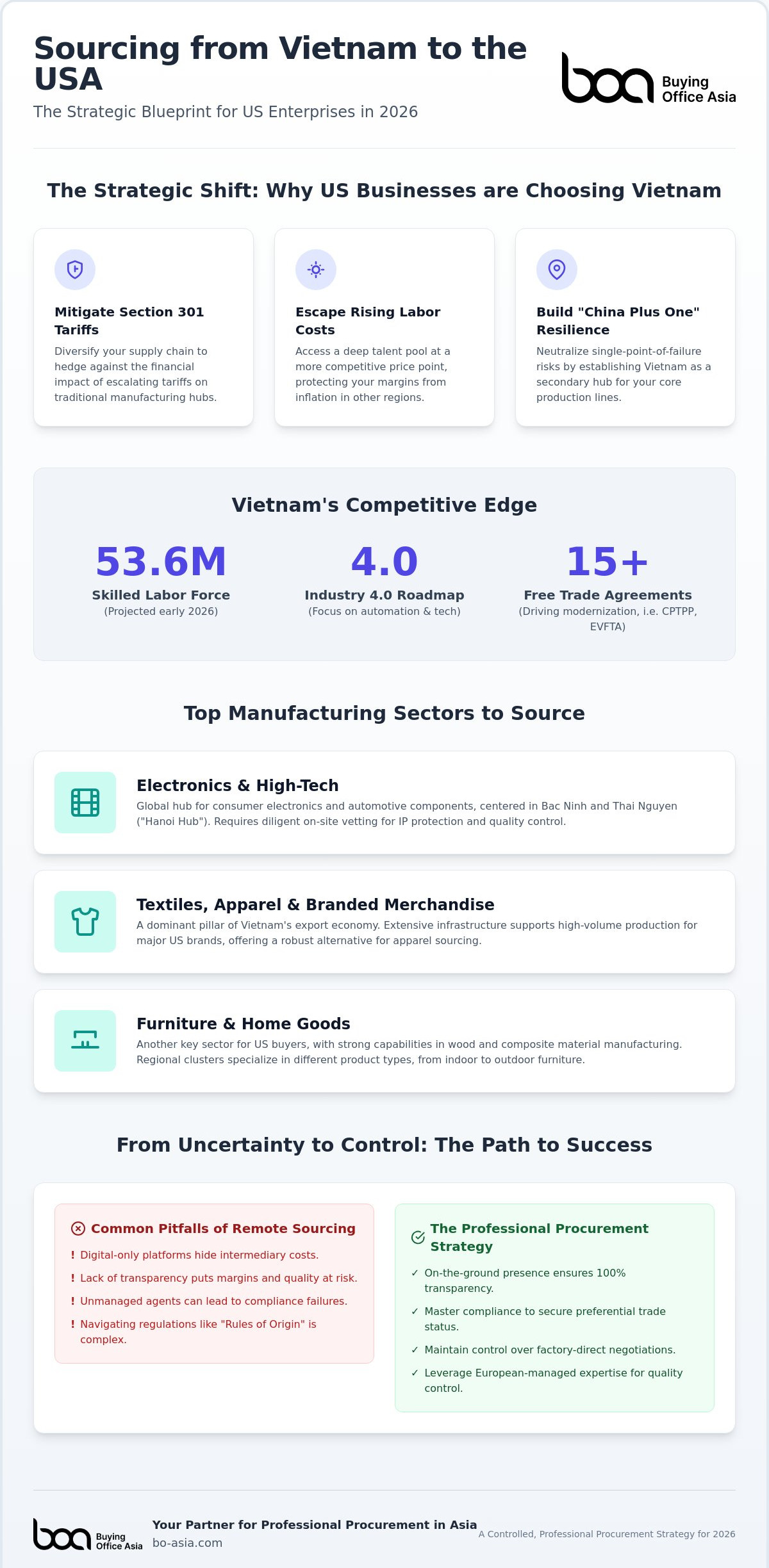
Digital platforms offer a facade of security that rarely survives the first mass production run. Many US enterprises fall into the trap of "Alibaba safety," assuming that a gold supplier badge or a verified video replaces the need for physical oversight. In the Vietnamese market, these digital markers don't account for the ground reality of factory subcontracting or equipment maintenance. When sourcing from Vietnam to USA, you aren't just buying a product; you're investing in a process that requires constant, physical validation to remain financially viable.
The "Middleman Trap" is a persistent threat to your margins. Local agents often lack the transparency required by sophisticated US corporations, frequently operating on kickback models or obscured costs that are buried within your unit price. These unmanaged supply chains create a lack of control that leads to unforeseen expenses and missed deadlines. We position ourselves as a stabilizing force, rejecting the traditional intermediary model to function as an integrated extension of your own team. This proximity ensures that every dollar you spend is accounted for and every production milestone is met with professional rigor.
A business license is merely an entry requirement, not a proof of competence. Our process moves beyond basic documentation to assess technical capability, tooling quality, and ethical compliance on-site. We verify that a factory actually possesses the machinery they claim to have and that their production capacity isn't being falsified through unauthorized subcontracting. These rigorous factory audits serve as your first line of defense against brand risk and operational setbacks. If you're concerned about hidden vulnerabilities in your current setup, connect with our regional office today for a professional assessment of your potential partners.
Quality fade is the silent margin killer in international manufacturing. It's a common phenomenon where the first 1,000 units meet specifications, but the subsequent 10,000 show a steady decline in material quality or craftsmanship. Preventing this requires a dedicated Asia procurement team that maintains a constant presence on the factory floor. By issuing detailed inspection reports and conducting compliance verification at every production stage, we ensure that the final shipment matches the approved sample. This hands-on oversight is what transforms sourcing from Vietnam to USA from a high-risk venture into a predictable, scalable competitive advantage.
Successfully sourcing from Vietnam to USA requires more than a local contact; it demands a partner who operates with the same level of professional rigor as your own executive team. We provide a unique hybrid model that combines European-standard management with deep regional expertise. By managing the entire procurement lifecycle from our strategic hubs in Hong Kong and Helsinki, we ensure your interests are protected at every stage of the journey. This structure provides the same level of oversight usually reserved for major global enterprises, yet remains accessible to independent business owners looking to scale.
Our philosophy is built on 100% transparency. We've explicitly rejected the conventional intermediary models that rely on hidden commissions or factory kickbacks. These obscured costs are the primary source of inefficiency in unmanaged supply chains. Instead, we function as an integrated extension of your team. You gain total visibility into the true cost of production, which allows for more accurate financial forecasting and improved long-term viability. We don't just facilitate a transaction; we build a defense against the operational setbacks that affect unmanaged procurement.
Our primary objective is to improve your profitability through factory-direct price negotiations. Because we operate locally, we can bypass the layers of trading companies that inflate unit costs. You benefit from a dedicated sourcing team that answers exclusively to you, not the factory. This alignment of interests is critical when managing high-volume production runs where even a minor price discrepancy can significantly impact your bottom line. Our success stories in the Vietnamese market demonstrate that a controlled, managed presence is the only way to achieve consistent results in 2026.
Bridging the time zone and cultural gap between the USA and Southeast Asia is one of the most difficult hurdles in international trade. Miscommunications often lead to production delays or quality failures. Our Helsinki leadership office ensures European-standard accountability, while our regional teams handle the day-to-day mechanics of factory management. This dual-presence model provides you with a stabilizing force in a complex global market. You get the steady confidence of an established expert who understands both the local manufacturing nuances and the high expectations of the US market. If you're ready to diversify your operations with calm assurance, contact Buying Office Asia for a consultation to discuss your specific requirements.
By 2026, sourcing from Vietnam to USA has become a sophisticated strategic hedge. Partnering with a professional procurement team allows you to navigate the complexities of tariffs, logistics, and quality control without the typical anxieties of international manufacturing. We provide the regional networks and technical expertise you need to turn Vietnam into your most reliable competitive advantage.
The 2026 trade environment requires more than just a search for lower labor costs. It demands a sophisticated approach to sourcing from Vietnam to USA that prioritizes transparency and regulatory compliance. You've seen that success relies on identifying the right regional clusters and maintaining a physical presence to prevent quality fade. By eliminating the "Middleman Trap" and securing factory-direct negotiations, you protect your margins from unforeseen expenses and shifting trade policies.
Buying Office Asia provides the stabilizing force your enterprise needs. Our European-managed teams offer 100% transparency and a permanent on-the-ground presence in key manufacturing hubs. We act as a professional extension of your team, ensuring every production run meets your exact standards from Helsinki to Ho Chi Minh City. Our expertise in high-volume sourcing and rigorous factory-direct negotiations removes the anxiety of international manufacturing.
Secure your Vietnam supply chain with a dedicated Asia procurement team and turn regional complexity into a scalable business advantage. Your path to a resilient, high-volume supply chain starts with the right partner.
Labor costs in Vietnam remain significantly lower than in China's mature manufacturing hubs, but your total savings depend on the specific product category and tariff exposure. With an employed labor force of approximately 52.5 million people, Vietnam offers a deep pool of competitive talent. However, you must account for logistics and raw material imports, as many Vietnamese factories still rely on Chinese components for assembly.
The primary risks include intellectual property protection and the threat of illegal transshipment audits by US Customs. The USTR initiated a Section 301 investigation into Vietnam’s IP practices in May 2026, and a proposed 12.5% tariff regarding labor concerns is currently under review. These regulatory shifts require constant monitoring and professional vetting to protect your brand's financial viability.
Reliable manufacturers are best identified through on-site vetting and major trade events like the Vietnam International Sourcing Expo 2026, scheduled for September 3 to 5 in Ho Chi Minh City. You shouldn't rely on digital platforms alone. A physical audit is necessary to verify that a factory possesses the actual technical capability and ethical standards required for your production lines.
Shipping from Vietnam to the US West Coast typically takes 18 to 28 days for port-to-port ocean freight. If you are shipping to the East Coast, expect transit times between 30 and 45 days. Air freight remains a viable option for high-value electronics or urgent samples, offering door-to-door delivery in approximately 5 to 10 days.
While you can buy directly, the lack of transparency often leads to obscured costs and "quality fade" during mass production. Using a dedicated procurement team ensures you have an advocate on the ground who negotiates factory-direct pricing without hidden commissions. This approach transforms sourcing from Vietnam to USA into a controlled, professional operation rather than a high-risk transaction.
Section 301 tariffs currently target specific Chinese goods, allowing many Vietnamese imports to enter the US under standard Most Favored Nation duty rates. However, you must prove that "substantial transformation" occurred within Vietnam. US Customs is actively auditing shipments to ensure companies aren't simply re-routing Chinese goods to avoid duties, which makes transparent documentation essential.
You should expect quality standards that align with global leaders like Samsung and Intel, who have established significant operations in the region. However, maintaining these standards across high-volume runs requires rigorous on-site inspections at every production stage. Without a permanent on-the-ground presence, you risk a decline in craftsmanship once the initial samples are approved.
Vietnam is fully equipped to handle high-volume OEM and ODM manufacturing, particularly in the electronics and textile sectors. The industrial clusters around Hanoi and Bac Ninh have matured significantly, offering the infrastructure needed for complex assembly. Success in these high-volume runs depends on having a team that manages the factory relationship as an integrated extension of your own brand.

What if your biggest supply chain risk isn’t the supplier you chose, but what you can’t see after the order is placed? Asia procurement services can connect supplier selection with factory follow-through, giving you clearer visibility into production, product quality, and responsibilities along the...

A supplier listing can open a door, but it can’t show whether a factory is right for your order. Choosing a ningbo sourcing agent means looking beyond access to local suppliers: you need clear oversight of supplier vetting, production follow-up, and quality checks. Without defined responsibilities,...

What if the supplier with the strongest online profile isn’t the factory best suited to your shoes? In footwear manufacturing in China, a directory listing can start your search, but it can’t confirm who will make your product, whether the factory can handle its construction and materials, or how cl...