


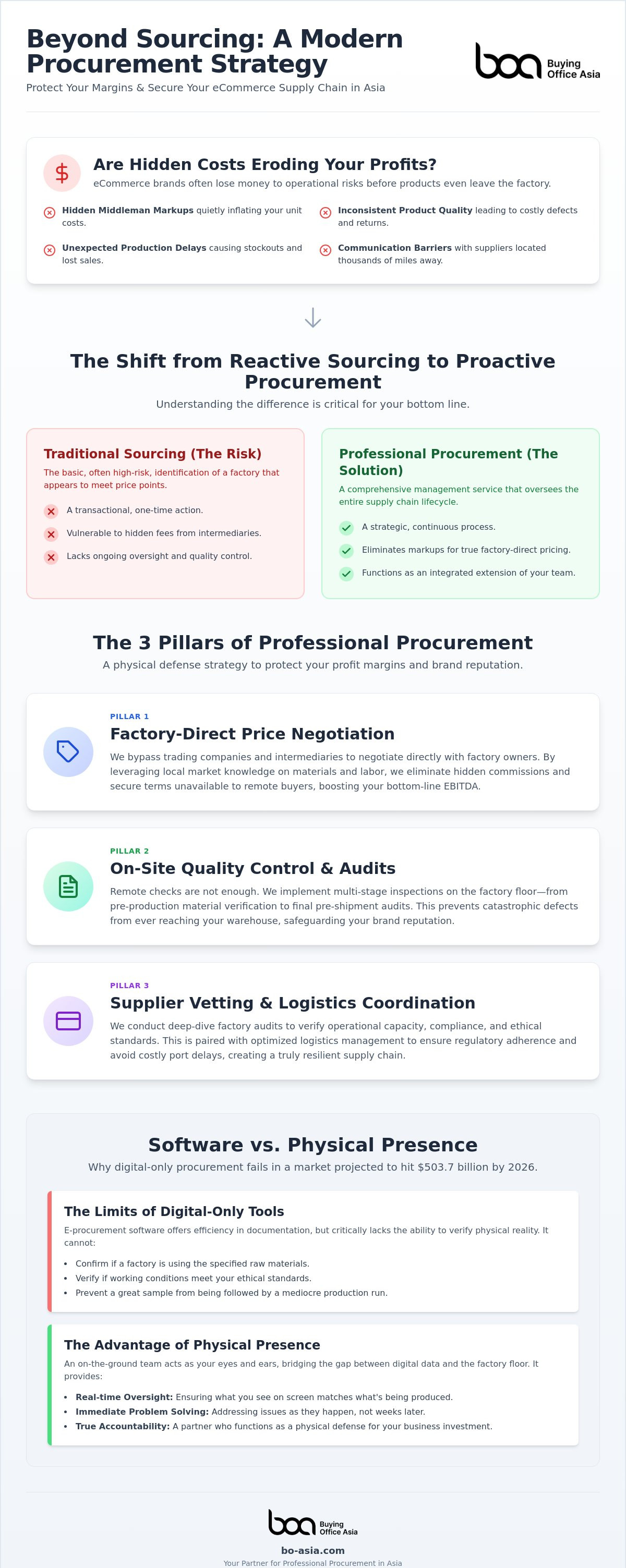
Most eCommerce brands don't realize that hidden middleman markups and "ghost" commissions are quietly eroding their profit margins before a single unit even leaves the factory floor. You've likely felt the frustration of inconsistent product quality. Perhaps you've dealt with the uneasy silence that follows a production delay when you're thousands of miles away. It's a common anxiety for brands scaling manufacturing for ecommerce brands in Asia, where communication barriers and a lack of real-time oversight often lead to expensive operational setbacks.
You'll learn how to transition from unmanaged, high-risk sourcing to a professional procurement model that secures your supply chain and protects your brand reputation in 2026. We examine the mechanics of achieving factory-direct pricing without hidden fees. This includes implementing on-site quality control that functions as an extension of your own team. From navigating the new 12% VAT requirements in Indonesia to managing rising labor costs in Vietnam, we'll outline a strategy for building a resilient, transparent supply chain that acts as a physical defense for your business.
• Move beyond basic sourcing to a strategic procurement model that functions as an integrated extension of your own internal team.
• Secure true factory-direct pricing by identifying and eliminating the hidden middleman markups that often compromise manufacturing for ecommerce brands in Asia.
• Safeguard your brand reputation through rigorous, on-site quality control and factory audits that eliminate defective batches before they ship.
• Understand why physical verification and regional proximity provide a necessary defense against the operational risks of digital-only supply chain tools.
• Identify immediate cost-saving opportunities by auditing your current supply chain for hidden fees and production inefficiencies.
In 2026, professional procurement is much more than a back-office function; it's a strategic defense for your profit margins. It's defined as a comprehensive management service that oversees your entire supply chain, from the initial factory vetting to the final delivery at your warehouse. For high-growth companies, the era of simple, transactional sourcing is over. Success now requires a shift toward integrated procurement services that provide real-time oversight and financial protection. Relying on digital directories is no longer enough when the Southeast Asian cross-border e-commerce market is projected to reach $503.7 billion by the end of 2026. You need more than just a login; you need a partner who bridges the gap between digital data and physical factory reality.
Manufacturing for ecommerce brands in Asia presents unique challenges that software alone cannot solve. While e-procurement tools offer efficiency in documentation, they lack the ability to verify if a factory is actually using the specified raw materials or if the working conditions meet your ethical standards. Professional procurement fills this void by placing experienced eyes on the production floor. This physical presence ensures that what you see on your screen matches what's being packed into your shipping containers.
It's easy to confuse these terms, but the distinction is critical for your bottom line. Sourcing is the identification phase. It's the process of finding a factory that appears to meet your technical requirements and price point. Procurement is the execution phase. It involves managing the contracts, ensuring production flows according to schedule, and maintaining rigorous quality standards. Professional sourcing and procurement prevents the common pitfalls where a great sample is followed by a mediocre production run. It ensures your brand's standards are upheld throughout the entire lifecycle of the product.
Effective management requires a multi-layered approach to protect your investment. When scaling manufacturing for ecommerce brands in Asia, your strategy must include these three pillars:
We conduct deep-dive factory audits to ensure operational compliance and ethical standards. This isn't a surface-level check; it's a physical verification of the factory's actual capacity.
We focus on achieving true factory-direct pricing. This means stripping away the hidden markups and "ghost" commissions that intermediaries often hide in your unit costs.
Managing international transport is about more than just booking a container. It's about optimizing routes and ensuring regulatory adherence to avoid costly port delays.
Scaling a brand requires moving beyond the "hope and pray" method of international sourcing. To maintain profitability, you must treat your supply chain as a physical defense strategy. Professional procurement rests on three specific pillars designed to eliminate financial leakage and operational risk. By focusing on these areas, you ensure that your manufacturing for ecommerce brands in Asia remains a competitive advantage rather than a liability.
Many brands fall for the myth that the lowest price is found on public B2B platforms. In reality, these sites are often crowded with trading companies posing as manufacturers. Our on-the-ground presence allows us to bypass these intermediaries and negotiate directly with factory owners. We leverage local market knowledge, such as current raw material costs and regional labor rates, to secure terms that are unavailable to remote buyers. Eliminating hidden commissions and intermediary markups ensures that every dollar saved at the source flows directly into your bottom-line EBITDA.
Remote quality checks are insufficient for the complexities of mass production. If you only discover a defect after the container arrives at your warehouse, the cost of returns and brand damage can be catastrophic. We implement a multi-stage inspection process including pre-production material checks, mid-production monitoring, and final pre-shipment audits. This rigorous oversight is essential for eCommerce supply chains in Asia, where consistency is the primary driver of customer lifetime value. High-quality production runs lead to fewer returns and stronger reviews, which are the lifeblood of any digital brand.
Modern consumers in 2026 demand more than just a functional product; they demand ethical production. Maintaining a 100% transparent audit trail is no longer optional for brands that value their reputation. This begins with deep-dive supplier vetting to ensure factories meet both your operational needs and international ESG standards. We provide a clear line of sight into every manufacturing activity, protecting you from the legal and reputational risks associated with unmanaged supply chains. If you're concerned about your current factory's compliance, you can speak with our regional experts to discuss an immediate audit.
These pillars provide the stability needed to navigate a complex global market. By removing hidden markups, enforcing quality at the source, and ensuring ethical transparency, you build a supply chain that supports long-term growth and protects your hard-earned margins.
Software can't smell smoke or feel the texture of a fabric. While ERP systems, such as those provided by NaviWorld (Thailand) Co., Ltd., are useful for tracking paperwork, they're fundamentally blind to what happens on the factory floor. For those scaling manufacturing for ecommerce brands in Asia, relying solely on digital dashboards creates a dangerous distance between your brand and your products. A "digital twin" of your supply chain is only as accurate as the physical verification backing it up. Without a human presence to confirm that the raw materials match the specifications, your software is simply reporting what the factory wants you to see. Paper compliance is a major risk in international trade; certificates can be forged or outdated, and only an on-site audit can confirm the truth.
The gap between data and reality is where most financial leakage occurs. When you rely on digital-only tools, you're essentially trust-falling into a complex production environment without a safety net. This lack of oversight often leads to "ghost" production batches or unauthorized sub-contracting, both of which compromise your brand's integrity. To scale safely, you need an integrated approach that combines modern data tracking with the steady confidence of a partner who is physically present at the source.
Major B2B portals often present a sanitized version of reality. Brands frequently fall into the "Alibaba Trap," assuming that a high rating on a portal guarantees production integrity. In reality, bait-and-switch tactics are common. A factory might send a perfect gold-standard sample but substitute cheaper components during mass production. Professional oversight prevents these costly errors before they reach your customers. You can see the impact of this intervention in our documented savings examples, where physical audits identified risks that digital tools missed entirely.
Effective supply chain management requires a balance of high-level corporate strategy and local operational grit. Having a partner with a European headquarters and a physical presence in hubs like Hong Kong and Mainland China ensures that your standards aren't lost in translation. This regional proximity is crucial for managing logistics connectivity for eCommerce, where local knowledge can bypass bottlenecks that stall unmanaged shipments. By utilizing a dedicated Asia procurement team, you gain a level of accountability that software alone cannot provide. Our teams act as your eyes and ears, ensuring that every production milestone is met with precision and transparency.
Moving from ad-hoc sourcing to a professional model is a critical pivot for any brand exceeding the startup phase. When you're scaling manufacturing for ecommerce brands in Asia, the complexity of your supply chain grows exponentially with your order volume. You can't rely on the same informal methods that worked for your first few hundred units. A professional transition requires a systematic audit of your current operations to identify where quality is leaking and where margins are being eroded by unmanaged intermediaries. By integrating a procurement team as an extension of your own operations, you regain control over your financial health and production timelines.
The first step in this transition is selecting a partner that operates with a transparent fee structure. You must move away from the traditional "hidden commission" model where intermediaries take a percentage of the unit price without your knowledge. Instead, look for a service that provides a clear audit trail for every dollar spent. This transparency allows you to define your requirements for OEM or ODM production standards with the confidence that your specifications are being met at the true factory-direct cost.
Before you can optimize, you must evaluate your current vulnerabilities. Use this checklist to determine if your current supplier performance is sustainable:
• Are your lead times consistent, or do they fluctuate without clear explanation?
• Do you have a documented record of every defect found in the last three production runs?
• Can you verify the actual manufacturer of your goods, or are you dealing with a trading company?
• Is there a clear process for managing custom tooling and Intellectual Property?
The "tipping point" for professional procurement usually occurs when the cost of quality failures and middleman markups exceeds the investment in professional oversight. Procurement ROI for a mid-market brand is the measurable increase in EBITDA achieved by recapturing hidden margins and eliminating the total cost of defective returns. For Australian industrial leaders, these supply chain refinements are most effective when paired with the comprehensive growth strategies offered by Co-Advisor, ensuring that recovered margins are reinvested into sustainable business expansion.
Transitioning from simple sample approval to rigorous mass production oversight is where brand reputations are built. This phase requires setting clear KPIs for both your procurement partner and your manufacturers, focusing on on-time delivery and first-pass yield rates. To manage custom tooling and product development without IP risk, you must ensure that all contracts are locally enforceable and that your partner has a physical presence to monitor factory floor activities. This level of oversight ensures that your brand's growth is supported by a stable, scalable foundation. To begin securing your supply chain, schedule a supply chain audit with our team today.
In a digital world, accountability is often the first casualty of distance. Buying Office Asia bridges the gap between your headquarters and the factory floor by combining European leadership with deep regional expertise. We don't just offer advice; we provide a physical presence in key manufacturing hubs like Hong Kong and Mainland China. This proximity ensures that your production standards are never compromised by distance or cultural misinterpretation. While others rely on digital dashboards, we function as your "on-the-ground" eyes and ears, managing the complexities of manufacturing for ecommerce brands in Asia with the steady confidence of a seasoned insider.
Our model is built for ambitious brands that require high-volume scalability without the typical anxieties of international trade. We act as a stabilizing force, protecting your brand from the unforeseen expenses and quality leaks that often plague unmanaged supply chains. By positioning ourselves as an integrated extension of your own team, we provide the same level of oversight usually reserved for major global enterprises.
Traditional sourcing agents often operate on a flawed model of hidden kickbacks and "ghost" commissions. They may claim to work for you while taking a percentage from the factory side, which creates a fundamental conflict of interest. This lack of transparency is the primary source of obscured costs in most supply chains. Our commitment to 100% transparency is a core part of the Buying Office Asia philosophy. We utilize a fee-based, zero-commission model that perfectly aligns our interests with your profitability. When we negotiate, we're fighting for your bottom line, not our own internal margins. This approach ensures that every dollar saved through our factory-direct negotiations stays in your business.
Scaling your brand requires moving beyond transactional help toward a long-term supply chain partnership. A dedicated procurement team provides the continuity needed to maintain production stability as your order volumes grow. You gain immediate access to our vetted network of top-tier manufacturers across Asia, bypassing the high-risk trial-and-error phase that stalls many growing companies. We handle the rigorous factory audits and mass production oversight, allowing you to focus on marketing and customer acquisition. If you're ready to move beyond unmanaged sourcing and secure your profit margins, contact Buying Office Asia to professionalize your procurement and build a resilient supply chain for 2026.
Transitioning to a professional procurement model is the final step in maturing your supply chain strategy. We've explored how moving beyond digital directories and implementing on-site quality control protects your brand from the operational risks of unmanaged sourcing. By eliminating hidden middleman markups and prioritizing 100% transparency, you secure the margins necessary for long-term scalability. Manufacturing for ecommerce brands in Asia doesn't have to be a source of anxiety when you have a partner who functions as a physical extension of your own team.
Our European-managed team provides the local Hong Kong expertise needed to navigate complex regional markets with ease. We offer a vetted network of Tier-1 manufacturers and a zero-commission model that ensures your financial interests always come first. This level of oversight provides the steady confidence you need to scale your operations without compromising on integrity. Your brand's growth deserves a supply chain built on accountability and professional rigor.
Secure Your Supply Chain with Buying Office Asia to begin your transition toward a more resilient and profitable manufacturing strategy today.
A sourcing agent typically focuses on the initial identification of a supplier, whereas a procurement service manages the entire lifecycle of the production and supply chain. This includes contract execution, logistics, and ongoing supplier development. For those scaling manufacturing for ecommerce brands in Asia, procurement acts as an integrated extension of your team, providing continuous oversight rather than a one-off introduction.
Procurement services provide a physical defense against defects through multi-stage, on-site inspections. Instead of relying on factory-provided photos, professional teams conduct pre-production, mid-production, and pre-shipment audits. This rigorous process identifies quality leaks before goods leave the factory floor, preventing the catastrophic costs of defective returns and protecting your brand reputation in the global marketplace.
Factory-direct pricing is superior because it removes the hidden markups and "ghost" commissions often embedded in trading company quotes. When you work directly with the manufacturer, you gain transparent insight into material costs and labor rates. This direct relationship also ensures that your technical specifications are communicated without the distortion of an intermediary, resulting in higher product consistency and better long-term margins.
Professional procurement services actively support custom product development by managing the technical sampling and tooling phases. They ensure that your Intellectual Property is protected through locally enforceable contracts and physical monitoring of the production site. This oversight is vital for manufacturing for ecommerce brands in Asia that require proprietary designs or complex OEM modifications to stand out in a competitive digital landscape.
Professional procurement fees are typically structured through a transparent, service-based model rather than hidden commissions. Most established firms offer either a fixed monthly retainer for dedicated team access or a project-based fee that aligns with the complexity of the supply chain management required. This approach ensures that the service provider’s interests are aligned with your profitability rather than the factory's sales volume.
Having an on-the-ground team reduces risk by providing immediate accountability and real-time problem-solving at the source. Physical proximity allows for unannounced factory visits and direct verification of production milestones, which a digital-only approach cannot provide. This regional presence acts as a stabilizer against the operational setbacks, communication barriers, and unforeseen expenses that frequently affect unmanaged international supply chains.
Hiring a professional service is highly beneficial for mid-volume production if your brand is in a growth phase or operates in a high-stakes category. The cost of a single defective batch or a significant shipping delay can be devastating for a mid-market brand. Professional oversight ensures that your supply chain is built for scalability, allowing you to transition smoothly to high-volume production without losing control over your margins.
You ensure transparency by selecting a partner that operates under a zero-commission model and provides a 100% transparent audit trail for all financial transactions. A truly transparent partner will allow you to see the original factory invoices and will never accept kickbacks or hidden fees from suppliers. This commitment to ethical standards and financial optimization is what distinguishes a professional procurement partner from a traditional intermediary.
What if your signed OEM agreement protects the product on paper but leaves the factory unclear about what to make, when to deliver it, or how quality will be judged? That gap is where an oem manufacturing agreement china project can lose control: responsibilities blur between buyer, sourcing interme...

What if the safest payment deal isn’t the one that delays the most cash, but the one that releases it only when progress is verifiable? Payment terms negotiation with Asian suppliers is about balancing your working capital with the supplier’s need for confidence, not simply pushing for a smaller dep...

What if your biggest supply chain risk isn’t the supplier you chose, but what you can’t see after the order is placed? Asia procurement services can connect supplier selection with factory follow-through, giving you clearer visibility into production, product quality, and responsibilities along the...