


If your 2026 procurement strategy relies on a "verified" badge from an online portal, you aren't just taking a risk; you're likely overpaying a middleman for a factory that lacks the technical capacity to deliver. The "bait and switch" remains a common industry scar, where a flawless prototype is followed by a mass production run that fails every quality check. You likely recognize the frustration of technical specs lost in translation or the sudden realization that your "factory contact" is actually a trading company adding a significant markup to every unit without adding any value.
This guide provides a strategic framework for vetting custom product manufacturers in China to eliminate these hidden costs and operational setbacks. You'll learn how to move beyond superficial checks and implement rigorous, on-site audits that ensure your partner can handle complex tooling and technical requirements. We'll examine the new 2026 ESG disclosure standards and supply chain security regulations that now define the manufacturing landscape. By the end, you'll have a roadmap to secure factory-direct pricing and maintain full transparency into the production floor, turning your supply chain into a stable, high-performance asset.
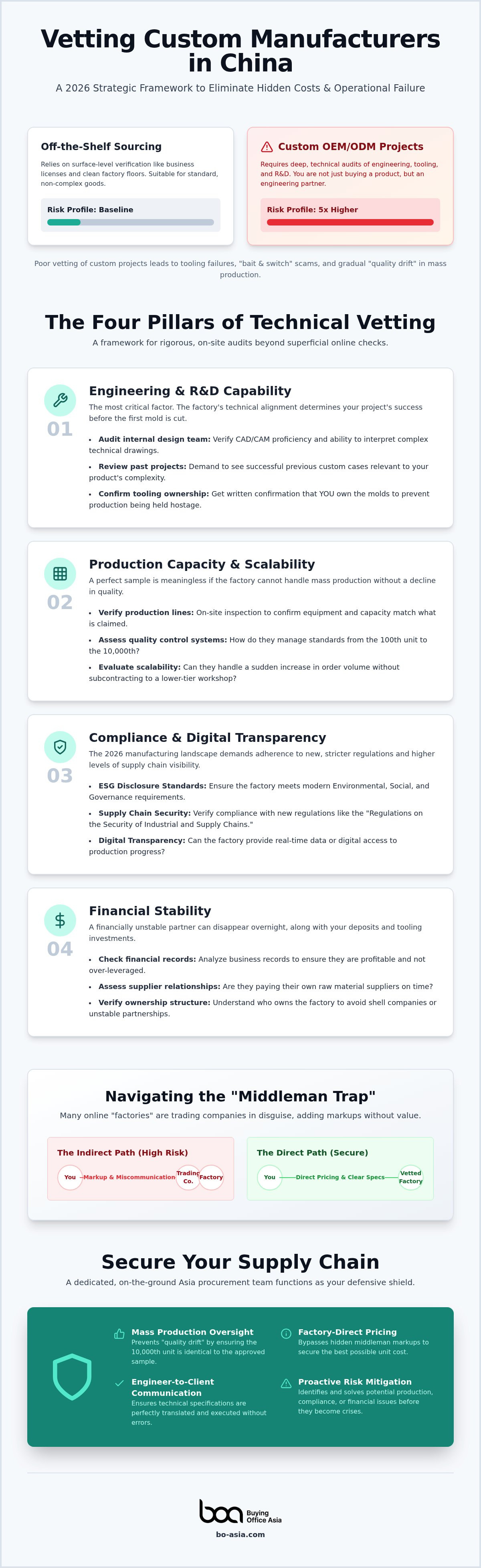
• Understand why custom OEM and ODM projects carry five times the operational risk of off-the-shelf sourcing and how to mitigate potential tooling failures.
• Master the four-pillar framework for vetting custom product manufacturers in China, prioritizing engineering alignment and financial stability over superficial online badges.
• Identify the "middleman trap" to bypass trading company markups and establish the direct engineer-to-client communication lines required for complex product development.
• Update your audit protocols for 2026 by integrating new ESG disclosure requirements and digital transparency standards into your factory selection process.
• Learn how a dedicated, on-the-ground Asia procurement team functions as a defensive shield to ensure mass production oversight and factory-direct pricing.
Vetting custom product manufacturers in China is the rigorous process of verifying a factory's technical, financial, and ethical ability to execute unique designs. It goes far beyond checking a business license on a B2B portal. In the 2026 trade environment, this process acts as your primary defense against operational failure. While buying standard goods is transactional, custom projects (OEM/ODM) carry roughly five times the risk. This increased hazard stems from the intensive tooling and R&D requirements that unique products demand. You aren't just sourcing a product; you're selecting an engineering partner.
Success in China's industrial sector, which accounts for nearly 28% of global manufacturing output, now requires navigating a more complex regulatory framework. New laws, such as the "Regulations on the Security of Industrial and Supply Chains" effective March 31, 2026, demand higher levels of oversight. Strategic vetting ensures your partner isn't just capable of making a sample, but is also compliant with these shifting legal and ESG standards. This protects your intellectual property and prevents the reputational damage that follows supply chain disruptions.
Whether you are producing industrial components or high-end furniture pieces for a brand like Yoca Interiors, understanding the distinction between standard and custom sourcing is the first step toward a secure supply chain.
Standard sourcing relies on surface-level verification. If you're buying generic chairs, a valid license and a clean factory floor might suffice. Custom builds change the equation. You aren't just buying a product; you're buying engineering hours and technical precision. Efficiently vetting custom product manufacturers in China requires a deep dive into the factory's R&D department and the specific expertise of their engineering staff. You must confirm they have the equipment and the talent for custom product and tooling development before you commit capital. Without this technical audit, you risk a "bait and switch" where the factory outsources your complex work to a lower-tier workshop.
Quality Drift is the gradual decline in production standards where the 100th unit meets specs but the 10,000th unit fails due to unmanaged factory shortcuts. This phenomenon can erode your brand's market position within a single production cycle. Tooling failures represent an even greater financial threat. A cheap, poorly engineered mold is the most expensive mistake you can make. It leads to massive waste, delayed launches, and the eventual cost of re-tooling from scratch. Investing in professional sourcing and procurement provides an immediate ROI by preventing these catastrophic expenses at the source.
A factory must satisfy four distinct pillars—Engineering, Capacity, Compliance, and Finance—before you can consider them truly vetted. While many businesses rely on digital certificates, these documents rarely reflect the reality of a workshop floor. Effective vetting custom product manufacturers in China requires physical presence to verify claims that look perfect on paper but fail under technical scrutiny. This isn't a one-time checkbox. It is an ongoing oversight process that evolves as your production needs grow. Consulting the U.S. government's commercial guide to China can provide additional context on the regulatory environment, but your specific custom needs require a deeper technical dive into the factory's operational DNA.
Engineering alignment is the most critical factor for custom projects. If a factory's internal design team lacks CAD/CAM proficiency or fails to demonstrate successful previous custom cases, your project is at risk before the first mold is cut. You must audit their internal design team to ensure they can interpret complex technical drawings without constant hand-holding. You must also secure clear, written confirmation of tooling ownership. Too many brands discover too late that the factory claims ownership of the molds, effectively holding your production hostage. You can read our guide on supplier vetting in Asia for a more detailed breakdown of these technical requirements.
A factory might deliver a perfect sample but fail during mass production if their equipment is outdated or poorly maintained. When vetting custom product manufacturers in China, you should evaluate machine age and review maintenance logs to ensure the facility can handle high-precision custom specs at scale. The transition from sampling and prototyping to full-scale manufacturing is where most failures occur. Watch for sub-contracting risks; factories often outsource parts of a complex order to smaller, unvetted workshops without your knowledge. This compromises quality and obscures your supply chain. If you are concerned about maintaining oversight during these critical phases, you can connect with our technical team to discuss your specific requirements.
Trading companies frequently pose as actual manufacturers on popular B2B platforms. This deception creates an "information wall" that prevents you from communicating directly with the engineers responsible for your custom tooling. For standard goods, this might be a minor inconvenience. For custom projects, it's often fatal. When vetting custom product manufacturers in China, you must distinguish between a factory that owns its equipment and a trading entity that simply manages a paper trail. If you can't speak to the person standing next to the CNC machine, you don't have a manufacturing partner; you have a gatekeeper who prioritizes their commission over your technical specs. This strategic approach to vetting custom product manufacturers in China ensures that every dollar of your budget goes toward production quality rather than intermediary fees.
The traditional "Agent Model" thrives on this lack of clarity. Agents often hide factory identities to prevent clients from bypassing them, which limits your ability to perform necessary due diligence. Insights from Harvard Business School on trade with China emphasize that navigating today's trade turmoil requires a much deeper level of supply chain visibility. Unlike transactional agents, a dedicated procurement team functions as an extension of your own company. At Buying Office Asia, we operate on a 100% transparency model. You know exactly which factory is producing your goods, and you have direct access to the production floor data.
Middlemen typically mark up prices by 15 to 30 percent without contributing a single engineering improvement. These hidden fees erode your margins and inflate your landed costs. Worse still is the risk of "Factory Switching." If a middleman finds a cheaper workshop, they may move your custom tooling without your consent to increase their own profit. This results in immediate quality drift. Securing factory direct price negotiations requires a local, on-the-ground presence that can verify the factory's identity and physically track the location of your molds at all times.
Knowing your factory is no longer just about price; it's about compliance. The 2026 mandatory ESG disclosure standards require you to track energy usage and labor conditions deep within your supply chain. Without direct access, ESG and sustainability tracking becomes impossible. Removing the middleman also accelerates your OEM manufacturing timeline. Direct communication with factory engineers eliminates the weeks of back-and-forth typical of unmanaged sourcing. This allows you to bring custom products to market faster and with fewer technical errors.
Vetting custom product manufacturers in China in 2026 requires a fundamental shift in focus from product quality to process integrity. You aren't just buying a component; you're inheriting the factory's entire operational footprint. New regulations, such as the Chinese Sustainability Disclosure Standards (CSDS), now make ESG reporting mandatory for over 400 of the country's largest manufacturers. This regulatory environment makes European-led management essential. A team with Helsinki-based leadership understands the specific legal and ethical rigors required by Western markets, ensuring your supply chain meets international compliance without the usual communication gaps or hidden risks.
To navigate these evolving global standards, you can check out ContentFactory for strategic advisory and ESG transformation services that help SMEs align with international compliance requirements.
Auditing for labor conditions and environmental impact is no longer a "nice to have" feature; it's a primary brand safety requirement. In 2026, your vetting process must include a granular review of the factory's waste management and energy usage, particularly for custom chemical or plastic builds. These high-impact industries face the most scrutiny under new supply chain security regulations. You need to verify that your partner isn't just delivering a product, but is doing so within a framework that protects your company from future regulatory penalties. You can learn about our commitment to ESG and how we integrate these standards into every factory audit we perform.
The "trust but verify" mantra is the only viable strategy for custom manufacturing in China. Effective vetting now incorporates real-time mass production oversight through digital reporting tools. This includes the requirement for real-time video audits and cloud-based inspection reports that provide immediate visibility into the production floor. These digital layers complement traditional on-site quality control and inspections, ensuring that the technical precision promised in the sampling phase is maintained throughout the entire run. Relying on static PDF reports is a legacy method that often hides quality drift until it's too late to fix. Modern vetting demands a transparent, data-driven connection to the factory floor.
If you need to secure a manufacturing partner that meets these rigorous 2026 standards, contact our Hong Kong headquarters to begin a technical assessment of your project.
Unmanaged sourcing is a liability that scales with your production volume. A dedicated Asia procurement team isn't an overhead expense; it's a strategic investment in your company's operational stability. By having a physical presence at the point of manufacture, you eliminate the information gaps that lead to quality drift and delayed shipments. This level of accountability is the only way to ensure that vetting custom product manufacturers in China results in a high-performance partnership rather than a series of expensive setbacks. You need an ally who prioritizes your financial health over factory commissions.
Buying Office Asia (BOA) bridges the gap between Western business expectations and the complexities of the Chinese industrial sector. Our unique structure combines Helsinki-based leadership for high-level strategy with a Hong Kong headquarters for immediate factory access. This model allows us to provide clear savings examples by negotiating directly with factory owners and removing the 15 to 30 percent markups typically hidden by intermediaries. You gain the steady confidence of an established expert acting as your on-the-ground defense, moving your supply chain away from transactional risk and toward long-term viability.
European management ensures that your intellectual property and legal contracts are handled with the same rigor you'd expect in your home market. We treat your proprietary designs as the core assets they are, implementing strict controls to prevent unauthorized use or reproduction. Operating through Hong Kong provides a secure legal and financial hub for transactions, offering a layer of protection that is often absent in mainland-only sourcing arrangements. You can read more about the ROI of a dedicated Asia procurement team to see how this structure translates into measurable business growth through improved oversight and reduced waste.
It's time to move beyond the search phase and into a proactive strategy. Vetting custom product manufacturers in China is the first step toward a resilient supply chain, but the real value lies in the ongoing management of those relationships. We invite you to view our cases to see how we've successfully delivered complex custom projects for independent business owners and major enterprises alike. If you're ready to secure your production and reclaim control over your margins, connect with us for a custom manufacturing consultation. We don't just find a factory; we build a secure, integrated extension of your own team.
The landscape of international trade has shifted from simple procurement to a high-stakes engineering partnership. Success now depends on your ability to verify a factory's technical precision and ethical compliance before capital is committed. By prioritizing engineering alignment and process transparency, you eliminate the risks of quality drift and hidden intermediary markups. Effective vetting custom product manufacturers in China requires more than digital verification; it demands a physical presence that acts as your defensive shield on the production floor.
Buying Office Asia provides the regional expertise and European-led oversight necessary to navigate these complexities. With our headquarters in Hong Kong and a commitment to 100% transparency, we ensure you receive factory-direct pricing and full visibility into your custom tooling and mass production. Don't leave your brand reputation to unmanaged supply chains or obscured middlemen. Take the next step toward a stable, high-performance manufacturing partnership today. Request a Custom Manufacturing Consultation with Buying Office Asia to secure your margins and your intellectual property. Your vision deserves the security of professional on-the-ground accountability.
Thorough vetting usually takes two to four weeks depending on the technical complexity of your project. This timeframe includes initial screening, on-site factory audits, and engineering capability assessments. While you can find a supplier online in days, securing a high-performance partner requires deeper due diligence. Vetting custom product manufacturers in China involves verifying previous OEM cases and ensuring their machinery meets your specific tolerances to prevent expensive tooling errors.
No, you shouldn't rely solely on digital badges for complex custom projects. A "Verified" status often only confirms a business's legal existence and basic office facilities. It doesn't guarantee the factory's technical engineering capacity or their ability to execute custom tooling development. You need a physical audit to confirm the factory actually owns the machinery shown in their profile and hasn't outsourced your order to an unvetted third-party workshop.
Critical red flags include a lack of documented maintenance logs for machinery and an absence of internal R&D staff. If a factory refuses to show you their production floor or can't explain their quality control process for raw materials, you should be concerned. Another warning sign is a mismatch between the machines on-site and the technical specs of your product. These operational gaps indicate a high risk of quality drift during mass production.
You must ensure your contract explicitly states that you own the molds and tooling. When working with Buying Office Asia, we ensure 100% transparency so you maintain ownership of your assets. Many traditional agents or trading companies hide the factory's identity, which makes it difficult to retrieve your molds if you decide to switch suppliers. Always verify that your tooling is stored securely and can be moved at your request.
In 2026, ESG compliance is a mandatory brand safety requirement due to new Chinese Sustainability Disclosure Standards. If your manufacturer fails to meet environmental or labor regulations, your company could face legal penalties or reputational damage. Vetting custom product manufacturers in China now includes auditing their waste management and energy usage. Buying Office Asia integrates these ethical standards into every audit to protect your brand from supply chain disruptions and regulatory scrutiny.
A direct factory owns the machinery and employs the engineers making your product. A trading company is a middleman that adds a 15% to 30% markup without adding technical value. Direct factories offer better pricing and clearer communication for custom specs. Trading companies often obscure the factory's identity to protect their commission. This "information wall" is dangerous for custom projects where you need direct access to the people building your tooling.
Protection starts with a bilingual NNN agreement enforceable in Chinese courts. You should only share sensitive technical drawings after verifying the factory's reputation and legal standing. Our European-managed leadership applies Western rigor to IP protection, ensuring your designs aren't leaked to competitors. We also recommend using fragmented sourcing for highly sensitive components to ensure no single factory has the complete blueprint for your innovation, further reducing the risk of unauthorized reproduction.
The most secure model uses Hong Kong as a legal and financial hub while manufacturing takes place in Mainland China. This structure allows you to benefit from China's massive industrial scale while enjoying the legal protections of Hong Kong's jurisdiction. Buying Office Asia operates with a Hong Kong headquarters to provide immediate factory access and secure transactions. This provides a defensive shield for your capital and ensures easier dispute resolution if issues arise during production.
What if the first clear sign of a production problem arrives after the goods are packed? Manufacturing risk management in Asia works best when controls are connected from the start, not left to a final inspection or occasional supplier update. You need visibility into factory activity, early warning...

What if the lowest unit quote isn’t the lowest-cost way to make your board game? Board game manufacturing costs depend on more than the number of boxes ordered. Component materials, custom tooling, assembly, packaging and delivery scope can all change what a quote covers, making headline prices diff...

What if the factory’s lowest quote isn’t the lowest-cost option? A lower unit price can hide differences in materials, tooling, packaging, quality checks or production terms. Understanding how sourcing agents negotiate factory prices starts with making those differences visible, not simply asking a...