


Successful oem sourcing asia isn't just a search for a factory, but the implementation of a transparent, on-the-ground management ecosystem. You likely already know that the traditional intermediary model is flawed, often hiding true costs behind layers of markups and opaque communication. It's frustrating when quality consistency fluctuates during mass production and you're left without a clear window into the factory floor. We understand the anxiety that comes with international manufacturing, especially when your brand's reputation and financial health are on the line.
You can reclaim control over your supply chain and secure factory-direct pricing without the risks of unmanaged production. This 2026 strategic guide provides the roadmap to managing these complexities with the steady confidence of a seasoned insider. You'll learn how to establish verifiable, on-site quality control and bridge the communication gap between your team and factory-direct partners. We'll outline a framework for improved profitability through total supply chain transparency; ensuring your procurement strategy acts as a defense against operational setbacks and brand risks.
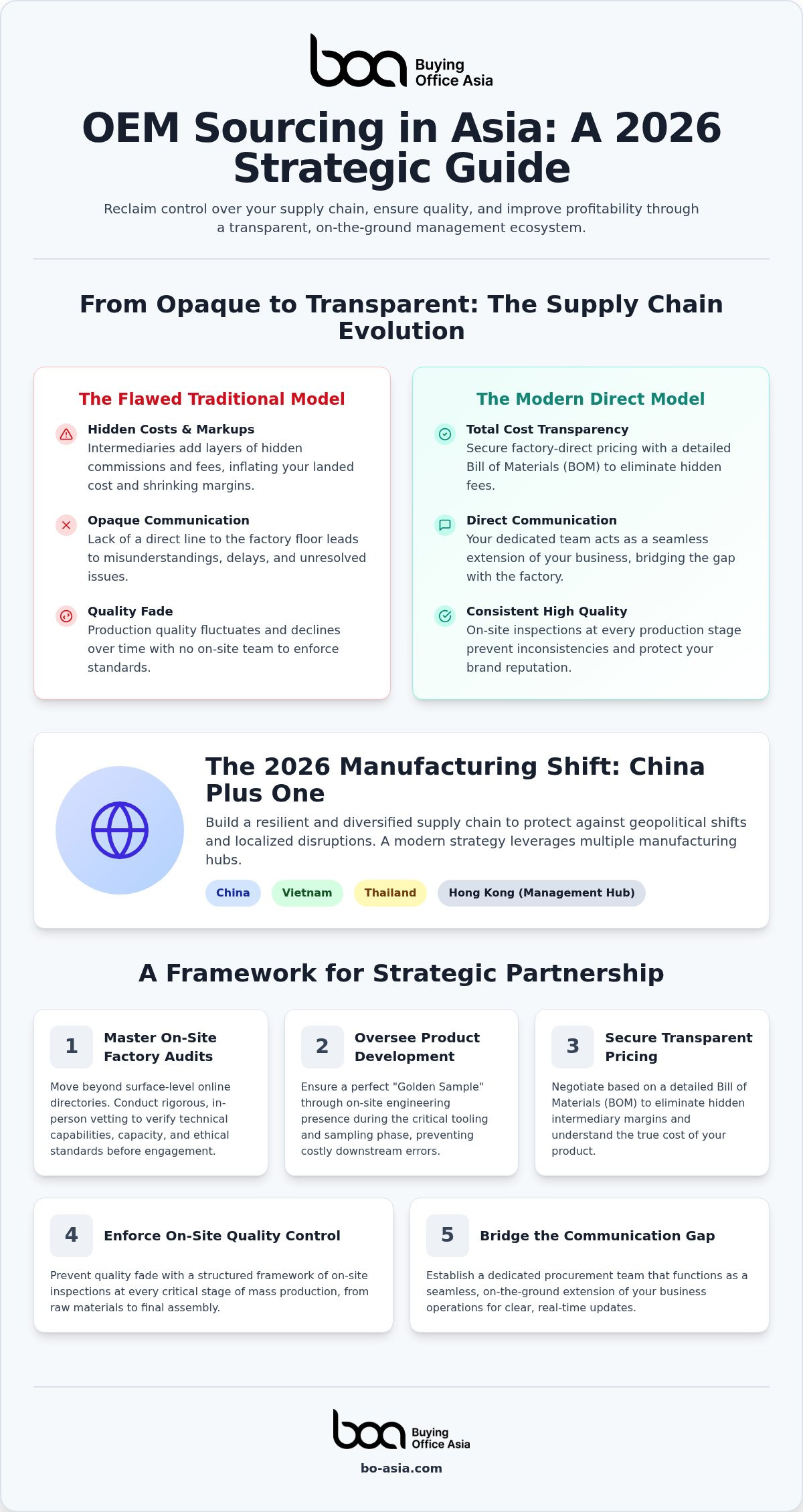
• Understand the 2026 manufacturing shift toward China Plus One strategies to build a more resilient and diversified supply chain.
• Master the complexities of oem sourcing asia by moving beyond surface-level online directories to conduct rigorous, on-site factory audits.
• Prevent quality fade and production inconsistencies through a structured framework of on-site inspections at every critical production stage.
• Secure factory-direct pricing and eliminate hidden intermediary markups to restore transparency and improve your bottom line.
• Bridge the communication gap with a dedicated procurement team that functions as a seamless extension of your own business operations.
Modern oem sourcing asia has transitioned from a simple transaction into a complex, integrated partnership. In the 2026 trade environment, the factory is no longer just a vendor; it's a strategic extension of your own operations. This evolution is driven by the necessity for resilience. Relying solely on a single region is a legacy risk that high-volume brands can no longer afford. The shift toward a "China Plus One" strategy has become the standard for securing supply chains against geopolitical shifts and localized disruptions. You need a footprint that spans multiple hubs while maintaining a centralized management core.
Traditional sourcing agents have become a liability in this new landscape. Most intermediaries operate on a model that prioritizes their own margins through obscured pricing and kickbacks. This creates a fundamental disconnect. If your representative in Asia is financially incentivized by the factory, they won't protect your interests during quality disputes. True accountability requires physical proximity. You need a team that is physically present on the factory floor, ensuring that your standards are met without the filter of a third-party agent who might be hiding production failures to protect their commission.
Middlemen don't just add a layer of cost; they erode your competitive advantage. Every hidden commission and markup directly inflates your landed cost, shrinking the margins you need to scale. When you lack direct access, you lose the ability to negotiate based on raw material fluctuations or operational efficiencies. The transparency gap is the systemic lack of visibility into actual production costs and factory-level decision-making that leaves brands vulnerable to unmanaged risks. By removing these barriers, you restore the financial health of your supply chain and ensure that every dollar spent contributes to product value rather than intermediary profit.
While the mainland remains a powerhouse, 2026 sees Vietnam and Thailand taking the lead in specialized OEM sectors like electronics and precision textiles. These regions offer competitive labor dynamics and favorable trade agreements that complement existing networks. Managing this multi-country approach requires a sophisticated gateway. Hong Kong maintains its status as the premier hub for trade management, offering the legal and financial infrastructure necessary to oversee diverse manufacturing bases. To stay ahead, you must understand how to integrate these hubs into a cohesive strategy. You can explore more about mastering sourcing and procurement in Asia to align your regional presence with your long-term growth goals.
Successful oem sourcing asia requires a framework that balances technical capability with long-term scalability. You don't just need a supplier; you need a partner whose production capacity mirrors your growth projections for 2026 and beyond. Identifying this partner involves more than reviewing a digital profile. It requires a deep dive into their engineering expertise and their ability to manage complex tooling requirements. A factory that excels at high-volume commodities might lack the precision needed for specialized custom components. Matching your specific technical complexity to a factory's core competency is the first step in eliminating downstream manufacturing risks.
The transition from a conceptual prototype to a "Golden Sample" is the most critical juncture in the OEM lifecycle. This phase demands rigorous technical oversight to ensure that every specification is repeatable during mass production. Many brands face significant delays because they overlook the nuances of custom product and tooling development. If the initial molds aren't calibrated correctly, you'll encounter dimensional inaccuracies that halt production. It's vital to have an engineering presence on-site to validate these tools before the first batch begins. You can learn more about managing these early stages through our OEM & ODM contract manufacturing services.
Effective negotiation for oem sourcing asia isn't about squeezing the factory for the lowest unit cost. Instead, it's about achieving total transparency through a detailed Bill of Materials (BOM). When you understand the cost of every sub-component and raw material, you eliminate the hidden margins that traditional agents often exploit. This level of insight allows you to secure terms that hold the factory accountable for specific defect rates and performance standards.
Remember that the lowest initial quote often leads to the highest total cost of ownership. Unmanaged factories frequently cut corners on material quality to maintain their margins, leading to "quality fade" and expensive product recalls. By focusing on a transparent cost structure, you align the factory's incentives with your own quality requirements. If you're looking to build a more resilient supply chain, you can speak with our procurement team to discuss a tailored strategy for your production needs.
Relying on online directory ratings for high-volume oem sourcing asia is a gamble that most sophisticated brands can't afford. A "Gold Supplier" badge on a digital marketplace indicates a paid membership, not operational excellence. It doesn't confirm if a factory actually owns its machinery or if it's merely a trading company masquerading as a manufacturer. You need to see the business licenses and export permits in person. Verifying these documents ensures the entity you're paying is the one actually producing your goods, protecting you from the legal and financial fallout of unverified partnerships.
A professional audit goes beyond a surface-level walkthrough. It involves a methodical review of maintenance logs to ensure machinery isn't prone to breakdown during your peak production cycle. You must also evaluate workforce stability. High turnover in a factory is a leading indicator of quality inconsistency; if the staff is constantly changing, the specialized knowledge required for your product is lost. A deep-dive audit provides the data you need to make an informed decision for oem sourcing asia, moving away from hope-based procurement toward evidence-based selection.
Assessing Quality Management Systems (QMS) like ISO 9001 isn't about looking at a certificate on a wall. It's about witnessing those protocols in action on the factory floor. You should inspect how raw materials are stored and whether the factory maintains strict traceability protocols. If a defect is found in a sub-component, can the factory trace it back to the specific batch of raw materials? You can find more details on how we manage these standards in our guide to Supplier Vetting in Asia.
In 2026, social compliance isn't just a moral choice; it's a critical brand defense. Regulatory bodies in Western markets are increasingly aggressive regarding labor practices and environmental standards. Non-compliance can lead to blocked shipments and irreparable damage to your reputation. Professional vetting includes a rigorous check of working conditions and environmental impact to ensure your supply chain meets modern ethical expectations. Our commitment to these standards is central to our BOA ESG Page, providing the security you need in a transparent global market.
The transition from a validated "Golden Sample" to full-scale manufacturing is the most hazardous phase of oem sourcing asia. This is the danger zone where "Quality Fade" typically occurs. Factories may initially use premium materials to pass the sampling phase, only to substitute them with cheaper alternatives during the tenth or twentieth production run to widen their own margins. Without a physical presence to monitor these subtle shifts, your brand's reputation is at the mercy of a supplier's internal cost-cutting measures. You must treat mass production as a process that requires constant, unblinking verification rather than a set-and-forget transaction.
Effective oversight requires more than a final check; it demands a structured presence throughout the production cycle. You must implement Acceptable Quality Level (AQL) standards directly into your manufacturing contract to establish a clear legal threshold for defects. This ensures that the factory understands exactly what constitutes a failure before the first machine starts. We recommend a multi-stage inspection approach:
These inspections allow you to catch systemic errors when only 20% of the batch is complete, preventing the waste of raw materials and time.
This is your last line of defense, ensuring the finished goods meet every specification before the balance payment is made.
Preventing a single defective container from reaching your warehouse delivers a higher return on investment than the total cost of a year's worth of on-site oversight. While third-party agencies offer a transactional service, a dedicated on-the-ground team acts as a protective extension of your own business, ensuring that your standards are never compromised for the sake of factory speed.
The supply chain doesn't end when the goods are packed. Managing high-volume procurement in 2026 requires sophisticated logistics coordination to navigate evolving customs requirements and optimize shipping routes. Consolidation strategies are essential for maintaining profitability, allowing you to group shipments from multiple factories into a single, efficient flow. Our sourcing and procurement services include this end-to-end management, ensuring your goods move from the factory floor to your destination without unforeseen delays. We focus on route optimization to mitigate the rising costs associated with global trade volatility. A secure supply chain is built on accountability at the finish line. If you're ready to eliminate production risks and secure your margins, contact our procurement experts today to discuss your 2026 manufacturing roadmap.
Buying Office Asia (BOA) provides the structural stability required to scale in the 2026 manufacturing environment. Our "Helsinki-Hong Kong Bridge" model pairs European leadership based in Finland with a permanent, boots-on-the-ground presence in Hong Kong and other primary Asian hubs. This isn't a third-party service; it's a defense against the communication barriers and lack of control that plague traditional oem sourcing asia. By positioning ourselves as an integrated extension of your own procurement department, we provide the same level of oversight usually reserved for major enterprises.
The foundation of our partnership is a 100% transparency model. You see exactly what the factory is paid, ensuring your capital is invested in product quality rather than hidden commissions or kickbacks. This approach explicitly rejects the conventional intermediary model, which we frame as a source of obscured costs and inefficiency. High-volume brands choose BOA because they require long-term supply chain stability and a partner who prioritizes their financial health over transactional gains. We act as your seasoned insider, utilizing our regional networks to secure your interests at every production stage.
The financial impact of dedicated oversight is measurable and immediate. High-volume brands often discover that the cost of professional management is eclipsed by the savings secured through factory-direct negotiations. By eliminating unmanaged risks and quality fade, you protect your margins and your brand reputation. You can review our pricing and savings examples to see how this transparency translates into reduced landed costs. Our strategic approach is further detailed in our case study on the ROI of a dedicated Asia procurement team, which illustrates the long-term value of on-site accountability.
Transitioning your existing OEM production to BOA management is a methodical process designed to minimize operational disruption. We begin with a comprehensive audit of your current supply chain to identify hidden vulnerabilities and cost-saving opportunities. From there, we establish a clear roadmap for either optimizing your current factory relationships or initiating new product development through our vetted network. Whether you're professionalizing an existing operation or launching a new project, our team provides the calm assurance of an established expert. We don't just describe a connection; we provide a defense against operational setbacks. Connect with our Helsinki or Hong Kong teams today to discuss how we can stabilize and optimize your oem sourcing asia strategy.
Navigating the complexities of oem sourcing asia requires a shift from passive procurement to active, on-the-ground management. You've seen how direct factory access and rigorous on-site audits eliminate the hidden costs and quality risks that erode your margins. By prioritizing 100% transparency on all factory pricing, you transform your supply chain into a predictable engine for growth. It's about replacing uncertainty with the calm assurance of a managed ecosystem.
Buying Office Asia acts as your stabilizing force in this volatile market. With European leadership based in Helsinki and our operational HQ in Hong Kong, we provide the regional expertise and physical proximity your brand needs. You don't have to manage these risks alone. It's time to move beyond the limitations of traditional intermediaries and integrate a team that functions as a protective extension of your own business operations.
Scale your OEM production with a dedicated Asia procurement team today to secure your manufacturing roadmap. Your path to a more profitable and resilient supply chain starts with a single strategic decision.
An OEM (Original Equipment Manufacturer) is the factory that physically produces goods to your specific designs and technical requirements. A sourcing agent is a third-party intermediary who finds these factories for you. Buying Office Asia differs from a traditional agent by acting as an integrated extension of your own team. We manage the entire supply chain process, from vetting manufacturers to performing on-site inspections, ensuring you receive factory-direct pricing without the hidden markups of a middleman.
You must request the factory's original "Unified Social Credit Code" and verify it through the National Enterprise Credit Information Publicity System (NECIPS). It's essential to check the "Business Scope" to ensure the factory is legally permitted to manufacture your specific product category. Buying Office Asia performs these checks on-site to confirm the factory isn't a trading company masquerading as a manufacturer, which is a vital step in any oem sourcing asia strategy.
High-volume orders require more protection than an online directory can provide. While Alibaba is a useful discovery tool, its ratings are based on paid memberships rather than actual operational performance. For a successful oem sourcing asia project, you need physical verification of machinery, workforce stability, and quality management systems. Relying solely on digital profiles exposes your brand to unmanaged risks like quality fade and production delays that an online platform cannot prevent.
On-site quality control allows for real-time correction of defects before they become systemic across a mass production batch. Remote inspections rely on factory-provided photos or samples that may not represent the actual run. Our dedicated team performs inspections at the factory floor during various production stages, including DUPRO and FRI. This hands-on approach ensures that every unit meets your technical specifications and regulatory standards before the goods leave the factory gates.
Traditional middlemen often hide their true profit in factory kickbacks or obscured unit price markups. These hidden commissions create a fundamental conflict of interest. If a quality dispute arises, a middleman who receives payments from the factory won't advocate for your brand's interests. We eliminate these financial hazards through a 100% transparency model. You see exactly what the factory is paid, ensuring your capital contributes to product value rather than unverified intermediary margins.
We utilize a direct-to-factory pricing model where you have full visibility into the actual production costs. Unlike traditional intermediaries who bundle their fees into the product price, we separate our management fees from the manufacturing expenses. This structure allows you to negotiate based on raw material fluctuations and ensures that every dollar is invested into the product itself. Our 100% transparency model provides the financial clarity needed to maintain long-term supply chain stability.
Yes, we specialize in supporting custom product and tooling development from the initial sampling phase through to mass production. Our technical team oversees the creation of molds and dies to ensure they meet your exact dimensional requirements. This hands-on management prevents common pitfalls, such as misaligned specifications that lead to expensive delays. We act as your engineering partner on the ground, validating every tool to ensure your product vision is realized with technical precision.
European management provides a bridge between Western business standards and Asian manufacturing execution. Our Helsinki-based leadership understands your regulatory requirements and communication expectations, while our Hong Kong HQ handles the tactical operations. This hybrid structure eliminates the cultural and communication barriers that often lead to manufacturing errors. It offers you the steady confidence of an established expert who speaks your language while maintaining a permanent, protective presence in the world's most complex trade hubs.

Scaling production to millions of units isn't a purchasing task; it's a high-stakes risk management discipline where a single percent of quality fade can liquidate your annual margin. You likely understand that the leap from mid-scale orders to massive procurement runs often exposes cracks in even t...

In 2026, the traditional sourcing agent isn't just an expense; they're a strategic liability that obscures your true cost of goods. Most procurement leaders recognize that supplier selection in asia has become a defensive maneuver where the goal is to eliminate the "Middleman Tax" before it erodes y...

If your procurement strategy relies on digital communication across twelve time zones without physical eyes on the factory floor, you aren't managing a supply chain; you're managing a series of expensive surprises. By 2026, the global procurement outsourcing market is projected to reach 7.18 billion...