


In 2026, the traditional sourcing agent isn't just an expense; they're a strategic liability that obscures your true cost of goods. Most procurement leaders recognize that supplier selection in asia has become a defensive maneuver where the goal is to eliminate the "Middleman Tax" before it erodes your margins. You've likely felt the sting of quality shifts during mass production or the silence of an intermediary when a production deadline slips. These aren't just inconveniences. They're avoidable financial risks that stem from a lack of boots-on-the-ground oversight and opaque pricing structures.
We understand that your priority is a supply chain that operates with the precision of an internal department. This strategic guide provides the blueprint to master the complexities of identifying and vetting high-performance manufacturers while securing 100% pricing transparency. We'll examine the mechanics of on-site audits, factory-direct negotiations, and the elimination of hidden margins to ensure your production remains both stable and financially viable. By the end of this briefing, you'll have a roadmap to reduce operational risk and transform your regional presence into a measurable competitive advantage.
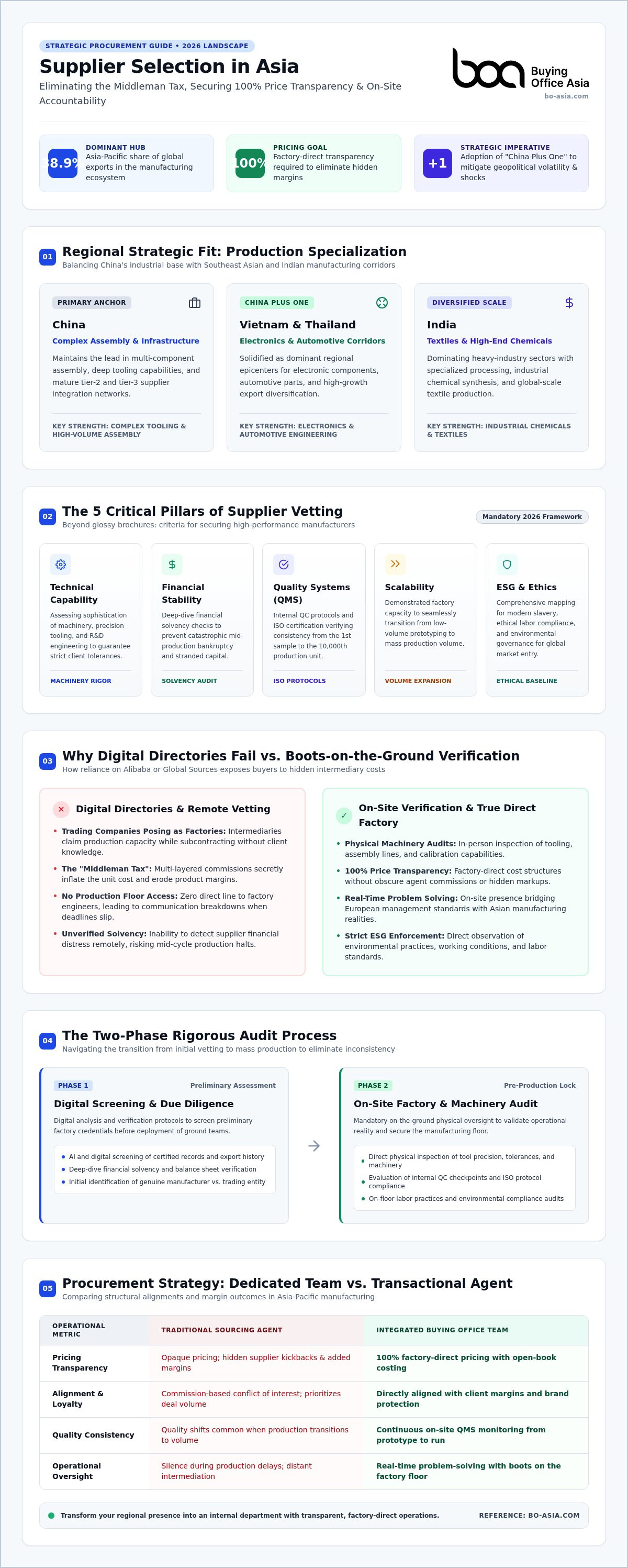
• Adapt to the 2026 manufacturing landscape by balancing China’s complex assembly power with regional specializations in Vietnam and Thailand.
• Secure your supply chain by evaluating the five critical pillars of vetting, including technical machinery assessments and deep-dive financial solvency checks.
• Navigate the transition from initial vetting to mass production through a rigorous, two-phase audit process designed to eliminate quality inconsistency.
• Optimize your procurement strategy for supplier selection in asia by replacing opaque commission-based agents with a transparent, integrated team model.
• Protect your margins by identifying and removing hidden intermediary costs that traditional sourcing models often conceal.
The 2026 landscape for supplier selection in asia requires a fundamental shift from transactional buying to strategic risk management. While the Asia-Pacific region holds a dominant 38.9% share of global exports, the complexity of these supply chains has evolved beyond simple cost comparisons. Most high-volume importers have moved past a single-source model, adopting a sophisticated China Plus One strategy to mitigate geopolitical volatility and supply shocks. This diversification isn't just a trend; it's a mandatory defense for your brand's financial health and operational continuity.
Regional specialization has become more pronounced across the continent. Vietnam and Thailand have solidified their roles as premier electronics and automotive hubs, while India continues to dominate the textile and high-end chemical sectors. Digital tools and AI now streamline the initial screening process, allowing for faster data analysis of factory certifications and past performance. However, these tools cannot replace physical oversight. In 2026, the final decision in supplier selection in asia still rests on on-site verification of machinery, labor practices, and ethical compliance. ESG standards are no longer optional "add-ons" but core requirements that determine your access to global markets and protect your brand from reputational damage.
Relying exclusively on digital platforms like Alibaba or Global Sources exposes you to significant operational risk. These directories often feature trading companies posing as factories, which leads to an obscured "Middleman Tax" that erodes your profitability. For high-volume manufacturing, 100% transparency is the only way to secure factory-direct pricing. Without a direct line to the production floor, you lose control over quality consistency and cost fluctuations. Traditional agents often prioritize their commissions over your product quality, creating a conflict of interest that can lead to disastrous production delays.
Remote vetting cannot account for the nuances of local regulations or the actual state of a factory's solvency. You need a partner who bridges the gap between European management standards and Asian manufacturing realities. Physical proximity allows for real-time problem solving and ensures your specifications are followed to the letter during mass production. This level of oversight is why many businesses choose to integrate a dedicated Asia procurement team into their operations rather than trusting unmanaged intermediaries. You can find more information regarding our specific approach at Why Buying Office Asia. Having an on-the-ground presence ensures that your interests are protected at every stage of the manufacturing process.
Effective supplier selection in asia requires a framework that moves beyond surface-level quotes and glossy brochures. To secure a high-performance partner, you must evaluate potential factories through a lens of operational and financial rigor. The Chartered Institute of Procurement & Supply highlights the four stages of supplier selection as a foundational starting point, yet 2026 demands even deeper scrutiny across five critical pillars:
You must assess the sophistication of machinery, tooling, and R&D departments to ensure they can meet your specific tolerances.
Verifying a factory’s solvency is the only way to prevent a mid-production collapse that could strand your capital.
Evaluate internal QC protocols and ISO standards to ensure consistency from the first sample to the ten-thousandth unit.
A supplier must demonstrate the capacity to grow with you, transitioning smoothly from sampling to high-volume mass production.
Mapping the supply chain for modern slavery risks and environmental adherence is now a non-negotiable requirement for global market access.
A common pitfall for high-volume importers is failing to distinguish between a trading company and a true manufacturer. Trading companies often present themselves as factories but lack the technical depth to manage complex OEM & ODM manufacturing projects. Technical capability isn't just about owning machines. It's about maintaining them. When you evaluate a manufacturer, look for dedicated tooling development teams and a clear history of custom product support. If a factory cannot demonstrate how they manage their own upstream component quality, they cannot guarantee your final product's integrity.
Financial transparency is where most unmanaged supply chains fail. Many sourcing agents hide their margins within the factory's unit price, making it impossible for you to know the true cost of production. To eliminate this "Middleman Tax," you need to verify business licenses and ownership structures directly. Factory-direct price negotiations require a granular understanding of raw material costs and local labor rates. Without this data, you're negotiating in the dark. Supplier Solvency in 2026 is the measurable capacity of a manufacturer to absorb fluctuations in raw material costs and energy prices without compromising production schedules or financial viability. If you're ready to secure a more resilient supply chain, our team can help you begin the audit process today.
Choosing the right manufacturing hub is a decision that dictates your long-term margin and supply chain resilience. In 2026, supplier selection in asia isn't just about finding the lowest labor rate; it's about identifying the best infrastructure-to-cost ratio for your specific product category. While the "China Plus One" strategy is now the industry standard, you must understand where regional specializations offer a genuine competitive advantage versus where they introduce hidden operational friction.
India and Indonesia are increasingly attractive for raw-material-intensive industries, such as furniture, textiles, and basic chemicals. These nations possess vast natural resources, which can significantly reduce your reliance on imported sub-components. However, port efficiency remains a critical variable. While a container might move through Shanghai or Ningbo in 48 hours, it might take significantly longer in Mumbai or Jakarta. These delays aren't just logistical hurdles; they're capital traps that affect your cash flow and inventory turnover. You must balance the savings on raw materials against the increased lead times and potential transshipment costs.
Mainland China remains the king of high-volume sourcing and procurement, particularly for complex electronics and machinery. Its integrated ecosystem allows for rapid scaling that other regions can't yet match. Hong Kong continues to act as the strategic gateway, offering the stable legal and logistics framework required for international trade. If your product requires intricate tooling or high-speed scalability, China is often the only viable choice. Learn more in our Definitive Guide to Choosing a China Sourcing Company.
Vietnam and Thailand are the primary choices for automotive components and consumer goods. While labor costs are lower than in coastal China, you must account for infrastructure maturity. We recommend using a formal supplier selection and vetting framework to assess factory capacity and local supply chain depth. This ensures you don't trade lower wages for higher defect rates or production bottlenecks. For a broader view, see our guide on Nearshoring vs Offshoring.
Ultimately, your regional strategy should prioritize logistics stability alongside production costs. Shipping routes from secondary ports in Southeast Asia are often less frequent, which can lead to higher freight rates during peak seasons. By analyzing the total landed cost, including duties and logistics, you can determine which regional fit supports your brand's financial health. An integrated approach ensures that your regional presence is a source of strength rather than a point of failure.
The transition from identifying a strategic region to securing a manufacturing partner requires a structured, four-phase audit process. Successful supplier selection in asia is never a single event; it's a sequence of risk-mitigation steps designed to protect your capital and brand reputation. By following a rigorous verification path, you move from broad market possibilities to a documented, high-performance production line.
We conduct deep-dive background checks, verifying business licenses, ownership structures, and export histories to filter out intermediaries.
Physical inspections assess technical capacity, machinery maintenance, and social compliance standards.
This phase bridges the gap between design and reality, ensuring the factory can replicate your specifications at scale.
Pre-shipment and during-production inspections serve as the final gatekeeper for quality before goods leave the factory floor.
A physical factory walk-through reveals operational truths that digital platforms and polished brochures often hide. During an audit, you must look for evidence of consistent machinery maintenance, organized raw material storage, and clear safety protocols. Verifying certifications like ISO, BSCI, or SEDEX at the source is essential to ensure they aren't expired or falsified. This level of scrutiny ensures the factory's internal culture aligns with your quality expectations. For a deeper look at these protocols, read our Supplier Vetting in Asia: The Insider’s Guide.
The most significant risk in high-volume manufacturing is "quality fade," where a factory gradually reduces material standards or rushes production after the initial samples are approved. This erosion of quality is a silent margin killer that often goes unnoticed until the goods reach your warehouse. Implementing on-site quality control during the production cycle acts as a vital insurance policy. By utilizing dedicated Sourcing & Procurement Services, you maintain a constant presence on the factory floor, preventing deviations before they become costly defects. If you need to secure your next production run with an on-site inspection, contact our audit team to schedule a visit.
The final stage of supplier selection in asia isn't just signing a contract; it's deciding how that relationship will be managed over the long term. Many importers fall into the trap of using commission-based agents who promise low fees but hide substantial margins within the unit price. This lack of transparency creates a structural conflict of interest. If a quality issue arises during mass production, a transactional agent might prioritize their relationship with the factory to protect their commission rather than defending your brand's standards. These hidden costs can silently erode the profitability of even the most well-negotiated deals.
A dedicated procurement team eliminates these risks by functioning as a direct extension of your own headquarters. Instead of a third-party intermediary, you gain a partner whose incentives are perfectly aligned with your financial health. This model ensures 100% transparency in the order flow, where every dollar spent is accounted for and every factory-direct negotiation is documented. By removing the "Middleman Tax," you don't just save on unit costs; you gain the control necessary to manage complex supply chains with the same rigor you apply to your domestic operations. This approach turns supplier selection in asia from a risky gamble into a controlled, professional briefing.
We provide a unique bridge between Western business standards and Asian manufacturing realities. With European leadership based in Helsinki and a physical presence in Hong Kong since 2010, we offer the regional expertise you need without the opacity of traditional models. Our team focuses on high-volume and OEM/ODM manufacturing, ensuring you secure true factory-direct pricing through data-driven negotiations. You can learn more about how we integrate with your operations by visiting our Your Dedicated Sourcing Team page. This proximity allows us to manage mass production oversight and supplier development with a level of detail that remote agents simply can't match.
Optimizing your supply chain requires a shift from one-off transactional orders to long-term supplier development. This involves more than just price; it's about improving factory efficiency, refining tooling, and coordinating logistics to maximize profitability. When your procurement team manages shipping and logistics coordination, you reduce the risk of unforeseen delays and port bottlenecks. This holistic approach transforms your manufacturing from a cost center into a strategic asset. To see the measurable impact of this model, explore our case study on The ROI of a Dedicated Asia Procurement Team. Transitioning to a managed partnership ensures your brand is protected by a team that shares your commitment to transparency and financial viability.
Mastering supplier selection in asia is no longer just about the lowest quote; it's about building a resilient, transparent ecosystem that protects your margins. Success in the current landscape requires a shift from remote vetting to on-the-ground accountability and the total elimination of hidden intermediary margins. By prioritizing deep financial vetting and strategic regional diversification, you transform your supply chain from a source of anxiety into a stable, competitive advantage. It's a move toward professional rigor that ensures your production stays on schedule and within budget.
Our European-managed team provides the sophisticated oversight usually reserved for major enterprises, ensuring 100% transparency across your high-volume OEM/ODM production. We function as your integrated regional office, negotiating factory-direct pricing while maintaining rigorous on-site quality control from our Hong Kong hub. If you're ready to stabilize your international manufacturing and remove the "Middleman Tax" for good, we're here to provide the steady confidence of a seasoned insider. Book a consultation with our Helsinki-based leadership to discuss your Asia procurement strategy and secure your brand's financial health today.
You must verify the company’s business license and export records directly. A true manufacturer’s license specifically lists manufacturing or processing in its scope of business, whereas middlemen often list generic wholesale categories. On-site audits remain the only foolproof method. If the staff cannot explain technical tooling or if the production floor is at a different location than the registered office, you’re likely dealing with a trading company.
The industry standard for new manufacturing partnerships is a 30/70 payment structure. You pay a 30% deposit to start production and the 70% balance only after a successful pre-shipment inspection. Don't release the final payment until your quality control team confirms the goods meet your specifications. While letters of credit or net terms are possible as the relationship matures, the 30/70 split provides the best initial risk mitigation for your capital.
Audit fees depend on the factory's location and the complexity of the technical assessment required. These costs cover the auditor’s travel, the time spent on the factory floor, and the delivery of a detailed report on machinery, labor standards, and financial stability. Focus on the depth of the vetting rather than the lowest fee. A rigorous audit acts as an insurance policy against the catastrophic financial loss of a mid-production factory collapse.
Remote supplier selection in asia is possible but carries significant operational risk. Digital platforms often feature trading companies posing as factories, leading to obscured costs and quality inconsistencies. Without physical oversight, you can't verify if a supplier is outsourcing your order to an unvetted sub-tier workshop. An on-the-ground team ensures that your management standards are enforced directly on the shop floor, preventing the "Quality Fade" that often affects unmanaged chains.
The "China+Many" strategy involves balancing a primary production hub in China with secondary sites in markets like Vietnam or Thailand. This approach mitigates geopolitical risks and protects your brand from supply chain shocks. When selecting suppliers, you must evaluate regional specializations. China remains the leader for complex assemblies and electronics, while Southeast Asia is increasingly competitive for consumer goods. This strategy requires a team capable of managing diverse regional regulations and logistics routes.
Evasive behavior regarding on-site inspections is the most immediate red flag. Be cautious of suppliers who provide business licenses with mismatched company names or refuse to share references from existing high-volume clients. A lack of documented internal quality control protocols or an inability to explain upstream component sourcing are also critical warnings. If a supplier’s quote fluctuates rapidly without a corresponding change in raw material costs, they're likely hiding an intermediary margin.
Buying Office Asia functions as an integrated extension of your own procurement department rather than a commission-based agent. We eliminate hidden margins by negotiating factory-direct pricing and providing you with a full audit trail of the costs. Our fees are structured as transparent service or retainer charges, ensuring our incentives align with your financial health. This model removes the conflict of interest inherent in traditional sourcing agents and gives you total control over your margins.
The process of supplier selection in asia typically spans six to twelve weeks. This timeline accounts for initial vetting, on-site audits, and the essential sampling and tooling phase. Rushing these steps often leads to expensive defects during mass production. You should allocate enough time for technical adjustments and social compliance verification. A methodical onboarding process ensures that your chosen manufacturer can scale with your growth while maintaining the quality standards your brand demands.

Scaling production to millions of units isn't a purchasing task; it's a high-stakes risk management discipline where a single percent of quality fade can liquidate your annual margin. You likely understand that the leap from mid-scale orders to massive procurement runs often exposes cracks in even t...

Successful oem sourcing asia isn't just a search for a factory, but the implementation of a transparent, on-the-ground management ecosystem. You likely already know that the traditional intermediary model is flawed, often hiding true costs behind layers of markups and opaque communication. It's frus...

If your procurement strategy relies on digital communication across twelve time zones without physical eyes on the factory floor, you aren't managing a supply chain; you're managing a series of expensive surprises. By 2026, the global procurement outsourcing market is projected to reach 7.18 billion...