


If your procurement strategy relies on digital communication across twelve time zones without physical eyes on the factory floor, you aren't managing a supply chain; you're managing a series of expensive surprises. By 2026, the global procurement outsourcing market is projected to reach 7.18 billion dollars, yet many businesses still struggle with the same old shadows: hidden markups, inconsistent quality, and the persistent silence of unmanaged factories. You know that relying on traditional intermediary models often leads to a loss of control and inflated operational costs that your business can no longer afford.
This comprehensive procurement outsourcing checklist serves as your strategic framework to master the transition to a high-performance, outsourced model. We promise to show you how to move beyond transactional sourcing and establish a reliable, on-the-ground team in Asia that functions as a seamless extension of your own headquarters. We'll preview the essential steps for achieving 100 percent transparency, securing factory-direct negotiations, and implementing the rigorous quality control measures necessary to protect your brand's financial health in a complex global market. This is about moving away from risk and toward the steady confidence of an established expert presence.
• Learn how to distinguish core from non-core procurement activities while setting measurable KPIs for cost savings and lead time reduction.
• Discover the critical requirements for physical on-site factory audits and local license verification to protect your brand from operational setbacks.
• Master the art of factory-direct negotiations by using our procurement outsourcing checklist to eliminate hidden markups and secure true pricing transparency.
• Understand how to implement a tiered Quality Control plan that utilizes Acceptable Quality Limits to ensure consistent excellence in mass production.
• Evaluate potential partners based on their physical proximity to manufacturing sites and their ability to provide European-level accountability with local Asian execution.
Every successful expansion into Asian manufacturing begins with a clearly defined boundary. You must decide which activities remain internal and which require the specialized oversight of a partner. A robust procurement outsourcing model isn't just about offloading tasks; it's about enhancing your reach. You need to distinguish between core strategic decisions and the high-volume execution that happens on the factory floor. While your headquarters retains control over brand direction and product vision, the operational heavy lifting is often handled more effectively by those with local proximity.
Your procurement outsourcing checklist should prioritize 100% transparency. This means eliminating the "black box" of traditional trading companies where markups are hidden. By focusing on manufacturing hubs in China, Vietnam, and India, you ensure that on-the-ground representation is physically present where the production happens. This geographic focus allows for real-time problem solving that isn't possible from a distance. Effective checklists also set measurable KPIs from the start. You should target specific outcomes such as factory-direct pricing without intermediary fees and a reduction in inventory levels, which industry data suggests can drop by 13% to 38% through professional manufacturing outsourcing.
Scalability is the priority for 2026. Your checklist must document the transition from merely managing vendors to building a strategic partnership. This involves establishing a clear communication protocol between your European headquarters and your operations in Asia. It ensures that your brand standards are upheld across every factory floor. When your goals align, your partner acts as a defensive shield, protecting your financial health from the volatility of global trade. You aren't just buying a service; you're securing a stabilizing force for your supply chain.
Evaluate your internal team's regional expertise before committing to a path. Do you have the language skills and technical knowledge to audit a factory in Shenzhen or Hanoi? Most businesses find that a managed service partner offers more security than software-only solutions because physical presence creates accountability. You can learn more about Mastering Sourcing and Procurement in Asia to identify where your internal gaps might be. This assessment protects you from the operational risks inherent in unmanaged supply chains and ensures your procurement outsourcing checklist covers every vulnerability.
Digital vendor management platforms often promise security, but they can't replace a physical presence in the manufacturing hub. A robust procurement outsourcing checklist must include a boots-on-the-ground verification of business licenses and export permits within the local jurisdiction. You're looking for more than just paperwork; you're verifying that the entity you're paying is the one actually producing your goods. Physical on-site audits are the only way to confirm that the machinery listed in a brochure actually exists and is capable of meeting your technical specifications.
Assess the factory's internal Quality Management System (QMS) by observing their daily workflows in real time. If they can't demonstrate a clear process for handling non-conforming materials, your defect rates will inevitably climb. Ethical compliance isn't just a checkbox; it's a brand safeguard. Reviewing social and ethical compliance (ESG) standards on-site ensures your supply chain remains free from the reputational hazards of poor labor practices. Using a comprehensive procurement outsourcing checklist helps you align with international benchmarks while securing your operations.
You must verify that the factory's capacity aligns with your production forecast. Many suppliers overpromise, leading to delays when they realize they can't handle your volume. Check the reliability of their sub-suppliers and where they source raw materials. This prevents sudden shortages and ensures material consistency. For deeper insights into managing these complex requirements, explore our End-to-End Sourcing & Procurement services to understand the mechanics of safe sourcing.
Legal disputes or financial instability in a supplier's past are red flags that digital audits often miss. Adherence to international standards like ISO 9001 for quality or SA8000 for social accountability provides a baseline for professional rigor. Supplier vetting is a non-negotiable insurance policy for your brand. By identifying these risks early, you establish a defensive shield against supply chain volatility and prevent the unforeseen expenses that plague unmanaged supply chains. If you're ready to secure your production lines, you can connect with our regional experts to discuss a tailored audit plan.
Financial stability in Asian procurement isn't found in the lowest quote; it's found in the most transparent one. Traditional sourcing agents often obscure the true factory cost to protect their own margins. A rigorous procurement outsourcing checklist must prioritize structural transparency to prevent this margin erosion. You need to verify the "Total Cost of Ownership" (TCO) for every SKU, accounting for duty, logistics, and quality overhead. Without this data, you're making decisions based on incomplete financial pictures.
Benchmarking raw material costs against the final quoted unit price is a non-negotiable step. If you aren't tracking the market price of the specific polymers or alloys used in your production, you can't effectively challenge a factory's price hike. Professional procurement management involves establishing payment terms that protect the buyer, such as the standard 30/70 split. This ensures you retain financial leverage until the goods are inspected and ready for shipment. It's about moving away from transactional uncertainty and toward a controlled, predictable financial model.
Hidden commissions are the silent killer of profitability in international manufacturing. Many intermediaries claim to offer "free" sourcing while taking kickbacks from the factory, which are ultimately added to your unit price. Open-book accounting is the only defense against these obscured costs. By demanding a clear view of the factory-direct price, you reclaim control over your bottom line. You can see how this transparency translates into measurable results by reviewing our Pricing and Savings Examples. This model ensures your interests and your partner's interests are perfectly aligned.
Leveraging mass production volume is about more than just asking for a discount. It's about securing long-term price stability in a volatile market. Your negotiations should include clauses that protect against sudden currency fluctuations or raw material price spikes. Establish a clear fee structure from the outset. Fixed-fee models are often superior to percentage-based models because they don't reward the partner for higher procurement costs. This approach creates a lean, efficient supply chain where every dollar spent is accounted for and every negotiation serves your long-term growth.
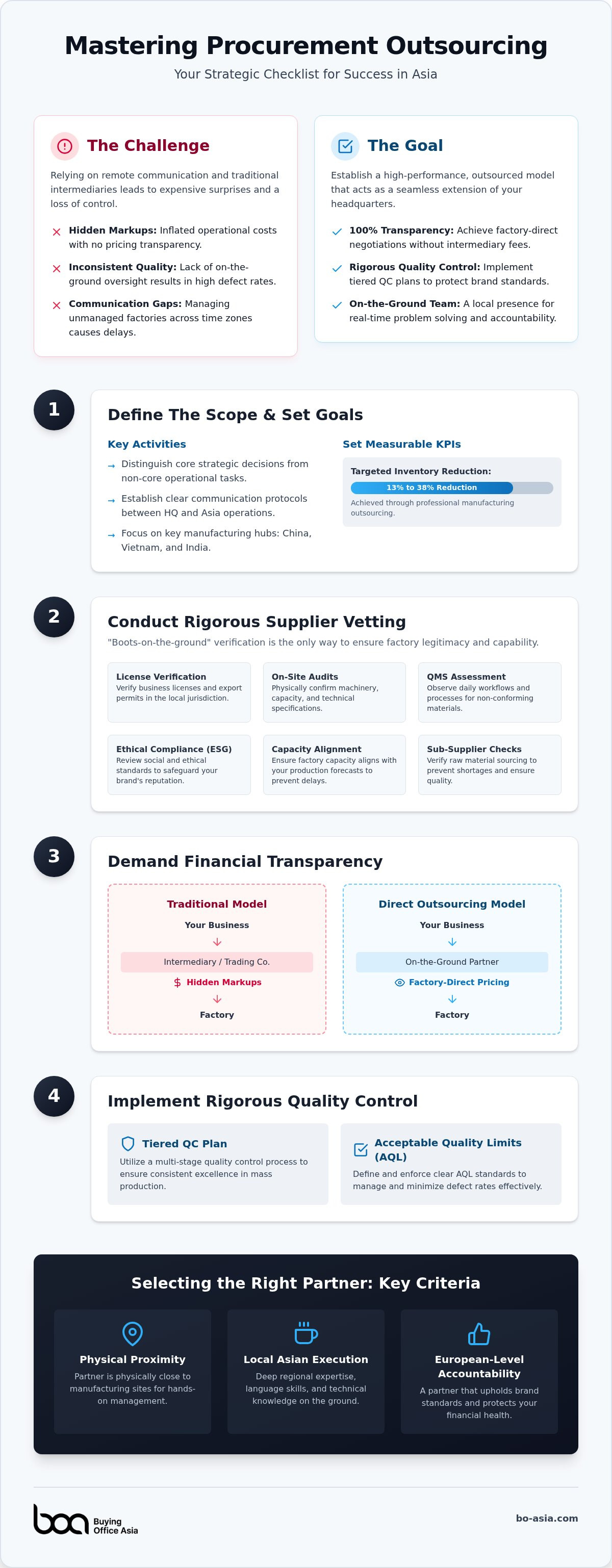
Strategy is useless without execution on the factory floor. Your procurement outsourcing checklist must detail a tiered Quality Control (QC) plan that begins long before the first container is loaded. This includes Pre-production inspections to verify raw materials, During Production (DUPRO) checks to catch assembly line errors early, and Final Random Inspections (FRI) before the goods leave the factory. Catching a defect when 20% of the order is finished allows for a minor adjustment; finding it at 100% is a financial catastrophe. By integrating these checks into your workflow, you create a defensive shield against sub-standard production.
Setting Acceptable Quality Limits (AQL) is vital for maintaining consistency across high-volume orders. You can't expect zero defects in mass production, but you must define exactly what is tolerable for your brand. By establishing clear AQL standards for each product category, you provide your on-the-ground team with an objective benchmark for approval or rejection. This level of professional rigor prevents "quality fade" and ensures your reputation remains intact. It's about ensuring that the product your customer receives is identical to the approved sample.
Mass production oversight is the bridge between a prototype and a profitable product. On-the-ground inspectors serve as your eyes and ears, preventing batch defects that often occur when factories try to cut corners to save time. This oversight extends to managing custom tooling and ensuring that product development samples are perfectly replicated in the final production run. For a deeper look at managing complex production cycles, consult our OEM Manufacturing Guide. Having a dedicated team at the source ensures that your technical specifications are followed to the letter.
Procurement doesn't end when the goods are packed. Your checklist must ensure all export documentation, including the Bill of Lading, Packing List, and Commercial Invoice, is handled accurately at the source. Errors in customs compliance can lead to expensive port delays and storage fees that erode your margins. Consolidating shipments from multiple suppliers into a single container can significantly reduce freight costs, a strategy often overlooked by unmanaged supply chains. You'll also need to choose between FOB, CIF, or DDP based on your risk appetite and logistical capabilities. Secure your supply chain today by scheduling a consultation with our logistics experts.
The final stage of your procurement outsourcing checklist involves moving beyond technical capabilities and assessing the structural integrity of your potential partner. While many agencies claim global reach, few offer the specific combination of regional proximity and western accountability required for high-volume manufacturing. You aren't just looking for a service provider; you're selecting a partner who will act as a stabilizing force for your brand. A partner's physical presence in primary manufacturing hubs like Hong Kong or Shenzhen is a non-negotiable requirement for real-time problem solving and accountability.
Verify the transparency of their business model before signing any long-term agreements. A reliable partner should operate on an open-book basis, allowing you to see the true factory-direct pricing without hidden markups or obscured commissions. Reviewing case studies for product categories similar to yours provides evidence of their regional expertise and ability to manage specific technical challenges. If a partner cannot demonstrate a history of successful mass production oversight for complex goods, they likely lack the defensive shield your supply chain needs.
The most effective procurement models for 2026 utilize a hybrid management structure. A Helsinki-Hong Kong bridge, for example, provides the perfect balance of European strategic alignment and Asian operational execution. This setup ensures that your headquarters receives clear, professional briefings in a familiar time zone while your dedicated sourcing team manages the factory floor in real time. It's a sophisticated approach that eliminates communication barriers and provides a level of oversight usually reserved for major enterprises. This proximity creates a signature promise of accountability that digital-only platforms simply can't match.
Use this 10-point scorecard during your final interviews to ensure a cultural and strategic fit. It's designed to dismantle common industry objections and reveal the true nature of the partnership. Your chosen ally should possess the networks you lack and the protective nature your brand deserves.
• Does the partner have a physical office within two hours of your primary factories?
• Is the fee structure fixed and transparent, or based on hidden percentages?
• Can they provide 100% transparency into the factory-direct price negotiations?
• Does the leadership offer European-level accountability and legal security?
• Do they have a documented history of managing high-volume mass production?
• Is there a clear protocol for handling non-conforming materials and batch defects?
• Do they possess the technical expertise to manage custom tooling and product development?
• Are they capable of consolidating shipments to optimize your logistics costs?
• Do they conduct their own on-site ESG and ethical compliance audits?
• Does the partner feel like an integrated extension of your team rather than a third party?
Selecting the right partner is the final step in securing your financial health and operational efficiency. If you're ready to transition to a high-performance model with 100% transparency, you can request a consultation with Buying Office Asia to discuss your 2026 procurement strategy.
Mastering your supply chain in 2026 requires moving beyond digital dashboards and into the physical reality of the factory floor. By implementing this procurement outsourcing checklist, you've identified the critical pillars of success: rigorous on-site vetting, 100% financial transparency, and a tiered quality control plan that catches defects before they leave the source. You now have the framework to eliminate hidden markups and reclaim control over your production margins.
True security comes from a partner who combines European-managed accountability with a permanent, on-the-ground presence in Hong Kong and across Asian manufacturing hubs. This hybrid model ensures your interests are protected by an elite team that functions as an extension of your own headquarters. It's time to replace the risks of unmanaged sourcing with the steady confidence of factory-direct transparency. We're ready to help you build a resilient, high-performance supply chain.
Download our comprehensive Procurement Outsourcing Guide to begin optimizing your operations today.
The primary risks include a lack of transparency in supplier pricing, inconsistent product quality from unmanaged factories, and communication barriers between your headquarters and production sites. Without physical oversight, businesses often face quality fade where standards drop after initial batches. These operational setbacks can result in unforeseen expenses and brand damage. Utilizing a professional procurement outsourcing checklist helps mitigate these hazards by establishing a defensive shield of on-the-ground accountability.
A procurement outsourcing checklist improves transparency by mandating open-book accounting and factory-direct pricing negotiations. It forces the disclosure of the true unit cost, eliminating the obscured commissions often taken by traditional sourcing agents. By standardizing the verification of business licenses and export permits, the checklist ensures you know exactly who is receiving your funds. This structured approach moves your operations away from the black box model and toward total visibility.
A sourcing agent typically operates as a transactional middleman; they often profit from hidden markups and kickbacks from the factory. In contrast, a procurement partner like Buying Office Asia functions as an integrated extension of your own team. We provide European-managed accountability with a permanent presence in Hong Kong. Our model focuses on long-term partnership and financial optimization through flat-fee structures rather than the obscured costs inherent in intermediaries.
Quality control is ensured through a tiered inspection plan that includes pre-production, during production, and final random inspections. You must set clear Acceptable Quality Limits for each product category to provide objective benchmarks for approval. Having dedicated, on-the-ground inspectors is the only way to catch batch defects before goods leave the factory. This physical oversight prevents the costly surprises that occur when relying solely on digital vendor management systems.
A comprehensive factory audit must include verification of local business licenses, export permits, and physical machinery inspections. You should assess the factory's internal Quality Management System and their capacity to meet your production forecasts. Additionally, review social and ethical compliance standards to protect your brand reputation. These on-site audits confirm that the manufacturer possesses the technical rigor and financial stability required for a long-term strategic partnership in Asia.
Calculating ROI involves measuring direct cost savings from factory-direct negotiations and the reduction of defect rates. Industry data indicates that professional manufacturing outsourcing can result in inventory level reductions of 13% to 38%. You should also factor in the value of lead time optimization and the elimination of internal overhead for regional expertise. By reducing operational risks and preventing batch failures, the service pays for itself through improved financial health.
The most secure option is a partner that offers European accountability with Asian execution. While local firms understand the regional landscape, they often lack the communication standards and legal security required by international headquarters. A partner with offices in Helsinki and Hong Kong provides a stabilizing force in a complex market. This bridge ensures your strategic goals are understood at a corporate level while being executed with local expertise.
Yes, you can outsource custom product development and tooling through a partner that offers technical oversight. This process involves managing the transition from initial technical drawings to physical samples and final mass production. A dedicated team ensures that your custom tooling is protected and that the factory follows your technical specifications to the letter. This support is critical for OEM projects where precision and material consistency are non-negotiable.

Scaling production to millions of units isn't a purchasing task; it's a high-stakes risk management discipline where a single percent of quality fade can liquidate your annual margin. You likely understand that the leap from mid-scale orders to massive procurement runs often exposes cracks in even t...

In 2026, the traditional sourcing agent isn't just an expense; they're a strategic liability that obscures your true cost of goods. Most procurement leaders recognize that supplier selection in asia has become a defensive maneuver where the goal is to eliminate the "Middleman Tax" before it erodes y...

Successful oem sourcing asia isn't just a search for a factory, but the implementation of a transparent, on-the-ground management ecosystem. You likely already know that the traditional intermediary model is flawed, often hiding true costs behind layers of markups and opaque communication. It's frus...