


Scaling production to millions of units isn't a purchasing task; it's a high-stakes risk management discipline where a single percent of quality fade can liquidate your annual margin. You likely understand that the leap from mid-scale orders to massive procurement runs often exposes cracks in even the most robust supply chains. When managing high-volume sourcing Asia, the distance between a European headquarters and an Asian factory floor can feel insurmountable if quality drifts or hidden intermediary fees begin to erode your ROI.
This guide provides a strategic framework to master mass production by establishing direct factory relationships and transparent oversight that eliminates the middleman. You'll learn how to move beyond transactional procurement into a model of integrated partnership that protects your financial interests. We will examine the mechanics of securing predictable production schedules and achieving zero-defect manufacturing through on-site presence, rigorous technical audits, and a commitment to 100% transparency in every transaction. By the end of this briefing, you'll have the tools to scale your operations with the steady confidence of a seasoned industry insider.
• Learn the distinction between retail platforms and enterprise-level high-volume sourcing Asia, specifically for procurement strategies involving 10,000 units or more.
• Discover how to combat the "Quality Fade" phenomenon through consistent on-site oversight; this ensures mass-produced goods maintain integrity from the first unit to the last.
• Implement a strategic vetting framework that validates factory solvency and machinery capacity to prevent operational bottlenecks before they disrupt your supply chain.
• Establish rigorous quality control protocols, including DUPRO and Final Random Inspections, to secure zero-defect outcomes and predictable delivery schedules.
• Realize significant ROI by adopting a transparent, middleman-free model that eliminates hidden markups and prioritizes direct factory-to-client negotiations.
High-volume sourcing Asia isn't a simple expansion of your current buying habits. It's the strategic procurement of goods at scale, typically 10,000 units or more, directly from primary manufacturers. While retail platforms like Alibaba work for small batches, enterprise-level scaling requires a dedicated presence to manage global sourcing complexities. By 2026, the shift from transactional buying to strategic supply chain partnerships is mandatory. This transition is the only way to maintain competitive margins while insulating your brand from market volatility and unvetted intermediaries.
Sourcing is the initial identification and vetting of high-capacity factories. It's where you verify a supplier's ability to handle massive runs without failing. Procurement is the ongoing management of contracts, orders, and logistics. High volume necessitates an integrated Source-to-Pay (S2P) approach. This ensures that every dollar spent is tracked and every quality standard is met. Managing high-volume sourcing Asia requires this holistic view to prevent the communication gaps that often occur between European headquarters and distant factory floors. For organizations looking to align these complex operational shifts with their broader business strategy, check out EBSA Consulting. Without an integrated team, you risk losing control over the very details that define your product's market success.
Asia's infrastructure remains the world's most efficient for mass production. The Greater Bay Area and Southeast Asia offer specialized industrial clusters that sub-suppliers can feed into instantly. These mature ecosystems provide a level of scalability that other regions simply can't match. Many brands are currently utilizing "China Plus One" strategies to diversify their footprint while maintaining volume stability. This approach allows for geographic flexibility without sacrificing the speed to market that Asian hubs provide.
Regional expertise is the only effective defense against geopolitical shifts. By utilizing a dedicated Asia procurement team, you gain the regional presence needed to hold factories accountable. This physical proximity transforms your supply chain from a vulnerable link into a stable financial asset. It's about having an integrated extension of your own team that speaks the language and understands the local business culture, ensuring your interests are protected at every stage of the production cycle.
Scaling production from a few thousand units to enterprise-level quantities changes the risk profile of your entire business. In the context of high-volume sourcing Asia, the most insidious threat is "Quality Fade." This isn't a sudden collapse in standards but a gradual substitution of cheaper materials or simplified processes over a long production run. Your first 5,000 units might be perfect, but unit #100,000 could fail because the factory switched to a lower-grade resin or reduced the drying time to meet a deadline. Without constant oversight, your margins are slowly liquidated by these invisible compromises.
Capacity bottlenecks represent another significant hurdle. Factories often overpromise their monthly output to secure a high-value contract. When they can't meet the volume, they might resort to unauthorized sub-contracting. This means your order is quietly moved to a lower-tier facility with unvetted equipment and labor standards. This lack of control doesn't just threaten quality; it exposes your brand to ethical and regulatory risks that are difficult to mitigate from a distance. You aren't just buying a product; you're buying the factory's operational integrity.
Financial volatility also scales with volume. On a 100,000-unit order, a minor shift in currency exchange rates or a spike in raw material prices like aluminum or plastic can erase your projected ROI. High-volume contracts require sophisticated price-adjustment clauses and a deep understanding of the manufacturer's cost structure to ensure long-term viability. Protecting your financial health requires more than just a purchase order; it requires a defensive strategy against market fluctuations.
Traditional sourcing agents often operate on a hidden commission structure, embedding 5% to 15% markups directly into your unit price. On a mass-production scale, this "middleman tax" equates to tens of thousands of dollars in lost profit. You can learn how BOA's transparent pricing model works to eliminate these obscured costs. True transparency means knowing exactly what the factory receives versus what you pay. By removing these unvetted intermediaries, you redirect that capital back into your own growth.
Production delays are rarely announced; they're discovered. In many manufacturing cultures, a factory manager will say "yes" to an impossible deadline to avoid losing face or the contract. Without an on-the-ground presence, you won't know there's a problem until the shipping container fails to arrive. Having a team that speaks the local language while upholding European quality standards is the only way to decode these signals and maintain a predictable production schedule. If you're concerned about maintaining control over your next large-scale run, you can discuss your project with our regional experts.
To eliminate the operational risks discussed earlier, your framework for high-volume sourcing Asia must transition from digital filtering to physical verification. Vetting is your first line of defense against factory insolvency and capacity overpromises. A robust audit ensures that the manufacturer isn't just capable of producing a sample, but is equipped to sustain a massive production run without compromising on quality or ethical standards.
Your first step involves deep financial and legal due diligence. You must verify factory solvency by reviewing bank references and legal filings to ensure they won't collapse mid-production. Following this, a capacity assessment is critical. This means physically counting machinery, verifying the active labor force, and auditing historical lead times. If a factory has ten injection molding machines but requires thirty to meet your 10,000-unit deadline, you've identified a bottleneck before spending a single dollar.
Ethical and ESG compliance is no longer optional under 2026 European regulatory standards. You need documented proof that your suppliers meet strict social responsibility and environmental criteria. Finally, validate your prototypes through rigorous sampling and tooling audits. Tooling is the "big switch" in mass production; if the mold is slightly off, every subsequent unit will carry that defect. Validating the prototype under actual production conditions ensures the final batch meets your exact specifications.
Evaluating social responsibility and working conditions on-site is the only way to guarantee ESG compliance. You should also inspect raw material storage and inventory management systems to ensure the factory isn't using unvetted sub-suppliers for components. For a deeper look at these protocols, consult The Insider’s Guide to Safe & Profitable Supplier Vetting. Physical presence dismantles the misinformation that often thrives in purely digital relationships.
Moving beyond the initial quoted price requires a granular understanding of the Bill of Materials (BOM). When you understand the raw material costs and labor inputs, you can negotiate from a position of authority. This transparency allows you to leverage your volume for better payment terms and priority scheduling. High-volume sourcing Asia thrives on these direct relationships because they build long-term supplier loyalty. Factories prioritize clients who demonstrate a professional understanding of their cost structures and operational realities. This approach secures your margins while ensuring your orders are treated as a top priority on the factory floor.
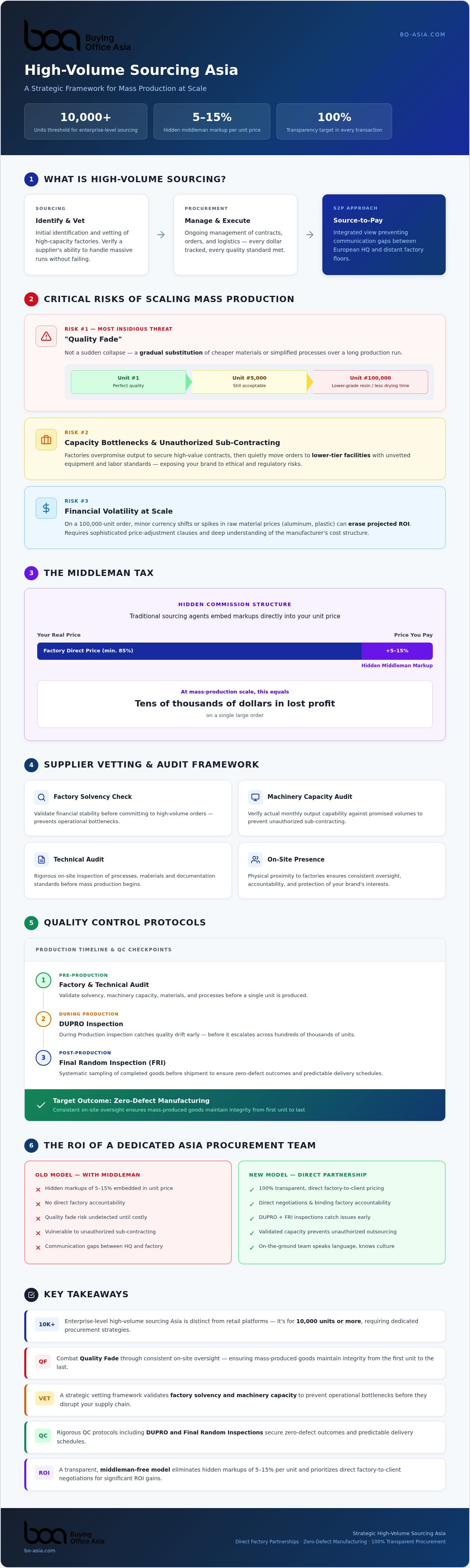
Maintaining consistency across a run of 50,000 units requires more than a final check before shipping. To combat the Quality Fade mentioned earlier, your strategy for high-volume sourcing Asia must include During Production (DUPRO) inspections. These on-site evaluations occur when approximately 20% to 30% of the order is finished. By catching deviations early, you prevent a minor calibration error from ruining the entire batch. This proactive oversight is the difference between a minor adjustment and a total loss of inventory.
Once production is complete, Final Random Inspections (FRI) are conducted based on international AQL (Acceptable Quality Level) standards. This statistical method allows you to verify the quality of a massive lot by examining a representative sample. Throughout this process, the "Golden Sample"—the original, approved prototype—serves as the non-negotiable benchmark. Every unit must mirror the Golden Sample's specifications, ensuring that unit #100,000 is identical to the first. You can explore our end-to-end sourcing and procurement services to see how we integrate these protocols into a seamless management framework.
Massive orders demand sophisticated logistics to protect your ROI. Container consolidation strategies are essential to eliminate dead freight costs, ensuring you aren't paying to ship empty space. In the 2026 customs landscape, staying ahead of evolving import regulations for the EU and US is critical to avoid costly port delays. Managing the "Last Mile" from Asian ports to your warehouse requires a coordinated effort between local teams and global freight forwarders. This ensures your supply chain remains fluid and your inventory arrives exactly when your market demands it.
High-volume manufacturing often involves custom molds and specialized tooling. Protecting your Intellectual Property (IP) during this phase is a high-stakes requirement. You must ensure that tool ownership remains legally and physically with your company, not the factory. This prevents the manufacturer from using your proprietary designs for other clients or holding your production hostage. For a deeper dive into these protections, read our Strategic Guide to OEM Manufacturing in 2026. If you need a partner to secure your tooling and oversee your next major production run, you can contact our on-the-ground team today.
High-volume sourcing Asia requires a transition from viewing procurement as a simple cost center to recognizing it as a primary driver of profitability. When you operate at scale, the financial impact of even minor inefficiencies is magnified. By utilizing a dedicated team, you move beyond the limitations of digital platforms and unmanaged factory relationships. The most immediate return on investment comes from the elimination of the traditional agent markup, which typically hides 10% to 20% in obscured commissions. Reclaiming this margin directly improves your bottom line without requiring a change in your retail pricing strategy. To support this transition, you can explore Contingent Staffing and Permanent Placement Fees to understand the costs of hiring specialized supply chain talent.
Beyond unit costs, a regional presence eliminates the significant travel expenses and productivity losses associated with sending European HQ staff to oversee production. While some competitors advocate for AI-driven or fully automated sourcing models, these digital tools cannot perform a physical inspection or negotiate in a factory boardroom. A dedicated team provides a defense against operational setbacks that software simply cannot detect. This on-site presence consistently results in lower defect rates and faster time-to-market, as communication gaps are bridged in real-time rather than across time zones.
The strategic advantage of Hong Kong as a procurement hub remains unparalleled in 2026. It serves as the tactical gateway to the manufacturing clusters of the Greater Bay Area and Southeast Asia. Our hybrid model combines European leadership in Helsinki, which ensures strategic alignment and legal security, with on-the-ground operations in Hong Kong for tactical execution. This structure provides you with the same level of oversight usually reserved for major global enterprises. You can discover why Buying Office Asia is the partner for growth by exploring how this integrated extension of your team functions as a stabilizing force in a complex market.
Moving from SME volumes to enterprise-level mass production is a high-stakes transition that requires absolute transparency. When every fee is visible and every factory relationship is direct, you gain the financial clarity needed to scale with confidence. This middleman-free approach doesn't just save money; it builds a more resilient supply chain that can withstand global volatility. For a detailed analysis of these financial advantages, read our report on The ROI of a Dedicated Asia Procurement Team. By prioritizing long-term partnership over transactional buying, you ensure your brand's growth is supported by a foundation of transparency, quality, and measurable financial health.
Success in high-volume sourcing Asia depends on your ability to replace uncertainty with rigorous, on-the-ground management. You've seen that scaling to mass production requires more than a purchase order; it demands a defensive framework that protects your quality and your capital. By establishing direct factory relationships and enforcing strict on-site quality control, you eliminate the "Quality Fade" and hidden fees that often liquidate margins in unmanaged supply chains. This transition from transactional buying to strategic partnership is the only way to secure long-term financial viability.
A transparent, middleman-free model isn't just a cost-saving measure; it's a strategic asset that ensures your brand remains competitive and resilient. As a European-managed firm with over 15 years of operational history in Asia, we provide the regional expertise and 100% transparency you need to scale with confidence. Our team functions as an integrated extension of your own, securing factory-direct pricing and providing oversight at every production stage. When you're ready to stabilize your supply chain and maximize your ROI, you can Book a Consultation with Our Dedicated Asia Procurement Team to secure your manufacturing future. Your path to scalable, zero-defect production starts with a partner who prioritizes your financial health as much as you do.
In the context of high-volume sourcing Asia, high volume typically refers to production runs of 10,000 units or more. At this scale, transactional retail platforms aren't sufficient to manage the complexities of the supply chain. You require enterprise-level procurement strategies that prioritize factory-direct relationships and rigorous oversight. Managing these quantities demands a move away from simple purchasing toward a comprehensive risk-management approach that secures your margins and ensures consistent delivery schedules.
Consistency is maintained through a combination of "Golden Samples" and on-site inspections at critical production stages. You should utilize During Production (DUPRO) checks when 20% of the batch is complete to catch errors early. Final Random Inspections (FRI) based on AQL standards provide the statistical verification needed for the total lot. Constant on-site presence by a dedicated team is the only effective defense against the gradual quality fade that often affects unmanaged mass production runs.
It's significantly more cost-effective to go direct to factories when you have professional on-the-ground representation. Traditional sourcing agents often hide commissions of 10% to 20% within your unit price. By utilizing a transparent partner like Buying Office Asia, you eliminate these obscured costs. You pay the factory-direct price while benefiting from the oversight of an integrated team. This model ensures you don't sacrifice control or quality for a lower price point.
Hidden costs often manifest as obscured agent markups, "dead freight" from under-utilized containers, and the financial impact of quality defects. You might also encounter unforeseen expenses related to port delays or regulatory non-compliance if your logistics aren't managed by regional experts. A transparent fee structure is essential to identify these leaks. By eliminating middlemen and optimizing shipping routes, you protect your ROI and ensure that every dollar spent contributes directly to your product's value.
Disputes are resolved through immediate on-site intervention and a deep understanding of local business culture. Because we operate as an integrated extension of your team, we address production delays or quality deviations at the source before they escalate. Our regional presence and pre-negotiated contracts provide the leverage needed to hold manufacturers accountable. We prioritize long-term stability over transactional conflict, ensuring that your interests are protected while maintaining a functional and productive supplier relationship.
Lead times for mass production typically range from 45 to 90 days, depending on product complexity and raw material availability. In 2026, these timelines are increasingly influenced by regional infrastructure efficiency and optimized shipping routes. To maintain a predictable schedule, you must verify factory capacity and machinery status during the initial audit. Proactive management of the production flow and logistics ensures that your high-volume sourcing Asia strategy meets your market’s specific demand windows.
Modern ESG regulations require documented evidence of ethical labor practices and environmental compliance. European brands must perform rigorous on-site audits to verify that their suppliers meet these 2026 standards. Failure to provide this transparency can result in significant legal risks and brand damage. A dedicated procurement team ensures that your manufacturers are not just solvent, but also compliant with the social responsibility criteria required to maintain your access to the European and global markets.
You can protect your intellectual property by ensuring that all custom tooling and molds remain your legal property. Contracts should explicitly state that the factory cannot use your proprietary designs for other clients. On-site oversight is the most effective way to monitor tool usage and prevent unauthorized production runs. By maintaining a physical presence on the factory floor, you ensure that your innovations remain exclusive and that your brand’s competitive advantage is never compromised.

In 2026, the traditional sourcing agent isn't just an expense; they're a strategic liability that obscures your true cost of goods. Most procurement leaders recognize that supplier selection in asia has become a defensive maneuver where the goal is to eliminate the "Middleman Tax" before it erodes y...

Successful oem sourcing asia isn't just a search for a factory, but the implementation of a transparent, on-the-ground management ecosystem. You likely already know that the traditional intermediary model is flawed, often hiding true costs behind layers of markups and opaque communication. It's frus...

If your procurement strategy relies on digital communication across twelve time zones without physical eyes on the factory floor, you aren't managing a supply chain; you're managing a series of expensive surprises. By 2026, the global procurement outsourcing market is projected to reach 7.18 billion...