


Is your current China manufacturing management strategy robust enough to survive the regulatory shifts of 2026? With the recent implementation of Decree 834 and the new "Made in China" procurement standards, the distance between a successful product launch and a costly supply chain failure has never been thinner. You likely feel the constant anxiety of quality drift during high-volume runs or the frustration of obscured unit pricing. It's a common struggle for growing brands that lack a physical presence on the factory floor.
This guide promises a masterclass in scalable production, offering a professional framework for vetting suppliers and securing factory-direct pricing without the middleman tax. We'll walk you through the strategic steps to ensure 100% quality transparency and protect your intellectual property from localized risks. From navigating the August 2026 Manufacturing PMI contraction to implementing on-site audits that mirror an in-house team, this briefing provides the steady confidence you need to scale. You'll discover how to transform your procurement from a source of risk into a stabilized, high-performance engine for growth. To ensure your marketing and revenue strategies align with this increased production capacity, Carter Strategies offers the fractional CMO expertise required for mid-market success.
• Identify genuine manufacturers and avoid the pitfalls of trading companies with a professional five-step factory audit framework.
• Secure factory-direct pricing by eliminating hidden commissions and the "kickback culture" common in traditional sourcing models.
• Maintain 100% quality transparency during high-volume production with on-site oversight and rigorous AQL standards.
• Adapt your China manufacturing management strategy to meet the 2026 regulatory demands for supply chain security and ESG compliance.
• Build a resilient defense against supply chain risk by integrating a dedicated Asia procurement team into your corporate structure.
In 2026, effective China manufacturing management has transitioned from a simple procurement exercise into a complex discipline of risk mitigation and regulatory compliance. The global economy no longer rewards the "lowest cost at any cost" model. Instead, enterprise leaders prioritize highest reliability and total transparency. A foundational understanding of The Evolution of China Manufacturing reveals why this region remains indispensable despite global shifts. While digital-only platforms provide a low barrier to entry, they often obscure the reality of who is actually standing behind the machines. For businesses moving beyond basic sourcing, a professional approach to sourcing and procurement is the only way to protect margins and brand integrity.
Hong Kong has solidified its role as the strategic hub for international trade oversight. It offers a sophisticated legal framework that acts as a bridge between Western corporate standards and mainland production. By managing operations through a Hong Kong-based HQ with regional expertise, you gain a layer of security that digital marketplaces simply cannot replicate. It's about moving from a transactional relationship to a managed infrastructure.
China's infrastructure maturity provides a "cluster effect" that emerging markets haven't yet matched. In specialized industrial zones, raw material suppliers, component manufacturers, and assembly plants sit within miles of each other. This proximity drives efficiency. The NBS Manufacturing PMI stood at 49.8 in August 2026, signaling a tightening market where only the most technologically advanced factories thrive. The "Made in China 2025" initiative has pushed these facilities toward automated assembly and precision manufacturing. This allows for high-volume orders that maintain tighter tolerances than regional competitors in Southeast Asia or India. You aren't just buying labor; you're accessing a high-tech ecosystem that handles scale with ease.
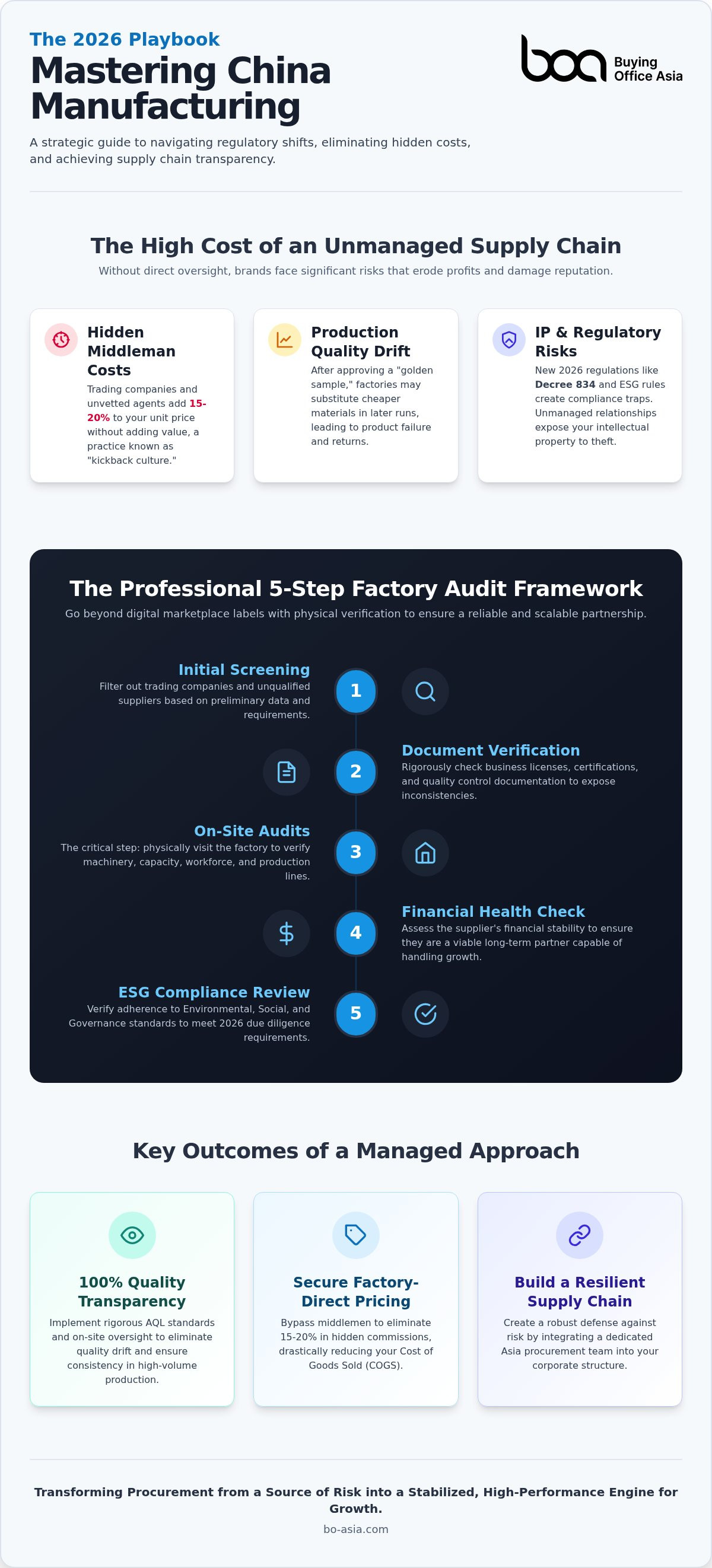
Unmanaged relationships carry hidden costs that can devastate your financial health. One of the most persistent threats is "Quality Drift." This phenomenon occurs when factory standards slowly erode after the initial golden sample is approved. Without on-site oversight, a factory might substitute cheaper components in the third or fourth production run to pad their own margins. It's a common trap.
Furthermore, the 2026 regulatory environment has become more restrictive. Decree 834 and Decree 835, implemented in early 2026, have changed how supply chain data is collected and shared. If you rely on unvetted factory relationships, you face significant Intellectual Property (IP) vulnerabilities and the risk of non-compliance with new ESG due diligence rules. Obscured supply chain layers often hide middlemen who add 15-20% to your unit price without adding a single cent of value. Professional China manufacturing management eliminates these parasitic costs by establishing a direct, audited line to the factory floor.
Digital marketplaces offer a convenient entry point, but they often mask the reality of the supply chain. Relying on a "gold supplier" badge is a risk most enterprise-level brands can't afford. Professional China manufacturing management requires a shift from digital trust to physical verification. Trading companies frequently pose as manufacturers to capture commissions, often leading to fragmented communication and quality drift. To scale safely, you need to identify the entity actually holding the tooling and managing the labor. It's the difference between a transactional middleman and a direct, accountable partnership.
Effective vetting in 2026 involves a rigorous five-step framework: initial screening, document verification, on-site audits, financial health checks, and ESG compliance reviews. While document reviews are a starting point, they are easily fabricated. Only an on-site presence can confirm if a factory's stated capacity matches its physical machine count and workforce. You can learn more about these nuances in our comprehensive guide on Supplier Vetting in Asia.
A professional audit goes beyond a simple walkthrough. We verify physical capacity to ensure the factory can meet your 2026 volume requirements without subcontracting to unvetted third parties. Financial health assessments are equally critical. A manufacturer facing liquidity issues might cut corners on raw materials mid-cycle or fail to pay workers, leading to production halts. We also scrutinize internal QC protocols and laboratory testing capabilities. If a factory doesn't have the equipment to test its own output, your quality is left to chance.
Environmental, Social, and Governance (ESG) compliance has become a mandatory metric for global brands. With Decree 834 and 835 now in effect, vetting suppliers at the source is the only way to navigate the complex data-collection landscape while ensuring ethical standards. We ensure your partners meet international standards while adhering to local Chinese regulations, protecting you from both operational and reputational risk.
IP theft often happens because of loosely defined relationships or unmanaged access to designs. You must secure enforceable manufacturing agreements within the local jurisdiction to have any real legal standing. We prioritize implementing tooling ownership protections from day one. This ensures that if a relationship ends, your molds and custom equipment remain your assets, not the factory's. Protecting your innovation requires a proactive defense and sophisticated China manufacturing management. If you're ready to secure your supply chain, you can speak with our regional experts to discuss a tailored audit strategy.
Traditional sourcing models are often built on a foundation of opacity. When you engage an unvetted agent, you're frequently stepping into a "Kickback Culture" where the agent's primary loyalty lies with the manufacturer rather than your brand. Professional China manufacturing management requires a radical departure from this model. By shifting to 100% transparency, you eliminate the hidden markups that inflate landed costs and compromise quality incentives. It's about ensuring that every dollar you spend is an investment in product quality, not an undisclosed commission for a middleman.
The math of unmanaged sourcing is often deceptive. Many agents quote a modest 5% service fee while secretly negotiating a 15% or 20% price inflation with the factory. You pay the higher unit price, and the agent collects the difference behind your back. This isn't just a financial drain; it's a significant conflict of interest. If a factory produces a sub-standard batch, an agent receiving hidden commissions is unlikely to stop the shipment or demand a rework. They won't bite the hand that feeds them.
True China manufacturing management demands seeing the original factory invoice. You need to know exactly what the factory is being paid for materials, tooling, and labor. This visibility allows for aggressive negotiation tactics based on actual market rates rather than inflated quotes provided by an intermediary. When you deal factory-direct, you gain the leverage to demand better terms and higher quality standards because the financial relationship is clear and direct.
A professional procurement model replaces hidden margins with a clear, fee-for-service structure. This approach aligns the interests of your Asia team with your own financial health. Instead of wondering where the extra costs are coming from, you pay for specific, high-value deliverables:
• Rigorous supplier vetting and factory audits.
• Continuous on-site mass production oversight.
• Complex logistics and shipping coordination.
When the service fee is transparently calculated, your procurement partner has every incentive to drive down the unit price and maintain strict quality standards. They work as an extension of your own team, not as a third-party seller. This model provides a measurable ROI by significantly reducing the total cost of ownership over high-volume production cycles. To see how this structure impacts the bottom line, you can explore our pricing and savings examples to understand the potential for financial optimization and risk reduction.
Digital management tools can track a Bill of Materials, but they can't see a misaligned mold or a substituted alloy. High-volume China manufacturing management requires a permanent on-the-ground presence to bridge the gap between digital data and physical reality. You need eyes on the factory floor to ensure that the quality of the ten-thousandth unit matches the approved golden sample. Relying on software for oversight is a risk that often leads to expensive reworks and shipping delays. It's about moving from reactive problem-solving to proactive prevention.
Setting Acceptable Quality Level (AQL) standards is the first step in creating a language the factory respects. Without clearly defined AQL parameters, "quality" remains a subjective term. We implement a three-tier inspection protocol to maintain total oversight:
We verify raw materials and components before the assembly line starts. This prevents the use of sub-standard inputs that could compromise the entire batch.
Catching errors while they're fixable is the most cost-effective way to manage risk. We inspect the first 10-20% of the run to identify systemic issues early.
Once production is 100% complete, we perform a statistically significant check and supervise container loading to ensure what you paid for is what actually leaves the port.
The transition from a prototype to mass production is where most projects fail. Dedicated Product Development & Sampling Support ensures that technical specifications don't get lost in translation. Managing custom tooling requires more than just a contract; it requires physical verification of the mold's condition and secure storage. If you don't have a team on-site, you're essentially leaving your most valuable assets in the hands of a third party without any defense.
Securing tooling ownership is a defensive necessity. We ensure your molds are tagged and tracked, preventing the factory from using your proprietary assets for "backdoor" production. This level of oversight is standard in OEM/ODM contract manufacturing, where the complexity of custom parts demands rigorous China manufacturing management. By controlling the tooling, you control the supply chain. Operational excellence isn't a goal; it's a requirement for financial viability. If you're ready to implement a professional oversight framework for your next production run, contact our on-site team in Hong Kong today.
The traditional sourcing agent model is inherently transactional. These intermediaries often prioritize their own margins over your long-term growth, creating a barrier between your brand and the factory floor. To achieve true China manufacturing management, you must move toward an integrated model. This approach replaces the external middleman with a dedicated procurement team that functions as a seamless extension of your headquarters. It's a shift from buying a service to building a defensive infrastructure that protects your financial interests and brand reputation. For B2C founders who want to master this transition and scale their overall business strategy, you can visit Founder Freedom for specialized coaching and leadership support.
Bridging the cultural and operational gap between Western brands and Chinese factories requires a dual-presence strategy. Helsinki-based leadership ensures that your supply chain remains aligned with European ethical standards and the complex regulatory requirements of 2026. This leadership provides the corporate governance and transparency that Western enterprises demand. Meanwhile, our Hong Kong-based execution team offers the physical proximity necessary for real-time oversight and accountability.
This structure solves the common problem of communication barriers and time zone delays. You don't have to wait 24 hours for an answer about a production delay; your team is already on-site, managing the situation as it happens. By pairing European rigor with local expertise, you create a stabilizing force in an often volatile market. This synergy is the foundation of a resilient supply chain that can navigate the nuances of Decree 834 and 835 without compromising on speed or quality. It's about having an advocate on the ground who speaks the language of both your boardroom and the factory floor.
Scaling high-volume production isn't just about finding more factories. It's about developing existing supplier relationships into strategic partnerships. A Dedicated Asia Procurement Team focuses on supplier management and development, ensuring that your partners grow alongside your business. This long-term focus prevents the quality drift and pricing volatility that plague unmanaged supply chains. You move from one-off transactional orders to a stable, managed supply chain that offers predictable outcomes.
When your procurement team is fully integrated into your workflow, they can anticipate risks before they impact your bottom line. They handle the complexities of custom tooling, on-site inspections, and logistics management, allowing your internal team to focus on innovation and market expansion. This isn't just an outsourcing solution; it's a strategic asset that provides a measurable competitive advantage. Secure your manufacturing future in 2026 by moving away from the vulnerabilities of the middleman model and toward the steady confidence of an integrated partner. Discuss your scaling requirements with our Helsinki and Hong Kong leadership today.
The manufacturing landscape in 2026 demands more than just a list of suppliers; it requires a robust, on-the-ground infrastructure. You've seen how shifting from digital marketplaces to physical vetting protects your IP and how eliminating hidden commissions stabilizes your unit pricing. Mastering China manufacturing management in this new era is about replacing the traditional middleman with a dedicated, transparent partner that acts as an extension of your own team.
By leveraging European-managed leadership from Helsinki paired with local execution in Hong Kong, you gain the elite oversight usually reserved for major enterprises. We provide 100% transparency on all factory-direct pricing and maintain a constant on-the-ground presence to prevent quality drift during mass production. This defensive strategy ensures your growth remains profitable and your brand stays protected from unforeseen operational risks. It's time to move toward a model defined by reliability and financial optimization. Request a transparent sourcing consultation with Buying Office Asia to stabilize your production today. We look forward to building a resilient partnership that drives your long-term success.
You can verify a supplier's status by examining their business license and VAT invoices. A genuine factory's license lists "manufacturing" or "production" in its scope, while trading companies are typically listed as "wholesale" or "consulting." On-site audits are the only definitive way to confirm that the machines and labor force belong to the entity you're paying. We verify this by matching social security records with the factory's corporate registration.
The primary risks in 2026 include regulatory shifts like Decree 834 and 835, which impact how supply chain data is collected. Quality drift remains a persistent threat, where material substitutions occur after initial samples are approved. Economic volatility can also lead to sudden production halts at unvetted facilities. Effective China manufacturing management requires navigating these regulatory changes while maintaining physical oversight. It's the only way to ensure financial viability throughout the production cycle.
You must register your trademarks and patents in China, as it's a "first-to-file" jurisdiction. Enforceable manufacturing agreements should be drafted in Chinese and governed by local courts to ensure legal standing. We recommend implementing tooling ownership protections where molds are physically tagged and audited. This prevents the factory from using your proprietary designs for unauthorized production runs or selling your innovation to competitors who might be operating in the same industrial cluster.
Original Equipment Manufacturing (OEM) involves producing goods based on your specific designs and custom tooling. Original Design Manufacturing (ODM) refers to products designed by the factory, which you then brand as your own. OEM offers greater control over IP and product uniqueness but requires higher upfront investment in R&D. ODM is faster to market but often limits your ability to differentiate the product from other brands using the same generic supplier designs.
A 100% transparency model eliminates the conflict of interest inherent in commission-based sourcing. Traditional agents often hide extra markups in the unit price, prioritizing their kickback over your quality requirements. With transparency, you pay a flat service fee and see the original factory invoice. This aligns your partner's incentives with your own, ensuring they negotiate the lowest possible factory-direct price while maintaining strict quality standards without any hidden financial agendas.
Physical presence is non-negotiable for high-volume orders. Digital tools cannot catch physical defects or unauthorized material substitutions on the assembly line. A dedicated team performs pre-production inspections, during-production checks, and final random inspections to ensure every batch meets your specifications. This level of China manufacturing management provides a defensive barrier against quality drift and ensures that production timelines are met through direct, on-site communication with the factory's management team.
Hong Kong provides a sophisticated legal and financial bridge to mainland China. It offers a familiar corporate environment with robust IP protections and transparent banking systems. Managing your supply chain through a Hong Kong HQ allows for easier contract enforcement and smoother international logistics coordination. It acts as a strategic oversight hub, providing the stability and regulatory alignment needed to manage complex manufacturing operations across the Greater Bay Area and other industrial zones.
European leadership ensures that your supply chain adheres to international ESG standards and Corporate Sustainability Due Diligence directives. We bridge the cultural gap by applying Western ethical rigor to local factory conditions. This includes auditing for fair labor practices, environmental compliance, and safety standards. Helsinki-based management provides the governance and accountability required by global enterprises, ensuring that your manufacturing operations don't just meet production targets but also fulfill your corporate responsibility goals.

As of July 2026, the average effective tariff rate on Chinese imports has climbed to 22.8%, but is the cost on the invoice really your biggest financial risk? You likely feel the mounting pressure of managing a supply chain where the rules of engagement change every quarter. The challenges of sourci...

What if your final quality check isn't just a formality, but the only thing standing between a successful product launch and a container full of unsellable defects? For many businesses, the fear of receiving substandard goods from overseas is a constant anxiety, often compounded by communication bar...

Most importers believe that factory kickbacks and hidden commissions are simply an unavoidable cost of doing business in Asia. You've likely felt the frustration of paying premium prices only to receive sub-par batches or discovering that your "direct" factory contact is actually a third-party trade...