


What if your final quality check isn't just a formality, but the only thing standing between a successful product launch and a container full of unsellable defects? For many businesses, the fear of receiving substandard goods from overseas is a constant anxiety, often compounded by communication barriers and the hidden fees of hands-off agencies. You deserve a procurement process where transparency isn't a luxury but a measurable standard. This guide will help you master the strategic nuances of a pre-shipment inspection China to secure your ROI and protect your brand reputation.
We'll show you how to achieve zero-defect shipments by leveraging on-the-ground expertise that functions as an integrated extension of your own team. You'll gain a clear understanding of the latest regulatory shifts, including the GACC Announcement No. 57 of 2026, which now impacts products ranging from baby goods to adult footwear. We'll preview the technical frameworks and release-evidence systems that eliminate the need for costly middlemen, ensuring your supply chain remains both lean and resilient through 2026 and beyond.
• Identify the critical window when 80% of goods are packed to perform a final check before your capital leaves your account.
• Master the technical anatomy of a pre-shipment inspection China, from quantity verification to identifying aesthetic variances that could trigger customer returns.
• Learn why generic "tick-box" inspection reports often fail and how an integrated procurement team provides the transparency needed to expose hidden factory kickbacks.
• Establish a "Golden Sample" agreement that sets a non-negotiable benchmark for workmanship and safety standards across your entire production run.
• Transition from transactional checks to a strategic supply chain defense that secures your brand reputation and long-term financial viability.
In the high-stakes environment of 2026 global trade, a Pre-shipment inspection (PSI) acts as your final defensive wall. It occurs during the critical window when 80% to 100% of your goods are finished and packed. This is the only moment you can verify that the order matches your approved samples before the container is sealed. A pre-shipment inspection China ensures that what you paid for is actually what is being loaded, preventing the disastrous discovery of defects after the goods have crossed the ocean.
Think of the final balance payment as the point of no return. Once that capital leaves your account, your leverage over the factory vanishes. Relying on trust in a transactional manufacturing environment is a strategy built on hope, not data. By integrating PSI into an end-to-end sourcing process, you maintain control until the very last second. This oversight protects your brand equity, as one bad batch in 2026 can dismantle years of market positioning in a matter of days.
A seemingly minor 5% defect rate can be catastrophic in high-volume retail. When you factor in shipping costs, import duties, and customer returns, the loss isn't just the unit price; it's the entire logistical investment. Factory-provided QC photos are often curated to show only the best examples, hiding systemic issues that only an on-site professional can catch. The Cost of Poor Quality is the total financial burden incurred by a business when products do not meet established standards, including the cost of scrap, rework, and lost brand trust.
Regulatory scrutiny has intensified with updates like the GACC Announcement No. 57 of 2026. Your shipments must meet strict EU and US sustainability mandates that require deep visibility into the factory floor. A professional PSI verifies that labeling requirements, such as the distinction between "Made in China" and "Made in PRC," are followed to avoid costly customs delays. Beyond simple product checks, a pre-shipment inspection China provides the necessary ESG transparency to prove your supply chain adheres to ethical and environmental standards. This level of rigor transforms a routine check into a strategic advantage for your business.
A rigorous technical protocol is the foundation of any successful pre-shipment inspection China. It isn't just about looking at the product; it's about systematic verification across four primary pillars:
Confirming the total count matches the purchase order to prevent short-shipping.
Identifying aesthetic variances like scratches, dents, or color deviations.
Performing on-site stress tests, battery cycles, and safety checks.
Verifying barcodes, shipping marks, and performing drop-test compliance.
These steps ensure your shipment arrives ready for retail. Functional testing involves specific stress tests to ensure electrical safety and durability. Packaging checks are equally vital. Inspectors verify barcodes and shipping marks while performing drop-tests to confirm the goods will survive international transit. This level of detail aligns with the views of the U.S. Trade Representative on PSI, which highlights the role of these inspections in facilitating fair trade and ensuring compliance.
Most professional inspections rely on the ISO 2859-1 standard, commonly known as AQL (Acceptable Quality Limit) sampling. This statistical method defines the maximum number of defects allowed before a batch is rejected. Inspectors categorize defects as Critical (safety hazards), Major (functional failures), or Minor (aesthetic flaws). Choosing the right inspection level is a strategic decision. While Level II is the industry standard, high-volume sourcing often requires the stricter Level III to mitigate increased risk.
For businesses engaged in custom product development, the technical requirements are even more precise. Mass production oversight must confirm that every unit matches the approved "golden sample" and technical drawings. We use professional caliber tools to measure tolerances on-site, ensuring that custom tooling hasn't drifted during the manufacturing run. This hands-on verification prevents the costly mistake of shipping thousands of units that don't fit together or function as intended. If you need a more tailored technical protocol for your specific product line, you can reach out to our technical team for a consultation.
Many importers treat a pre-shipment inspection China as a standalone "policing" event. They hire a third-party agency, receive a generic PDF report, and assume the job is done. This "tick-box" approach often misses the big picture because freelance inspectors lack product-specific context. They don't know your history with the factory or the subtle nuances that define your brand's quality standards. When an inspector only visits for eight hours, they see a snapshot, not the full production narrative.
Transparency remains a significant hurdle in the traditional model. It's an open secret that some agencies or unmanaged agents take "kickbacks" from factories to overlook minor defects or pass a borderline batch. This corruption is why the WTO Agreement on Preshipment Inspection was established—to mandate non-discriminatory, transparent, and objective procedures. The Buying Office Asia approach eliminates these conflicts of interest by operating as your internal quality department rather than a detached service provider.
Unmanaged sourcing agents often obscure factory-direct pricing to hide their own commissions, which can inflate your landed costs without adding value. This lack of transparency makes it impossible to know if you're overpaying for substandard materials. A dedicated Asia procurement team answers only to you, ensuring every cent of your budget is used to secure the best possible components. Persistent on-the-ground presence prevents "quality fade," where factory standards slowly decline over long-term production cycles as the supplier attempts to increase their own margins through cheaper inputs.
Bridging the gap between European expectations and Chinese manufacturing reality requires more than just a translator. It demands a leadership structure that understands both business cultures. Our model pairs European management with local execution, providing a seamless flow of information from the factory floor to your desk. You get real-time inspection data while you sleep, allowing you to make informed decisions the moment you start your workday. Local presence isn't just a convenience; it's a signature promise of accountability that a remote agency simply can't replicate. We don't just report problems; we resolve them before the container is ever sealed.
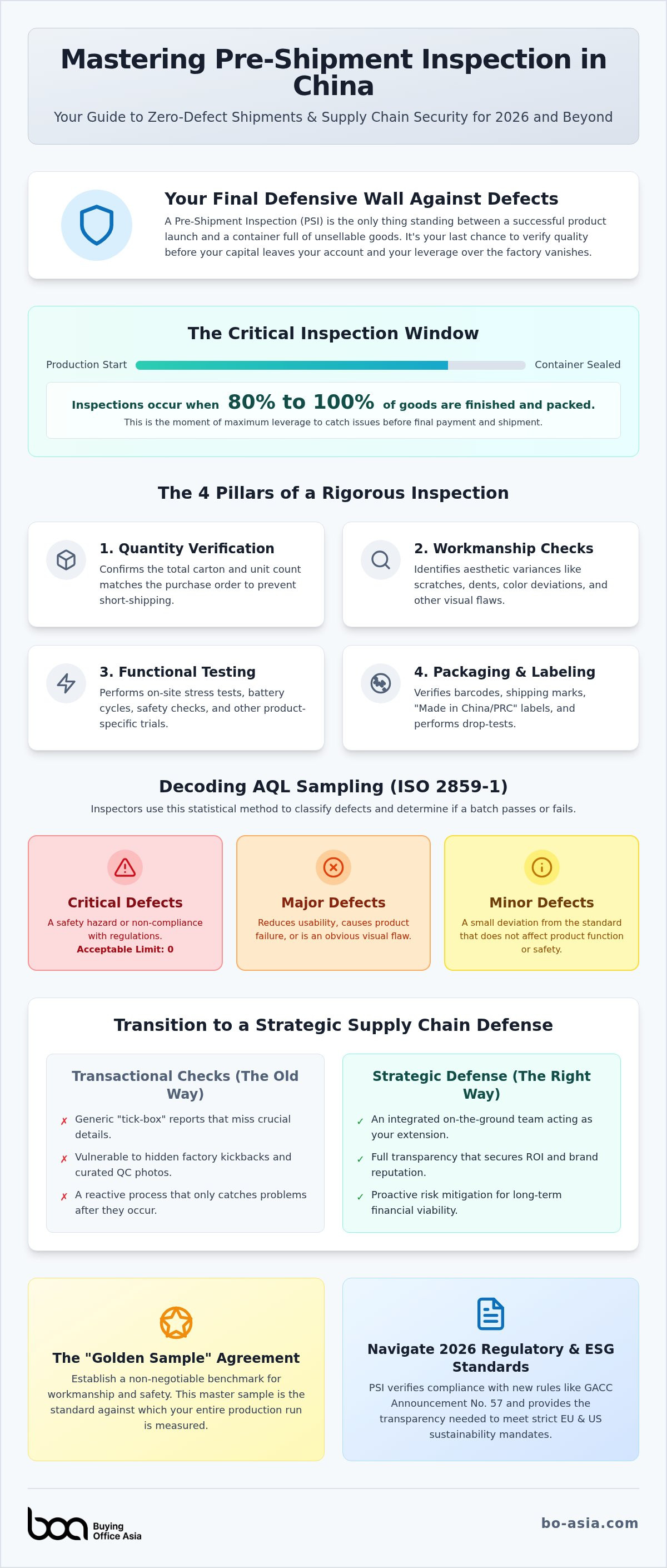
A pre-shipment inspection China is only as effective as the checklist that guides it. Your checklist should be a living document that translates your brand standards into measurable criteria. The foundation of this process is the "Golden Sample" agreement, which serves as the physical benchmark for every unit produced. Without this signed and sealed reference, quality becomes subjective, leaving you vulnerable to factory excuses during the final stages of production.
Categorizing defects correctly is the most vital step in your quality protocol. Critical defects are non-negotiable safety hazards or legal violations, such as exposed wiring or prohibited chemical levels, that trigger an immediate batch rejection. Major defects affect the product's primary function or significantly degrade brand value, while minor defects are aesthetic variances that don't impact utility. In 2026, your checklist must also integrate specific logistics requirements, such as ensuring shipping marks comply with the latest GACC sampling categories for baby products and low-voltage electrical appliances.
Accuracy starts with the paperwork. Your inspector needs the Bill of Materials (BOM) and final technical drawings to verify that the factory hasn't swapped out high-quality components for cheaper alternatives. We also align the Purchase Order (PO) to check SKU variations and total quantities against the packed cartons. Crucially, we verify that our suppliers have all necessary 2026 export licenses ready to avoid costly delays at the port. This proactive documentation check prevents administrative errors from turning into logistical nightmares.
A failed inspection isn't the end of the partnership; it's a call for professional intervention. You must demand a formal Corrective Action Plan (CAP) that outlines how the factory will fix the defects without compromising the shipping schedule. To protect your margins, your initial contract should clearly state that the factory pays for any required re-inspections. Managing this relationship requires a balance of firmness and partnership, ensuring the supplier understands that your quality standards are a fixed requirement for future business. If you need an expert review of your current quality standards, contact our procurement team to audit your PSI checklist.
A pre-shipment inspection China shouldn't be a standalone event; it's a critical component of a broader, strategic supply chain management philosophy. Buying Office Asia (BOA) moves beyond the "tick-box" mentality of generic agencies to provide a comprehensive defense for your procurement interests. We don't just report on the state of your goods; we act as an integrated extension of your team to ensure that factory-direct price negotiations don't come at the expense of quality. This hands-on approach ensures you never overpay for substandard production while maintaining the steady confidence of a managed supply chain.
Our operational model is built for scalability, allowing you to manage high-volume sourcing across multiple Asian provinces without losing oversight. We provide the regional expertise and networks that independent business owners often lack, transforming a complex global market into a stable, predictable environment. From analyzing initial savings examples to enforcing final quality standards, our goal is to put you in total control of your financial health and product integrity.
The financial viability of your import business depends on your ability to reduce the total landed cost by catching errors at the source. A pre-shipment inspection China conducted by our on-site team is the most effective way to prevent the unforeseen expenses of customer returns and logistics failures. You can review the documented outcomes of our rigorous oversight in our BOA cases, where we highlight real-world examples of defect prevention in diverse product categories. Having European leadership manage our Asian operations provides a unique vocal signature of accountability, bridging the gap between your expectations and the reality of the factory floor.
Integrating BOA into your existing procurement workflow is a straightforward transition that immediately alleviates the anxieties of international manufacturing. We help you move away from unmanaged sourcing models that obscure costs and hide inefficiencies, replacing them with a transparent buying office model. This shift doesn't just protect your next container; it builds a foundation for long-term growth and brand security. You'll gain access to a dedicated team that prioritizes your ROI over transactional commissions. If you're ready to secure your supply chain with the oversight usually reserved for major enterprises, contact Buying Office Asia for a consultation today.
Mastering the pre-shipment inspection China is no longer just about quality control; it's about safeguarding your capital and brand equity in an increasingly complex regulatory environment. By implementing a rigorous technical checklist and moving away from unmanaged intermediary models, you eliminate the hidden costs and communication barriers that often plague international manufacturing. This shift ensures your shipments arrive exactly as specified, protecting your ROI from the first unit to the last.
Our European-managed leadership in Helsinki, paired with a permanent on-the-ground presence in Hong Kong and Mainland China, ensures 100% transparency with zero hidden commissions. You deserve a partner that functions as an integrated extension of your own team, providing the elite oversight necessary for high-volume success. It's time to transition from transactional checks to a strategic supply chain defense that prioritizes your financial health.
View Our Transparent Pricing and Sourcing Models
Your path to a zero-defect future starts with the right eyes on the factory floor. We're here to ensure your vision is realized with precision and reliability.
A Factory Audit evaluates a supplier's capability and infrastructure before you place an order. In contrast, a Pre-Shipment Inspection evaluates the actual finished goods before they leave the factory. While an audit focuses on the vendor's long-term reliability, the PSI focuses on a specific batch's quality and conformity. We provide both services as part of our end-to-end sourcing model to ensure you only work with vetted suppliers and receive defect-free products every time.
A pre-shipment inspection China should ideally be performed when 100% of the goods are produced and at least 80% are packed. Conducting the check at this stage allows the inspector to verify the final packaging, labeling, and carton markings while ensuring the entire order is ready for transport. This timing provides a representative sample of the total production run, reducing the risk of hidden defects being found in the final cartons.
A typical inspection usually takes one to two man-days, depending on the complexity of the product and the sample size. For simple consumer goods with standard AQL Level II sampling, a single day is often sufficient. However, technical products or large, high-volume orders requiring specialized testing may extend the process. Our dedicated team manages these schedules to ensure comprehensive oversight without causing unnecessary delays to your shipping timeline or final delivery.
The buyer typically pays the initial inspection fee as part of their quality control budget. However, it's standard practice to include a clause in your contract stating that the factory is responsible for the cost of any re-inspections if the first one fails. This arrangement incentivizes the manufacturer to maintain high standards and ensures you don't incur additional expenses due to their production errors or a lack of internal oversight.
Remote video inspections are generally insufficient for professional procurement because they lack the physical rigor of on-site testing. A video feed can easily hide aesthetic flaws, material substitutions, or functional failures that only a physical inspector can detect. We maintain a permanent on-the-ground presence in Hong Kong and Mainland China to provide the physical proximity required for absolute accountability, rather than relying on curated digital views that hide risks.
If a factory refuses an independent inspector on-site, it's a major red flag indicating potential quality issues or non-compliance. Your purchase agreement should explicitly grant your inspection team access to the production floor as a condition of final payment. When we manage your supply chain, our local presence and established factory relationships prevent these barriers, ensuring full transparency into the factory floor before any capital leaves your account or goods are shipped.
While the first order is the most critical, perform a pre-shipment inspection China for every shipment to prevent "quality fade." Suppliers may lower their standards over time to increase their margins, often substituting cheaper materials in subsequent production runs. Consistent oversight ensures that the factory adheres to your "Golden Sample" benchmarks indefinitely. This ongoing vigilance is the only way to secure long-term brand reputation and minimize the risk of customer returns.
Higher AQL levels, such as Level III, require a larger sample size, which increases the time needed for the inspector to complete the check. More time on-site translates to higher man-day costs for the buyer. However, for high-volume retail or complex technical products, the increased sample size is a necessary investment. It provides a higher statistical confidence level, significantly reducing the probability of major defects reaching your customers and destroying your market positioning.

As of July 2026, the average effective tariff rate on Chinese imports has climbed to 22.8%, but is the cost on the invoice really your biggest financial risk? You likely feel the mounting pressure of managing a supply chain where the rules of engagement change every quarter. The challenges of sourci...

Is your current China manufacturing management strategy robust enough to survive the regulatory shifts of 2026? With the recent implementation of Decree 834 and the new "Made in China" procurement standards, the distance between a successful product launch and a costly supply chain failure has never...

Most importers believe that factory kickbacks and hidden commissions are simply an unavoidable cost of doing business in Asia. You've likely felt the frustration of paying premium prices only to receive sub-par batches or discovering that your "direct" factory contact is actually a third-party trade...