


As of July 2026, the average effective tariff rate on Chinese imports has climbed to 22.8%, but is the cost on the invoice really your biggest financial risk? You likely feel the mounting pressure of managing a supply chain where the rules of engagement change every quarter. The challenges of sourcing from China in this new era aren't just about logistics; they're about the "transparency gap" created by remote digital sourcing and the heavy weight of new regulatory demands. Whether it's the definitive phase of the EU Carbon Border Adjustment Mechanism (CBAM) or the first mandatory ESG reports due this year, the complexity of international trade has reached a critical peak.
You deserve a procurement strategy that offers calm assurance instead of constant anxiety. This guide will show you how to master these complexities by moving away from opaque intermediary models and toward a transparent, factory-direct approach. We'll explore how to secure verified ESG compliance for European markets and implement rigorous on-site oversight to eliminate quality fade during mass production. By the end of this briefing, you'll have a strategic roadmap to mitigate risk, protect your brand reputation, and ensure your supply chain remains a stabilizing force for your business's financial health.
• Identify the shift from simple logistics to complex regulatory data management to ensure your supply chain remains compliant with 2026 global standards.
• Learn how to bypass the "invisible" middleman on digital platforms to overcome the transparency challenges of sourcing from China and secure direct factory access.
• Transition your ESG strategy from a passive checklist to an active brand defense that meets the rigorous demands of the latest CSRD requirements.
• Discover why mass production oversight is the only reliable defense against "Quality Fade" and how to maintain product integrity through the final batch.
• Evaluate the financial and operational ROI of replacing transactional agents with an integrated, on-the-ground procurement team in Hong Kong and Mainland China.
The industrial landscape of 2026 has fundamentally redefined the challenges of sourcing from China. You no longer face a market defined by endless cheap labor; instead, you're interacting with a high-tech manufacturing powerhouse that leads the world in automation and specialized production. This shift means your primary risk isn't just a shipping delay. It's the "Transparency Gap" that grows when you manage complex technical projects from a distance without on-the-ground eyes to verify every step of the process.
Chinese factories have aggressively moved up the value chain. As a result of rising labor costs in China, the region has pivoted toward sophisticated robotics, green energy components, and high-end electronics. Finding a factory that can hit a target price is easy; finding one that integrates into your specific technical ecosystem is the real hurdle. In 2026, sourcing is less about procurement and more about custom product development. You need a partner who understands the engineering behind the quote, not just the numbers on the page.
The "China Plus One" strategy hasn't diminished China's role. It has refined it. While you might source basic textiles or simple assemblies from emerging markets, your high-complexity components still rely on the deep infrastructure found in the Pearl River Delta. This specialization requires a higher level of oversight. You can't afford a "set and forget" mentality when the technical stakes are this high. Efficiency in 2026 is measured by how well you bridge the gap between your design office and the factory floor.
Trade policy is now structural, not seasonal. With average effective U.S. tariffs sitting at 22.8%, and iron or steel products facing rates as high as 40.5%, your margins depend on precise landing cost calculations. These challenges of sourcing from China require a strategic buffer. Operating through a regional presence in Hong Kong provides that stability. It allows for seamless movement of capital and information while maintaining physical proximity to the manufacturing heartland of Guangdong.
European-managed oversight acts as your brand's defense. Having Finnish leadership on the ground in Asia ensures that communication remains logical and results-oriented. It bridges the gap between Western compliance expectations and Eastern operational realities. You gain the security of a local team that speaks the language of your boardroom while holding factories accountable in their own backyard. This model eliminates the obscured costs typical of unmanaged supply chains and puts you back in control of your financial health.
Digital convenience often masks structural risk. While the rise of e-commerce and digital sourcing in China has simplified the initial search for suppliers, it has also paved the way for the "Invisible Middleman." Many entities appearing as direct manufacturers on major platforms are actually trading companies. They operate without owning a single piece of machinery. This creates a significant hurdle in the challenges of sourcing from China because it adds an unnecessary layer of cost and a dangerous barrier to direct communication. When you work through these intermediaries, you lose the ability to negotiate factory-direct pricing, often paying premiums that are hidden within the unit cost.
Trading companies often excel at digital marketing, using professional photography and "Verified" badges to project an image of industrial scale. However, these badges usually confirm a business's legal existence, not their manufacturing capability. You should watch for red flags like a product catalog that spans multiple unrelated categories. A true factory specializes. To protect your margins, you must insist on on-site quality control to verify that the machines actually exist and that the production capacity matches the sales pitch. 100% transparency ensures that you aren't paying a hidden markup to an agent who adds no value to the production process. This direct connection is the only way to ensure long-term profitability and accountability.
Standard translation services are insufficient when you're managing complex OEM or tooling projects. A simple linguistic misunderstanding regarding material grades or tolerances can lead to catastrophic failures during mass production. This is where "quality fade" begins. It's a common phenomenon where a supplier gradually substitutes cheaper materials or simplifies processes to increase their own margins after the initial contract is signed. Without a dedicated Asia procurement team that speaks the technical language of the factory floor, your specifications can be "lost in translation." You need eyes on the ground to ensure the third batch maintains the same integrity as the first sample. Expert oversight acts as a defense against these operational setbacks.
If you're unsure whether your current supplier is a factory or a middleman, you can reach out to our team for a professional assessment of your supply chain transparency.
By 2026, the regulatory environment has transformed ethical sourcing from a corporate choice into a legal mandate. The Corporate Sustainability Reporting Directive (CSRD) now requires European importers to disclose detailed data regarding their supply chain's environmental and social impact. If you're still using a "set and forget" approach to procurement, you're carrying a significant brand liability. The challenges of sourcing from China in this era include the high stakes of regulatory non-compliance, which can lead to severe financial penalties and exclusion from key European markets.
Integrating ESG principles into your standard procurement workflow is the only way to safeguard your operations and ensure long-term financial viability. Relying on self-reported data from a factory thousands of miles away is no longer a viable strategy. You need a system that captures real-time data on carbon emissions, waste management, and labor practices. This level of rigor is essential because traditional sourcing models often lack the granular visibility required for modern auditing. Without a physical presence on the factory floor, you're essentially guessing at your own risk profile.
Verifying a factory's carbon footprint is now a technical necessity due to the definitive phase of the EU Carbon Border Adjustment Mechanism (CBAM). CSRD compliance in the context of China sourcing means importers must provide verifiable data on their Chinese suppliers' environmental impact and labor practices to meet mandatory EU reporting standards. This goes beyond checking a box; it involves auditing energy sources and waste disposal methods. A recent U.S.-China Economic and Security Review Commission hearing highlighted the systemic risks of industrial overcapacity and raw material control, emphasizing why deep supply chain visibility is critical for both security and compliance.
Protecting your brand reputation requires more than just an initial factory vetting. Ethical standards can slip once mass production begins, especially when factories face pressure to meet tight deadlines or rising costs. Remote vetting is notoriously difficult because "shadow" factories or unauthorized subcontracting can hide labor violations from digital audits. On-the-ground presence ensures continuous monitoring of factory conditions. Our team provides the elite oversight necessary to verify that fair labor practices are maintained throughout the entire production cycle. This proactive defense prevents the operational setbacks and brand risks that stem from unmanaged or unethical supply chains.
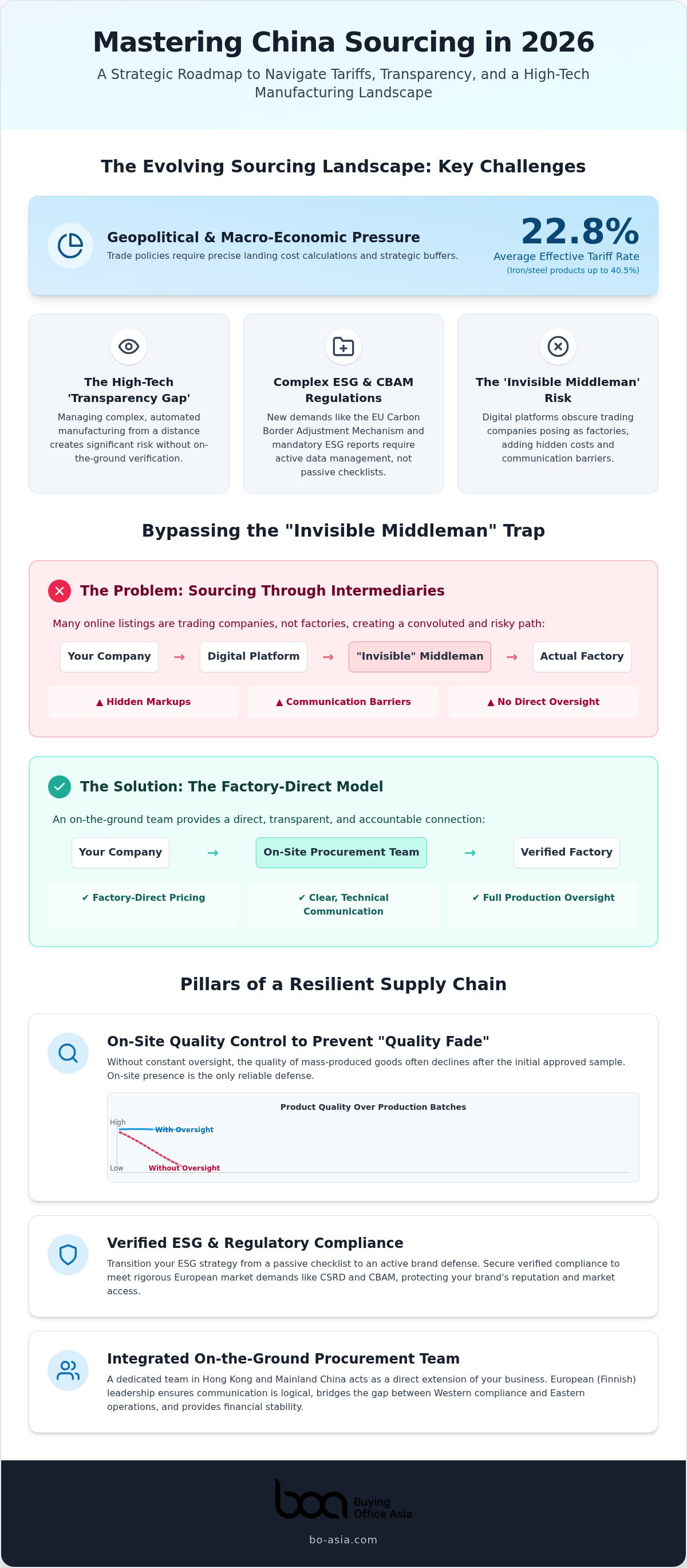
One of the most persistent challenges of sourcing from China is the phenomenon known as "Quality Fade." Your first shipment arrives perfect, meeting every specification. By the third or fourth batch, however, you notice subtle regressions in material grade or finish. This happens because factories often feel pressure to reclaim margins through cheaper substitutions once a long-term contract is established. Industry data from 2026 indicates that defect rates for orders from emerging manufacturing hubs can be up to three times higher than for Western buyers, making rigorous oversight a financial necessity. You can't rely on a successful initial sample as a guarantee for future success. Mass production requires a different level of vigilance.
Handling defects shouldn't mean stopping your entire supply chain. Instead, it requires a proactive system that identifies non-compliance at the source. If you only discover a flaw once the container reaches your warehouse, you've already lost the battle. Physical oversight at the factory level allows for immediate corrective actions, ensuring that your production timeline remains intact while maintaining the high standards your brand demands.
A robust defense against manufacturing errors relies on a structured, four-stage approach. We don't just check the final box; we oversee the entire lifecycle to eliminate hidden risks:
We vet raw materials and components before the machines even start, ensuring the foundation of your product is sound.
Our teams inspect the first 10% to 30% of the run. This allows us to catch systemic issues early, before the whole batch is affected.
We conduct a final verification of quality and quantity against your specific AQL (Acceptable Quality Limit) standards.
We ensure your goods are packed correctly and that the container is sealed, preventing damage during the final transit phase.
The risks intensify when your project involves proprietary designs. In the context of OEM and ODM manufacturing, IP theft and technical inaccuracies are real threats during the tooling phase. If you aren't physically present to monitor the creation and storage of your molds, you lose control over your intellectual property. Our regional teams act as a protective barrier, ensuring your technical drawings are followed precisely and that your tooling remains your exclusive asset. This level of hands-on management is what separates a successful launch from a costly operational setback.
Protect your investment with a defense-oriented quality strategy. You can book a consultation with our on-site inspection team to secure your next production run.
Managing the modern challenges of sourcing from China requires a fundamental shift in how you structure your supply chain. In 2026, the traditional transactional agent model is no longer sufficient to protect your interests. Standard agents often operate on commissions that obscure the true cost of goods, creating a conflict of interest that favors the supplier over the buyer. Transitioning to an integrated team model allows you to treat your procurement office as a strategic extension of your own company. This approach replaces suspicion with calm assurance, ensuring that every decision made on the factory floor aligns with your financial and operational goals.
A regional presence in Hong Kong and Mainland China serves as your primary defense against the risks of remote manufacturing. It provides the physical proximity needed for immediate intervention, which digital platforms simply cannot replicate. When your procurement team is on-site, they don't just find suppliers; they manage them. This hands-on oversight is the stabilizing force that keeps your production on track, even when geopolitical or regulatory shifts threaten to disrupt the global market. It turns your supply chain from a source of anxiety into a measurable competitive advantage.
The most immediate benefit of a transparent model is the realization of savings through transparency. By bypassing the "invisible" middlemen discussed earlier, you gain access to factory-direct negotiations. This isn't just about reducing the unit price. It's about securing better payment terms and ensuring your orders are prioritized during peak production cycles. When a factory knows you have an integrated team monitoring their performance, they are less likely to deprioritize your project in favor of unmanaged clients. Continuous supplier vetting ensures that your partners remain financially stable and technically capable of meeting your long-term volume requirements.
Efficiency relies on a dual-office strategy that solves the time-zone and cultural gap. With European leadership in Helsinki and operational teams in Hong Kong, you benefit from a bridge that ensures Western business standards are applied to Eastern manufacturing realities. You gain the accountability of having a local partner to call during your business hours who can then exert direct influence in Asia. This structure eliminates the miscommunications that lead to quality fade and regulatory non-compliance.
Your supply chain deserves the same level of professional rigor as your internal operations. You can Contact Buying Office Asia today to audit your current strategy and secure a transparent, factory-direct future for your procurement.
Successfully navigating the challenges of sourcing from China in 2026 requires more than just a digital presence. You must bridge the gap between Western compliance standards and Eastern manufacturing realities. By moving away from opaque trading models and embracing 100% transparency on factory pricing, you protect your margins and your reputation. Implementing a structured inspection framework and a robust ESG strategy ensures your supply chain remains a stabilizing force for your business's financial health.
The transition from unmanaged procurement to a transparent partnership provides the calm assurance you need in a complex global market. With European-managed accountability and a physical on-site presence in Hong Kong and Mainland China, you gain the oversight usually reserved for major enterprises. This strategic alignment is your best defense against operational setbacks. It's time to turn your supply chain into a resilient asset that supports long-term growth.
Secure Your Supply Chain with Buying Office Asia and take control of your production today.
Financial exposure and regulatory non-compliance are the primary risks. In 2026, navigating the challenges of sourcing from China alone means you lack on-site verification. It's a path that leads to obscured pricing and quality fade. Without local eyes, you risk falling behind on mandatory ESG disclosures, which can result in legal penalties and exclusion from European markets. A dedicated partner acts as a defense against these operational setbacks.
ESG compliance is now a structural requirement for importing into the EU. Under the Corporate Sustainability Reporting Directive (CSRD), you must provide verifiable data on your suppliers' environmental impact and labor practices. This shift makes set and forget sourcing a brand liability. If your Chinese factory can't provide transparent ESG data, your goods may face border delays or total rejection. Professional oversight ensures your supply chain meets these standards.
Alibaba is useful for discovery but remains hazardous for high-volume procurement without secondary verification. Digital platforms are often saturated with trading companies posing as factories. Relying solely on Verified badges exposes you to hidden markups and a lack of technical control. For mass production, you need physical factory audits and on-site inspections. High-volume success depends on moving beyond digital profiles toward a transparent relationship managed by a regional team that's on the ground.
Preventing quality fade requires a continuous, four-stage inspection framework. You must verify raw materials during pre-production and conduct on-site inspections during the early stages of mass production. If you only check the final shipment, you've already lost control. Regular DUPRO checks allow you to catch material substitutions or process shortcuts before they affect the entire batch. Consistent physical presence is the only reliable defense against regressions in product integrity that's verified on-site.
Trading companies are intermediaries that add a markup without owning manufacturing assets. In contrast, factory-direct manufacturers own the machinery and control the production process. Working directly with factories eliminates hidden commissions and ensures 100% pricing transparency. Identifying the difference is one of the core challenges of sourcing from China; it requires on-site vetting to confirm that the entity you're paying is actually producing your goods. This direct connection ensures better technical communication and leverage.
A Helsinki office provides European companies with local accountability and alignment with Western business logic. It bridges the cultural and time-zone gap between your headquarters and Asian factories. You gain a partner who speaks your language and understands European regulatory demands, such as CSRD and CBAM. This dual-office strategy ensures that instructions are communicated clearly to the Hong Kong team, providing a stabilizing force that's essential in a complex global market.
Factory-direct negotiations involve bypassing intermediaries to deal directly with the manufacturer's management. This process requires deep regional expertise and an understanding of the factory's cost structures. By negotiating from a position of transparency, you can secure better unit prices and prioritized production schedules. It's an approach that ensures your margins are protected from obscured costs. It turns your procurement into a results-oriented partnership rather than a series of transactional interactions with middlemen.
A professional 2026 factory audit goes beyond verifying a business license. It includes a rigorous assessment of manufacturing capacity, technical equipment, and ESG compliance. Auditors verify carbon footprint data, waste management systems, and labor rights documentation to meet EU standards. The audit also examines the factory's quality management systems and financial stability. This comprehensive vetting provides the calm assurance that your supplier is a reliable, long-term partner capable of handling high-volume production.

Is your current China manufacturing management strategy robust enough to survive the regulatory shifts of 2026? With the recent implementation of Decree 834 and the new "Made in China" procurement standards, the distance between a successful product launch and a costly supply chain failure has never...

What if your final quality check isn't just a formality, but the only thing standing between a successful product launch and a container full of unsellable defects? For many businesses, the fear of receiving substandard goods from overseas is a constant anxiety, often compounded by communication bar...

Most importers believe that factory kickbacks and hidden commissions are simply an unavoidable cost of doing business in Asia. You've likely felt the frustration of paying premium prices only to receive sub-par batches or discovering that your "direct" factory contact is actually a third-party trade...