

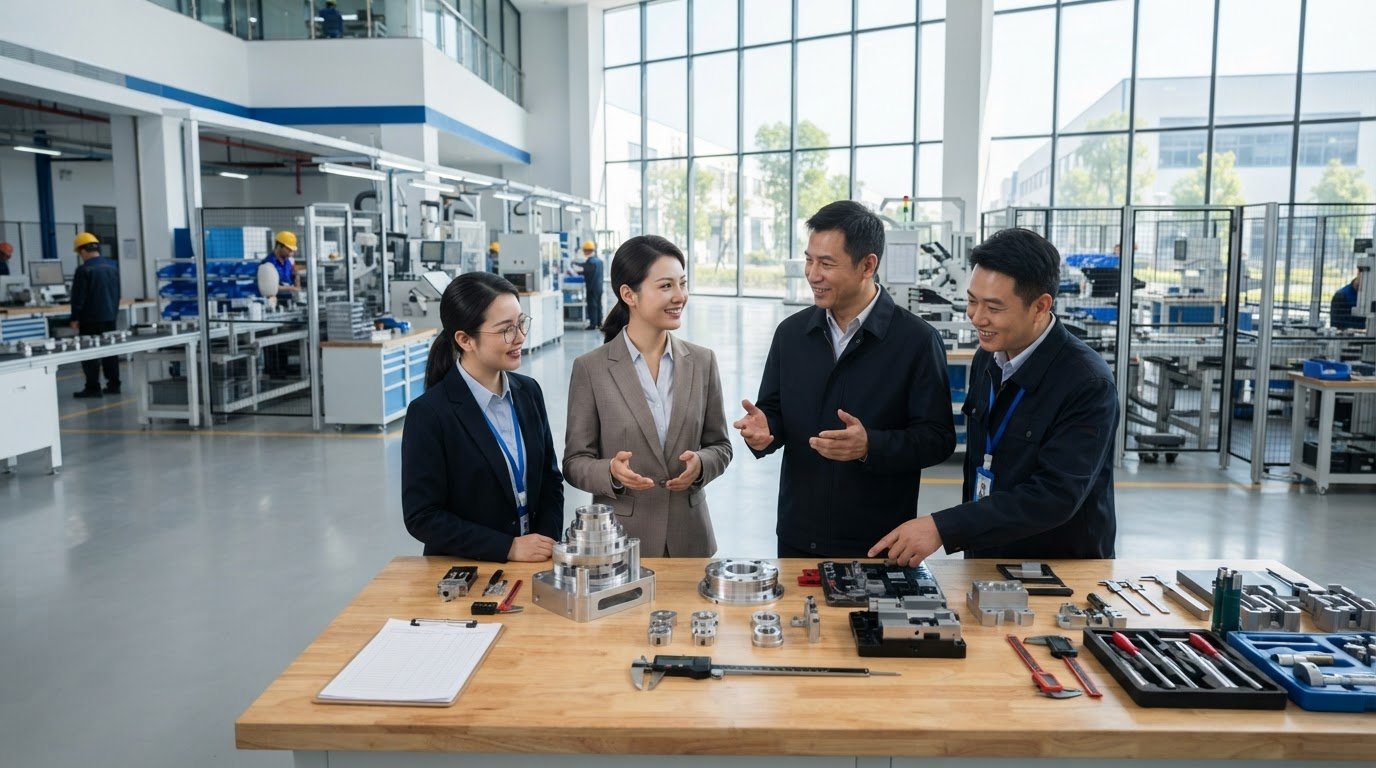
What if your signed OEM agreement protects the product on paper but leaves the factory unclear about what to make, when to deliver it, or how quality will be judged? That gap is where an oem manufacturing agreement china project can lose control: responsibilities blur between buyer, sourcing intermediary, and factory, while specifications, tooling, and production approvals drift apart.
You’re right to expect clear commitments. A useful agreement links commercial terms to measurable production requirements, names who can approve changes, and explains how the parties will address quality issues and delivery delays. This guide covers the terms to address and ways to keep them traceable through specifications, samples, purchase orders, and production approvals.
Written terms also need practical oversight. Supplier vetting, production monitoring, and on-site inspections can help document whether factory activity aligns with agreed requirements. Buying Office Asia supports this operational work through procurement, supplier management, and quality control in Asia. Legal advice and contract drafting are separate. The aim is to make responsibilities visible and commitments easier to manage from sourcing through production.
• Tailor an oem manufacturing agreement china to the product, production model, supplier relationship, and related transaction documents.
• Define how approved specifications, samples, production changes, and tooling ownership will be documented and controlled.
• Connect each production requirement to the relevant document, decision-maker, approval, and evidence.
• Before signing, check that the contracting parties, their roles, payment destination, and factory location are consistent.
• Use supplier vetting, production follow-up, and on-site quality inspections to observe whether manufacturing aligns with agreed requirements.
An oem manufacturing agreement china arrangement sets the commercial framework between a buyer and the manufacturer responsible for making a product. OEM refers to an Original Equipment Manufacturer (OEM), but the label alone doesn’t establish who is doing the work or what they have agreed to deliver. The agreement should identify the parties and define their responsibilities for production, approvals, quality, delivery, and other relevant terms.
Start by identifying the legal entity that will manufacture the goods. A sourcing agent, trading company, or related business may coordinate the relationship, but that doesn’t automatically make it the factory or the party responsible for production. If one entity signs while another operates the factory, state each party’s role clearly and make sure the production responsibilities are assigned.
The agreement can support a one-time project or ongoing production. Purchase orders can specify the details of each order, while approved specifications and samples show the factory what to make. For a closer look at OEM and ODM contract manufacturing, consider how these documents fit your production model.
Related documents serve different purposes:
focuses on confidentiality, such as how shared business information may be used or disclosed.
typically addresses non-disclosure, non-use, and non-circumvention. Its scope depends on its wording and the parties involved.
records a particular order, including its quantity, price, and requested delivery details.
defines the product’s materials, dimensions, components, workmanship, and other acceptance requirements.
These documents may complement an OEM agreement, but they aren’t interchangeable. Explain how related orders, specifications, and approved samples connect to the agreement, so the parties have a clear reference when questions arise.
Clear obligations reduce conflicting assumptions. For example, the agreement can state who approves a sample, how production changes must be authorized, which quality criteria apply, and what happens if a delivery commitment is missed. Be specific: “meet buyer’s quality expectations” is harder to assess than a requirement tied to an approved specification or sample.
An OEM agreement defines responsibilities and production commitments; it doesn’t, by itself, verify that the factory can meet them or is following them. Supplier checks and production monitoring help make those commitments observable. Supplier vetting, factory audits, production oversight, and on-site quality inspections can complement the written framework, but they don’t replace it.
Applicable law and the practical effect of a contract depend on the parties, the agreement’s terms, and the circumstances. Don’t assume a particular language or governing-law clause will produce the same outcome in every transaction. Contract-specific questions need appropriate legal review.
There’s no universal clause set for every factory relationship. Tailor an oem manufacturing agreement china project to the product, production model, supplier relationship, and connected purchase orders or specifications. Each commitment should be clear enough to guide production and document whether it was met.
Define the product through controlled records, such as drawings, bills of materials, packaging requirements, and revision numbers. Identify which version applies to each order, and establish written approval steps for samples, substitutions, and engineering changes. Without change control, a factory may use an outdated file or treat an unapproved alternative as acceptable.
Address custom tooling and product files directly. Specify who owns them, who may access or use them, where tooling is stored, and who is responsible for its maintenance. Set out what happens to tooling and files when production ends or the supplier relationship changes. For context on China OEM and ODM manufacturing, consider how development and production arrangements shape these terms.
Translate quality expectations into criteria that can be checked. Identify the controlling specification or approved sample, define defect categories and inspection records, and state whether and how inspection access will be provided. Set a process for recording nonconforming goods, corrective actions, and any agreed correction, replacement, or other response. Inspection records make decisions traceable; vague wording leaves room for disagreement.
Commercial clauses need the same precision. Link payment triggers to defined milestones and supporting documents, such as an approved sample or inspection record, where appropriate. State how pricing is handled, what assumptions apply to forecasts, and how lead-time commitments are measured, including the event that starts the delivery clock. Clarify delivery terms and the documents expected at each handoff rather than relying on informal messages.
Products, services, and production responsibilities covered.
Authorized people, required records, and when approval is effective.
Quality measures, milestones, delivery commitments, and evidence.
Change requests, delays, defects, and agreed remedies.
Governing law, dispute resolution, and contract language can affect how an agreement operates. Their suitability depends on the transaction and the parties, so have qualified legal counsel review those terms. The U.S. International Trade Administration's China Commercial Guide offers broader market context, but it doesn’t replace contract-specific legal advice.
Buying Office Asia connects written production requirements with supplier checks and production follow-up through its sourcing and production oversight services.
A signed agreement only guides production if the people placing orders, approving changes, and checking goods can work from the same requirements. For an oem manufacturing agreement china project, create a document trail that shows what applies to each order, who approved it, and what evidence records the result.
Set out how the agreement, purchase order, pro forma invoice, product specification, approved sample, and inspection records relate to one another. Don’t assume a universal legal hierarchy. State which document controls each detail and how inconsistencies or revisions are handled. Use a consistent product code, issue date, revision number, and written approval record across the documents.
| Requirement | Controlling document | Owner and approval | Evidence to retain |
|---|---|---|---|
| Product design and acceptance criteria | Specification and approved sample | Product owner approves the version | Dated specification, sample record, approval |
| Quantity, price, and order details | Purchase order, reconciled with pro forma invoice | Buyer issues and authorizes the order | Accepted order and matching invoice |
| Production changes | Written change approval linked to the affected order | Authorized buyer and factory contacts approve | Change request, decision, updated revision |
| Inspection and acceptance | Agreed criteria and inspection plan | Assigned quality owner records findings | Inspection report, photos, corrective-action record |
This is a working example, not a prescribed order of legal priority. The agreement should explain how order documents become applicable and what happens if a purchase order or invoice conflicts with a specification. Before funds are sent, supplier identity and capability checks should connect the named counterparty to the factory performing the work. Buying Office Asia’s supplier vetting and factory audits support this operational review.
Map acceptance criteria to checkpoints across production. Incoming-material checks can reference approved materials; in-process checks can record whether key operations follow the specification; pre-shipment inspections can assess finished goods against agreed criteria. Define who records results, how failures are reported, and which corrective actions need approval before production continues.
Measurable specifications turn quality expectations into verifiable production evidence. Keep inspection findings, photos, corrective-action records, and approval decisions tied to the product code, order, and current revision. That trail helps your team distinguish a production issue from a disagreement over which requirement applied.
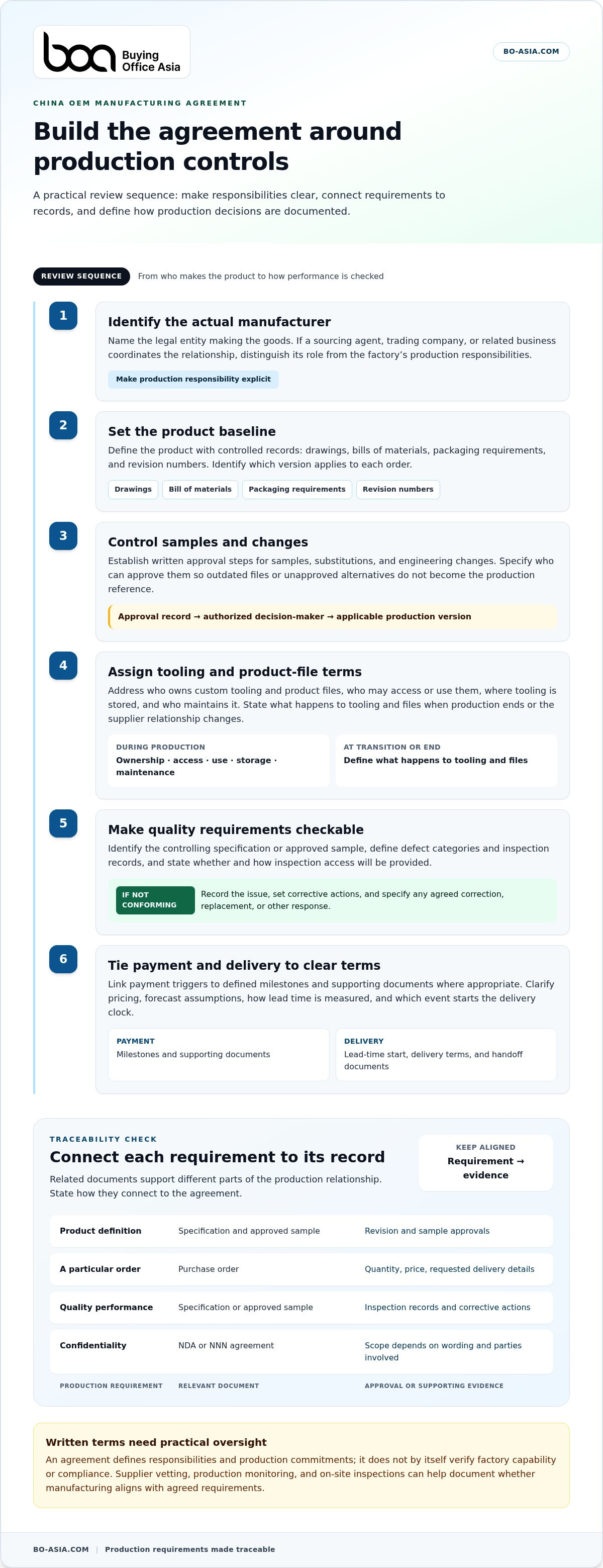
Review the agreement alongside the actual production arrangement, not as a standalone file. This sequence helps identify mismatches before signing and assign responsibility for resolving them. It supports operational readiness, but it isn’t a substitute for legal advice on the contract.
Start with the parties and the factory. Verify that the legal entity named in the agreement matches the entity responsible for the agreed work, and compare it with the names on relevant invoices and payment instructions. Record any agent, trading company, or related entity’s role rather than assuming it is the manufacturer. Confirm the facility where production will take place, too. Supplier vetting and factory audits can help establish who is involved and assess operational capability.
Use this review sequence to turn the agreement into a practical control plan:
Match legal names, contracting responsibilities, payment destination, and factory operating location. Resolve any unexplained mismatch before proceeding.
Identify who can approve samples, materials, engineering changes, and release of finished goods on both sides. Document how approvals are recorded.
Check that the agreement, purchase order, pro forma invoice, product specifications, approved sample, and packaging details identify the same product and current revision. Remove or clearly supersede outdated files.
For each important obligation, identify an owner, deadline or trigger, measurable standard, and completion record. For example, a quality requirement should point to a specific criterion and the inspection evidence used to assess it.
Map incoming-material, in-process, and pre-shipment checks to the agreed criteria. Confirm reporting expectations, escalation contacts, and who owns corrective actions if a check fails.
Local supplier and production oversight can help your team observe whether approved requirements are being followed and preserve records of what was checked. These operational controls complement the contract; they don’t establish its legal effect.
Before signing, have qualified legal counsel review jurisdiction-specific terms, contract language, dispute resolution, and questions of enforceability. The right analysis depends on the parties and agreement, so a general checklist can’t determine the legal outcome of a particular oem manufacturing agreement china.
Buying Office Asia connects supplier checks with production follow-up and quality inspections through its sourcing and production oversight services.
A well-written agreement sets expectations. On-the-ground oversight helps you see whether supplier activity and production records reflect those expectations. Supplier vetting, production follow-up, and quality inspections connect the written requirements to factory activity, while the agreement remains the reference point for responsibilities and acceptance criteria.
Supplier vetting and factory audits help assess whether a supplier’s capabilities and operating setup fit the production requirements. They can also clarify which facility is involved and how the work is organized. These checks don’t replace legal terms; they help you understand the operational context in which the terms must be carried out.
During production, tie each inspection checkpoint to an agreed requirement. An incoming-material check, for example, should refer to the approved material specification, while a finished-goods inspection should use the relevant product criteria and approved sample. Record the result, note any deviation, and document who owns the next action. This gives your team a shared basis for discussing corrections or escalation instead of relying on general assurances.
A dedicated Asia procurement team can coordinate supplier communication, production milestones, and quality follow-up as an extension of your team. Local presence makes it possible to observe and document relevant factory activity directly, then report progress and issues against agreed requirements. Clear reporting helps keep decisions, approvals, and corrective actions visible across the buyer, procurement team, and factory.
Buying Office Asia provides sourcing and procurement support, including supplier management, mass production oversight, and on-site quality inspections. It is an operational partner, not a law firm or contract-drafting service. Its role is to connect written requirements, production checks, and documented follow-through. Explore end-to-end sourcing and procurement support to see how procurement coordination can support implementation.
For an oem manufacturing agreement china project, this oversight helps your team identify deviations while production is underway and coordinate a documented response. It doesn’t guarantee a particular outcome, but it gives you clearer visibility into what is happening and what action has been taken.
Discuss your China OEM manufacturing project and the supplier and production oversight it requires.
A practical oem manufacturing agreement china does more than set commercial expectations. It connects responsibilities, approved specifications, purchase orders, and quality criteria so your team and factory can work from traceable requirements. Clear change approvals and records also help prevent different versions of a product or process from quietly entering production.
A contract can’t confirm that a supplier has the right capabilities or that production follows the agreed terms. Supplier vetting, factory audits, production oversight, and on-site quality inspections help make factory activity observable and give your team evidence to address deviations. Qualified legal counsel should review contract-specific questions; sourcing and procurement oversight supports execution on the ground.
Buying Office Asia provides on-the-ground sourcing and procurement operations in Asia, connecting supplier management and production follow-up with documented quality checks. If you’re preparing a project or strengthening an existing supplier relationship, discuss your China OEM manufacturing project. Clear commitments and practical oversight working together can give your team greater visibility as production moves forward.
It’s a written framework for the commercial and production responsibilities between a buyer and a manufacturer making goods to the buyer’s requirements. For an oem manufacturing agreement china project, it may cover product scope, specifications, quality, pricing, delivery, tooling, and intellectual property. The exact terms should reflect the arrangement and connected order documents. The agreement supports accountability, but it doesn’t replace supplier checks or production oversight.
It should identify the parties and define product requirements, approvals, change control, quality criteria, pricing, payment milestones, delivery, tooling, intellectual property, and confidentiality. It can also address how the parties will handle nonconforming goods, termination, and disputes. The appropriate provisions depend on the product, production model, and transaction documents. Have qualified legal counsel review governing law, dispute resolution, language, and other contract-specific questions before signing.
No. An NDA can set confidentiality obligations, but it usually doesn’t define the wider responsibilities involved in manufacturing. You may also need clear terms for product specifications, tooling, quality checks, order quantities, payment, delivery, production changes, and intellectual property. The right documents depend on the project and supplier relationship. Don’t assume a confidentiality agreement alone covers every commercial or operational risk in production.
A bilingual agreement can help both parties work from a shared text, but the language and the status of each version can have legal consequences. The right approach depends on the parties, transaction, and applicable law. If both languages are used, make sure they express the same obligations and arrange appropriate legal review. A translation alone doesn’t resolve differences in interpretation or determine how a contract will be treated.
An OEM agreement generally sets out manufacturing responsibilities and commercial production terms. An NNN agreement focuses on non-disclosure, non-use, and non-circumvention, subject to its wording and legal context. The documents may address different risks and can be used alongside other transaction documents. Define how they relate to the supplier relationship and have qualified counsel review their scope. Neither label alone establishes what a particular agreement covers.
You can make requirements easier to manage by tying measurable specifications to current purchase orders, approved samples, inspection criteria, and written approval records. Assign owners for checks and corrective actions, and keep inspection findings linked to the relevant order and specification version. Supplier vetting and on-site production checks can help make factory practices visible, but they can’t guarantee perfect compliance. Use the records to identify deviations and coordinate next steps.

What if the safest payment deal isn’t the one that delays the most cash, but the one that releases it only when progress is verifiable? Payment terms negotiation with Asian suppliers is about balancing your working capital with the supplier’s need for confidence, not simply pushing for a smaller dep...

What if your biggest supply chain risk isn’t the supplier you chose, but what you can’t see after the order is placed? Asia procurement services can connect supplier selection with factory follow-through, giving you clearer visibility into production, product quality, and responsibilities along the...

A supplier listing can open a door, but it can’t show whether a factory is right for your order. Choosing a ningbo sourcing agent means looking beyond access to local suppliers: you need clear oversight of supplier vetting, production follow-up, and quality checks. Without defined responsibilities,...