


A supplier listing can open a door, but it can’t show whether a factory is right for your order. Choosing a ningbo sourcing agent means looking beyond access to local suppliers: you need clear oversight of supplier vetting, production follow-up, and quality checks. Without defined responsibilities, problems can go undiscovered until they cost time and money.
Regional knowledge and close coordination are useful when they’re backed by a transparent process, documented checks, and reporting that keeps you informed. A capable procurement partner should make clear who is responsible at each stage, from supplier assessment through production and inspection.
This guide explains how to assess an agent’s responsibilities and process, identify where local coordination adds value beyond online supplier discovery, and set controls for supplier selection, product quality, and order progress. You’ll also learn what to define in the service scope so inspection, production oversight, and logistics coordination are accounted for.
• A ningbo sourcing agent can coordinate procurement tasks, while you retain responsibility for product requirements and commercial decisions.
• Compare marketplaces, direct factory relationships, and agents by who handles verification, negotiation, follow-up, inspection, and reporting.
• Use a documented brief, approved samples, and clear inspection criteria to reduce avoidable misunderstandings before production.
• Assess a partner’s scope through defined responsibilities, transparent reporting, and evidence of how supplier and production checks are carried out.
• Buying Office Asia coordinates Asia sourcing through supplier vetting, factory-direct negotiations, production oversight, inspections, and logistics coordination.
A supplier search can produce names and quotations. It can’t establish whether a factory can meet your specifications or keep production aligned with what you approved. A ningbo sourcing agent works on the buyer’s side, coordinating supplier search and agreed procurement tasks so decisions are informed by checks and follow-up, not just an online listing.
Ningbo’s role in global trade makes this distinction useful. The Port of Ningbo-Zhoushan is a major cargo hub, but access to suppliers and trade infrastructure doesn’t remove the need to assess factories, clarify requirements, and monitor execution. An agent can coordinate those activities. You remain responsible for defining the product, commercial terms, and approval criteria.
The work can start with supplier identification, initial screening, communication, and quotation coordination. Depending on the agreed scope, it can continue through sample development and review, factory-direct negotiation, production monitoring, and on-site inspections. Supplier vetting and product inspection serve different purposes: vetting assesses whether a supplier appears suitable for the project, while inspection checks whether goods or production meet defined requirements.
A sourcing agent coordinates procurement work on the buyer’s behalf. A marketplace listing helps buyers discover suppliers but doesn’t, by itself, manage supplier performance. Clear responsibilities and reporting help you retain visibility and make the approval decisions that remain yours. An integrated sourcing and procurement process can connect supplier selection with production oversight and inspection in one working relationship.
Direct sourcing can suit experienced buyers with established suppliers, repeatable specifications, and internal staff who can manage communication, production follow-up, and quality checks. It isn’t inherently unsafe, and not every Ningbo transaction needs an agent.
Additional coordination becomes more valuable when a supplier is unfamiliar, specifications or sampling are complex, or your team lacks capacity to follow production in-region. Without consistent follow-up, questions about changes, progress, or defects can take longer to resolve across distance and time zones. Consider whether the project’s coordination demands exceed your team’s available oversight. Buying Office Asia supports companies manufacturing in Asia through supplier vetting, negotiations, production oversight, and inspections. Its reporting helps buyers stay informed while they retain product and commercial approval authority.
A well-defined sourcing workflow turns your product requirements into decisions you can review before production begins. Start with a written brief covering specifications, target pricing, expected order quantity, and any capacity or compliance requirements. Then move from supplier identification and screening to a shortlist, quotation review, and sample evaluation. Place the order only after you approve the supplier, sample, and relevant terms.
Define the agent’s scope alongside that workflow. A ningbo sourcing agent may coordinate communication and negotiations, arrange sampling, monitor production, and conduct or coordinate inspections. Written responsibilities should identify who prepares each update, which decisions need your approval, and how exceptions such as a specification question or production delay will be raised. This keeps the process visible without handing over your authority to approve the product or commercial terms. Buying Office Asia’s end-to-end sourcing and procurement connects supplier selection, negotiation, production oversight, and inspection in one procurement relationship.
For broader context on operating conditions and business risks, the UK government’s Overseas business risk: China guide can help buyers understand the environment in which suppliers operate. It doesn’t replace project-level checks, which should be tied to your product and order.
Screen suppliers by comparing their stated capabilities with your actual requirements, including product type, production capacity, processes, and relevant compliance needs. A factory audit can provide evidence about facilities and operations at the time of assessment, helping you judge suitability. It isn’t a guarantee of future performance, so document findings and open questions before selecting a supplier. Keep this separate from product inspection: vetting asks whether the factory is a reasonable fit; inspection asks whether specific goods meet agreed criteria.
Sampling gives you a chance to resolve ambiguities before mass production. Review the sample against the brief, document requested changes, and identify the approved version that production should follow. During manufacturing, progress updates should track milestones, unanswered questions, deviations, and corrective actions against agreed requirements.
Set inspection timing and criteria according to product risks and your specifications. A written inspection plan should state what will be checked, how results will be reported, and how issues will be escalated for your decision. Detailed reports preserve buyer visibility and create a clear record from sample approval through production checks.
These routes differ less by their promises than by who handles each task. A marketplace can help you find suppliers and communicate with them. With direct sourcing, supplier communication and order oversight sit with your team. A ningbo sourcing agent coordinates the procurement tasks you agree to delegate, while you retain product and commercial approval. The right fit depends on your team’s experience, the order’s complexity, and the level of ongoing oversight it requires.
| Responsibility | Marketplace | Direct factory | Sourcing agent |
|---|---|---|---|
| Supplier discovery | Provides a search and communication environment | Buyer identifies suppliers | Can identify and shortlist suppliers within the agreed scope |
| Verification | Buyer assesses supplier suitability | Buyer arranges checks | Can coordinate screening or factory audits |
| Negotiation | Buyer communicates with suppliers | Buyer negotiates directly | Can negotiate on the buyer’s behalf |
| Production follow-up | Buyer coordinates separately | Buyer manages supplier updates | Can monitor progress and raise issues |
| Inspection | Buyer arranges separately | Buyer arranges or conducts checks | Can coordinate inspections and report findings |
| Visibility | Depends on buyer’s own follow-up | Buyer sees direct supplier communication | Depends on agreed reporting and access to information |
No model removes the need for clear requirements and buyer approvals. Marketplaces may suit initial discovery when your team can manage checks and follow-up. Direct relationships can work well for repeat orders with established suppliers and capable in-house oversight. An agent can add coordination when a supplier is new, production requires close monitoring, or your team lacks capacity to manage each step. The U.S. Government Guide to Market Entry in China also notes the potential value of trusted local partners. Buyers still need to define each partner’s role.
Make responsibilities measurable before agreeing on the scope. Define the deliverables, reporting frequency, decisions that require your approval, and how delays or quality concerns will be escalated. Clarify how supplier communication is shared and how commercial arrangements are disclosed. Transparent records help you understand who the supplier is, what has been agreed, and what needs a decision. For additional guidance on a sourcing partner’s role, read our guide to why buyers choose a sourcing partner.
If coordinated supplier vetting, negotiations, production oversight, or inspections fit your project, discuss your sourcing requirements with Buying Office Asia.
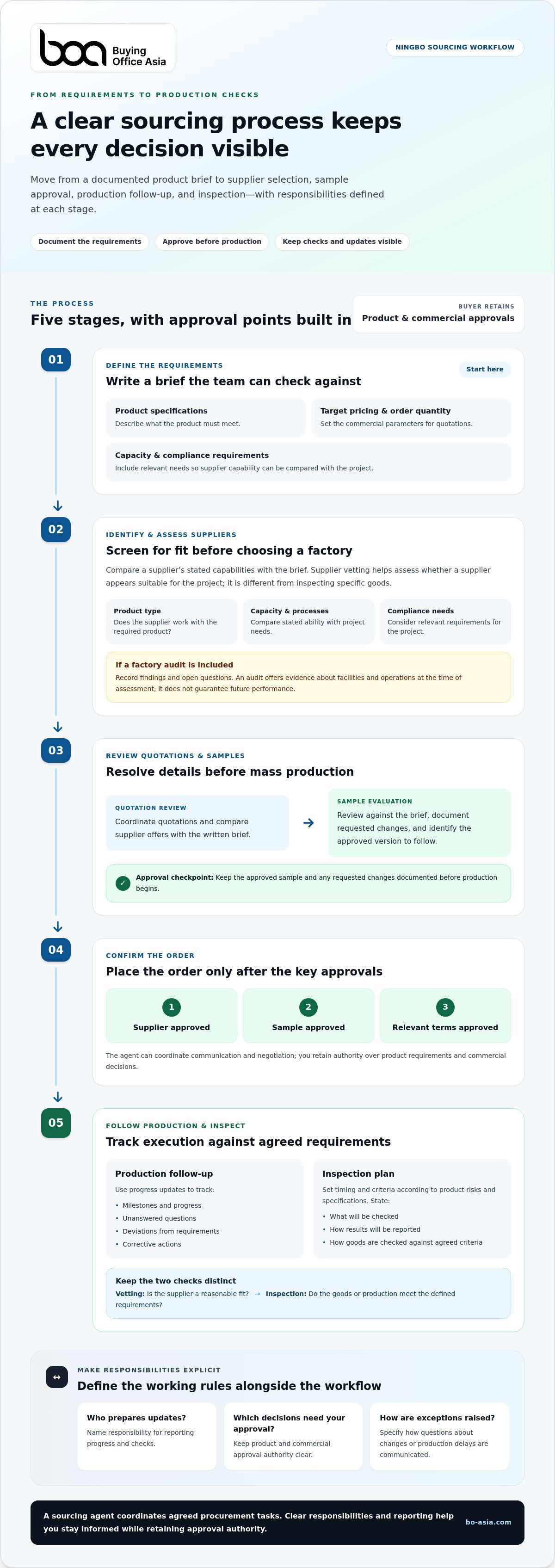
Risk controls work best when each stage has a documented input, a clear approval point, and a record of what happened. A ningbo sourcing agent can coordinate checks and updates, but you should retain authority over product changes, acceptance decisions, and commercial commitments. Use this sequence to keep responsibilities visible:
Record specifications, packaging requirements, tolerances, applicable compliance needs, and acceptance criteria. Be precise wherever interpretation could change cost, function, or quality.
Compare each candidate’s stated capabilities and capacity with your project requirements, and document open questions before selecting a supplier.
Give feedback against the written specifications, record the approved sample version, and state that changes require your written approval.
Agree on progress updates, responsibilities, and how issues or delays will be escalated. Keep an issue log with the concern, owner, next action, and buyer decision needed.
Define what will be checked and when, based on product risks and your acceptance requirements. Review findings before deciding whether corrective action or further follow-up is needed.
Align production and inspection status with the agreed shipping plan and required handoffs. Coordination helps organize information and timing; it is not the same as physically transporting the goods.
Specifications, sample approval, and inspection criteria serve different roles, but they should point to the same requirements. For example, if a dimension or packaging detail matters, include it in the brief, review it on the sample where applicable, and specify how it will be checked. A shared milestone plan should show due dates, responsible parties, open questions, and approval checkpoints. This record reduces interpretation gaps and makes clear that supplier or agent recommendations don’t authorize a change without your approval.
Progress reports are most useful when they show status against milestones rather than offer general reassurance. An inspection report should document findings, supporting evidence, and any corrective-action follow-up. Set an escalation path in advance: who informs you about a deviation, what information they provide, and which decisions must wait for your response. Buying Office Asia coordinates production oversight, on-site quality inspections, and logistics planning so buyers can review documented updates while retaining approval authority. Learn more about quality control and inspection support.
For support coordinating supplier follow-up, inspection, and shipment planning, discuss your sourcing requirements with Buying Office Asia.
The right partner is the one whose responsibilities match the work your project needs. Before choosing a partner, assess four things: relevant service scope, a documented process, transparent reporting, and clear approval responsibilities. These make supplier coordination accountable while ensuring you retain control of product requirements and commercial decisions.
Are supplier selection, negotiation, production oversight, inspections, or shipment coordination needed?
Are the steps and deliverables clear from the start?
Will you receive updates and documented findings that show progress and open issues?
Is it clear which changes or decisions require your authorization?
Buying Office Asia supports Asia sourcing through supplier vetting, factory-direct negotiations, on-site inspections, and production oversight. The company is headquartered in Hong Kong, with European leadership in Helsinki, supporting coordination between local operations and international teams. If the scope and controls align with your project, discuss your sourcing requirements.
For a new supplier, prioritize identification, vetting, and factory-audit support before committing to an order. For an active order, focus on production oversight, quality inspection, and timely follow-up on issues. If you need ongoing coordination across sourcing tasks, consider a dedicated Asia procurement team. A ningbo sourcing agent should have a defined role that complements your team, with reporting and buyer approvals built into the working process.
A concise project brief helps establish fit and makes the first discussion more productive. Include:
• Product specifications, target order requirements, packaging details, and relevant compliance needs.
• Preferred milestones, sample or production approval points, and inspection expectations.
• Existing supplier information, approved samples, prior order records, and known production risks.
With these details in hand, you can define the support required and identify where procurement coordination will add value. Contact the procurement team to discuss your project requirements.
The right ningbo sourcing agent makes responsibilities visible without taking product and commercial decisions out of your hands. Match the support to your project, define approval points, and expect documented updates from supplier selection through production and inspection. These controls help you address issues early and keep decisions grounded in your requirements.
Buying Office Asia coordinates supplier vetting, factory audits, negotiations, on-site quality inspections, and production oversight within an end-to-end procurement relationship that also includes logistics coordination. Headquartered in Hong Kong, with European leadership in Helsinki, the company supports international coordination.
If you’re planning a new order or need stronger oversight of an active project, discuss your Ningbo sourcing requirements. Share a clear brief to start a conversation about the procurement support your project needs.
A Ningbo sourcing agent coordinates agreed buyer-side procurement tasks, which can include identifying potential suppliers, communicating requirements, negotiating terms, following production, and arranging quality inspections. Document the scope so you know what updates and deliverables to expect. The agent supports your procurement process, but you still define product requirements, approve samples, and make key commercial decisions. Clear approval points prevent assumptions from becoming unauthorized changes.
No, a sourcing agent isn’t necessary for every purchase. Buyers with established factory relationships and the in-region capacity to manage communication and order oversight may source directly. An agent can add coordination if you’re sourcing from abroad, assessing an unfamiliar supplier, or need help following production and arranging inspections. Decide based on your team’s capacity, product requirements, and the level of independent oversight the order calls for.
Assess the agent’s defined scope, supplier-vetting process, reporting deliverables, inspection approach, and escalation procedures. Make sure supplier communications and buyer approvals will remain visible throughout the project. Compare documented responsibilities with the work you need managed. A marketplace profile or broad marketing claim alone won’t demonstrate operational accountability. Look for a process you can understand and track, not just promises of supplier access.
Yes. A sourcing agent can perform or coordinate on-site quality inspections when inspection work is included in the agreed scope. Set out the inspection stage, criteria, evidence to be recorded, reporting format, and corrective-action process in the project plan. Reports can show findings against specified requirements and support your decisions about next steps. An inspection reflects the items and criteria checked; it shouldn’t be treated as a guarantee that every unit is defect-free.
Provide a product brief with specifications, target order requirements, packaging details, and applicable compliance needs. Include approved samples or drawings, acceptance criteria, and preferred milestones so supplier evaluation and production follow-up can be tied to your requirements. Share existing supplier information and known production risks as well. A clear brief helps align quotations and define useful inspection checkpoints, while making it easier to identify questions that need your decision before work proceeds.
Fees depend on project scope and the work involved, such as supplier identification, factory audits, negotiations, production oversight, inspections, or logistics coordination. Compare what each fee covers and how the commercial arrangement is structured rather than focusing on a figure alone. Buying Office Asia provides information about its service model on the sourcing and procurement pricing page. Review the details there alongside the deliverables relevant to your project.
A sourcing agent can coordinate production follow-up and logistics or shipping arrangements when those responsibilities are part of the agreed scope. Coordination is not the same as acting as the carrier or physically transporting goods. Define production milestones, documentation responsibilities, inspection points, and shipment handoffs in advance. This gives you visibility into who manages each task, how issues are raised, and where your approval is required before the order moves forward.

What if the supplier with the strongest online profile isn’t the factory best suited to your shoes? In footwear manufacturing in China, a directory listing can start your search, but it can’t confirm who will make your product, whether the factory can handle its construction and materials, or how cl...

What if the mold you paid to develop couldn’t be released when you needed to change suppliers? Managing tooling and molds with a foreign factory means more than tracking where production equipment is stored. Payment alone may not establish clear ownership, access, or transfer rights. Without visibil...

A polished factory sample can still be the wrong one to approve if it doesn’t reflect the materials, dimensions, and process planned for mass production. If you’re figuring out how to get product samples from Asian factories, the challenge isn’t simply getting a package delivered. It’s making sure t...