


What if the safest payment deal isn’t the one that delays the most cash, but the one that releases it only when progress is verifiable? Payment terms negotiation with Asian suppliers is about balancing your working capital with the supplier’s need for confidence, not simply pushing for a smaller deposit.
It’s reasonable to hesitate when a supplier requests substantial payment before production or shipment. Unclear milestones can make it difficult to know what a payment covers, while communication across countries, time zones, and business practices can leave expectations open to interpretation. A well-structured agreement turns those risks into documented steps both sides can understand.
This guide explains how to negotiate terms that support cash flow while maintaining a productive supplier relationship. You’ll learn how to connect payment releases to measurable production and inspection milestones, document responsibilities clearly, and establish a repeatable process for future orders. When factory communication, production oversight, and quality checks are aligned, payment terms become a practical form of staged risk-sharing rather than a standalone discount negotiation.
• Build your proposal around order exposure, production stages, evidence of progress, and internal approval requirements before discussing figures.
• Compare deposits, staged payments, balances before shipment, and documentary instruments by buyer exposure, supplier cash-flow support, and administrative requirements.
• Make payment terms negotiation with Asian suppliers a staged risk-sharing discussion, with each release tied to clear, documented milestones.
• Agree on the evidence that triggers each payment, record responsibilities, and monitor milestones against production progress.
• Connect supplier vetting, factory-direct negotiations, production oversight, and inspections to make payment commitments easier to manage.
Payment terms define when, how, and under what conditions you pay a supplier’s invoices. They shape your cash-flow commitments and determine how much you pay before you can verify production progress, inspect goods, or arrange shipment. Effective payment terms negotiation with Asian suppliers balances your financial exposure with the supplier’s need to fund materials, labor, and production.
Milestone-based payment terms release agreed portions of payment when specified, documented production or inspection milestones are met. The milestones and evidence should fit the order. A complex, customized production run may need different checkpoints from a repeat order, so no single payment structure suits every transaction.
Payment terms can cover a deposit before production, interim payments during manufacturing, a balance payment, and the due dates and conditions for each. The earlier a larger payment is due, the more buyer funds are committed before later checks can confirm the order is progressing as expected. A deposit may help the supplier begin work, while a balance due before shipment leaves the buyer with less leverage once production is complete.
Keep the agreement operational, not just verbal. Record payment triggers, deadlines, required documents, and who verifies each milestone in the purchase order and contract. Payment terms are separate from Incoterms: Incoterms allocate delivery-related responsibilities between buyer and seller, but don’t set invoice payment timing. For a different kind of trade payment mechanism, Letters of Credit (LCs) involve banks and document conditions, so understand their process and obligations before proposing one.
A supplier may need funds to purchase materials, schedule labor, and keep production moving. A buyer may prefer to release more money only after receiving evidence that the order has reached an agreed stage. Depending on the transaction, that evidence could include production records, inspection findings, or shipment documents.
The right balance depends on the circumstances. Supplier leverage, order complexity, production lead-time dependencies, and the history of working together all affect what each side can reasonably accept. A new relationship may involve different concerns from an established one, but trust should still be supported by clear documentation and checks. Before negotiating, understand the supplier’s production setup and communication needs. Reviewing supplier relationships across Asia can help place payment discussions in the context of how orders are managed on the ground.
Approach the discussion as a shared plan for funding and verification, not a demand to shift all risk to one side. Clear triggers help suppliers understand when funds are released and help buyers connect each payment to documented progress.
Preparation turns payment terms negotiation with Asian suppliers from a debate over percentages into a plan grounded in order risk, production evidence, and your company’s approval process. Before proposing terms, map the order value, production stages, lead-time dependencies, and the points at which your team can verify progress. Account for internal approvals too, so a workable milestone doesn’t stall while payment authorization catches up.
Identify how much cash would be committed at each stage and what would remain unverified when each payment is due. Note dependencies such as material purchasing, sample approval, or a production run that must finish before inspection.
For each proposed trigger, decide what record, sample, or inspection could demonstrate that it has been met. Specify the evidence clearly enough for your team and supplier to interpret it consistently.
Use your financial controls to establish acceptable initial exposure, approval thresholds, and who can authorize exceptions. Separate essential safeguards from flexible details, such as the wording of a milestone or the format of its supporting document.
Present a preferred structure and a reasoned fallback. A fallback might adjust the sequence or evidence requirements while retaining your essential safeguards. This gives both sides room to find workable terms without relying on a take-it-or-leave-it demand.
A useful payment proposal specifies the amount, the trigger for release, the evidence that verifies it, and the due date. For example, instead of saying “pay during production,” define which production stage qualifies, who reviews its records, what happens if evidence is incomplete, and how soon payment is due once it passes review.
Write down your must-haves, such as documented progress before a particular payment, and identify where you can be flexible. Set an escalation path for exceptions, including who reviews a proposed change and what documentation they need. Your limits should reflect your organization’s cash-flow planning and risk controls, not a figure improvised under negotiation pressure.
Match each payment trigger to an observable event, such as approved samples or documented production progress. Assign a reviewer, define acceptable evidence, and state how discrepancies or delays will be handled. Supplier due diligence also helps you assess whether proposed milestones are practical; see this guide to supplier vetting in Asia. Review Incoterms separately to understand delivery responsibilities, rather than treating them as payment triggers.
Payment structures differ in when money moves, what evidence is available at that point, and how much coordination each side must manage. Use the comparison below to identify questions for your order, not to assume one arrangement is universally safer. The right fit depends on order complexity, the supplier relationship, available documentation, and the relevant jurisdiction.
| Structure | Buyer exposure | Supplier cash-flow support | Evidence and administration |
|---|---|---|---|
| Deposit | Funds are committed before production progress can be verified. | Provides funds to begin work or arrange inputs. | Define what the deposit initiates, how it is recorded, and whether later payments depend on progress. |
| Staged payments | Exposure increases in steps as payments are released. | Provides funds at agreed points during production. | Requires observable milestones, consistent records, a named reviewer, and clear handling of exceptions. |
| Balance before shipment | The buyer pays the remaining amount before goods leave, potentially before receiving them. | Supplier receives the balance before dispatch. | State exactly what qualifies as shipment readiness and which inspection or shipping documents support the trigger. |
| Documentary instruments | Payment is linked to specified banking and document procedures, but this does not remove product or delivery risk. | Payment depends on the instrument’s conditions and the documents presented. | Requires careful coordination among buyer, supplier, and banks; procedures and documentation add administration. |
A deposit funds the start of work, while staged payments divide payment across production events. A final balance concentrates the remaining payment at a later trigger. Staging can make releases easier to track when each milestone has an unambiguous name and supporting evidence. Avoid wording such as “once production is complete” without defining what completion means, who verifies it, and which records or inspection findings are required. Put the exact balance trigger in the contract.
Ordinary bank transfers move funds directly between accounts according to the agreed payment schedule. A letter of credit adds a bank process tied to stated documents and conditions. Documentary collection routes documents through banks for payment or acceptance, without the same undertaking by the bank to pay as a letter of credit. The U.S. International Trade Administration’s Methods of Payment in International Trade outlines the principal approaches and their trade-offs. Bank procedures, fees, required documents, and country rules need case-specific review. Documentary instruments don’t certify product quality or eliminate delivery and dispute risks. For payment terms negotiation with Asian suppliers, compare the instrument’s documentary controls with the evidence your order actually needs.
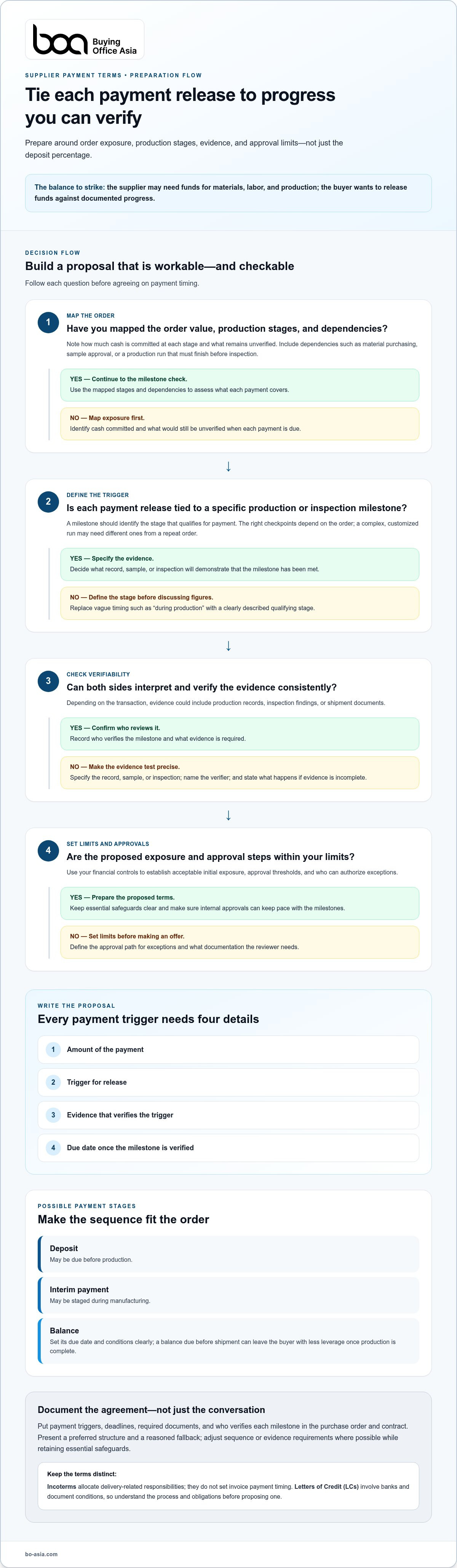
Once you’ve identified workable terms, put them into a process that connects the supplier’s commitments with your team’s payment approvals. Keep the conversation calm and specific: explain how clear triggers support predictable cash flow, production continuity, and the possibility of repeat orders. The goal is shared clarity, not transferring every risk to one side.
Briefly describe the order, production schedule, and need to align payments with verifiable progress.
State each payment amount, trigger, required evidence, and due date. If a supplier raises a concern, discuss alternatives such as changing milestone timing or using a different document while preserving essential controls.
Record accepted terms promptly in the purchase order or contract. Make sure everyone is working from the same current version, including any revised dates, evidence requirements, or approval steps.
Track production updates and inspection findings against the agreed milestones. Route exceptions for review instead of treating an update as automatic approval to pay.
A collaborative proposal gives both sides a practical basis for discussion. If a supplier needs earlier funds to keep production moving, consider whether an earlier release can be tied to a clearly defined record or inspection. If the evidence is unavailable or shows a variance, agree in advance who will review it and how the issue will be resolved. This keeps negotiation grounded in facts rather than assumptions.
Assign clear owners for reviewing invoices, production evidence, inspection reports, and exceptions. Production updates and inspection findings can inform your internal decision, but they don’t change the payment conditions in the contract. Keep the purchase order, contract, and operational records aligned so the team can verify the same trigger before releasing funds.
Payment approval should follow the agreed trigger and documented evidence, not an informal status update. That discipline makes payment decisions traceable and helps identify delays or discrepancies before they become disputes. On-site quality control and inspections can support verification by connecting production oversight with the evidence your team uses to assess milestone progress.
Payment terms work best when they reflect how a supplier is selected, how production is managed, and how progress is verified. Your internal procurement team may be able to negotiate and monitor terms when it has an established supplier relationship, clear production records, and enough capacity to follow each payment trigger. On-the-ground support can help when production is complex, communication is difficult to coordinate, or your team needs more visibility into factory progress.
That support is most useful as part of an integrated process, not as a standalone negotiation. Supplier vetting informs the level of oversight an order may need. Factory-direct negotiations connect commercial terms with production realities. Ongoing production oversight and inspections provide information your team can use to track commitments. Together, these capabilities help make payment expectations practical and manageable.
Local supplier communication can clarify production constraints, the sequence of work, and what records are available to document progress. That context helps you propose milestones that are both verifiable and workable for the factory. Supplier selection and ongoing oversight also inform how much monitoring a project may require, so payment conditions are based on the order and supplier relationship rather than a generic template.
For ongoing coordination across suppliers and production stages, explore dedicated Asia procurement support. For broader support that connects supplier management, production oversight, and procurement, review end-to-end sourcing and procurement.
Before your next negotiation, map the current terms, payment triggers, supplier risks, and any gaps in internal approvals. Note which milestones lack clear evidence, who reviews that evidence, and where production updates or inspection findings could improve visibility. Document open questions, then review them with procurement, finance, and operations stakeholders so everyone understands the proposed controls.
For payment terms negotiation with Asian suppliers, this review helps turn individual agreements into a repeatable procurement process. Integrated sourcing support can bring supplier communication, production oversight, and procurement into one coordinated process.
Strong payment terms connect cash flow to documented progress. Prepare your limits and evidence before negotiating, compare structures against the order’s risks, and record each trigger clearly so your team can monitor commitments and approve payments consistently. That’s the practical foundation of payment terms negotiation with Asian suppliers.
Buying Office Asia combines factory-direct negotiations with supplier vetting and production oversight, helping connect agreed milestones with factory realities. With headquarters in Hong Kong and European leadership based in Helsinki, the team also supports transparent sourcing and on-site quality inspections as part of a coordinated procurement process.
Whether you’re reviewing an existing supplier agreement or planning a new order, start by defining your requirements. Discuss your Asia sourcing and payment-term requirements with Buying Office Asia’s procurement team to take the next step toward more manageable supplier commitments.
Start by assessing your order exposure, production stages, and internal approval limits. Ask the supplier what funding and documentation they need, then propose specific payment triggers tied to verifiable evidence. Compare workable structures instead of insisting on a single option. Record agreed amounts, dates, required documents, responsibilities, and how exceptions will be handled in the purchase order or contract. Review applicable legal and banking requirements for the relevant jurisdictions.
No single structure is safest for every order. Assess how much you’ll pay before production progress can be verified, what evidence is available at each stage, and when goods can be inspected. Staged payments can distribute exposure across production, while documentary instruments involve their own procedures and risks. Define triggers precisely, keep related documents consistent, and seek jurisdiction-specific legal or banking advice for complex transactions.
A deposit may help a supplier purchase materials or schedule production, but the appropriate amount and timing depend on the order and relationship. Before agreeing, clarify what the deposit covers, whether it’s refundable, and what happens if production is delayed or specifications change. Put these conditions in writing. Then connect subsequent payments to clear, documented milestones so you can review progress before releasing additional funds.
Choose production stages that can be evidenced, such as sample approval, documented progress, or an inspection outcome. For each trigger, specify the required records, who reviews them, the payment due date, and how exceptions are resolved. Avoid vague wording such as “when production is satisfactory.” Use consistent definitions in the contract, purchase order, and internal approval process so the team can assess each release against the same criteria.
No. Incoterms allocate specified delivery responsibilities, costs, and risks between buyer and seller, but they don’t establish when or how invoices must be paid. State payment timing separately in the commercial agreement, and ensure it aligns with relevant delivery documents and operational processes. Incoterms editions and contract details matter, so verify which edition applies and seek appropriate advice for questions specific to your transaction.
Yes. A sourcing partner can support supplier communication and negotiate commercial terms as part of procurement work. Buying Office Asia provides factory-direct term negotiations alongside supplier vetting, production oversight, and on-site inspections. Define the partner’s scope and authority, and keep written approval processes in place so you retain control of decisions. The final agreement should reflect your requirements and be documented by the contracting parties.
Include payment amounts or calculation methods, due dates, payment method, milestone definitions, required evidence, invoice requirements, and the parties responsible for review and approval. Address how discrepancies, delays, changes, and disputes will be handled. Keep the purchase order, contract, and production records consistent. Legal, tax, and banking requirements vary by jurisdiction, so have relevant professionals review complex agreements or transactions with substantial exposure.

What if your biggest supply chain risk isn’t the supplier you chose, but what you can’t see after the order is placed? Asia procurement services can connect supplier selection with factory follow-through, giving you clearer visibility into production, product quality, and responsibilities along the...

A supplier listing can open a door, but it can’t show whether a factory is right for your order. Choosing a ningbo sourcing agent means looking beyond access to local suppliers: you need clear oversight of supplier vetting, production follow-up, and quality checks. Without defined responsibilities,...

What if the supplier with the strongest online profile isn’t the factory best suited to your shoes? In footwear manufacturing in China, a directory listing can start your search, but it can’t confirm who will make your product, whether the factory can handle its construction and materials, or how cl...