


A collector’s edition succeeds when its packaging supports the product experience and the practical demands of production. Collector’s edition box manufacturing brings design, materials, components, and assembly planning together in one coordinated brief. The aim is a presentation that feels considered and remains practical to produce, pack, and deliver.
That balance can be difficult to achieve. A distinctive concept may involve several suppliers, specialized materials, or multiple versions, and each decision can affect artwork preparation, sample approval, and release planning. Map those connections early, before separate choices lead to costly changes or avoidable schedule pressure.
This article explains how complexity, finishes, paperboard, order quantities, and shipping shape a project. You’ll find practical criteria for comparing options and making decisions, from defining the package’s purpose to aligning specifications with production. The result is a clearer way to weigh trade-offs and turn an appealing idea into a workable manufacturing plan.
• Map every item, insert, finish and assembly step before finalizing the box structure; component complexity affects both production planning and quality checks.
• Build the delivery schedule around sampling, approvals, production, packing and transport, allowing time to resolve issues before dispatch.
• Choose finishes and stocks for their visual effect and practical performance, while considering how they affect handling, assembly and cost.
• Assess minimum order quantities against setup requirements and total project needs, not just the unit price.
• Use coordinated sourcing and production oversight when multiple suppliers, components or manufacturing stages need to stay aligned.
A limited-edition package may combine a rigid box, printed wrap, fitted insert, and several collectibles. Plan the structure, how components fit together, and the assembly sequence as one system. A change to any one element can affect the fit and handling of the complete pack.
A collector’s edition box presents and protects a product alongside additional items. Rigid versions commonly use formed board wrapped in printed or specialty paper. Inserts may be made from EVA foam, cardboard dividers, paperboard trays, or molded material. Choose the structure to suit the contents, such as a tray that supports a figurine without pressing against a booklet. Review the actual items during design, not just their illustrations.
Check the assembled prototype against a component list. Confirm that the lid closes without compressing the contents, each item has a defined position, and the box opens without snagging or damaging artwork. Record placement and acceptable fit in the assembly specification. These details help ensure a distinctive visual concept can be packed consistently at production scale.
Overseas production can put the design team farther from the factory, making time-zone differences, sample transport, and change approvals important to coordinate. US production may make in-person reviews easier for a domestic team, but location alone doesn’t determine capability, communication, or quality control. Compare how each process handles sample approvals, changes, component sourcing, and delivery coordination.
For either location, define who approves artwork, materials, and the final pack-out. Maintain one current specification identifying every component and its version. If a collectible is produced separately, coordinate its dimensions and arrival with box assembly instead of treating it as a late add-on. Collector’s edition box manufacturing depends on controlled handoffs as much as on the box structure.
Common options include rigid board with a paper wrap and inserts made from EVA foam, cardboard, paperboard, or molded material. Sustainability considerations may include recycled-content paperboard, paper-based inserts, and fewer mixed materials. Assess the complete package: a paper box paired with an insert that is difficult to separate may complicate disposal.
Write material requirements into the specification and compare them with the package’s protection needs. A lightweight paperboard divider, for example, may suit flat cards, while a heavier collectible needs an insert designed to hold it securely. Review material samples alongside the completed assembly so sustainability choices account for both function and the mix of components.
Before automation, document each component’s orientation, attachment point and assembly order. Test the sequence with a complete prototype, then note where manual placement protects finished surfaces. A collector’s edition box manufacturing plan should also define how separate retail and limited-edition pack-outs are identified, so teams use the right artwork and contents for each release.
Custom structures that need product and packaging decisions coordinated can be planned through custom product development and manufacturing.
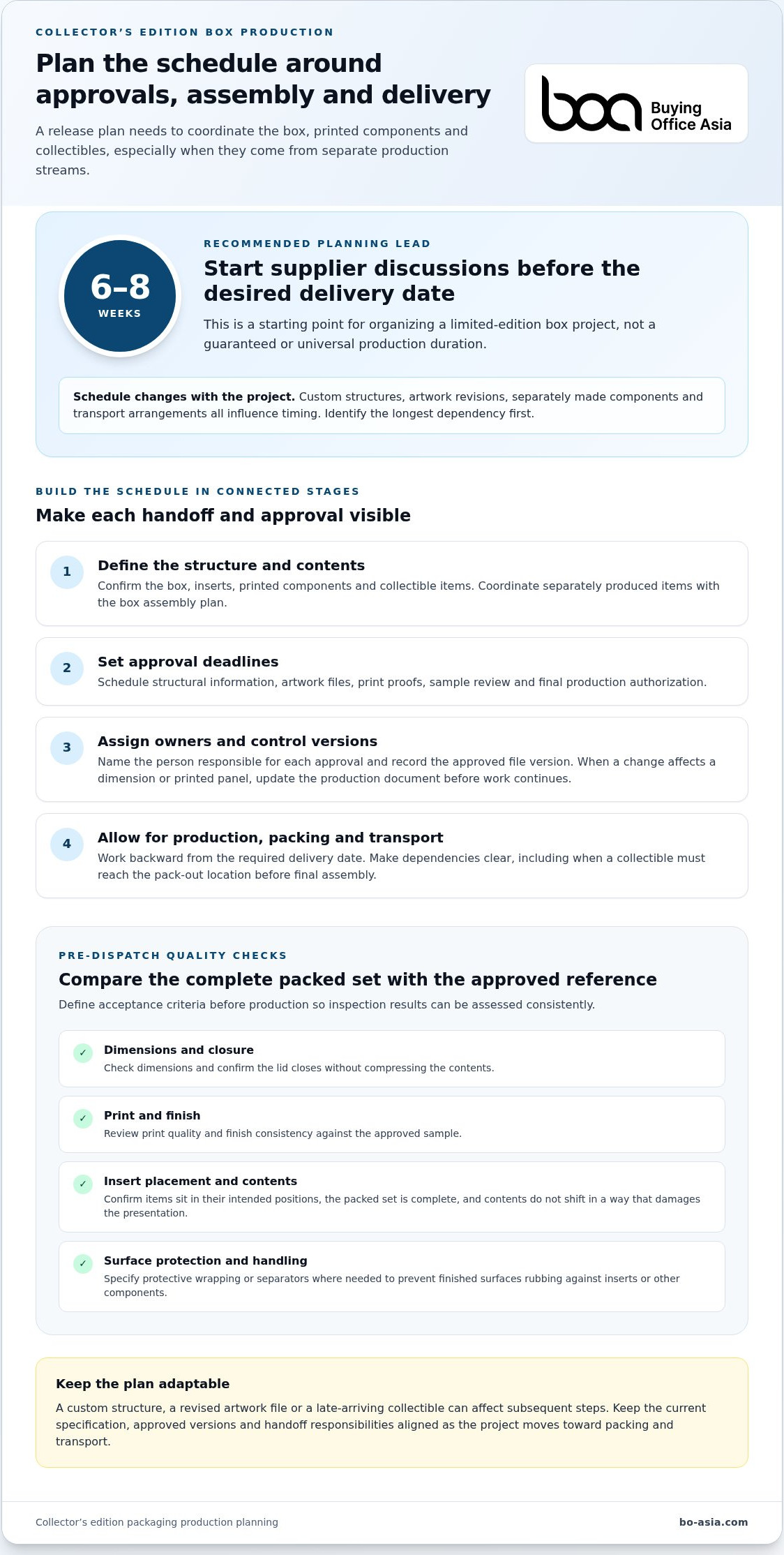
A release schedule should include approvals, production, packing, and transport, not just the factory’s manufacturing window. Work backward from the required delivery date and assign an owner to each decision. This makes dependencies visible, particularly when the box, printed components, and collectible items come from separate production streams.
Build a project-specific schedule with the supplier before committing to a launch date. The infographic's 6-8 week recommendation is an illustrative planning window, not a minimum, delivery commitment or reliable estimate for every project; complex collectibles and ocean transport may require substantially earlier work. A custom structure, artwork revisions, separately made components and transport arrangements all influence the schedule. Identify the longest dependency first, such as a collectible that must reach the pack-out location before final assembly.
Build approval stages into the schedule. Set deadlines for structural information, artwork files, print proofs, sample review, and final production authorization. Name the person responsible for each approval and record the approved file version. If feedback changes a dimension or printed panel, update the relevant production document before work continues. This helps prevent teams from working from different revisions.
Protect premium design details with clear handling and packing instructions. Identify finished surfaces that must not rub against inserts or other components, and specify separators or protective wrapping where needed. During inspection, examine the print, finish, placement, and condition of the assembled box. Confirm that all contents are present, sit in their intended positions, and won’t shift in a way that damages the presentation.
What quality control tests should collector’s edition boxes pass? Inspect dimensions, lid and closure fit, print quality, finish consistency, insert placement, and the completeness of the packed set. Compare the finished assembly with the approved reference and check whether the packaging protects the contents during handling. Define acceptance criteria before production so inspection results can be assessed consistently.
Size the box from the actual contents and insert, then plan the shipping carton separately. A 6 x 6 x 3 inch box is one example for a collectible with a booklet or certificate; a figurine or multi-item release needs dimensions based on its own components. Allow for protective clearance and confirm that the outer carton limits movement and protects corners during distribution.
Obtain a route-specific transit estimate from the selected carrier, including any international transport, customs clearance and domestic delivery stages. Include the destination and handoff date in the delivery plan, and distinguish factory completion from arrival. Pack-out instructions should also identify separate retail and collector-edition versions when their contents differ, preventing the wrong configuration from being dispatched.
When sampling, production checks and delivery coordination need to align, discuss your packaging production plan with a team that can coordinate those steps.
A premium finish changes how a box looks and feels, and it also affects production choices. Match each material and treatment to the artwork, inserts, handling, and delivery conditions.
Specify the outer wrap, board, lining, and insert separately. A textured paper wrap can contrast with a smooth printed panel, while a colored lining can carry the visual identity inside the lid. Record the material, color reference, grain direction, and placement for each surface. Review them together on a physical sample, since separate swatches can’t show how the assembled box will look.
Foil stamping, embossing, debossing, and spot gloss can make selected artwork stand out against a matte or uncoated surface. Use these effects selectively: a foil title on the lid, for example, can draw attention without competing with detailed character art. Mark each treatment area on the artwork file and structural template so the printer can align it with the correct panel and avoid folds or cut lines.
Assess finishes on the actual material, not from screen proofs alone. Request a sample showing the specified paper, ink, and coating together. Inspect color, registration, texture, and transitions between treated and untreated areas. For metallic effects, confirm whether the method is foil or printed ink; they create different surfaces and require different production instructions.
Finishing choices must also account for edges and folds. A treatment placed too close to a crease may distort when the wrap is formed, while a large textured area can change the feel of the cover. Mark safe artwork zones on the dieline, then review corners, spine edges, and lid seams on the assembled sample. This makes placement part of the specification instead of a last-minute visual adjustment.
Pair decoration with the contents. A dark, soft-touch exterior and bright interior printing can make the reveal distinctive, but the interior must still accommodate inserts without rubbing the finished surfaces. Use a complete pack-out sample to check where trays, cards, or collectibles may press against the lid or base. Add separators where needed and include them in the approved assembly instructions.
Before production, document the finish name, location, color reference, and acceptable appearance in one specification. Compare the finished sample under consistent viewing conditions, then keep it as the reference for print and finish checks. This gives the production team a clear standard for each decorated panel and helps prevent unapproved substitutions from changing the package’s appearance before delivery.
A minimum order quantity (MOQ) is the smallest production run a supplier accepts for a specified box or component. There is no universal production minimum for limited-edition boxes. Request a project-specific MOQ: structure, materials, printing, variants and supplier processes affect the quantity offered.
Separate the minimum order quantity (MOQ) for the finished box from the requirements for each component. A custom insert, specialty wrap, or printed sleeve may have its own setup and production batch. If an edition includes a figurine, art print, and booklet, compare each component’s production quantity with the number of complete boxes. Surplus components can create storage and reconciliation work after assembly.
Compare setup and unit costs across realistic order quantities. Printing plates, cutting forms, tooling, and setup work can raise the per-box cost of a smaller run. A larger run may spread those fixed expenses across more units, but it also commits more budget to packaging and inventory. Request comparisons based on the same specifications rather than changing materials between quantity options.
Variants can multiply the quantity decisions. A standard edition and a retailer-exclusive edition, for example, may share a box structure but use different artwork or inserts. Confirm whether shared components can be produced together and identify which items need separate runs. Production becomes more complex when every version changes the wrap, contents, or finishing process.
Use a demand forecast to set the run, then test it against the release plan. Consider confirmed orders, planned distribution, replacement stock, and the possibility of a later reprint. Numbered artwork may make it difficult to extend a limited edition without changing the concept, while a reusable box design may allow another run with revised printed elements. Keep the edition quantity and packaging specification consistent across purchase documents.
Before approval, document the following points for each supplier and component:
• The MOQ for the complete box and every separately sourced element.
• Whether artwork changes, finishes or color variants affect the required quantity.
• How excess inserts, wraps or printed parts are handled after assembly.
• Which sample and approved artwork represent the production version.
• Whether a future repeat run can use the same tooling and specifications.
Request quantity-based quotations against one fixed specification, including box dimensions, material, finish, and pack-out. Compare the total commitment, unit cost, and risk of leftover components. For example, a lower unit cost at a higher production quantity may not suit a release with uncertain demand or several exclusive variants.
Finally, connect the MOQ to inspection and delivery planning. A larger run needs a clear production reference, component counts, and packing records; staggered orders need clear version identification. Approve a complete sample before production and keep its artwork, finish, and assembly details with the quantity agreement. This record helps align later reorders with the original concept.
Paperboard weight influences how a collector’s edition box feels, folds and supports its contents. Specify the structural board, decorative wrap and inserts separately. A rigid box commonly uses a thick chipboard or greyboard core with a separate paper wrap; folding-carton stock is a different construction. Choose the grade and thickness for the actual dimensions, contents and support requirements.
GSM describes a material’s weight per square metre, but it doesn’t by itself show how a completed box will perform. Compare paperboard samples in the proposed construction, including wrapped corners, folded edges, and lid panels. Heavier stock may feel more substantial, but the box still needs suitable geometry and support for its contents.
Texture affects both presentation and printing. Linen-like or subtly textured stock can create a distinctive surface, while smoother stock can suit fine lines and detailed artwork. Request a printed sample on the actual stock. Digital proofs help assess layout and color intent, but they can’t reproduce physical texture or show how light interacts with the material.
Assess grain direction before production. It can affect how paperboard folds and how neatly the wrap sits around corners. Review the lid, spine, and base edges on the sample, where creasing or exposed board can affect the finished appearance. Record the selected stock and its orientation in the production specification.
Choose materials to suit the box’s purpose. A display box opened occasionally has different handling demands from packaging repeatedly moved through retail distribution. For a box containing a booklet and flat inserts, assess panel rigidity and fit; for a heavier collectible, review the base and insert support as a complete assembly. Let the contents, intended use, and construction guide the choice.
Use a simple comparison when selecting stocks:
Compare the specified structural board, wrap and insert grades against the required construction.
Check artwork clarity, tactile effect and finish on the real material.
Inspect creases, corners and wrapped edges on an assembled sample.
Review the box under the lighting and viewing conditions where customers will see it.
Approve a physical reference sample before mass production. Label it with the stock, texture, artwork version, and finishing details, then use it for production checks. This reduces ambiguity if the material or paper surface changes between sampling and the production run.
For a project that needs its structure and materials developed together, explore custom product and tooling development.
Buying Office Asia coordinates end-to-end sourcing and procurement for collector’s editions involving multiple suppliers, components, and production stages. If you’re aligning a custom box with inserts, printed artwork, and collectibles, its dedicated Asia procurement team can manage supplier communication and keep project specifications connected.
For higher-volume production, Buying Office Asia also supports factory-direct price negotiations and procurement planning. This approach helps keep decisions about materials, components, and assembly aligned from development through production. If your team already manages sourcing and needs support for a particular purchasing stage, the project scope can focus on that need.
Contact Buying Office Asia to discuss your collector’s edition sourcing and production requirements.
Treat collectors edition box manufacturing as a product-development decision, not simply an artwork handoff. Turn the approved concept into a shared decision record: who owns each approval, which document is current, and how a change affects the release plan. Clear decision rights help your teams and suppliers work toward the same outcome.
Before committing, align product, procurement, and brand stakeholders on what must remain consistent across the finished edition. Record the priorities that guide trade-offs, then assign one owner to resolve conflicts between visual goals, component requirements, and production constraints. This prevents late feedback from becoming an untracked change and gives the team a clear basis for reviewing samples and production updates.
If you want coordinated support moving from sourcing decisions into production planning, contact Buying Office Asia to discuss your project. A well-structured brief gives your team a stronger starting point for a distinctive edition and a more controlled path to market.
Production starts by defining the box structure, contents, and assembly requirements. The team then prepares structural templates and artwork, reviews a physical sample, and approves any needed revisions. After approval, the box and components are produced, decorated, assembled, and inspected against the agreed reference. For example, a pack-out plan can specify the order for placing a booklet, collectible, and certificate, helping reduce final assembly mistakes.
Common formats include rigid lid-and-base boxes, slipcases, and drawer-style boxes. A book collection may suit a slipcase, while a box holding several merchandise items may need a fitted tray. Finishes can include foil stamping, embossing, debossing, and spot gloss, paired with matte or textured surfaces. Choose treatments for their intended visual effect, then assess the combined result on a physical sample before production approval.
The appropriate minimum is supplier- and project-specific, depending on structure, materials, printing, variants and components. The box and separately made inserts may have different production quantities. Compare quotations using the same specification and ask how excess components are handled. A smaller run may reduce leftover stock, while a larger run may spread setup work across more finished units.
Agree a project-specific timeline that allows for artwork approval, sampling, revisions, component production, packing and transport. The infographic's 6-8 week planning example is not a delivery commitment; complex projects or ocean freight may need longer. Confirm carrier estimates and customs allowances for the actual route. Work backward from the launch date and distinguish factory completion from delivery to the final destination.
Choose a manufacturing partner that can manage the box structure, printed components, inserts, and pack-out as one coordinated specification. Review its sampling process, production checkpoints, communication, and ability to handle the complete component list. For example, a separately made collectible needs clear coordination with box assembly. Buying Office Asia supports sourcing and procurement, sampling, and production oversight for manufacturing projects in Asia.
Prepare artwork for the box and structural template, along with files for any book, dust jacket, endpapers, or printed edges in the edition. Supply separate files for each component and identify its panel, orientation, and version. Include insert dimensions, component placement, and assembly instructions so the sample reflects the final pack-out. Clear file names and approval records help keep outdated artwork out of production.

Learn how to find a manufacturer in China without an in-house Asia team: define your brief, shortlist factories, compare quotations, validate samples and control quality.

Fine detail only matters when it can be reproduced reliably. Injection moulded figurine manufacturing shapes plastic by injecting molten material into a closed mould, cooling it, then ejecting the formed part. The method supports repeatable, intricate components, while the mould’s design and precisi...
A final inspection is a release checkpoint, not a guarantee that every unit is flawless. A standalone quality inspection in Asia can assess a random sample against your agreed specifications; a pre-shipment inspection typically takes place after production is 100% complete and at least 80% of the or...