


The lowest freight quote can carry the highest operational risk if supplier readiness, documentation, and exception handling are left outside the plan. If you’re asking how to choose a freight forwarder for Asia, look beyond the headline rate. A smooth shipment depends on who coordinates each handoff and whether the transport plan reflects production reality.
It’s reasonable to expect clear pricing and reliable delivery. Yet proposals can cover different services, and unclear responsibility for paperwork, customs coordination, or delays can turn a small gap into a costly disruption. Your provider also needs to understand the practicalities of coordinating with Asian suppliers, not just booking cargo space.
This guide explains how to assess route and regional expertise, compare proposals on a like-for-like basis, and assign ownership for documentation, communication, and exceptions. You’ll also learn how to connect freight decisions with sourcing, production schedules, consolidation, and delivery requirements. Buying Office Asia manages logistics and shipping as part of broader procurement, combining Hong Kong-based regional presence with European leadership in Helsinki to align supplier operations and shipment planning.
• Understand how freight forwarders, carriers, customs brokers, and importers fit into a shipment so responsibilities stay clear.
• To decide how to choose a freight forwarder for Asia, assess its experience with your cargo, route, handling needs, and communication expectations.
• Compare proposals using the same shipment assumptions, then identify exclusions, conditional charges, and who owns each task.
• Use a practical selection process that separates essential requirements from preferences before evaluating options.
• When sourcing, production, quality checks, and shipping involve multiple handoffs, integrated logistics management can help align cargo readiness with shipment plans.
A freight forwarder organizes the movement of cargo between locations. It may arrange transport with carriers rather than operate the vessel, aircraft, or truck itself. Understanding that distinction is a practical first step in how to choose a freight forwarder for Asia. For a foundational overview, see What is a Freight Forwarder?
Several parties may contribute to one shipment. Their responsibilities can overlap unless the agreed scope is clear:
Coordinates shipment planning, bookings, documents, consolidation, and handoffs within the agreed service scope.
Physically transports the cargo by sea, air, road, or rail.
Supports customs clearance and related declarations when engaged for that purpose.
Provides accurate shipment and product information and meets its own import responsibilities.
Who prepares or submits specific documents, coordinates clearance, and handles exceptions depends on the agreed scope, shipment terms, and applicable requirements. Assign ownership early rather than assuming one party manages every step.
A shipment plan connects factory readiness to final delivery. The forwarder may coordinate a transport booking, arrange factory collection, consolidate cargo from multiple suppliers, manage shipment documentation, and coordinate handoffs through to destination delivery. Each stage depends on the one before it: a booking is useful only if the cargo is ready, correctly identified, and available for collection.
For example, if goods from two factories are meant to move together, their production and collection schedules need to align with the consolidation plan. If one order is delayed, the shipment plan may need to change. Clear updates about cargo readiness help reduce avoidable rescheduling and keep responsibilities visible.
Freight coordination manages the movement of goods. It doesn’t replace supplier selection, production control, or customs decisions. Procurement teams manage supplier relationships and purchasing, while production oversight tracks manufacturing progress. Linking these workstreams helps ensure collection dates reflect actual factory readiness, including relevant inspection outcomes, rather than an outdated estimate.
This coordination matters when several suppliers, production schedules, or quality checks feed into one delivery plan. Buying Office Asia combines a Hong Kong headquarters with a Helsinki leadership office to connect regional coordination with European communication. Learn more about Buying Office Asia’s regional approach, or explore broader sourcing and procurement in Asia to understand how supplier and purchasing decisions fit into the supply chain.
A provider’s regional presence matters, but it’s useful only when paired with relevant route and cargo experience. To understand how to choose a freight forwarder for Asia, assess whether its operating approach fits your shipment, from the factory location and cargo characteristics to the destination and handling needs. Broad claims about a network reveal less than a clear explanation of how the shipment’s handoffs will be coordinated.
Start with the actual movement: where the goods are produced, where they need to go, and what handling or packaging they require. Fragile, oversized, temperature-sensitive, or regulated cargo may need different arrangements. Requirements depend on the goods and route, so make responsibilities for verifying documentation and compliance explicit rather than assumed.
Look for evidence of relevant experience. A concrete explanation of how a comparable operational challenge was handled, such as coordinating collection across factories or responding when cargo readiness changed, is more useful than a general claim. A similar example can demonstrate a process, but it can’t guarantee the same outcome for a different shipment.
Set a clear communication structure before cargo moves. Identify the accountable contact, how factory updates reach the importer, how often shipment status is shared, and who escalates delays or missing information. Name an owner for documentation coordination at each handoff. This clarity helps prevent responsibility gaps from surfacing after the shipment is already in motion.
Factory-side risk is part of the picture. Supplier reliability, production progress, and cargo readiness affect whether a shipping plan is workable. Our guide to supplier vetting in Asia explains how supplier assessment supports stronger operational oversight.
Use this evidence checklist to distinguish clear operating capability from broad sales language:
Experience matches the origin, destination, cargo type, and handling needs.
Status updates and communication frequency are defined.
Factory coordination, documentation, delays, and escalation each have an accountable party.
The process explains how changed readiness or shipment details are communicated and handled.
Buying Office Asia coordinates shipment planning, consolidation, documentation, and route optimization as part of logistics and shipping management. With a Hong Kong headquarters and leadership office in Helsinki, the team connects regional coordination with European communication. If your shipment plan needs to align with sourcing, production, or inspection activity, discuss logistics coordination with our team.
A meaningful comparison starts with identical shipment assumptions. If one proposal covers factory collection and delivery while another prices only the main transport leg, their headline figures don’t describe the same service. To understand how to choose a freight forwarder for Asia, compare scope, assumptions, and responsibilities alongside the quoted transport elements.
Prepare one shipment brief and use it as the baseline for every proposal. Include the origin and destination, cargo dimensions and weight, expected readiness date, required delivery point, and known handling or packaging needs. Record the proposed transport mode, service boundaries, assumptions, and quote validity conditions.
Missing information is a comparison gap, not evidence that two estimates are equivalent. If a proposal doesn’t specify whether factory collection or consolidation is included, mark that scope as unclear rather than treating it as covered. This keeps the comparison grounded in the services actually described.
Look beyond the transport line items. Compare who coordinates collection, consolidation, shipment documentation, status updates, and delivery handoffs. Separate included services from exclusions and charges that depend on shipment details or changes. Also record who is responsible if cargo isn’t ready, documentation is incomplete, or schedules shift.
A simple comparison framework makes gaps visible before you commit:
Which transport and coordination activities are included?
Who owns collection, documentation, updates, and each handoff?
What services or circumstances fall outside the proposal, and what charges are conditional?
How are shipment status and changes communicated?
Who coordinates a response to delays, incomplete cargo, or schedule changes?
Then compare operational fit, not just the total. A lower headline quote may leave more coordination to your team or omit a service the shipment needs. That doesn’t automatically make a higher proposal better. It means you need to understand the difference in light of your delivery requirements and internal capacity.
Keep the original assumptions beside each proposal, and note every clarification or scope change. This creates a reliable record for the final decision and operating handoff. Logistics and shipping management that coordinates shipment planning, documentation, consolidation, and route optimization can connect the quote to the wider supply chain rather than treating freight as an isolated transaction.
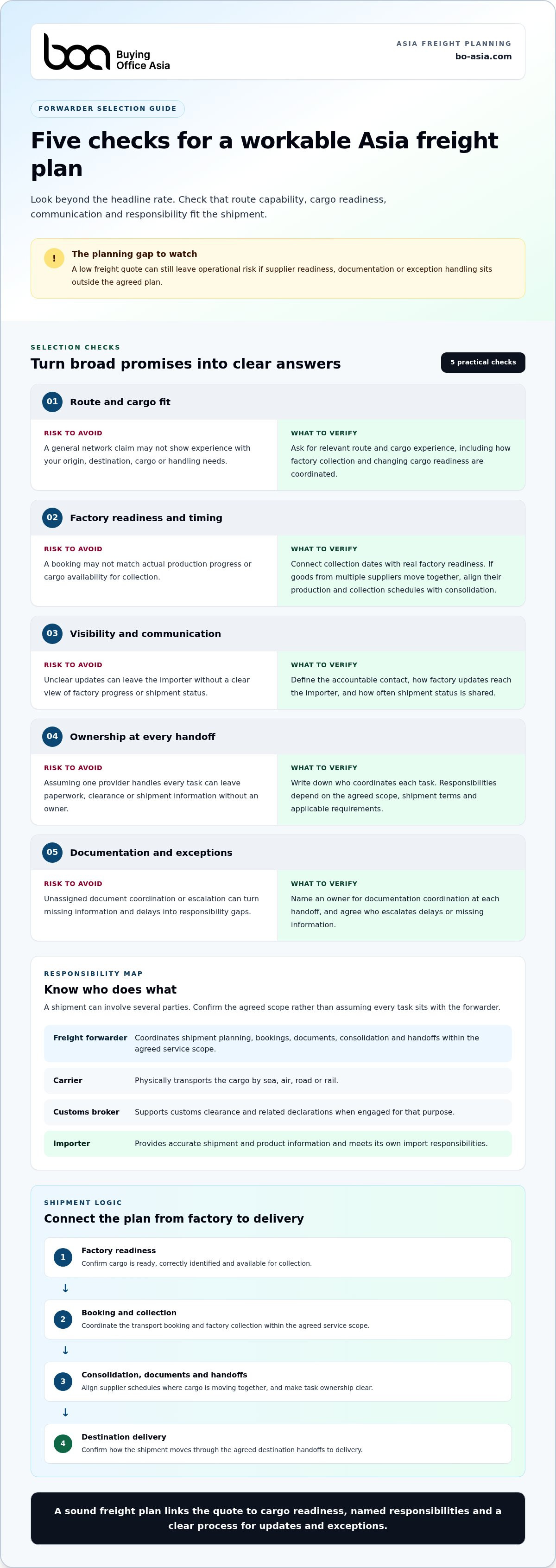
A repeatable selection process takes you from an initial shipment brief to a clear operating handoff. Define what the shipment requires before comparing proposals, then connect the final plan to factory milestones and cargo readiness. This is how to choose a freight forwarder for Asia without letting a low headline rate distract from the coordination needed to move the goods.
Build one brief that gives every proposal the same starting point. Record the product category, factory origin, destination, cargo profile, expected shipment timing, and delivery requirements. Add the coordination your team needs, such as shipment status updates, documentation support, and communication when plans change.
Include the dependencies that affect dispatch: production completion, inspection or quality release, and the supplier’s handover of cargo. A planned collection date does not confirm readiness. If an inspection is pending or production is behind schedule, reflect that dependency in the shipment plan instead of treating the date as fixed.
Before comparing options, divide requirements into two groups:
Essential route and cargo fit, clear task ownership, required visibility, and an agreed approach to exceptions.
Useful service features or communication formats that add value but aren’t essential to dispatching and delivering the shipment.
Score each proposal against the same criteria: route fit, scope clarity, communication, and ownership of exceptions. Use the shipment brief as your reference and resolve differences before deciding. A strong fit is one where the service scope matches your needs and no critical task is left between the factory, logistics coordinator, carrier, and importer without an owner.
Once you’ve selected an approach, document the operating handoff. Record the agreed shipment assumptions, each party’s responsibilities, production and inspection milestones, cargo-readiness confirmation, collection coordination, and status-reporting expectations. This gives your team a shared reference if a schedule changes or a handoff needs attention.
Regional coordination can connect factory updates with shipment planning. Buying Office Asia’s Hong Kong headquarters and Helsinki leadership office support an on-the-ground Asia presence alongside European communication. Read more about Buying Office Asia’s regional approach.
With your shipment brief defined, discuss your Asia logistics requirements and how coordination can align with sourcing, production, and delivery needs.
A standalone freight arrangement may be enough when supplier handoffs are simple and cargo readiness is clear. But when sourcing, production, quality checks, and shipment planning sit with separate teams, updates can become fragmented. A factory may revise its completion date without the logistics contact knowing, or an inspection outcome may affect dispatch readiness after collection has been planned.
Integrated logistics management connects these decisions. It doesn’t replace carriers, customs brokers, or the importer’s responsibilities. Instead, it links supplier and production information with shipment coordination so the transport plan reflects what is happening at the factory. This broader view can be useful when deciding how to choose a freight forwarder for Asia.
Production status and quality release can inform when cargo is ready to move. If an inspection identifies an issue, the shipment plan can account for the change instead of relying on an outdated dispatch assumption. A shared coordination channel also helps connect factory updates with collection, consolidation, documentation, and delivery planning.
The benefit is clearer ownership and fewer information gaps, not a guaranteed delivery time or fixed saving. Actual shipment outcomes depend on the project, cargo readiness, and agreed scope.
Buying Office Asia combines logistics and shipping management with wider procurement support. Its Hong Kong headquarters provides regional presence, while its Helsinki leadership office supports communication with European clients. Supplier vetting, production oversight, and quality inspections can connect factory-side updates and inspection outcomes with cargo readiness and shipping plans.
This integration is particularly relevant when a shipment depends on several suppliers or production milestones. Coordination can include shipment planning, consolidation, documentation, and route optimization, while keeping each party’s responsibilities clear. It treats freight as part of the supply chain rather than an isolated booking.
If multiple handoffs are creating coordination overhead, consider whether an integrated approach better fits your operating model. Discuss coordinated sourcing and shipping support for your Asia supply chain.
Choosing well means looking beyond the headline quote. Compare proposals against the same shipment assumptions, confirm who owns each task, and select a service scope that fits your cargo, route, and communication needs. Most importantly, connect shipment planning with supplier readiness, production milestones, and quality inspection outcomes.
Buying Office Asia coordinates logistics and shipping as part of wider sourcing and procurement support. With a Hong Kong headquarters and a European leadership office in Helsinki, the team connects regional coordination with European communication. If you’re considering how to choose a freight forwarder for Asia, an integrated view can help keep sourcing, supplier oversight, inspections, and shipping plans aligned.
Discuss your Asia sourcing and logistics requirements and take the next step toward a more coordinated supply chain.
A freight forwarder coordinates a shipment, but isn’t necessarily the carrier that physically transports the cargo. Depending on the agreed scope, it may arrange transport bookings, coordinate shipment documents, consolidate goods, and manage handoffs. Before cargo moves, confirm who owns each task, including factory collection, documentation, and destination coordination. Clear responsibilities help prevent gaps between the forwarder, carrier, customs broker, supplier, and importer.
Assess experience with your specific route and cargo, then compare scope transparency, communication, shipment visibility, and exception handling. To understand how to choose a freight forwarder for Asia, give each provider the same shipment assumptions instead of relying on broad network claims or a headline quote. Check that the proposed plan accounts for factory readiness, cargo handling, and destination requirements, and clarify who coordinates changes if production or dispatch dates shift.
Compare proposals built around the same origin, destination, cargo profile, timing, and service assumptions. Review included services, exclusions, responsibilities, quote conditions, and how delays or schedule changes are handled. A lower initial figure may reflect a narrower scope, so it may not be equivalent to another proposal. Identify missing details and resolve differences before selecting a provider. This gives you a sound basis for comparing operational fit as well as quoted amounts.
A freight forwarder may coordinate customs-related documentation or clearance, but the exact role depends on the route, service scope, and shipment arrangement. Coordination support doesn’t automatically transfer obligations assigned to the importer or another party. Define who prepares, supplies, and submits required information, and who handles clearance at each stage. Because requirements vary by destination and cargo, verify current rules with qualified sources before shipment and document responsibilities in the shipping agreement.
Look for evidence tied to your actual origin and destination, cargo type, handling needs, and required service scope. Ask for a clear description of the operating process, references where available, and examples of how shipment updates or exceptions were managed. General claims about global reach don’t establish fit for your shipment. Also keep route-specific compliance checks current, since relevant requirements depend on the goods and destination.
Not necessarily. Weigh the quoted amount against service scope, exclusions, route fit, shipment visibility, and accountability. Proposals based on different assumptions or responsibilities aren’t directly comparable. A lower quote doesn’t automatically signal poor service, just as a higher quote doesn’t guarantee better performance. Clarify what’s included and who handles key tasks, then consider whether the proposed coordination approach fits your cargo, delivery needs, and team’s capacity.
Integrated coordination can be useful when supplier communication, production schedules, inspections, cargo readiness, and shipping plans depend on one another. For example, an inspection outcome or production delay may affect when goods can be collected. Aligning updates across these activities can reduce handoff gaps and keep the shipment plan connected to factory reality. The right setup depends on your suppliers, operating model, and shipment requirements, not on a one-size-fits-all approach.

What if your signed OEM agreement protects the product on paper but leaves the factory unclear about what to make, when to deliver it, or how quality will be judged? That gap is where an oem manufacturing agreement china project can lose control: responsibilities blur between buyer, sourcing interme...

What if the safest payment deal isn’t the one that delays the most cash, but the one that releases it only when progress is verifiable? Payment terms negotiation with Asian suppliers is about balancing your working capital with the supplier’s need for confidence, not simply pushing for a smaller dep...

What if your biggest supply chain risk isn’t the supplier you chose, but what you can’t see after the order is placed? Asia procurement services can connect supplier selection with factory follow-through, giving you clearer visibility into production, product quality, and responsibilities along the...