


That line item for procurement on your balance sheet isn't an overhead expense; it's actually your most significant opportunity for profit recovery. If you're currently losing sleep over midnight factory calls or feeling the sting of unmanaged quality risks, you aren't alone. Many leaders are struggling with the hidden costs of middlemen and a total lack of transparency in factory pricing. You likely recognize the need for a professional shift, but convincing your boss to hire a sourcing team requires a proposal rooted in financial rigor rather than operational frustration.
• Identify why the 'sourcing solitary' model fails in 2026 and how to frame unmanaged supply chains as a critical business risk.
• Learn to quantify the financial impact of hidden markups and quality failures to demonstrate how a professional sourcing team pays for itself.
• Discover the five essential steps for convincing your boss to hire a sourcing team by focusing on margin expansion and EBITDA growth.
• Compare the total cost of ownership between internal recruitment and dedicated procurement partners to find the most efficient path to scale.
• Position a sourcing partner as a transparent, on-the-ground extension of your leadership team rather than a traditional, commission-based intermediary.
Managing complex international supply chains alone is no longer a viable operational model. In 2026, procurement workloads are projected to increase by 8% while staffing levels decline, creating a "Sourcing Solitary" trap. This occurs when a single individual is tasked with overseeing hundreds of factory relationships across multiple jurisdictions, from China to Southeast Asia. This isn't just an efficiency problem; it's a strategic vulnerability. When your supply chain relies on one person's capacity to handle midnight calls and technical audits, you aren't conducting global sourcing; you're simply surviving it.
The landscape in 2026 is defined by rapid geopolitical shifts and stringent ESG requirements. With new Section 122 tariffs and proposed Section 301 increases affecting various Asia-Pacific economies, the margin for error has disappeared. If you're convincing your boss to hire a sourcing team, you must frame this as a transition from "ordering" to "strategic procurement." A dedicated team doesn't just place orders; they proactively mitigate the 15% to 25% duty burdens that can suddenly erase your product margins. Every hour your leadership spends on logistics is an hour lost to high-level strategy, representing a massive opportunity cost for the business.
Relying on digital platforms like Alibaba without physical oversight creates a dangerous illusion of control. While these platforms offer accessibility, they cannot replace on-site verification of factory-direct pricing or ethical standards. Information asymmetry in Asia sourcing frequently leads to a 15% to 30% price inflation because remote buyers lack the local leverage to see the true cost of production. Without a dedicated sourcing team performing physical audits, your brand is exposed to unmanaged quality risks and hidden intermediary markups that are impossible to detect from a laptop in Europe or North America.
The physical toll of managing Asian production from a different hemisphere is a recipe for operational failure. Time-zone exhaustion slows decision-making speed and leads to "Key Person Dependency," where your entire supply chain grinds to a halt if one manager leaves or burns out. A professional procurement partner ensures business continuity by maintaining a steady presence during regional holidays or local disruptions. By moving away from a single-person model, you protect the organization from the volatility of individual burnout and ensure that production oversight remains constant, regardless of the hour or the location of your home office.
Executive leadership demands hard numbers. When convincing your boss to hire a sourcing team, you must frame the team as a profit-recovery mechanism rather than a headcount expense. Research into High-Performance Sourcing and Procurement shows that top-tier organizations view procurement as a strategic lever for EBITDA growth. By eliminating hidden markups and quality-related losses, a professional team typically pays for itself within the first few production cycles. You aren't just adding staff; you're securing your margins.
Many unmanaged supply chains suffer from a "middleman tax" of 10% to 20%. These unvetted intermediaries often present themselves as factories but are actually trading companies adding layers of obscured commission. Reclaiming these margins immediately improves your bottom line. A dedicated team provides the technical oversight to audit these relationships and ensure you're paying for product value, not a broker's vacation.
Trading companies provide a veneer of convenience that hides significant financial leaks. A transparent procurement model allows you to see the true cost of materials and labor. This shift ensures every dollar spent contributes to product value rather than an intermediary's profit. You can review savings examples to see how this transparency translates into measurable improvements. Moving to a factory-direct relationship is the most effective way to protect your long-term financial health.
A single rejected batch can wipe out an entire quarter's profit. Beyond the cost of the goods, you face the expense of freight, disposal, and the "stock-out" crisis that damages retail relationships. These are the hidden costs of unmanaged sourcing that rarely show up on a simple purchase order but devastate the balance sheet.
On-site inspections are a brand's strongest insurance policy. The cost of professional quality control is negligible compared to the catastrophic impact of a product recall. A dedicated team catches defects at the source, before the goods leave the factory floor. This proactive oversight maintains your reputation and ensures consistent market availability. It's a calculated defense against the operational setbacks that affect unmanaged supply chains.
Local teams possess the cultural and linguistic nuances required to secure "local" pricing. Foreign buyers often pay a "tourist premium" simply because they lack on-the-ground representation. A dedicated team also identifies opportunities to consolidate orders from multiple suppliers into single shipments. This reduces your logistics overhead and simplifies the customs process. If you're ready to quantify your specific potential for profit recovery, reach out for a preliminary supply chain audit.
When you're convincing your boss to hire a sourcing team, the debate often centers on a critical choice: do we recruit internal staff or partner with an established firm? While hiring a direct employee might seem like the traditional route, it carries a heavy burden of total cost of ownership that many executives overlook. As of June 2026, recruitment agency fees for procurement roles remain high at 15% to 25% of an annual salary. When you factor in an average base salary of $116,000 to $128,000 USD for a sourcing manager in Asia, the initial investment is significant before a single factory audit occurs.
Choosing an established partner over a lone hire provides immediate speed to market. A new employee needs months to navigate local labor laws and build a network from scratch. In contrast, a procurement partner offers the steady confidence of an established expert with existing regional infrastructure. This allows your business to move from a "reactive" ordering state to a proactive strategic model without the delays of a traditional hiring cycle.
Managing a legal entity in Hong Kong or Mainland China involves more than just a salary. You face the complexities of visas, office leases, and regional HR compliance. An outsourced dedicated Asia procurement team transforms these fixed liabilities into a variable cost. This model allows your organization to adjust sourcing support based on production volume. It's a scalable solution that avoids the management burden of training a new hire, providing a lean approach to syntax and operations that mirrors your own efficiency goals.
A sourcing team's existing database is infinitely more valuable than a new hire's LinkedIn profile. Professional partners bring years of experience in OEM/ODM contract manufacturing, which is vital for specialized product development and tooling. By implementing strategic sourcing best practices through a partner, you leverage their regional influence to secure better lead times and priority on the production line. This isn't just about finding a factory; it's about accessing a defense against the operational setbacks that affect unmanaged supply chains.
Accountability is the final piece of the executive business case. A partner with a European leadership office offers a layer of financial and legal security that a lone hire cannot provide. You gain a protective, hands-on partner who acts as an integrated extension of your own team. This ensures continuity during regional holidays or disruptions, protecting your brand from "Key Person Dependency" while focusing entirely on your financial health.
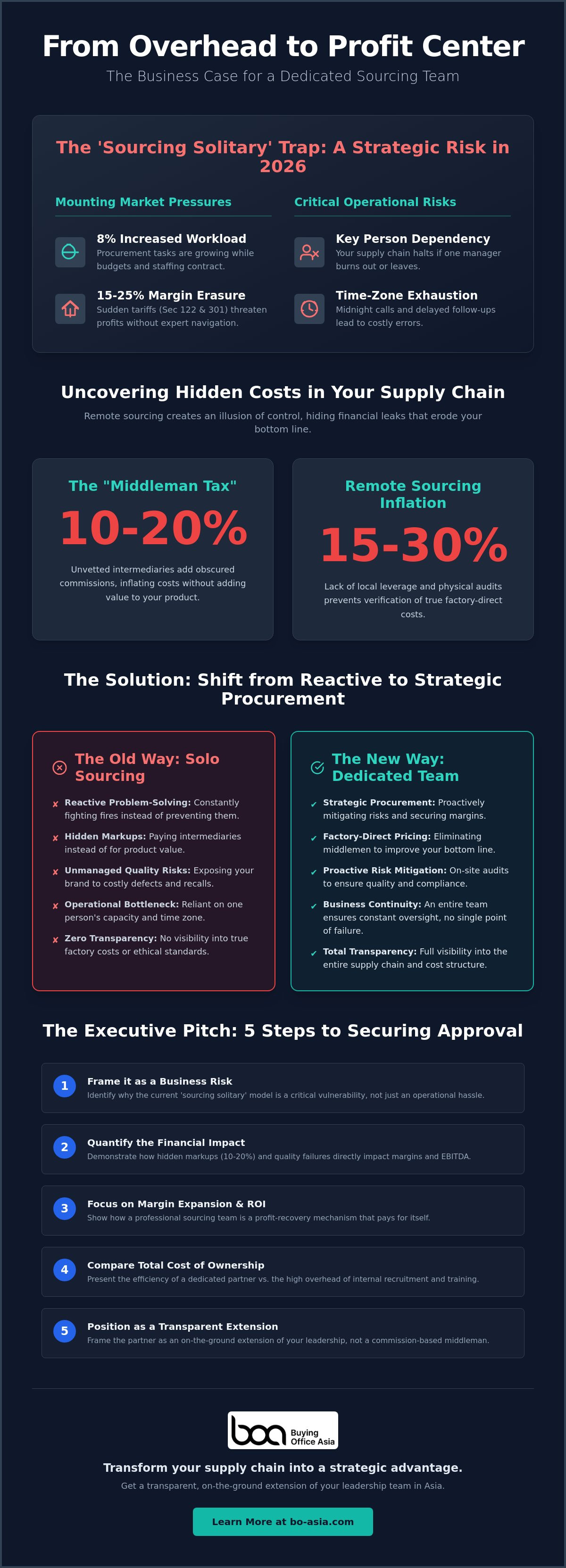
Executive approval hinges on a logical progression from identified risk to measurable financial gain. When convincing your boss to hire a sourcing team, you must present a proposal that speaks the language of the C-suite: EBITDA, risk mitigation, and operational transparency. A structured five-step approach transforms your request from a departmental "ask" into a strategic business imperative.
– Document every recent quality failure, shipping delay, or unexpected price increase. Quantify the total cost of these disruptions to show that the status quo is more expensive than a professional partner.
– Compare your current landed costs against factory-direct benchmarks. Demonstrate how removing intermediary markups directly improves company-wide profitability.
– Present the sourcing team as an integrated extension of your own office rather than a third-party vendor. This emphasizes control and alignment with corporate goals.
– Lower the barrier to entry by proposing a single project or product line. Proving the model on a small scale builds the trust necessary for a full-scale rollout.
– Define clear KPIs and reporting standards. Executives need to know exactly how performance will be measured and how transparency will be maintained.
Transparency isn't a vague ethical goal; it's a financial asset. In a market where hidden commissions often inflate production costs, having a partner who operates on an open-book basis ensures every dollar is accounted for. You can utilize case studies to show how similar organizations have scaled their operations by reclaiming control over their supply chain data. If your boss objects to the initial cost, pivot to a cost-avoidance model. Explain that the investment prevents the catastrophic expense of a product recall or a total stock-out during peak season.
A dedicated team serves as your primary defense against global supply chain volatility. With the 2026 regulatory landscape shifting toward stricter ESG requirements, unmanaged sourcing is a brand disaster waiting to happen. Rigorous supplier vetting protects the company from ethical risks that could lead to legal penalties or consumer boycotts. It's about securing the long-term viability of the business in a complex global market.
The 30-Second Elevator Pitch: "Our current unmanaged supply chain is a liability for our 2026 margins. By integrating a dedicated sourcing team, we can recover 10% to 20% in hidden markups and eliminate the risk of batch failures. It's a profit-recovery strategy that provides the oversight we need to protect our brand and our bottom line."
If you're ready to build a customized business case for your leadership team, contact us for a strategic procurement briefing.
Positioning Buying Office Asia (BOA) as a direct extension of your leadership team is the final, most persuasive step in convincing your boss to hire a sourcing team. It's not about adding another external vendor to the list; it's about establishing a physical, accountable presence where your products are actually manufactured. BOA bridges the geographical and cultural divide between European headquarters and Asian manufacturing hubs. Our dual presence in Helsinki and Hong Kong ensures that communication remains seamless and high-level strategy remains aligned with regional execution. You no longer have to manage the anxieties of midnight phone calls or translation errors because we act as your local representatives on the factory floor.
We provide a stabilizing force by managing the entire lifecycle from sourcing to logistics. This comprehensive oversight eliminates the fragmentation that typically leads to quality slips or unforeseen shipping delays. By placing your brand at the center of the action, we move away from transactional interactions and toward a steady, long-term partnership. Our regional presence functions as a signature promise of accountability in a digital world, offering the same level of oversight usually reserved for major global enterprises.
Traditional sourcing agents often hide their profit within factory markups, which creates an inherent conflict of interest. BOA operates on a transparent, fee-based model with zero hidden commissions. We explicitly reject conventional intermediary models because they obscure the true cost of production and prioritize volume over quality. By functioning as your internal procurement department, we ensure our incentives are perfectly aligned with your financial health. You can explore Why Buying Office Asia stands apart from transactional brokers by offering 100% transparency in every negotiation.
Integrating a dedicated team into your current workflow is a methodical process designed to build trust incrementally. The first step is a strategic procurement audit. We analyze your current supplier performance and landed costs to identify immediate opportunities for margin recovery. This data-driven entry point provides the hard evidence required for convincing your boss to hire a sourcing team by demonstrating exactly where profit is being leaked. It's a professional briefing focused entirely on your bottom line.
Don't leave your supply chain to chance in an increasingly volatile 2026 market. Our team provides the elite oversight and regional expertise required to protect your brand and improve your EBITDA. Book a consultation with our Asia procurement experts today to secure your production and move toward a more resilient, profitable future.
Transitioning from unmanaged risk to a strategic procurement model is no longer a luxury; it's a fundamental requirement for maintaining healthy margins in an increasingly complex market. By quantifying the ROI of professional oversight and identifying the hidden markups of traditional intermediaries, you've built a case that prioritizes long-term financial viability over short-term savings. Successful leaders recognize that convincing your boss to hire a sourcing team is ultimately about demonstrating how physical proximity and regional expertise function as a defense against global volatility.
Scale your production with a Dedicated Asia Procurement Team and reclaim control over your manufacturing outcomes today.
Partnering with an established sourcing firm is generally more cost-effective than building an internal team because it eliminates fixed overhead like visas, office leases, and local HR compliance. While a dedicated sourcing manager in Asia can earn over $120,000 USD annually, a partner offers a variable cost model. This allows you to scale support based on production volume without the long-term liability of full-time salaries and recruitment fees.
You should frame the ROI around profit recovery and cost avoidance. Highlight the reclamation of the 10% to 20% hidden markup typically charged by unvetted trading companies. Additionally, present the insurance value of on-site inspections, which prevent the catastrophic expense of product recalls or stock-outs. When convincing your boss to hire a sourcing team, focusing on improved EBITDA and margin expansion provides the hard evidence CFOs require.
The primary risks include unmanaged quality defects, information asymmetry leading to price inflation, and brand exposure to ESG violations. Without a physical presence, you lack the leverage to verify factory-direct pricing or ethical standards. This remote management gap often results in 15% to 30% higher costs and leaves your supply chain vulnerable to geopolitical shifts and regulatory changes that local experts would proactively mitigate.
Yes, a professional team leverages local linguistic and cultural nuances to secure pricing that's often unavailable to foreign buyers. By bypassing intermediaries and negotiating directly with factory owners, they eliminate obscured commissions. This regional influence ensures you pay for actual material and labor value rather than a tourist premium, providing a level of financial optimization that's impossible to achieve through digital platforms alone.
Quality is maintained through on-site mass production oversight and technical audits performed during the manufacturing process. Instead of waiting for goods to arrive at your warehouse to find defects, a sourcing team identifies issues at the source. This proactive approach includes sampling support and custom tooling development, ensuring that production meets your exact specifications before any balance payments are made or shipping containers are sealed.
Your proposal should include a risk audit of current failures, a margin analysis comparing current landed costs to factory-direct benchmarks, and a clear accountability framework. Define specific KPIs for quality and lead times to show how the partnership aligns with corporate goals. convincing your boss to hire a sourcing team is most effective when you present a pilot program for a single product line to prove the model's financial viability.
Sourcing teams manage the end-to-end flow by coordinating factory output with freight forwarders to optimize container utilization. They consolidate orders from multiple suppliers into single shipments, significantly reducing logistics overhead and simplifying customs clearance. This high-level oversight ensures that production schedules align with shipping windows, preventing the costly delays and storage fees that frequently plague unmanaged supply chains.
A trading company acts as a middleman that adds a hidden markup to factory prices, whereas a professional sourcing office operates on a transparent, fee-based model. Sourcing offices function as an integrated extension of your own team, providing open-book access to factory data and ethical audits. This distinction is critical for financial rigor; one model obscures costs for its own profit, while the other optimizes costs for yours.

A supplier listing can open a door, but it can’t show whether a factory is right for your order. Choosing a ningbo sourcing agent means looking beyond access to local suppliers: you need clear oversight of supplier vetting, production follow-up, and quality checks. Without defined responsibilities,...

What if the supplier with the strongest online profile isn’t the factory best suited to your shoes? In footwear manufacturing in China, a directory listing can start your search, but it can’t confirm who will make your product, whether the factory can handle its construction and materials, or how cl...

What if the mold you paid to develop couldn’t be released when you needed to change suppliers? Managing tooling and molds with a foreign factory means more than tracking where production equipment is stored. Payment alone may not establish clear ownership, access, or transfer rights. Without visibil...