


In the 2026 procurement landscape, your contract is only as strong as the relationship behind it. While many Western buyers treat a signed agreement as the final word, your Chinese supplier likely views it as the beginning of a fluid negotiation. Understanding the cultural differences when negotiating with Chinese suppliers is no longer a soft skill; it's a financial necessity for protecting your margins and ensuring product integrity. When you misinterpret a polite "yes" as a confirmation of technical capability, you're not just losing time. You're inviting the risk of mid-production price hikes and quality drift that can derail your entire quarter.
You've likely experienced the anxiety of a supplier going silent during a dispute or felt the sting of unexpected costs following China's 2026 VAT law changes. This guide helps you master the nuances of Chinese business etiquette to secure lower factory-direct pricing and build partnerships that respect your brand's goals. We'll explore how to establish trust without a constant physical presence and how to leverage the new 2026 regulatory environment to your advantage. This briefing provides the strategic roadmap you need to transform your supply chain from a source of uncertainty into a stable, high-performance asset.
• Bridge cultural differences when negotiating with Chinese suppliers to eliminate the hidden costs of miscommunication and secure stable, factory-direct pricing.
• Master the dual concepts of Guanxi and Mianzi to position your brand as a preferred partner, ensuring your production receives priority during high-demand cycles.
• Recognize that contracts in China often function as evolving intent rather than fixed end-points, requiring a strategic focus on relationship management to ensure ongoing adherence.
• Utilize the "Seniority Match" technique to bypass middle management and negotiate directly with factory owners who have the authority to guarantee quality standards.
• Leverage local, on-site oversight to provide the accountability and regional expertise necessary to protect your brand from unforeseen manufacturing setbacks.
In international trade, what you don't understand about your partner can cost you more than the tariffs on your goods. Cultural friction in procurement manifests as missed deadlines, unexpected material substitutions, and eroded margins. Many Western buyers enter the room with a linear mindset, focusing on line items and legal clauses. However, International negotiation styles vary significantly; in high-context Asian markets, the unspoken context is often more important than the written word. If you ignore the cultural differences when negotiating with Chinese suppliers, you risk treating a complex partnership as a simple transaction. This often leads to a total breakdown in supply chain reliability.
Developing Cultural Intelligence (CQ) is a strategic move for your procurement team. It allows you to move beyond surface-level interactions and identify the underlying motivations of your factory partners. Instead of pushing for a quick win that might cause the supplier to lose money, a partnership-driven approach ensures that both parties are invested in long-term success. When a supplier feels squeezed by a buyer who doesn't respect their local constraints, they're more likely to deprioritize your orders. This shift in perspective is what separates elite sourcing operations from those constantly fighting operational fires.
When a factory manager says "yes" to an aggressive production timeline, they aren't necessarily lying. In many cases, they're showing respect or indicating they've heard your request. If you don't recognize these cultural differences when negotiating with Chinese suppliers, you might mistake a polite acknowledgement for a firm commitment. This misalignment often results in "quality fade." This is where the supplier gradually reduces the specification of materials to maintain their own profit margins after agreeing to an unsustainable price. It's not malice; it's a survival mechanism triggered by a failure to establish a realistic, culturally informed agreement.
The procurement environment of 2026 demands higher levels of ESG transparency than ever before. European leadership teams often struggle to reconcile these rigid regulatory requirements with the fluid, relationship-based reality of Asian factory floors. Digital tools and video calls provide a baseline of communication, but they lack the nuance required to verify ethical standards or environmental compliance. Physical proximity remains the ultimate bridge. By having a dedicated team on the ground, you can verify that the factory's actions match their verbal commitments. This turns potential cultural risks into a documented competitive advantage for your brand.
In the Chinese supply chain, social capital is as valuable as cash flow. Mastering the cultural differences when negotiating with Chinese suppliers requires a deep understanding of Guanxi (relationships) and Mianzi (face). These aren't abstract social concepts; they're the invisible currency that determines whether your order is prioritized during a peak season or pushed to the back of the queue. Your factory partner operates within a "circle" concept. As an outsider, you receive standard commercial treatment. Once you're inside the circle, the relationship provides a level of security and pricing flexibility that a contract alone cannot guarantee.
This transition from outsider to trusted partner is achieved through the accumulation of social credit. According to the US-China Business Council, building trust in Chinese negotiations is a continuous process that extends far beyond the boardroom. When a supplier sees you as a long-term ally rather than a transactional buyer, they're more likely to offer factory-direct pricing and absorb minor cost fluctuations themselves. Navigating these cultural differences when negotiating with Chinese suppliers transforms your procurement from a series of high-stakes battles into a resilient, mutually beneficial partnership.
Effective procurement starts before the first formal meeting. Shared meals and informal discussions are essential "pre-negotiation" phases where suppliers assess your character and commitment. Consistency is your greatest asset here. If your communication is erratic or your goals shift constantly, you signal instability. Many successful brands utilize dedicated Asia procurement teams to maintain this relationship momentum. Having a local presence ensures that the bond remains strong even when you aren't physically in the country, preventing the "out of sight, out of mind" decay that often affects remote partnerships.
Mianzi, or face, represents a person's social standing and dignity. In a quality dispute, causing a factory owner to "lose face" through public criticism or aggressive blaming can cause them to shut down communication entirely. To secure concessions, you must master the art of "giving face." Address defects privately and frame the solution as a collaborative improvement rather than a failure. By allowing the supplier to maintain their dignity, you create the psychological space for them to offer credits or replacements without feeling attacked. If you find yourself struggling to balance firm standards with these delicate social nuances, consulting with experts on regional etiquette can protect your brand from a total partnership collapse.
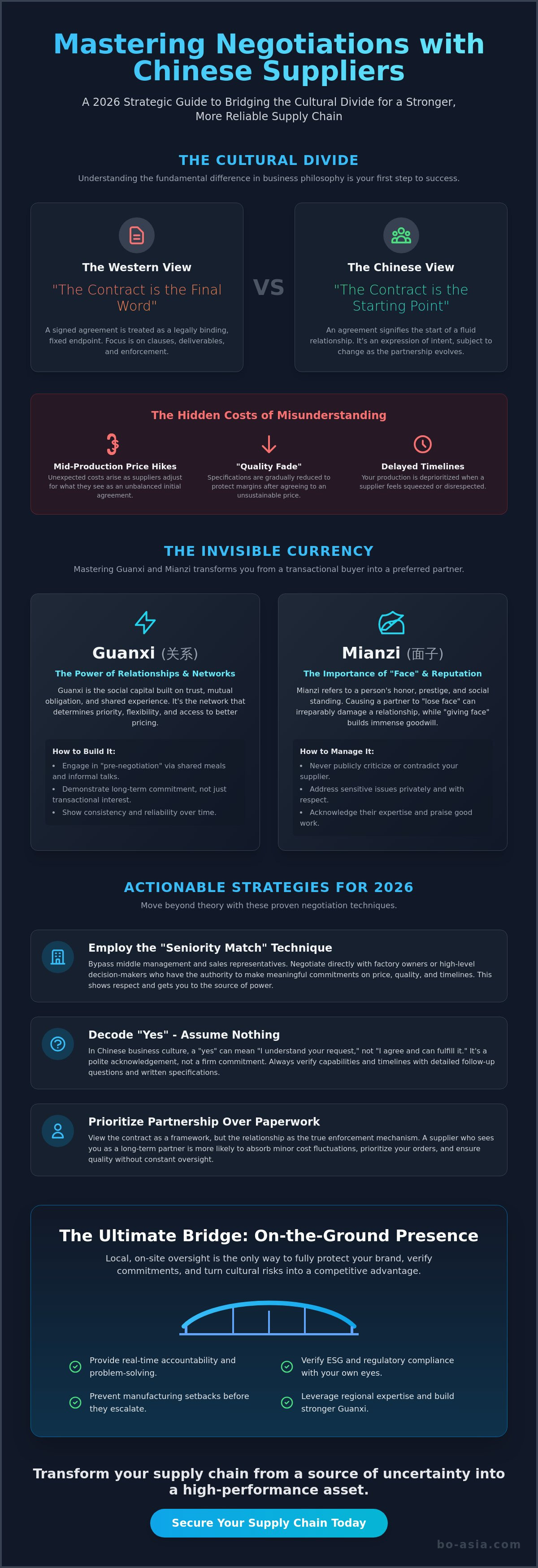
For many Western businesses, a signed contract is the final, unshakeable law of the partnership. In the Chinese manufacturing sector, however, that same document is often viewed as a "memorandum of current intent." It reflects the state of the relationship at the moment of signing but remains subject to change as circumstances evolve. If you fail to account for these cultural differences when negotiating with Chinese suppliers, you'll likely find yourself frustrated when terms are suddenly reopened mid-production. A signature is not the end of the negotiation; it's the baseline for an ongoing dialogue.
In 2026, navigating this legal divide requires a shift from rigid legalism to strategic flexibility. While you must have a clear contract, its enforceability often depends more on the strength of your Guanxi than on the threat of litigation. Attempting to resolve a dispute through aggressive legal threats often leads to "silent exits," where the supplier simply stops responding. Instead, you must build a framework where the contract serves as a roadmap for shared success rather than a weapon for enforcement.
To make agreements more culturally enforceable, incorporate performance-based milestones that align with the supplier's own business goals. This approach provides tangible incentives for adherence that transcend the written word. Rigorous supplier vetting is your first line of defense. By selecting partners who already demonstrate a track record of reliability and transparency, you reduce the need for constant contractual policing. Remember that in Mainland China, legalistic aggression often backfires, damaging the trust needed to resolve production issues quickly.
Suppliers may attempt to renegotiate prices if raw material costs fluctuate significantly. This is a common point of friction where cultural differences when negotiating with Chinese suppliers become most apparent. To hold a supplier to original terms, you must leverage your relationship rather than just pointing to a clause. Regular, on-site mass production oversight acts as a powerful contract enforcement tool. It signals that you're an active, present partner who is monitoring every stage of the process. This physical presence creates a level of accountability that digital communication simply cannot match, ensuring that "moving goalposts" don't compromise your financial viability.
Negotiation in the 2026 procurement landscape is not a single event; it's a structured sequence of tactical maneuvers. To secure the best terms, you must move beyond the "buyer versus seller" dynamic and adopt a methodology that respects local norms while protecting your bottom line. Success requires a five-step approach that leverages cultural differences when negotiating with Chinese suppliers to your advantage.
• Step 1: Conduct deep factory audits before the first meeting. Information is your primary leverage. Verifying a supplier's actual production capacity and ownership structure prevents you from wasting time with trading companies masquerading as factories.
In a hierarchy-conscious culture, sending a junior procurement officer to meet a factory owner signals a lack of respect. Ensure your lead negotiator matches the rank of the supplier's decision-maker to keep high-level concessions on the table.
Patience is a strategic weapon. Westerners often negotiate against their own clocks. By remaining comfortable with extended timelines, you signal that you have alternatives. This often prompts the supplier to offer their best price to close the deal.
Publicly praising a supplier’s technical expertise can be traded for tangible benefits, such as improved payment terms or priority scheduling.
A contract in English alone is often viewed as a suggestion. A bilingual document, vetted by local experts, ensures there's no "lost in translation" excuse during production.
Identifying "middleman" signals is critical for maintaining healthy COGS. If a supplier is hesitant to show you the actual production line or provides vague answers about machinery, you're likely paying an unearned markup. When arguing for lower prices, base your position on high-volume projections and the strength of your long-term Guanxi. However, be wary of the "Price-Quality Trade-off." Pushing a supplier below their viable margin often triggers "quality fade," where the factory recovers its profit by using inferior components. If you need to secure aggressive pricing without compromising your brand, connect with our procurement team to manage these delicate trade-offs on your behalf.
In a Chinese boardroom, a long pause is rarely an invitation to keep talking. It's often a tactical tool used to observe your reaction. Mastering these cultural differences when negotiating with Chinese suppliers means becoming comfortable with silence. You must also understand that "No" is rarely said directly. Phrases like "it is difficult" or "we will study it" are often polite rejections. Utilizing a third-party intermediary allows you to deliver "hard" messages about quality or deadlines without damaging the personal relationship with the factory owner. This allows the intermediary to play the "enforcer" while you maintain the high-level partnership required for long-term supply chain stability.
Sourcing from a distance creates a transparency gap that no digital dashboard can close. In a culture where the relationship serves as the primary security mechanism, being physically absent means you're perpetually on the outside of the trusted circle. Buying Office Asia functions as an integrated extension of your team, bridging the divide between European leadership and Asian manufacturing floors. Our "Helsinki-Hong Kong" model combines European management standards with local execution. This ensures that your brand’s requirements aren't just heard; they're enforced by a team that understands the subtle cultural differences when negotiating with Chinese suppliers.
The financial impact of this proximity is measurable. By identifying hidden costs and optimizing the negotiation flow, our clients often realize a 15% to 20% reduction in total production expenses. These results come from expert oversight, not from compromising product quality. When your procurement team is physically present, the supplier understands that accountability is a daily reality, not a quarterly check-in. This constant presence transforms the supplier's perception of your brand from a distant customer to a high-priority partner.
Unmanaged sourcing often carries an invisible "foreigner tax" that inflates your COGS. Local negotiators know how to strip away the markups added by trading companies and agents who claim to be the factory. By conducting regular on-site visits, our team identifies the true factory-direct price and ensures that the materials you pay for are the ones actually used on the line. This shift from a traditional sourcing agent to an integrated procurement partner provides the financial optimization required for a competitive 2026 market. You gain the steady confidence of an established expert who knows exactly what happens on the factory floor when the cameras are off.
Proximity is the only way to ensure 100% transparency in your supply chain. As global trade regulations become more complex, you need to know that your partners are adhering to the ethical and quality standards your brand promises. Preparing for future disruptions requires a diversified, culturally-aligned network that can pivot when needed. Your resilience depends on the strength of your regional expertise and your ability to manage the cultural differences when negotiating with Chinese suppliers in real-time. To ensure your procurement strategy is optimized for the year ahead, schedule a briefing with our Asia procurement team to audit your current negotiations and identify immediate saving opportunities.
Success in the Chinese market requires moving beyond a transactional mindset. You've seen how mastering the nuances of Guanxi and Mianzi can prevent quality fade and mid-production price hikes. By aligning your contractual expectations with local cultural realities, you transform a rigid agreement into a resilient partnership. Understanding the cultural differences when negotiating with Chinese suppliers isn't just about etiquette; it's about building a defense against the operational risks that threaten unmanaged supply chains.
Since 2010, we've provided our clients with the steady confidence that comes from expert, on-the-ground oversight. As a European-managed firm with a permanent presence in Hong Kong, we offer 100% transparency with no hidden middleman fees. We ensure your brand goals are respected at every stage of the manufacturing process. It's time to replace uncertainty with the calm assurance of a partner who understands the regional landscape. Protect your margins with a dedicated Asia Procurement Team and secure a stable, high-performance manufacturing future for your business.
A "yes" in this context is often an act of social harmony or an acknowledgement that your request was heard. In a high-context culture, saying "no" directly is considered aggressive and impolite. You must learn to listen for indirect cues like "this will be difficult" or "we will try our best," which usually signal that the request is beyond their current technical or scheduling capacity.
Mianzi represents a person's social standing and professional reputation. If you criticize a factory manager in front of their staff, they lose face, which often results in them ending the partnership entirely to preserve their dignity. Addressing quality issues privately and framing them as "mutual improvements" allows the supplier to fix the problem while keeping their reputation intact, ensuring your production continues without interruption.
While Chinese courts recognize international agreements, a Western contract is often difficult to enforce without a local legal presence. To increase security, your documents should be bilingual and stamped with the factory's official "chop." Most successful buyers treat the contract as a baseline for the relationship, relying on on-site oversight and cultural differences when negotiating with Chinese suppliers to ensure the terms are actually followed on the factory floor.
You should allocate at least double the time you would for a Western meeting. Rushing to sign a deal is seen as a sign of weakness or lack of commitment. Expect the first few days to be dominated by site tours and shared meals. These informal stages are where the actual trust is built, and they're essential for reaching the final, most favorable terms for your brand.
You don't need to be fluent, but you do need a representative who speaks the language and understands technical procurement. Relying on the factory's own sales staff for translation is a significant risk, as they'll likely filter out negative information to keep the deal moving. Having your own advocate ensures that your specific quality requirements and timelines are communicated with absolute precision and no bias.
The most common error is ignoring the social hierarchy. If you send a junior staff member to negotiate with a factory owner, it's seen as a lack of respect for the owner's status. Other mistakes include showing visible anger during delays or failing to participate in the local dining culture. These actions signal that you're an outsider who doesn't value the long-term partnership required for stable manufacturing.
Strong Guanxi provides you with "insider" status, which translates directly into lower COGS and priority scheduling. Suppliers who view you as a trusted ally are more likely to absorb minor raw material price increases rather than passing them on to you immediately. This relationship-based security is a primary driver for financial optimization, as it protects your margins from the volatility often found in unmanaged supply chains.
Yes, because we function as an integrated extension of your own team with a permanent regional presence. Our negotiators use their deep understanding of cultural differences when negotiating with Chinese suppliers to eliminate the hidden markups often charged to foreign buyers. We leverage our existing factory networks and seniority to bypass middlemen, ensuring you receive true factory-direct pricing and the highest level of accountability throughout the production cycle.

What if the first clear sign of a production problem arrives after the goods are packed? Manufacturing risk management in Asia works best when controls are connected from the start, not left to a final inspection or occasional supplier update. You need visibility into factory activity, early warning...

What if the lowest unit quote isn’t the lowest-cost way to make your board game? Board game manufacturing costs depend on more than the number of boxes ordered. Component materials, custom tooling, assembly, packaging and delivery scope can all change what a quote covers, making headline prices diff...

What if the factory’s lowest quote isn’t the lowest-cost option? A lower unit price can hide differences in materials, tooling, packaging, quality checks or production terms. Understanding how sourcing agents negotiate factory prices starts with making those differences visible, not simply asking a...