

Your traditional sourcing agent might be the biggest threat to your bottom line. While they promise simplicity, the reality often involves hidden commissions and a lack of control over mass production quality. In a market where the $800 de minimis exemption was suspended in 2025 and 10% global surcharges are now standard, your margins can't afford the cost of opacity. Mastering Sourcing from China to USA in 2026 requires more than just a contact list; it demands a transparent, factory-direct infrastructure that puts you in the driver's seat.
We understand that navigating the current landscape of duty stacking and rigorous UFLPA enforcement feels like a constant defensive maneuver. This guide will show you how to transition from unmanaged risk to a high-level procurement strategy that reduces your landed cost per unit. You'll learn how to implement on-site quality assurance, navigate complex US customs requirements, and build resilient factory relationships that function as a true extension of your own team.
• Navigate the 2026 regulatory environment by implementing strategies to mitigate the impact of duty stacking and increased tariff enforcement.
• Optimize your Sourcing from China to USA by transitioning from hidden-commission agents to a transparent, factory-direct procurement model.
• Implement a robust quality assurance framework that utilizes on-site inspections to protect your brand from mass production inconsistencies.
• Reduce your total landed cost per unit by leveraging expert negotiation strategies and 100% visibility into your supply chain financials.
• Establish a dedicated regional presence that provides the same level of oversight and accountability as a global enterprise’s internal procurement office.
The 2026 trade environment demands a total departure from the "find and flip" mentality of the past decade. Successful Sourcing from China to USA now centers on transparency and structural resilience rather than simple unit-price arbitrage. The old model is broken. With the suspension of de minimis exemptions in 2025, every shipment is now a point of regulatory scrutiny. You need a strategic procurement partner who understands that a low factory quote is meaningless if your goods are seized at the border or hit with uncalculated duty stacking.
Hong Kong remains the essential gateway for managing these complexities. It serves as a critical bridge for financial oversight and contract law, providing a layer of security that direct-to-factory relationships often lack. This regional presence allows for real-time adjustments to supply chain disruptions. It moves your operations away from transactional interactions and toward a fully integrated end-to-end procurement strategy that prioritizes financial viability over short-term savings.
Section 301 tariffs remain active at rates between 7.5% and 25%. While the USTR review continues through mid-2026, the 10% global surcharge from Section 122 adds another layer of financial pressure. Although the Court of International Trade recently ruled this surcharge unlawful in May 2026, the injunction is limited to specific plaintiffs. Most importers must still account for these costs in their landed cost calculations. The historical prestige and challenges associated with the Made in China label have evolved into a high-stakes compliance exercise. Accurate HTS code classification isn't just paperwork; it's a financial defense mechanism. Professional sourcing teams provide the documentation required for CBP audits. This ensures you don't overpay or face penalties for misclassification.
Compliance isn't a "nice to have" for US brands. CBP's strict enforcement of the Uyghur Forced Labor Prevention Act (UFLPA) means your entire supply chain must be mapped and verified. You can't rely on a factory's word from 7,000 miles away. On-the-ground audits are the only way to ensure your products aren't linked to forced labor or environmental violations. This level of due diligence protects your brand equity. It ensures long-term viability in a market that increasingly values ethical accountability. By integrating ESG standards into your supplier vetting process, you turn a regulatory burden into a competitive advantage.
High-volume Sourcing from China to USA requires more than a digital search. It demands a transition from simple product discovery to a fully managed supply chain ecosystem. For US businesses scaling their operations, the goal isn't just finding a vendor; it's securing a partner capable of sustaining enterprise-level demand. This framework moves you beyond the transactional and into a strategic procurement model that prioritizes long-term financial health. It's about building a defense against the operational setbacks that plague unmanaged supply chains.
Enterprises often outgrow public marketplaces. While platforms like Alibaba serve a purpose for small-scale testing, they rarely offer the transparency or capacity needed for high-volume contracts. You need to identify factories with the actual technical capability and financial stability to meet US-market standards. On-site audits are the only way to verify these claims. We go beyond digital profiles to inspect machinery, labor practices, and raw material sources. Learn more about our supplier vetting process to understand how we filter for reliability and technical excellence.
Middleman markups are the silent killers of profitability. By engaging in factory-direct price negotiations, you eliminate the obscured costs inherent in traditional agent models. Local expertise is vital here to prevent the "China price" bait-and-switch, where a low initial quote leads to unexpected surcharges or material downgrades later. Contracts must be structured to protect your intellectual property and mandate strict adherence to quality standards. Understanding the fundamentals of Basic Importing and Exporting ensures your negotiated terms align with US regulatory expectations and landed cost targets.
Mass production oversight is where the most significant risks reside. Without on-the-ground management, "quality fade" becomes an inevitable reality as factories look to cut costs during long runs. You must establish clear KPIs for production timelines and defect rates. This is especially critical when managing custom product development or proprietary tooling for unique US designs. Sampling support serves as your foundation, but consistent oversight ensures the final container matches the approved prototype. If you're ready to secure your production line, you can connect with our procurement specialists to discuss your specific high-volume requirements.
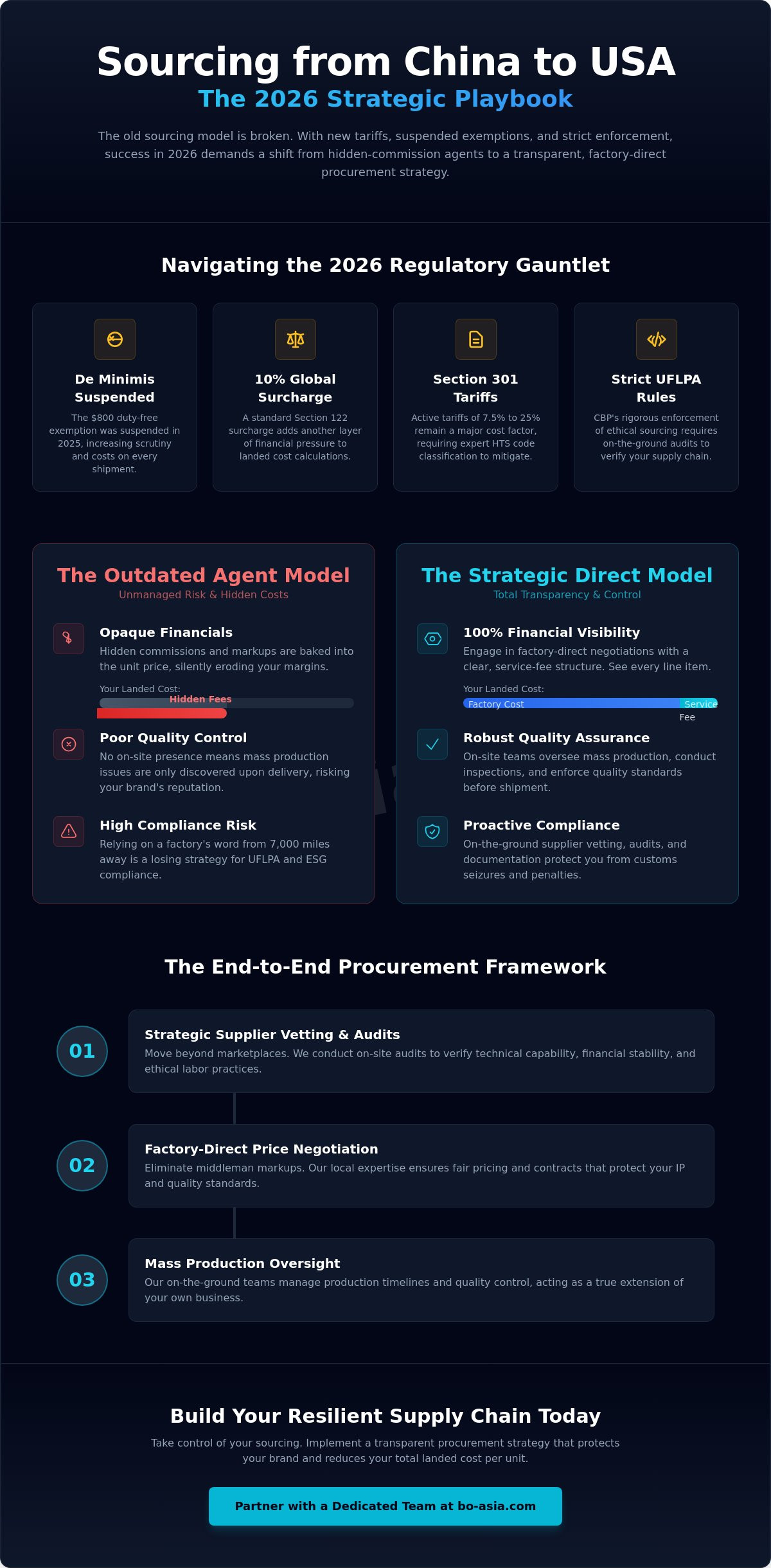
"Free" is a dangerous word in international trade. If an agent doesn't charge you a service fee, they're collecting a commission from the factory instead. This creates a fundamental conflict of interest. When an agent's income depends on the factory's payout, their loyalty is split. They're less likely to flag quality inconsistencies. They won't push for the lowest price. This hidden markup often exceeds the cost of a professional service fee. You're left with higher unit costs and increased risk.
The hidden commissions common in Sourcing from China to USA don't just drain your budget; they erode your control over product quality. Effective Sourcing from China to USA requires a partner whose incentives align perfectly with your own. Our model replaces obscured commissions with a transparent, fee-based structure. This ensures we negotiate solely for your benefit, securing factory-direct pricing without the silent "middleman tax." By stabilizing your supply chain through 100% financial visibility, we protect your margins against the volatility of U.S. trade policy on China and evolving tariff structures.
Managing a supply chain from a US time zone is inherently flawed. Without physical proximity, you're forced to rely on hearsay and digital photos. A dedicated team acts as a physical extension of your company, conducting unannounced factory visits and real-time oversight. This presence is the only way to verify that your "factory-direct" price hasn't been inflated by a network of local sub-agents. See our transparent pricing and savings examples to understand how this model translates into measurable bottom-line growth.
Communication failure is often the root of supply chain collapse. Our Helsinki-based leadership bridges the gap between Western business logic and Asian manufacturing practices. This leadership ensures that your standards for ethical sourcing and technical precision aren't lost in translation. Operating from a Hong Kong headquarters provides an additional layer of legal and financial security. It offers a sophisticated framework for contract enforcement and IP protection that most local agents cannot provide. This elite oversight allows independent brands to scale with the same confidence as major enterprises.
For a US brand, quality is the ultimate risk mitigation strategy. "Good enough" doesn't exist when you're competing in a saturated marketplace where one bad batch can destroy years of brand equity. Efficient Sourcing from China to USA requires a proactive approach to quality that begins long before the goods reach a shipping container. It's about establishing a technical baseline that aligns with US safety certifications and consumer expectations. This ensures your products don't just arrive; they perform.
Relying on a factory's self-inspection report is a critical operational error. Factories are naturally incentivized to overlook minor defects to meet production deadlines or reduce waste. You need independent, on-site quality control and inspections to verify every batch against Acceptable Quality Level (AQL) standards. This process identifies issues while the goods are still on the factory floor, where they can be corrected without the massive cost of international returns. The Insider’s Guide to Safe & Profitable Sourcing provides deeper insights into why this oversight is your last line of defense against quality fade.
The logistics landscape of 2026 remains financially volatile. Sea freight for a 40-foot container currently fluctuates between $3,015 and $3,685, making cost optimization a necessity for maintaining margins. Consolidating orders from multiple suppliers into a single Full Container Load (FCL) can significantly reduce your per-unit shipping cost compared to multiple LCL shipments. Beyond physical transport, your logistics and shipping management must include meticulous documentation for US Customs entry.
Mismatched paperwork or incorrect HTS codes lead to expensive delays and storage fees at the port. With the 2025 suspension of de minimis exemptions still in place, every commercial import faces rigorous scrutiny. You need a strategy that accounts for port congestion and provides predictable lead times. By integrating your quality checks with your shipping schedule, you ensure that only compliant, high-standard goods enter your Sourcing from China to USA pipeline. This level of oversight transforms a complex international move into a managed, predictable business process. If you want to secure your supply chain from the factory floor to your warehouse, connect with our logistics specialists to build a custom oversight plan.
Major US enterprises don't rely on third-party agents; they build dedicated procurement offices to ensure 100% supply chain visibility. For independent brands, replicating this internal infrastructure is often cost-prohibitive. We bridge this gap by functioning as your integrated team on the ground. Scaling Sourcing from China to USA requires moving beyond transactional deals and toward a model where your procurement team is a physical extension of your business. This approach eliminates the information asymmetry that often leads to quality fade and financial loss.
Profitability in high-volume manufacturing depends on your ability to control every variable. From custom product and tooling development to the final US market launch, we provide the oversight necessary to protect your intellectual property and design integrity. By managing the transition from initial prototypes to full-scale production, we ensure that the technical precision established during sampling is maintained throughout the entire manufacturing lifecycle. This level of control is what allows you to reduce your landed cost per unit while maintaining the high standards your US customers expect.
The difference between a transactional agent and an integrated partner lies in accountability. An agent's involvement often ends when the order is placed; our work continues through every phase of production. Discover the benefits of a dedicated sourcing team that prioritizes your financial health over factory kickbacks. We help US businesses scale with confidence, providing the regional expertise needed to manage complex high-volume production schedules without sacrificing quality or transparency. This partnership moves you away from the risks of unmanaged sourcing and into a stable, results-oriented procurement environment.
Short-term price chasing often leads to long-term operational failure. Sustainable success in Sourcing from China to USA is built on relationships with vetted, high-performing manufacturers. We don't just find suppliers; we develop them. Through continuous improvement initiatives and rigorous factory audits, we help our manufacturing partners reach the ethical and technical standards required for the US market. This proactive management reduces your risk profile and ensures that your supply chain remains a competitive asset rather than a liability. If you're ready to move beyond unmanaged sourcing, contact Buying Office Asia to optimize your China-to-USA supply chain and secure your brand's future.
Transitioning your procurement strategy from a reactive to a proactive model is the most significant step you can take to protect your margins. By eliminating the "middleman tax" and implementing rigorous on-site quality control, you remove the variables that lead to operational setbacks. Mastering Sourcing from China to USA in this complex regulatory environment requires a partner who operates with 100% transparency and the same results-oriented philosophy as your own executive team.
As a European-managed firm with leadership in Finland, we provide the accountability and elite oversight usually reserved for major enterprises. Our on-the-ground presence in Hong Kong and key manufacturing hubs ensures that your interests are protected directly at the source. This regional proximity is your ultimate defense against quality fade and unforeseen expenses. You've now seen the framework for success; it's time to implement a supply chain that functions as a competitive asset.
Secure your factory-direct pricing with a dedicated Asia procurement team.
Your brand's growth depends on a stable foundation, and we're ready to help you build it.
The primary risks in 2026 involve regulatory non-compliance and the financial impact of duty stacking. With the suspension of de minimis exemptions and stricter enforcement of the Uyghur Forced Labor Prevention Act, shipments face higher seizure risks and unexpected tax burdens. You must also account for Section 301 tariffs, which remain between 7.5% and 25% for most goods. These factors make transparency and on-the-ground vetting essential to prevent operational delays.
You can identify a legitimate factory by conducting an on-site audit and reviewing the "scope of business" on their official business license. Trading companies often lack specialized machinery or a dedicated production floor for your specific product category. We verify these details by visiting the facility to inspect technical capacity and labor practices. This physical presence ensures you're negotiating directly with the manufacturer rather than an intermediary who adds a hidden markup.
A professional buying office operates as an integrated extension of your own company with 100% financial transparency. Traditional sourcing agents often rely on hidden commissions from factories, which creates a conflict of interest that can compromise your product quality. By choosing a buying office model, you secure factory-direct pricing through a fee-based service. This ensures your procurement team's loyalty remains entirely with your brand rather than the supplier's payout.
The cost of a dedicated team is structured as a professional service fee rather than a hidden commission per unit. This model typically offers a higher ROI for high-volume Sourcing from China to USA because it eliminates middleman markups and reduces the risk of quality fade. You should evaluate the cost against the potential savings in landed cost and the value of having an on-the-ground defense against supply chain disruptions and regulatory penalties.
Yes, a professional procurement partner provides comprehensive support for custom product and tooling development. We manage the transition from your initial prototype to mass production, ensuring that proprietary US designs are protected and manufactured to your exact specifications. This includes overseeing the creation of custom molds and conducting technical reviews at the factory level. This oversight prevents the design deviations that often occur during unmanaged production runs.
Tariffs significantly impact your landed cost through a practice known as duty stacking. For example, Section 301 tariffs on Chinese imports range from 7.5% to 25%, while a 10% global surcharge may also apply to certain shipments. Accurate HTS code classification is vital to ensure you don't overpay. We analyze these regulatory factors during the procurement phase of Sourcing from China to USA to provide a clear picture of your total financial commitment.
The most effective way to handle quality control for high-volume orders is through independent, on-site inspections using Acceptable Quality Level standards. Relying on factory self-inspections is a risk that often leads to mass production inconsistencies. By placing professional inspectors on the factory floor, you can identify and correct defects before the goods are packed. This pre-shipment oversight serves as your last line of defense against receiving non-compliant or damaged inventory.
Shipping goods from China to a US warehouse typically takes 25 to 40 days for sea freight, depending on the specific port of entry and current congestion levels. Air freight is significantly faster, usually taking 5 to 10 days, but it comes at a higher cost per kilogram. You must also account for a buffer period for customs clearance, especially as enforcement has intensified in 2026. Predictable lead times require integrated logistics management to coordinate production and transport.

What if the first clear sign of a production problem arrives after the goods are packed? Manufacturing risk management in Asia works best when controls are connected from the start, not left to a final inspection or occasional supplier update. You need visibility into factory activity, early warning...

What if the lowest unit quote isn’t the lowest-cost way to make your board game? Board game manufacturing costs depend on more than the number of boxes ordered. Component materials, custom tooling, assembly, packaging and delivery scope can all change what a quote covers, making headline prices diff...

What if the factory’s lowest quote isn’t the lowest-cost option? A lower unit price can hide differences in materials, tooling, packaging, quality checks or production terms. Understanding how sourcing agents negotiate factory prices starts with making those differences visible, not simply asking a...