

What if the "eco-friendly" certificate your supplier just emailed you is nothing more than a well-designed PDF with no basis in operational reality? You're likely aware that sustainability isn't a marketing luxury anymore. It's a strict regulatory mandate, especially with the 2026 implementation of the EU’s Corporate Sustainability Reporting Directive (CSRD) and Vietnam's own Decree No. 48/2026/NĐ-CP. Finding sustainable manufacturers in Vietnam requires more than a digital search; it demands a boots-on-the-ground strategy to bypass greenwashing and verify real-time compliance data.
We understand the anxiety of managing remote audits and the frustration of navigating opaque ESG reporting from thousands of miles away. This guide serves as your strategic roadmap to identify, vet, and manage truly compliant partners. You'll learn how to leverage regional expertise to eliminate hidden risks, handle complex negotiations, and secure a transparent supply chain that protects your brand's integrity. We will preview the essential vetting protocols and management frameworks that transform sustainability from a financial liability into a measurable competitive advantage for your 2026 sourcing strategy.
• Understand why 2026 marks a critical shift toward mandatory ESG compliance in Vietnam driven by new EU and US supply chain transparency regulations.
• Define high-level ESG benchmarks using verified ISO 14001 and SA8000 standards to ensure both environmental and social accountability.
• Learn why digital platforms are often insufficient for finding sustainable manufacturers in Vietnam and how to move beyond paid badges to verify actual factory operations.
• Implement a robust on-site audit framework that scrutinizes waste management and energy systems to eliminate greenwashing risks.
• Discover how a dedicated on-the-ground procurement team functions as an extension of your company to ensure 100% transparency and eliminate hidden costs.
Vietnam has moved far beyond its reputation as a simple low-cost alternative. In 2026, the country has solidified its position as a primary hub for green manufacturing, driven by massive infrastructure investments and a national commitment to net-zero targets. This shift is visible in Vietnam's economic trajectory, which now prioritizes high-value, ESG-compliant production over sheer volume. For international buyers, finding sustainable manufacturers in Vietnam is no longer about finding a factory that uses recycled cardboard; it's about identifying partners who have integrated renewable energy and ethical labor practices into their core operations.
The urgency is fueled by strict international mandates. The EU’s Corporate Sustainability Reporting Directive (CSRD), fully active in 2026, requires companies to disclose granular ESG data from every tier of their supply chain. Vietnamese exporters have responded by adopting circular economy models, supported by government initiatives like Decision No. 926/QD-TTg. This program aims to transition 25,000 enterprises toward sustainable practices by 2030. If your suppliers aren't already aligned with these standards, they risk being locked out of major Western markets.
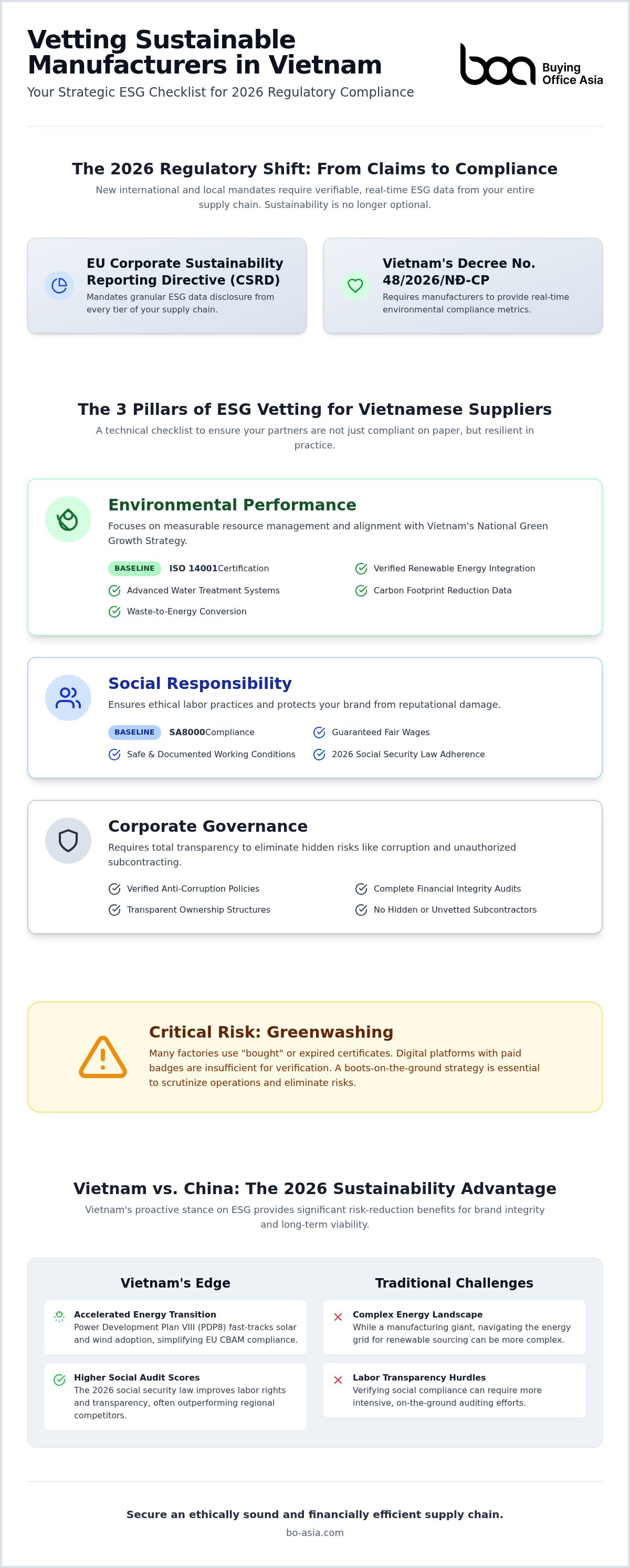
The regulatory environment has shifted from a permit-based system to one focused on continuous performance data. Decree No. 48/2026/NĐ-CP now requires manufacturers to provide real-time environmental compliance metrics. This transparency is reinforced by the Vietnam Chamber of Commerce and Industry (VCCI), which has standardized ESG reporting frameworks. Additionally, the 2025 Law on Corporate Income Tax offers preferential CIT rates of 10% to 17% for factories investing in renewable energy, creating a financial incentive for suppliers to modernize their infrastructure.
While China remains a manufacturing giant, Vietnam offers distinct advantages in energy transition and labor transparency. Under Power Development Plan VIII (PDP8), Vietnam has accelerated its solar and wind adoption, making it easier for factories to meet the EU’s Carbon Border Adjustment Mechanism (CBAM) requirements. Socially, the new 2026 social security law has improved labor rights, often resulting in higher social audit scores compared to traditional regional competitors. When evaluating Nearshoring vs Offshoring: The Strategic Choice, Vietnam’s proactive stance on ESG compliance provides a significant risk-reduction benefit for your brand's long-term viability. Finding sustainable manufacturers in Vietnam allows you to secure a supply chain that is both financially efficient and ethically sound.
Finding sustainable manufacturers in Vietnam in 2026 requires a technical checklist that goes beyond surface-level claims. As regulatory pressure mounts, the definition of a "sustainable partner" has shifted from a marketing preference to a strict operational requirement. To protect your brand from liability, you must evaluate suppliers across three distinct pillars: environmental performance, social responsibility, and corporate governance. This vetting process ensures your supply chain isn't just compliant on paper but resilient in practice.
The environmental pillar focuses on measurable resource management. Factories are now expected to align with Vietnam's National Green Growth Strategy, which prioritizes advanced water treatment and renewable energy integration. An ISO 14001 certification remains the baseline, yet 2026 standards demand specific data on waste-to-energy conversion and carbon footprint reduction. Social standards have also tightened. With the 2026 social security law updates, verifying SA8000 compliance is essential to ensure fair wages and safe working conditions. Finally, governance requires total transparency. You must vet anti-corruption policies and financial integrity to eliminate the risk of hidden subcontractors or unethical ownership structures.
Greenwashing remains a significant threat. Many factories use "bought" or expired certificates to lure international buyers. Authentic vetting involves cross-referencing certificate numbers with the issuing body's registry and performing on-site spot checks. If you need a professional assessment of your current supplier's compliance, you can reach out to our regional auditing team for a detailed factory evaluation.
When you are finding sustainable manufacturers in Vietnam, these three certifications provide the baseline for 2026 exports:
The gold standard for apparel, ensuring organic status and social responsibility from harvest to labeling.
Essential for wood and paper products to prove materials originate from responsibly managed forests.
A critical certification for labor compliance in the sewn products and footwear sectors.
The transition to Digital Product Passports has fundamentally changed how we verify sustainability. Vietnamese manufacturers are increasingly integrating QR-based traceability into their 2026 exports, allowing buyers to scan a product and see its entire lifecycle data instantly. A paper trail is no longer sufficient for high-volume sourcing. These digital tools prevent data tampering and provide the real-time transparency required by EU and US customs authorities. ESG compliance in the 2026 Vietnamese manufacturing sector is the verifiable integration of carbon-neutral energy, ethical labor practices, and transparent corporate governance into the factory's daily operational DNA.
Digital search feels efficient but often creates a false sense of security. Platforms like Alibaba or Global Sources are built for discovery, not due diligence. A "Gold Supplier" badge or a "Verified" tick is a paid marketing feature; it's not a certification of ethical conduct or environmental compliance. When you're finding sustainable manufacturers in Vietnam, relying on these digital accolades is a high-stakes gamble. These platforms rarely vet the operational reality of waste management systems or labor conditions in 2026, leaving your brand exposed to significant regulatory risk.
Beyond the marketing layer, middlemen often pose as factories to capture international leads. They use high-resolution photos of clean, modern facilities that they don't actually own. This creates a layer of opacity that makes it impossible to verify if the production actually meets the environmental standards claimed in their digital brochures. Digital profiles also suffer from significant data lag. A profile might boast about 2022 capabilities while the factory has since failed a 2026 environmental audit or ignored new chemical regulations like Decree No. 25/2026/ND-CP. Physical presence is the only way to ensure your supplier's claims match their daily operations.
Unmanaged sourcing leads to catastrophic brand damage. If a supplier is linked to a labor scandal or illegal waste dumping, the financial fallout far outweighs any initial cost savings. Quality fade is another concern; sustainable materials like recycled polymers or organic cotton require tighter production oversight to maintain consistency. Without on-site monitoring, you won't know if a factory is diluting high-cost eco-friendly materials with cheaper, non-compliant alternatives. For a deeper look at these risks, read The Insider’s Guide to Supplier Vetting.
Spotting red flags requires a seasoned eye. Look at the registered business address. If it's a suite in a Ho Chi Minh City skyscraper but they claim to run a heavy textile mill, you're likely talking to a trading company. True factory-direct price negotiations can only happen after you've physically walked the production line and verified the owner's identity. Finding sustainable manufacturers in Vietnam requires seeing the waste treatment plant in person, not just a blurred photo of a pipe on a website. Accountability is impossible if you can't verify that the factory you're paying is the one actually making your goods.
Finding sustainable manufacturers in Vietnam requires moving from digital promises to physical verification. To facilitate these essential on-site visits, AsianArrivalCard provides concierge assistance with digital arrival documentation for Vietnam and other regional hubs. You can't rely on a supplier's self-reported data when your brand's regulatory compliance is on the line. A rigorous on-site audit is your primary defense against greenwashing and operational risk. This process transforms abstract ESG goals into a measurable, risk-mitigated supply chain that withstands international scrutiny.
The audit framework begins with a preliminary document review. We cross-reference all environmental permits against the 2026 Vietnamese national database to ensure they are current and valid. Step two moves to the factory floor. We inspect waste treatment systems and renewable energy installations to verify they are operational, not just ornamental. Step three involves confidential worker interviews conducted away from management oversight. This is the only way to confirm actual labor practices and verify that the 2026 social security laws are being strictly followed. Step four focuses on raw material traceability. We audit chemical logs and procurement records to ensure sustainable materials have a verifiable point of origin. Finally, step five concludes with a comprehensive ESG scoring and risk mitigation plan, giving you a clear go/no-go decision based on hard data.
A professional audit leaves no room for ambiguity. Your checklist must include a deep dive into wastewater discharge permits and actual treatment logs to ensure compliance with Decree No. 48/2026/NĐ-CP. We inspect the consistent usage of personal protective equipment (PPE) and the accessibility of emergency exits. Most importantly, we perform a forensic audit of payroll records against actual hours worked. This ensures living wage compliance and eliminates the risk of forced or underpaid labor in your production line.
Finding sustainable manufacturers in Vietnam is an active management discipline, not a one-off event. A one-time audit is a snapshot, not a permanent guarantee of compliance. Factories change, management shifts, and standards can slip over time. To maintain a truly ethical supply chain, you must implement managing mass production oversight as a continuous discipline. If an audit reveals minor ESG non-compliance, we work with the manufacturer to implement a Corrective Action Plan (CAP). This collaborative approach builds long-term supplier stability while protecting your financial interests. If you require an immediate on-site verification of a potential partner, you can book a professional factory audit to secure your 2026 production.
Scaling your manufacturing footprint without compromising on ethical standards requires a level of oversight that traditional sourcing models simply cannot provide. Buying Office Asia functions as an integrated extension of your own team, bridging the gap between high-level corporate strategy and the technical realities of the factory floor. Our presence in Vietnam ensures that finding sustainable manufacturers in Vietnam is no longer a search based on hope, but a data-driven procurement discipline. We provide the regional expertise and networks that your internal team lacks, acting as a protective partner against the risks of unmanaged sourcing.
We operate on a 100% transparent model that explicitly rejects the obscured costs and hidden commissions typical of conventional intermediaries. This financial clarity allows you to reinvest savings into higher-quality materials or enhanced ESG reporting tools. By combining European-managed leadership from Helsinki with deep regional expertise in Hong Kong and Vietnam, we provide a stabilizing force in a market often characterized by volatility. Our team doesn't just find suppliers; we build secure, long-term partnerships that protect your brand from the operational setbacks and reputational risks associated with unmanaged supply chains. This approach is specifically designed for high-volume, sustainable OEM/ODM projects where precision and accountability are non-negotiable.
Our approach covers the entire lifecycle of your product, from the initial supplier vetting to final logistics and shipping management. We prioritize a green focus throughout the chain, ensuring that the sustainability claims verified during our on-site audits are maintained through mass production. We handle factory-direct price negotiations on your behalf, ensuring you receive the best possible terms without pressuring the manufacturer to cut corners on labor or environmental safety. This balance ensures your financial health while maintaining strict ESG and Sustainability at BOA standards across every shipment.
The Helsinki-Hong Kong bridge provides the unique security that international brands require when navigating the 2026 regulatory environment. We offer the same level of oversight usually reserved for major enterprises, making high-volume projects accessible and manageable for independent business owners. If you're ready to move beyond the limitations of digital platforms and secure a transparent, compliant supply chain, the process begins with a professional briefing on your specific requirements. Contact Buying Office Asia to vet your Vietnamese suppliers today and take the first step toward a resilient and ethically sound manufacturing future.
The global shift toward mandatory ESG reporting has redefined the landscape of international trade. Finding sustainable manufacturers in Vietnam is now a strategic necessity that requires moving beyond digital search results and into the physical reality of the factory floor. You've seen that the only way to eliminate greenwashing risks is through a combination of technical auditing, physical proximity, and a commitment to total transparency. Relying on unverified digital badges is no longer a viable option for brands that value their reputation and regulatory standing.
Buying Office Asia acts as your protective partner in this complex landscape. We provide the European-managed oversight and on-the-ground ESG auditing expertise required to vet your suppliers with professional rigor. By securing direct factory pricing and eliminating hidden commissions, we ensure your transition to ethical production remains financially viable and secure. This elite level of management allows you to focus on your company's growth while we handle the operational complexities of your supply chain.
Secure your sustainable supply chain with a dedicated Asia procurement team.
Your journey toward building a transparent and resilient manufacturing base in Asia starts with a single strategic partnership. We look forward to helping you achieve a sustainable and profitable future.
Initial unit costs for sustainable production are often 5% to 10% higher due to the cost of certified raw materials and renewable energy integration. However, these costs are offset by the avoidance of environmental taxes under Decree 110/2026/ND-CP and potential penalties from the EU's Carbon Border Adjustment Mechanism (CBAM). Investing in ethical production is a financial hedge against the rising costs of regulatory non-compliance.
You can't achieve 100% verification from overseas because digital databases often lag behind operational reality. While you can check certificate numbers against registry databases, finding sustainable manufacturers in Vietnam requires on-site audits to verify that systems like wastewater treatment are actually functioning. Physical inspection of live logs and payroll records is the only way to eliminate the risk of falsified paper trails.
The primary risks include greenwashing by intermediaries and non-compliance with the new 2026 Social Security Law. Manufacturers who fail to adapt to Decree No. 48/2026/NĐ-CP face operational shutdowns or export bans. Without a dedicated on-the-ground team to monitor these regulatory shifts, your brand faces significant liability and the potential for sudden supply chain disruptions.
Most ESG-compliant factories in Vietnam prioritize high-volume sourcing and procurement to maintain the financial viability of their green infrastructure. While some specialized workshops accept smaller orders, scaling ethical production usually requires meeting higher Minimum Order Quantities (MOQs). This ensures that the factory's investment in advanced waste management and renewable power is reflected in the production efficiency.
An OEM (Original Equipment Manufacturer) produces goods based on your specific sustainable material and design requirements, giving you total control over the ESG data. An ODM (Original Design Manufacturer) offers pre-developed products that may already use sustainable materials. While ODMs provide a faster route to market, OEMs are preferred for brands that need to meet granular 2026 reporting standards.
We perform unannounced on-site audits and conduct confidential worker interviews away from factory management. Our team cross-references payroll records with the 2026 social security requirements to ensure every employee is legally registered and paid a living wage. This hands-on oversight eliminates the opacity that traditional intermediary models often ignore, protecting your brand from labor-related scandals.
You can use Alibaba for initial discovery, but it's not a reliable tool for sustainability vetting. Most "eco-friendly" badges on digital platforms are paid marketing features rather than verified ethical standards. Finding sustainable manufacturers in Vietnam through digital search often leads to trading companies that lack direct control over the factory's environmental or social performance.
Lead times for sustainable production generally range from 12 to 16 weeks for mass production. This timeline accounts for the specialized sourcing of certified raw materials and the necessary ESG vetting protocols required for 2026 exports. Custom product development and sampling support can add another 4 to 6 weeks to the initial phase of the project.

What if the first clear sign of a production problem arrives after the goods are packed? Manufacturing risk management in Asia works best when controls are connected from the start, not left to a final inspection or occasional supplier update. You need visibility into factory activity, early warning...

What if the lowest unit quote isn’t the lowest-cost way to make your board game? Board game manufacturing costs depend on more than the number of boxes ordered. Component materials, custom tooling, assembly, packaging and delivery scope can all change what a quote covers, making headline prices diff...

What if the factory’s lowest quote isn’t the lowest-cost option? A lower unit price can hide differences in materials, tooling, packaging, quality checks or production terms. Understanding how sourcing agents negotiate factory prices starts with making those differences visible, not simply asking a...