

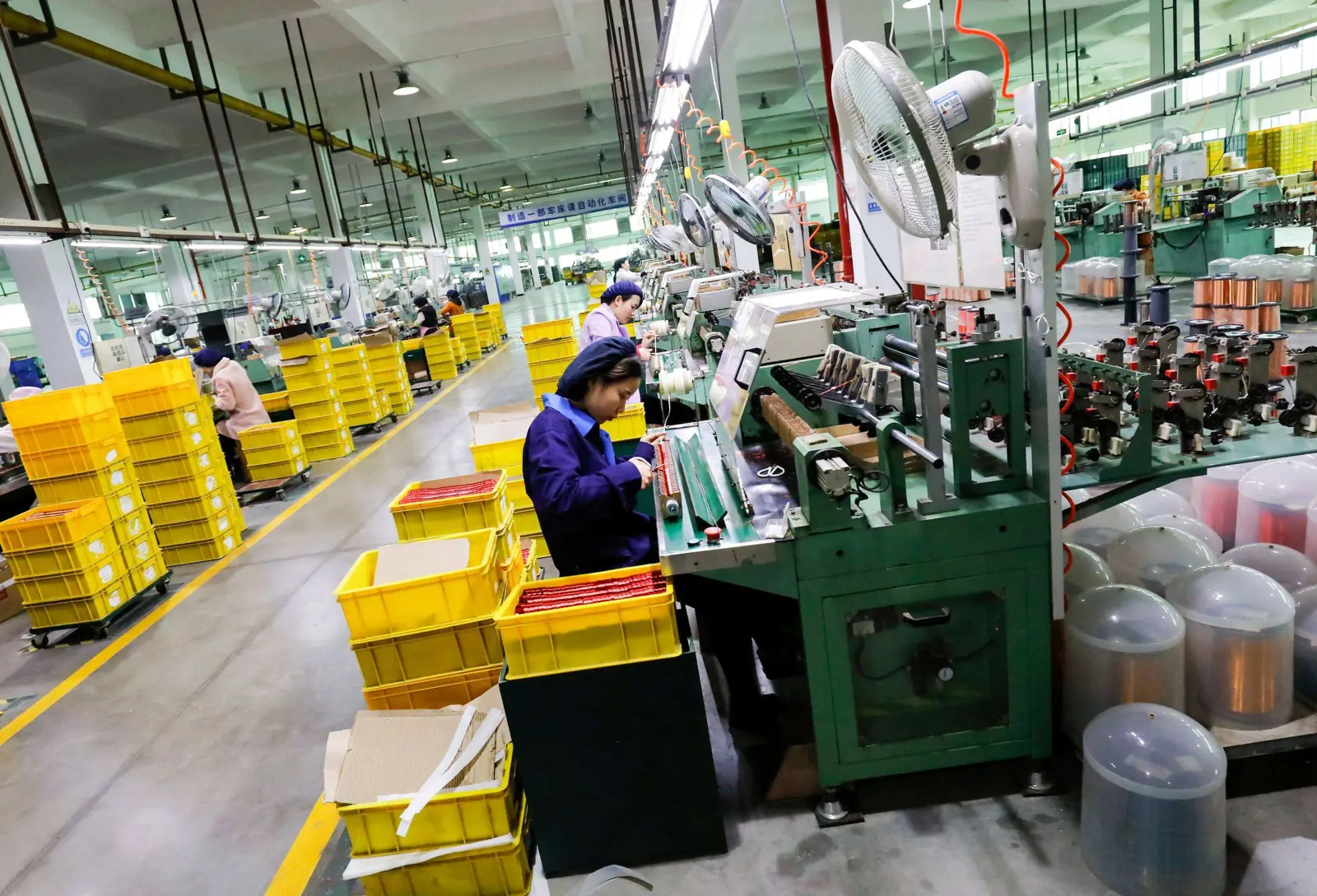
While 98% of companies now claim to embed ESG data into their procurement, only 18% actually have full end-to-end visibility into their supply chains. You likely recognize the growing pressure to ensure your operations are clean; yet, the distance between your office and a factory floor in Vietnam or India often creates a dangerous blind spot. It's difficult to manage shifting regional regulations like the 2026 SMETA 7.0 standards or India's Code on Wages from thousands of miles away, especially when you suspect a middleman is filtering the truth. Navigating ethical sourcing in Asia requires more than just trust; it requires a strategy rooted in physical oversight and regional expertise.
This guide will show you how to close that transparency gap and turn your supply chain into a measurable competitive advantage that protects your brand from reputational disasters. We'll break down the latest 2026 regulatory shifts, the current costs of rigorous factory audits, and a roadmap for building a supply chain that's as profitable as it is principled. You'll learn to move beyond unverified paperwork and establish the steady, on-the-ground control necessary for long-term financial health.
• Understand how the 2026 regulatory landscape, including the EU’s CSDDD, has shifted ethical standards from voluntary goals to mandatory legal requirements.
• Identify the core pillars of labor rights and environmental stewardship that are essential for maintaining a compliant and sustainable supply chain.
• Discover why traditional middlemen often obscure factory conditions and why it’s vital to have a dedicated presence for ethical sourcing in Asia.
• Master a practical vetting framework that utilizes both preliminary documentation checks and rigorous on-site audits to verify supplier integrity.
• Learn to implement a defensive procurement strategy that doesn’t leave your brand’s reputation or financial health to chance.
Ethical sourcing in Asia is the process of ensuring your products are manufactured under safe, fair, and environmentally sustainable conditions. In the competitive markets of 2026, this isn't a philanthropic gesture; it's a core requirement for business continuity. The regulatory environment has tightened significantly, with the EU’s Corporate Sustainability Due Diligence Directive (CSDDD) now making supply chain transparency a legal mandate for many enterprises. If you fail to vet your partners, you aren't just risking a fine. You're risking a total operational collapse. Ethical sourcing is a dual commitment to human rights and operational stability that protects your bottom line from unforeseen shocks.
Failure to prioritize ethical sourcing in Asia leads to more than just legal headaches. When a supplier is flagged for environmental violations or labor abuses, the resulting factory closures and shipment seizures create immediate, costly disruptions. You lose your inventory, your lead times explode, and your customers lose faith in your ability to deliver. In an era where supply chain resilience is the primary driver of profitability, leaving your ethics to chance is a high-stakes gamble you don't need to take.
The era of vague Corporate Social Responsibility reports is over. It has been replaced by Environmental, Social, and Governance (ESG) compliance, which demands hard data and verifiable metrics. Stakeholders now expect you to prove adherence to standards like the Ethical Trading Initiative principles through real-time reporting and physical audits. This shift benefits you directly. By insisting on ESG transparency, you reduce worker turnover and minimize quality defects caused by poor working conditions. A stable, fairly treated workforce is a reliable workforce. This translates directly into higher production efficiency and more predictable margins for your business.
In a digital world, your supply chain is only as strong as its most hidden link. High-profile scandals involving unvetted suppliers have demonstrated that "I didn't know" is no longer an acceptable defense for executives. Today’s consumer culture is quick to penalize brands for perceived ethical lapses, making transparency a survival necessity. You need a defense against the reputational damage that stems from hidden labor violations or environmental neglect. Establishing a clear, audited pathway for your goods ensures that your brand remains a symbol of integrity rather than a target for public scrutiny. Learn how we manage ESG at Buying Office Asia to provide the rigorous oversight your brand requires.
To achieve ethical sourcing in Asia, your strategy must rest on three non-negotiable pillars: labor rights, environmental stewardship, and business integrity. These aren't isolated silos. They function as a defensive perimeter for your production. When a factory invests in safe conditions and fair wages, worker turnover drops, which stabilizes your quality. When they manage waste properly, they avoid the sudden regulatory shutdowns that plague unmanaged supply chains. By eliminating the bribery and "kickbacks" common in traditional middleman models, you gain the financial transparency needed to reinvest in these standards without inflating your landed costs.
These pillars interact to create a resilient, high-volume production environment. A factory that respects its workers and the environment is inherently more organized and better managed. This operational maturity reduces the risk of mass production errors and shipping delays. By prioritizing these standards, you aren't just doing the right thing; you're building a supply chain that can withstand the scrutiny of the 2026 market.
Healthy factories are identified by low turnover and rigorous safety protocols. In 2026, navigating wages is complex. For instance, Cambodia's minimum wage for the garment sector rose to $210 per month, while Bangladesh stands at BDT 12,500. You must look beyond these baselines toward living wages to ensure long-term supplier reliability. On-site inspections remain the only way to verify that "decent work" claims match reality on the factory floor. Paperwork can be falsified; the physical presence of an audit team cannot. For organizations planning the necessary travel for these inspections, Brothers International Tours & Trading Pte Ltd offers expert logistical support for business trips throughout the region.
True stewardship involves active chemical management and advanced water treatment facilities. Many industrial zones in Vietnam and China are aggressively transitioning toward renewable energy to meet international demands and local carbon reduction targets. Adhering to OECD standards on responsible business conduct ensures your partners aren't just following local laws, but meeting the global expectations of your stakeholders. Vetting for ISO 14001 standards is a baseline, but we go deeper by auditing actual resource consumption and waste disposal practices. Review our approach to supplier management and development to see how we integrate these environmental metrics into our core procurement process.
Business integrity is the final piece. It’s about removing the "middleman markup" that often funds unethical shortcuts. Transparency ensures that every dollar you spend on production actually reaches the factory floor and the workers, rather than being siphoned off by unverified agents. This level of oversight turns a vulnerable supply chain into a resilient asset. If you're concerned about hidden risks in your current network, speak with our team about establishing a more secure foundation.
The distance between your headquarters and an Asian production line is often filled by intermediaries who promise ease but deliver opacity. These traditional agents frequently operate on a commission-based model that prioritizes the transaction over the truth. When an agent relies on hidden "kickbacks" from a factory, their loyalty is divided. This conflict of interest is the primary reason why 100% transparency is impossible through a conventional middleman. To achieve genuine ethical sourcing in Asia, you must bridge this gap with direct oversight that places your interests first.
Our "Helsinki-Hong Kong" bridge solves this by combining European management standards with a physical presence in the region. By having leadership in Finland and a dedicated team on the ground in Hong Kong, we ensure Western ethical expectations are met without being lost in translation. This model replaces the transactional nature of an agent with the steady accountability of a partner who functions as an integrated extension of your own team. You gain a protective layer that traditional intermediaries simply aren't structured to provide.
This protective layer and regional expertise are just as crucial when planning your own visits to the area. For professionals who want to experience the Indonesian archipelago with the same level of precision and luxury they apply to their business, Indonesia en tus Manos offers expert guidance for bespoke travel in 2026.
Middlemen often lose control of the production chain, leading to the use of "shadow factories" or unauthorized sub-contracting. When an agent isn't physically present to verify production, factories may outsource orders to smaller, unvetted facilities to meet tight deadlines. These shadow factories are where the most severe labor and environmental violations occur. Because the agent's income depends on the shipment leaving the port, they have a massive financial incentive to ignore these red flags. Why Buying Office Asia eliminates the middleman is a core part of our philosophy; it removes the financial incentives that lead to obscured ESG data and hidden risks.
A dedicated procurement team provides real-time data that a third-party agent cannot match. You receive unedited photos from the factory floor and raw compliance data rather than sanitized reports prepared at an office desk. This direct link allows you to include specific ethical requirements in your contracts that are both legally binding and physically verified. The ROI of a Dedicated Asia Procurement Team becomes clear when you calculate the cost of a single reputational scandal or a seized shipment. Direct oversight isn't just an ethical choice; it's a strategic financial defense mechanism that ensures your ethical sourcing in Asia remains authentic and profitable.
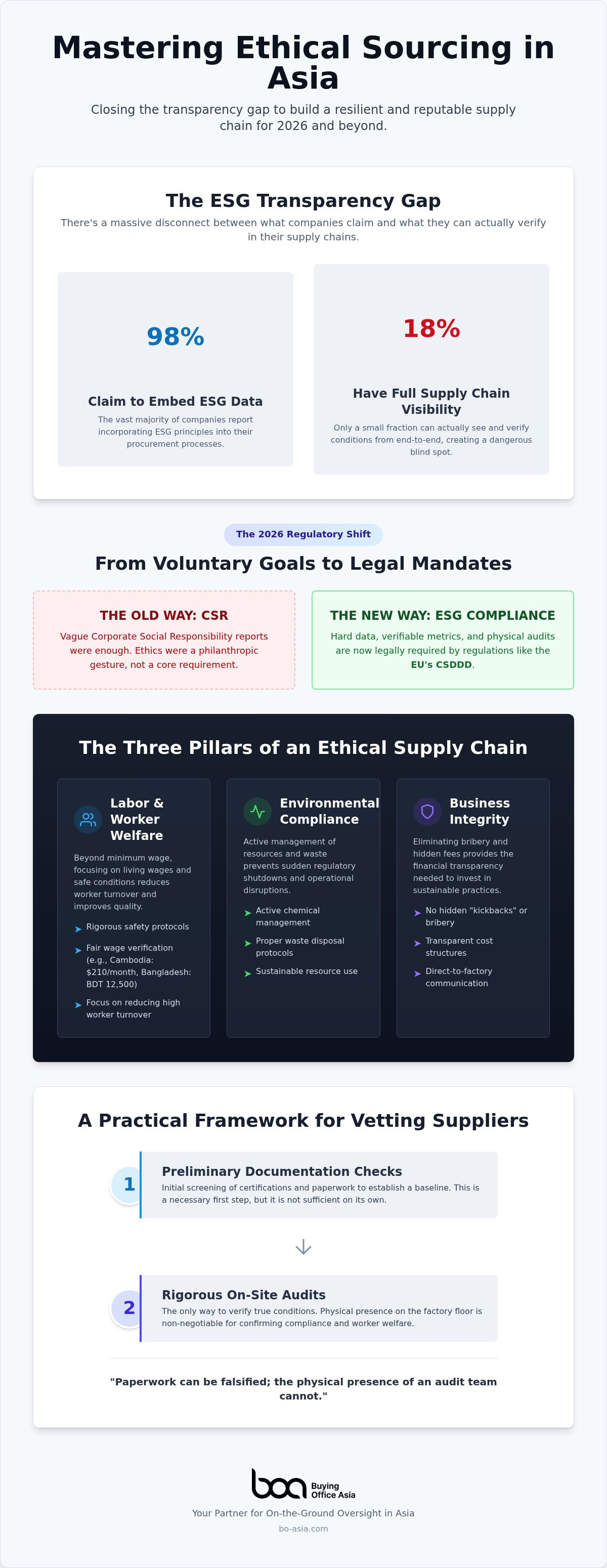
Paperwork is the most easily manipulated element of international trade. Relying solely on digital certificates leaves your brand vulnerable to hidden risks that a computer screen cannot detect. Robust ethical sourcing in Asia requires a transition from passive document collection to active, physical verification. This framework ensures that your suppliers are as compliant in practice as they are on paper, protecting your business from the "transparency gap" that often leads to reputational damage.
The vetting process follows four critical stages designed to build a defensive shield around your procurement:
You begin by verifying business licenses and researching historical compliance records to identify past red flags, environmental fines, or legal disputes.
This involves a physical walkthrough to inspect safety exits, dormitory conditions, and the actual functioning of waste management systems. We look for evidence of real-world application, not just "audit-day" preparation.
We cross-reference payroll records with anonymous worker interviews. This is the only reliable way to spot "ghost employees" or the double-bookkeeping frequently used to hide excessive overtime or wage theft.
One-off audits are insufficient for high-volume mass production. Ethical standards can drift during peak seasons, making ongoing oversight a necessity for maintaining your brand’s integrity throughout the year.
While certifications like BSCI (Business Social Compliance Initiative), SMETA (Sedex Members Ethical Trade Audit), and ISO standards provide a useful baseline, they're often treated as "check-box" exercises by factories. A "pass" on a SMETA audit only reflects the conditions on the day of the inspection. It doesn't account for the unauthorized sub-contracting that might happen during a peak production rush two months later. You should view these acronyms as a starting point, not a guarantee of total safety. For a deeper look at these mechanics, read The Insider’s Guide to Supplier Vetting in Asia.
Your quality control inspectors are your most effective ethical scouts. Because they're on the factory floor during mass production oversight, they can perform "pulse checks" that a scheduled auditor might miss. They're trained to spot red flags such as blocked fire escapes, unlabeled hazardous chemicals, or the presence of workers who don't appear in the official registry. This integrated approach ensures that quality and ethics are managed as a single, cohesive standard. If you want to move beyond "paper-only" compliance and secure your production with physical oversight, get in touch with our team today.
Implementing a strategy for ethical sourcing in Asia requires a partner who operates as a defensive extension of your own team. At Buying Office Asia (BOA), we replace the uncertainty of unmanaged supply chains with a results-oriented framework focused on risk mitigation and long-term reliability. Our model is built on the steady confidence of European leadership, directed from our headquarters in Finland, combined with the immediate accountability of our on-the-ground presence in Hong Kong. This dual-regional structure ensures that your Western ethical standards are never compromised by local operational pressures.
Moving from a transactional sourcing model to a strategic partnership allows you to focus on growth while we manage the complexities of the factory floor. We don't just facilitate a connection; we build a defense against the operational setbacks and brand risks that affect unmanaged procurement networks. By establishing direct-to-factory relationships and handling rigorous negotiations, we ensure your production is anchored in a compliant, stable, and financially viable environment.
Our 100% transparency model is designed to eliminate the obscured costs and inefficiencies inherent in traditional intermediary models. You deserve to know the exact factory where your goods are produced, the true cost of materials, and the specific conditions of the workforce. This level of visibility is particularly critical during complex product and tooling development, where ethical shortcuts can lead to significant quality defects or legal liabilities. By removing the middleman, we provide you with the raw data and physical oversight necessary to satisfy both your stakeholders and global regulators. Explore our sourcing and procurement services to see how we integrate transparency into every stage of the process.
Scaling your manufacturing from a single prototype to high-volume mass production is the point where ethical drift most frequently occurs. We provide the continuous oversight required to ensure that the standards verified during your initial audit are maintained throughout the entire production cycle. This protective layer extends to our logistics and shipping management, ensuring that your goods are handled by compliant partners from the moment they leave the factory floor until they reach your warehouse. We provide the elite level of oversight usually reserved for major enterprises, tailored to the specific needs of independent business owners. Contact Buying Office Asia for a transparent procurement strategy and secure your brand's future in the 2026 market.
The regulatory shifts of 2026 have transformed supply chain transparency into a mandatory legal requirement. You've seen how physical oversight and direct factory relationships dismantle the risks hidden by traditional middlemen. By prioritizing labor rights and environmental stewardship, you aren't just complying with standards like SMETA 7.0; you're building a resilient asset that drives long-term profitability. Implementing ethical sourcing in Asia remains your most effective defense against the operational setbacks that threaten unmanaged procurement networks.
Buying Office Asia provides the steady confidence of a European-managed firm, led from Helsinki, with the real-time accountability of an on-the-ground presence in Hong Kong. We eliminate the inefficiencies of intermediaries to deliver 100% transparency and factory-direct pricing. It's time to move away from unverified paperwork and establish a supply chain rooted in physical reality. Secure your brand's future with transparent sourcing from Buying Office Asia. Your journey toward a more secure and principled manufacturing operation starts with a single strategic decision today.
The most frequent risks include unauthorized subcontracting, excessive overtime, and inadequate hazardous waste management. Unauthorized subcontracting is particularly dangerous because your production moves to unvetted "shadow factories" where you have zero control or visibility. These lapses often lead to shipment seizures or sudden factory closures by local authorities. Physical, on-site oversight is the only reliable way to ensure your orders stay in the audited facility.
You must verify the audit's unique reference number directly within the amfori or Sedex digital databases. Don't rely on a PDF or printed certificate provided by the factory; these are easily altered to hide expired dates or poor scores. Authentic audits also include a detailed photographic record and a list of specific corrective actions. Digital verification ensures you're reviewing the most current, unedited compliance data available.
Ethical practices reduce manufacturing costs by stabilizing your production environment and lowering worker turnover. Factories with fair labor standards experience fewer disruptions, which directly reduces training costs and quality defects. Additionally, compliant factories are less likely to face sudden regulatory shutdowns or environmental fines. This operational stability leads to more predictable lead times and protects your bottom line from the expenses of emergency resourcing.
A sourcing agent is a third-party intermediary who often relies on commissions and hidden kickbacks from the factory. In contrast, a dedicated procurement team functions as an integrated extension of your own company. This team provides real-time reporting and direct-to-factory negotiations without the divided loyalties that characterize the middleman model. You gain the security of an internal office with the regional expertise of a local partner.
The CSDDD requires you to identify and mitigate human rights and environmental risks across your entire supply chain. It moves ethical sourcing in Asia from a voluntary commitment to a mandatory legal obligation for 2026 and beyond. If your Asian suppliers fail to meet these standards, your business could face heavy fines or exclusion from the EU market. Proactive due diligence is now a prerequisite for legal and financial security.
You should issue a Corrective Action Plan (CAP) that outlines specific improvements and strict deadlines for compliance. For minor infractions, working with the supplier to improve standards builds a more loyal and reliable partnership. However, zero-tolerance violations such as forced labor require an immediate termination of the relationship. Maintaining a list of vetted backup suppliers allows you to transition production without suffering a total operational collapse.
You should conduct on-site inspections at least once per quarter to ensure standards don't drift between major audits. It's also vital to perform "pulse checks" during mass production cycles when factories are under the most pressure to cut corners. Using your quality control team to monitor safety exits and worker conditions during their routine visits provides a continuous layer of defense that annual audits cannot match.
Achieving 100% transparency is possible only if you maintain a direct relationship with the factory and eliminate intermediaries. By removing the middleman, you gain access to unedited payroll records, raw material costs, and real-time production data. This direct link is the only way to ensure your ethical sourcing in Asia is supported by physical reality rather than sanitized reports. It turns your supply chain into a verifiable asset.

What if the first clear sign of a production problem arrives after the goods are packed? Manufacturing risk management in Asia works best when controls are connected from the start, not left to a final inspection or occasional supplier update. You need visibility into factory activity, early warning...

What if the lowest unit quote isn’t the lowest-cost way to make your board game? Board game manufacturing costs depend on more than the number of boxes ordered. Component materials, custom tooling, assembly, packaging and delivery scope can all change what a quote covers, making headline prices diff...

What if the factory’s lowest quote isn’t the lowest-cost option? A lower unit price can hide differences in materials, tooling, packaging, quality checks or production terms. Understanding how sourcing agents negotiate factory prices starts with making those differences visible, not simply asking a...