


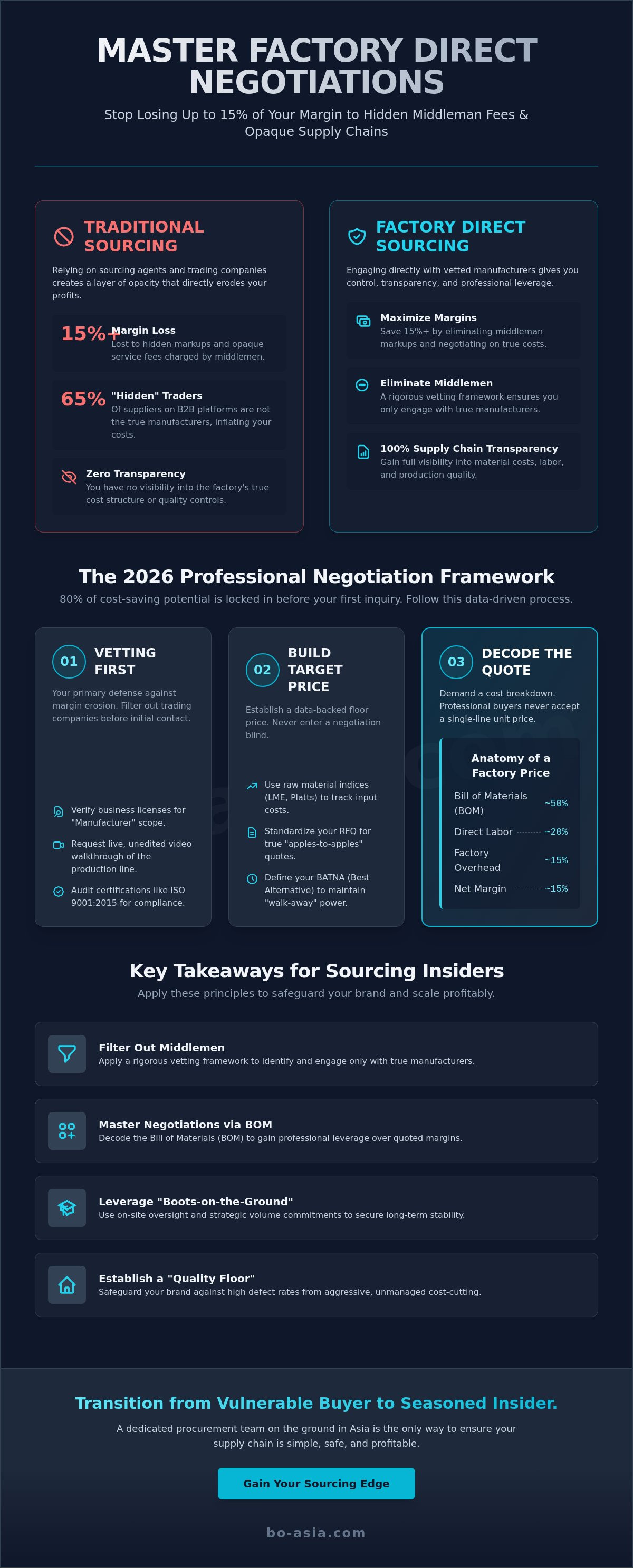
If you're still relying on traditional sourcing agents in 2025, you're likely losing up to 15% of your margin to hidden markups and opaque middleman fees. Most brand owners understand that direct factory access is the only way to scale, yet the fear of a price-quality death spiral often keeps them tethered to expensive trading companies. You shouldn't have to choose between your bottom line and your brand's reputation.
This guide provides the professional framework you need to master factory direct price negotiations, ensuring you secure the lowest possible unit costs without sacrificing the integrity of your production line. We'll show you how to stop leaving money on the table by leveraging local cost-benchmarking data and on-site oversight. You'll learn the 2026 checklist for local cost-benchmarking, communication strategies that bypass language barriers, and the exact steps to achieve 100% supply chain transparency. It's time to transition from a vulnerable buyer to a seasoned insider with a dedicated sourcing team on the ground.
• Identify true manufacturers and eliminate opaque middlemen by applying a rigorous vetting framework before initial contact.
• Master the art of factory direct price negotiations by decoding the Bill of Materials (BOM) to gain professional leverage over quoted margins.
• Leverage "boots-on-the-ground" tactics and strategic volume commitments to secure long-term stability and immediate price reductions.
• Establish a non-negotiable "Quality Floor" to safeguard your brand against the high defect rates associated with aggressive cost-cutting.
• Scale your operations efficiently by transitioning from DIY sourcing to a dedicated procurement team that ensures safety and profitability.
Successful factory direct price negotiations don't start with a handshake or a video call. They begin weeks earlier in a spreadsheet. In the complex Asian manufacturing landscape of 2026, 80% of your cost-saving potential is locked in before you send your first inquiry. If you enter a discussion without a data-backed floor price, you've already lost your leverage. You aren't just buying a product; you're buying production capacity and efficiency. To secure the best margins, you must eliminate the opaque middlemen who mask true costs with service fees. This requires a firm grasp of negotiation strategies that prioritize hard data over intuition.
Preparation is your shield against the "reputational damage" and "hidden costs" that plague unmanaged supply chains. When you approach a factory with a precise understanding of their overhead, material costs, and regional benchmarks, the dynamic shifts. You move from being a "customer" to a "professional partner." This level of preparation signals to the manufacturer that you're a seasoned insider who won't accept arbitrary price hikes. It's the only way to ensure your procurement remains simple, safe, and profitable.
The "Vetting First" rule is your primary defense against margin erosion. You can't get factory-direct pricing from a trading company. These entities often add 15% to 30% in hidden markups while claiming to be the source. In 2026, approximately 65% of entities on major B2B platforms are still "hidden" trading companies. You must verify business licenses against the National Enterprise Credit Information Publicity System (NECIPS) or equivalent local databases. Look specifically for a "Manufacturer" scope in their official business license. A true factory-direct signal is technical depth. If a contact can't explain the machine cycle times or the specific grade of alloy used in the casting, they're likely a middleman. For a deep-dive into these verification steps, read our guide on Supplier Vetting in Asia.
Use this 2026 checklist for every new prospect:
Ensure the license is held by the factory entity, not a separate export agent.
Request a live, unedited video walkthrough of the production line.
Review ISO 9001:2015 or IATF 16949 certifications to confirm manufacturing compliance.
You can't negotiate effectively without a fair market benchmark. Use raw material indices like the London Metal Exchange (LME) for metals or the S&P Global Platts for plastics to track input fluctuations. If resin prices dropped 12% in Q3 2025, your 2026 factory direct price negotiations should reflect that delta. Standardize your RFQ (Request for Quotation) to ensure every vendor bids on the exact same material grade, weight, and packaging spec. This "apples-to-apples" approach prevents factories from hiding margins in inferior sub-components.
Finally, define your Best Alternative to a Negotiated Agreement (BATNA). In the Asian market, supply chain shifts are constant. If a factory realizes they're your only option, your negotiation power vanishes. Always maintain a "Plan B" with a vetted alternative in a different region, such as Vietnam or Thailand. This gives you the "walk-away" power necessary to keep primary vendors honest. Set your target prices based on volume tiers and seasonality; for instance, avoid locking in new contracts during the peak shipping months of October and November when factory capacity is at its tightest.
Professional buyers don't accept a single-line unit price. Relying on a flat quote leaves you blind to where your money actually goes. To master factory direct price negotiations, you must strip the quote down to its raw components. Most Asian manufacturers calculate their offers based on a combination of the Bill of Materials (BOM), direct labor, factory overhead, and a net margin. When you see a "unit price," you're looking at a finished puzzle; your job is to take it apart to see which pieces are oversized.
The BOM is your most powerful diagnostic tool. You must demand a detailed breakdown of every component, from raw substrate to the smallest screw. Cost Engineering is the process of optimizing production steps to reduce price. Beyond materials, you need to account for factory utilization rates. A facility running at 65% capacity has higher fixed costs per unit than one running at 92%. By timing your production runs during a factory's "shoulder season," you can often secure a 5% to 8% discount simply by helping them maintain a steady workflow.
Traditional sourcing agents often obscure these details to protect their "hidden margins." They act as a black box, marking up the factory's price before it reaches you. A transparent procurement model removes this layer of fog. It allows you to see the actual factory floor costs, ensuring your factory direct price negotiations are based on reality rather than an agent's commission goals. This clarity transforms the relationship from a zero-sum game into a strategic partnership.
Haggling is for tourists; professional procurement relies on data. One of the most common areas for savings is challenging material waste assumptions. Many factories include a 10% to 15% "buffer" for scrap and defects in their initial quotes. By conducting a cost-benefit analysis of the production line, you can often identify technical improvements that reduce this waste to under 4%. This creates a permanent price reduction without squeezing the factory's actual profit margin.
For long-term partnerships, aim for "Open Book" pricing. This involves an agreement where the factory shares its internal cost changes in exchange for guaranteed volumes. It builds a protective shield around your supply chain, preventing sudden price spikes when commodity costs fluctuate. You can see how these strategies translate into bottom-line results by reviewing our Pricing and Savings Examples. If you want to stop overpaying for hidden inefficiencies, you can connect with our local team to audit your current quotes.
Success in factory direct price negotiations for the 2026 cycle requires moving beyond simple bidding wars. You must offer the factory stability to extract the lowest possible unit cost. The "Volume Commitment" strategy involves trading a guaranteed 12-month forecast for an immediate price floor. By securing production slots during the factory's off-peak months, you reduce their overhead and justify a 5% to 7% reduction in price. This creates a partnership based on predictable revenue rather than spot-market volatility.
Physical presence remains your strongest leverage. Remote negotiations are inherently limited; they lack the nuance of a factory floor walkthrough. Our "Boots-on-the-Ground" approach changes the dynamic instantly. When a supplier sees a local representative, the "foreigner tax" often disappears. This physical oversight frequently reveals that a factory is over-quoting on raw material waste, a common tactic that inflates costs by 10% or more. We call this the "Helsinki-Hong Kong Bridge." It anchors your negotiations in European leadership and standards while executing with local Asian expertise through your dedicated sourcing team.
Timing is the final piece of the 2026 puzzle. With the Lunar New Year starting on February 17, 2026, the window for negotiation closes rapidly in late 2025. Aim to finalize terms by April or May 2026 for the following peak season. This timing allows you to negotiate when the factory is hungry for orders, rather than when they're overwhelmed by the Q4 rush and less likely to budge on price.
Respecting "Mianzi" (Face) is a functional business tool, not just a cultural courtesy. If you force a factory manager to lose face by demanding impossible concessions in front of their staff, the relationship will sour. Instead, use "The Walk-away" professionally. State your requirements clearly and be prepared to exit the deal if the numbers don't align. This isn't a bluff; it's a demonstration of your firm's professional standards. To protect your margins, you must also manage "Incrementalism." Suppliers often try to add small surcharges for packaging or expedited handling. Reject these 1% to 2% creeps early to maintain your negotiated price floor.
Price isn't just the unit cost; it's the total landed cost. Negotiating between FOB (Free on Board) and EXW (Ex Works) can reveal hidden logistics margins that opaque middlemen often pocket. For a deep dive into these definitions, see Mastering Sourcing and Procurement in Asia. Additionally, use payment terms as a negotiation lever. Moving from a standard 30/70 split to a 20/80 or even 0/100 structure based on quality inspection milestones can be more valuable than a 2% price cut. It shifts the financial risk back to the manufacturer and ensures they remain committed to your quality standards until the final container is sealed.
Aggressive factory direct price negotiations often lead to a hidden trap known as the "Price-Quality Death Spiral." When a factory's margin is squeezed below its operational threshold, they rarely absorb the loss. Instead, they recover their margins by substituting cheaper raw materials or reducing the number of quality check stations on the assembly line. This creates a dangerous correlation where the lowest bid frequently yields the highest defect rate. You must establish a "Quality Floor," a set of non-negotiable standards that remain fixed regardless of how low the unit price goes.
Protect your investment by embedding contractual "Clawbacks" into your purchase agreements. If the defect rate exceeds a pre-agreed limit, such as an AQL (Acceptable Quality Level) of 1.5 for major defects, the factory should be contractually liable for the cost of the goods, international shipping, and disposal fees. This financial penalty ensures the supplier remains incentivized to prioritize precision over speed. Without these safeguards, a 5% saving on unit price can easily be wiped out by a 10% failure rate at your distribution center.
Precision begins with an "Unambiguous Spec Sheet." Vague terms like "high quality" or "industry standard" are useless during a dispute. You need to list specific material grades, exact tolerances, and weight requirements. Every negotiation must be anchored to a "Golden Sample." This physical prototype represents the exact output you expect from the production line. This approved sample serves as the definitive legal benchmark for mass production quality and is used to resolve any disputes regarding finish or functionality.
Buying factory direct requires a physical presence on the factory floor. Remote management is a recipe for expensive errors and "material creeping," where a factory slowly degrades component quality over several orders. You should link your payment schedule to successful QC milestones. For example, release the final 70% of the balance only after an on-site pre-shipment inspection confirms that the batch meets every specification. This approach transforms quality control from a hurdle into a price protector. To manage complex production cycles effectively, professional OEM/ODM contract manufacturing requires dedicated on-site oversight to prevent material substitution at the source.
Managing a handful of vendors is manageable for a small team. Coordinating 50+ suppliers across different time zones is a massive operational burden that drains your internal resources. DIY factory direct price negotiations often fail at high volumes because the buyer lacks the real-time data needed to challenge rising material costs or labor shifts. Without a physical presence, you're reacting to information rather than controlling it. This lack of oversight leads to "bracket creep" where prices rise incrementally without a clear justification.
Professional procurement turns a cost center into a profit driver. While traditional agents often hide their 10% to 15% margins within the unit price, Buying Office Asia operates on a transparent fee model. You see the raw factory invoice. This shift from a transactional buyer to a strategic partner allows you to reinvest recovered margins into product development. By eliminating the "Middleman Margin," you gain 100% visibility into your spend. It's the difference between being a customer and being a stakeholder in the factory's production schedule.
We bridge the gap between European management standards and local execution. Our Helsinki headquarters ensures your contracts meet Western legal expectations, while our Hong Kong team handles the boots-on-the-ground reality. This structure grants you access to "Tier 1" factories. These facilities produce for global brands and rarely list on public B2B platforms. Since 2023, supply chain transparency laws have tightened significantly. We prioritize ESG and compliance to ensure your low price doesn't result in reputational damage or legal fines.
Your journey toward better factory direct price negotiations begins with a "Savings Audit" on your current supply chain. We typically identify 12% to 18% in avoidable costs during the first 90 days of engagement. Our "No Hidden Margins" promise is the foundation of our partnership. Unlike traditional agents who profit from your lack of information, we profit from your efficiency. This approach makes your procurement process simple, safe and profitable. It’s time to move past the uncertainty of remote sourcing and secure your margins with a partner who is actually on-site.
Success in factory direct price negotiations requires more than just a spreadsheet; it demands a physical presence on the factory floor and a technical grasp of raw material costs. By implementing a professional pre-negotiation checklist and decoding factory cost structures, you eliminate the guesswork that often leads to production delays. You've now seen how a dedicated procurement team prevents the price-quality death spiral that destroys growing brands. Our European management team based in Hong Kong provides the on-site oversight necessary to keep your supply chain resilient and transparent.
Buying Office Asia acts as your seasoned insider, replacing opaque middlemen with a 100% Transparency Guarantee. We've delivered a 15-30% cost reduction for wholesalers by optimizing logistics and negotiating directly with vetted manufacturers. You don't have to navigate the complexities of Asian manufacturing alone. Let us handle the boots-on-the-ground rigor while you focus on scaling your business. It's time to ensure your global trade is simple, safe, and profitable.
Get a Factory-Direct Price Audit from Buying Office Asia
Yes, you can negotiate pricing on custom OEM builds by focusing on the Bill of Materials (BOM) and specific manufacturing processes. Factories often build a 10% to 15% buffer into initial custom quotes to account for engineering unknowns. By providing detailed technical drawings and specifying exact materials, you eliminate their risk and justify a lower unit cost. This transparency ensures you aren't overpaying for perceived complexity that doesn't exist in the actual production cycle.
Most Asian factories include a 5% to 10% margin for negotiation in their first offer. This buffer isn't a gift; it's a standard protection against fluctuating raw material costs or small initial order volumes. When you engage in factory direct price negotiations, you should aim to reduce this margin by offering faster payment terms or larger volume commitments. Our on-site audits show that factories prioritize stable partners over those chasing the absolute lowest, unsustainable price.
Negotiating a price below the factory's break-even point leads to "quality fade," where the supplier swaps specified components for cheaper alternatives. According to the 2023 Quality Control Industry Report, sub-standard material substitutions account for 35% of production failures in low-margin deals. You risk your brand's reputation and face significant delays. A profitable factory is a reliable factory. We focus on securing a fair price that maintains your margins without compromising product integrity.
Traditional sourcing agents often hide a 3% to 7% markup within the unit price, making your "direct" deal more expensive. You're better off with a dedicated sourcing team that charges a transparent fee rather than an opaque middleman taking kickbacks. This approach ensures every cent you negotiate goes toward product quality or your bottom line. We provide the local presence you need to secure factory-floor pricing without the hidden costs associated with old-school agency models.
You handle increases by including a Price Adjustment Formula in your initial contract based on public indexes like the London Metal Exchange (LME). If raw material costs rise by more than 5%, a pre-negotiated price shift occurs. This prevents sudden 20% price hikes that disrupt your supply chain. It's a professional way to manage volatility while protecting your profit margins. Having on-site representation allows you to verify if these market shifts actually affect the factory's current inventory.
Factories frequently add extra charges for export packaging, palletization, or inland trucking to the port after the unit price is set. These costs can inflate a final invoice by 2% to 4% if they aren't disclosed upfront. You must demand an "All-In" FOB (Free On Board) quote during your factory direct price negotiations to avoid these surprises. Clear documentation prevents the factory from clawing back their margins through administrative or logistical surcharges during the shipping phase.
Volume tiered pricing uses specific quantity milestones to trigger lower unit costs as the factory achieves better economies of scale. For example, a 3% discount might trigger at 5,000 units, while a 7% reduction applies at 10,000 units. This structure rewards your growth and provides the factory with predictable production schedules. It's a win-win that moves you away from transactional buying and toward a strategic partnership. We help you map these tiers based on actual machine capacity.
You can handle preliminary quotes via email, but final price breakthroughs usually happen during on-site inspections. Being physically present at the factory shows you're a serious buyer and allows you to see the real production costs. Data from our 2024 procurement audits indicates that on-site negotiations yield 4% to 6% better results than remote communication alone. It's about building trust and removing the faceless element of global trade to secure a safe, profitable deal.

If your current sourcing agent claims their services are free, you're likely paying a hidden tax of 10% to 30% through inflated unit prices and factory kickbacks. This lack of transparency doesn't just erode your margins; it creates a dangerous barrier between you and the factory floor. Finding a re...

A perfect golden sample is often the most dangerous document in your supply chain. If a prototype is handcrafted by a master technician rather than built using scalable factory processes, your sample development phase isn't a success; it's a liability. This gap between a one-off masterpiece and a hi...

Scaling production to millions of units isn't a purchasing task; it's a high-stakes risk management discipline where a single percent of quality fade can liquidate your annual margin. You likely understand that the leap from mid-scale orders to massive procurement runs often exposes cracks in even t...