


In 2023, 40% of global firms reported significant disruptions due to over-extended supply chains, proving that the cheapest labor often carries the highest hidden price. You're right to be wary of opaque supply chains and the hidden margins that traditional agents often bury in their quotes. It's frustrating to watch lead times stretch while quality control slips in a factory located half a world away. The debate of nearshoring vs offshoring isn't just about geography; it's a strategic choice for your company's resilience heading into 2026. You'll discover how to secure factory-direct pricing and build a supply chain that protects your brand from reputational damage. This article provides the framework you need to weigh distance against cost, ensuring your operations remain simple, safe, and profitable. We'll break down the specific mechanics of both models so you can stop leaving money on the table and start operating with the confidence of a seasoned insider.
• Shift your strategy from simple cost-cutting to a resilience-first approach that secures your supply chain against 2026 market volatility.
• Evaluate the nearshoring vs offshoring framework to identify which model optimizes your specific product complexity, volume, and lead-time requirements.
• Move beyond factory quotes by mastering Total Cost of Ownership (TCO) calculations that reveal hidden margins and protect your bottom line.
• Protect your brand reputation through a robust ESG and risk management strategy that ensures compliance and quality at every stage of production.
• Learn how to achieve a simple, safe, and profitable procurement process by utilizing a dedicated on-site team that acts as your shield in the global market.
By 2026, the debate regarding nearshoring vs offshoring has moved far beyond a simple accounting exercise. You can't rely on 2010 playbooks that prioritized pennies over predictability. Today, the choice represents a fundamental decision about your brand's resilience. While offshoring involves moving production to distant, often overseas locations, nearshoring focuses on regional partnerships that share a border or a time zone with your primary market. To navigate these options effectively, you must start with clear Offshoring and Nearshoring Definitions to ensure your team is aligned on the strategic intent of each model.
The 2026 market demands a shift away from simple cost-cutting. Recent data from the 2025 Global Supply Chain Report indicates that 62% of European wholesalers have faced significant delays due to geopolitical instability. This reality has redefined "near" and "far" for many brands. Trade agreements like the EU-Vietnam Free Trade Agreement (EVFTA) and the evolving Carbon Border Adjustment Mechanism (CBAM) have turned geographic distance into a secondary concern compared to regulatory compliance and carbon footprints. You need a partner with an on-the-ground presence who understands these nuances. Without a local shield to manage these complexities, you're essentially leaving your profitability to chance.
Modern offshoring is no longer about finding the lowest possible wage. In 2026, major Asian markets like Vietnam and India have transitioned into high-value sourcing hubs. These regions have invested over $50 billion in specialized manufacturing infrastructure since 2023, offering technical capabilities that regional neighbors often lack. When you offshore today, you're buying into massive scale and sophisticated logistics networks that can handle high-volume production with precision. The risk isn't the distance; it's the lack of transparency. If you don't have a dedicated sourcing team on-site, you're vulnerable to the opaque middlemen who eat your margins. Offshoring is a strategic move to access global talent and scale.
Nearshoring aims to solve the problem of lead times. For fast-moving industries like consumer electronics or seasonal apparel, the ability to move goods across a border in 48 hours is a tactical advantage that offsets higher labor costs. You're trading a lower unit price for lower shipping fees and better cultural alignment. This model is particularly effective for:
Where reacting to weekly trends is vital for survival.
Where Just-In-Time (JIT) delivery is non-negotiable.
Where every day spent in transit reduces the product's market value.
However, proximity doesn't guarantee quality. Even in a nearshore setup, you still face the risk of production delays and reputational damage if you don't have local oversight. Whether you choose nearshoring vs offshoring, the goal remains the same: a simple, safe, and profitable supply chain that protects your bottom line.
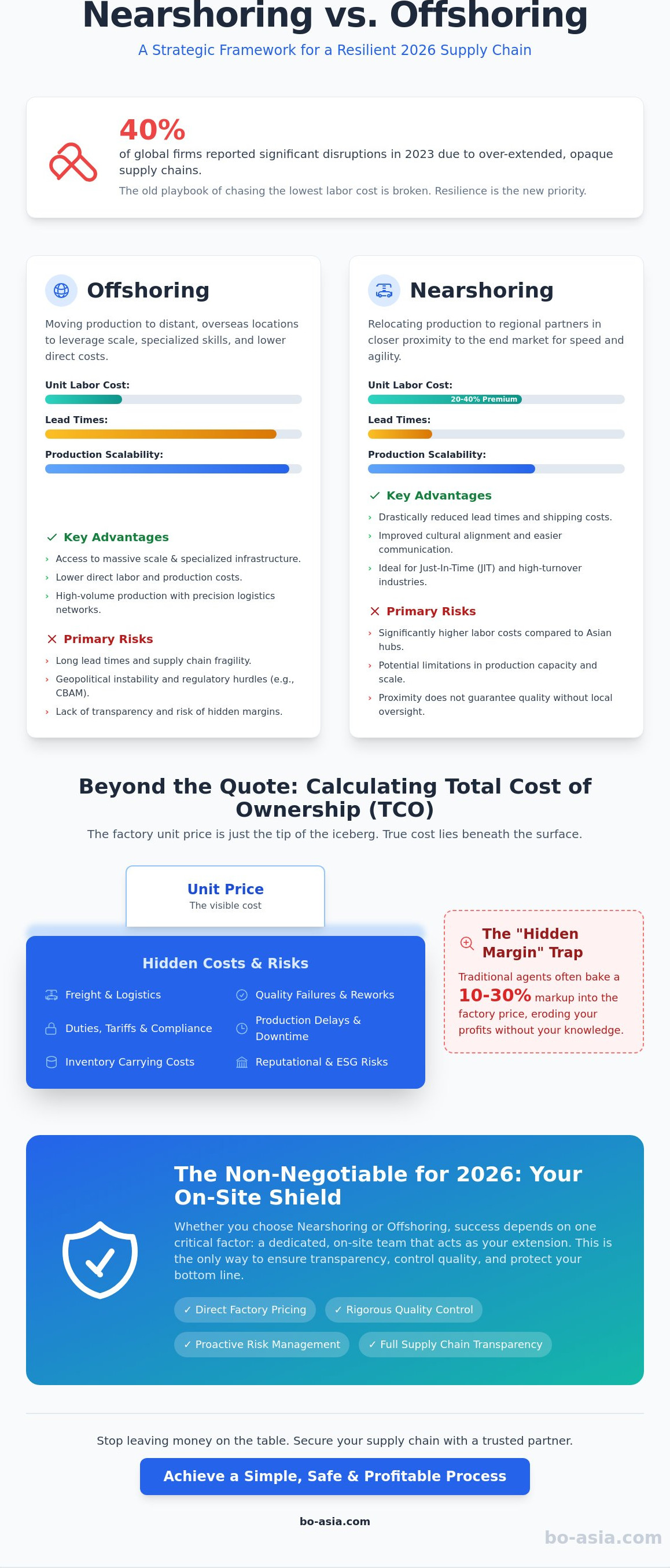
Many procurement managers look at the unit price on a factory quote and stop there. That's a mistake that leads to budget overruns. To make a logical choice between nearshoring vs offshoring, you must calculate the Total Cost of Ownership (TCO). This includes duties, freight, inventory carrying costs, and the price of quality failures. According to 2024 data from the Reshoring Institute, while labor costs in Mexico or Eastern Europe are lower than in the US or Western Europe, they still command a 20% to 40% premium over established Asian manufacturing hubs. Offshoring remains the benchmark for raw production scalability, but the financial math is changing as logistics volatility increases.
The "Hidden Margin" Trap is where most brands lose their competitive edge. Traditional sourcing agents often bake a 10% to 30% markup into the factory price without telling you. They claim to offer "free" sourcing services while taking their cut from the back end. This lack of transparency makes it impossible to know if you're getting a fair market rate. You shouldn't settle for opaque middlemen who prioritize their commission over your bottom line. Instead, you need a dedicated sourcing team that operates on a transparent fee structure, ensuring every cent of a price reduction stays in your pocket.
Lead times are about more than just shipping days. While nearshoring can cut transit time from five weeks to five days, it often lacks the massive throughput of Asian ecosystems. A factory in Vietnam or China can often scale production from 5,000 to 50,000 units faster than a smaller regional facility. When analyzing nearshoring vs offshoring, you have to weigh the speed of the boat against the speed of the assembly line. If a regional factory takes three weeks longer to source raw materials, your shipping advantage disappears instantly.
Achieving 100% transparency requires factory-direct relationships. You can't negotiate effectively from a desk in another time zone. It's about local language skills and cultural context. When you bypass the "traditional agent" and use a dedicated local team, you eliminate the kickbacks that inflate your COGS. This direct approach typically yields a 15% saving compared to standard agency models, allowing you to reinvest that capital into product development or marketing.
Proximity doesn't equal quality. It's a myth that a factory closer to your headquarters requires less oversight. A facility 500 miles away can produce defective goods just as easily as one 5,000 miles away. You need a physical presence on the factory floor to prevent mass production defects before they ship. We use standardized QC reports and on-site audits to ensure compliance with international standards. This "boots-on-the-ground" strategy is the only way to protect your brand from the reputational damage of a sub-standard production run.
The primary objection to global sourcing is the perceived threat to brand reputation. Many executives worry that geographic distance leads to a loss of control. However, the debate between nearshoring vs offshoring shouldn't be framed by fear, but by the rigor of your oversight. In 2026, ESG (Environmental, Social, and Governance) compliance is a mandatory pillar of procurement. With the Corporate Sustainability Reporting Directive (CSRD) now affecting roughly 50,000 companies in the EU, transparency is a legal necessity. You can't protect your brand from a desk in Europe. You need a stabilizing force on the ground to ensure your partners meet these stringent standards.
Navigating the "Made in PRC" label requires a sophisticated approach to risk management. While some European brands look toward regional labels to simplify their marketing, the technical capacity of offshore hubs often remains unmatched. The risk isn't the location; it's the lack of transparency. By removing opaque middlemen and working directly with verified facilities, you turn a complex global market into a safe and profitable asset. This strategy allows you to maintain the cost-efficiency of global trade without sacrificing the ethical standards your customers demand.
Remote verification is no longer enough for high-volume sourcing. A digital certificate can be forged, but a physical production line cannot. The 2026 standard for factory audits goes beyond simple checklists. It involves deep dives into labor rights, waste management, and real-time technical capacity. We examine the actual conditions of the workers and the precision of the machinery to ensure they align with your brand's promises. A vetted factory is the only way to ensure 100% supply chain integrity. This level of professional rigor acts as a shield, preventing the reputational damage that stems from unmanaged offshore production.
Resilience is built through strategic diversification. Currently, about 70% of global manufacturers utilize a "China Plus One" model to balance cost and security. This hybrid approach allows you to leverage the massive infrastructure of established hubs while maintaining a secondary footprint to mitigate geopolitical shifts. The key is maintaining oversight of mass production when your headquarters is thousands of miles away.
Our Helsinki-Hong Kong bridge serves as a dedicated sourcing team that eliminates the distance gap. It provides the local leadership necessary to manage complex logistics and quality control in real time. You don't have to choose between nearshoring vs offshoring based on proximity alone. Instead, you can choose the model that offers the best results, knowing that your interests are protected by a partner who is physically present at the source. This professional oversight ensures you stop leaving money on the table and start building a resilient, compliant supply chain.
Choosing between nearshoring vs offshoring isn't a coin flip; it's a cold calculation of your unit economics and long-term scalability. If your strategy for 2026 relies on ultra-fast weekly pivots or small, artisanal batches of under 500 units, nearshoring offers a logical path. However, for brand owners looking to protect margins on complex goods, the industrial infrastructure in Asia remains the gold standard. You need a model that eliminates risk while maximizing your return on investment.
The decision typically rests on three pillars: product complexity, total volume, and your required speed-to-market. Nearshoring wins on proximity, but it often loses on the depth of the component ecosystem. Offshoring provides the lowest landed cost, but only when managed by a dedicated sourcing team that maintains a physical presence on the factory floor.
Tooling costs in established Asian hubs are typically 30% to 50% lower than in North American or European markets. This price gap isn't just about labor; it's about the density of the manufacturing ecosystem. When your product requires custom injection molds or specialized PCB assembly, you need a factory that has executed similar designs thousands of times. We ensure your intellectual property stays protected through local, on-site oversight, preventing the "reputational damage" that occurs when quality slips.
Best for simple assemblies or products with low tooling requirements.
Essential for products requiring specialized machinery, complex molds, or multi-stage quality control.
Our local expertise allows us to audit factory capabilities in person, ensuring they meet your specific sampling needs before a single dollar is committed.
Scaling production from 5,000 units to 50,000 units requires more than just floor space. It requires a deep sub-supplier network. In 2024, approximately 70% of the world's manufacturing output for consumer electronics originated from Asian hubs because the supply chain depth is impossible to replicate quickly elsewhere. High-volume sourcing demands this level of infrastructure to avoid the production delays that destroy seasonal profitability.
Logistics and shipping management become your biggest levers for profit at scale. While nearshoring reduces transit time, the higher per-unit manufacturing cost often eats the savings. Managed offshoring allows you to leverage Asian cost-efficiencies while we handle the logistical heavy lifting. It's a simple, safe and profitable way to grow without the traditional headaches of remote procurement.
Stop leaving money on the table by working with opaque middlemen. You can secure your supply chain today by partnering with a dedicated sourcing team that acts as your shield in the global market.
While the nearshoring vs offshoring debate continues into 2026, offshoring remains the most powerful lever for margin growth when handled with professional rigor. Buying Office Asia (BOA) functions as your dedicated on-the-ground procurement team, eliminating the ambiguity of remote manufacturing. By providing 100% transparency and factory-direct pricing, we ensure you stop leaving money on the table through opaque middleman markups. Our European leadership ensures your standards are never lost in translation, providing a bridge between Western expectations and Asian production realities.
The traditional sourcing agent model often hides margins behind "all-in" quotes. We've seen brands reduce their landed costs by 15% to 22% simply by transitioning to our transparent model. We secure direct factory contracts for you, removing the hidden commissions that inflate your COGS. This oversight makes mass production simple, safe, and profitable. It's about moving away from the "hope for the best" strategy and toward a professionalized procurement structure that favors the buyer, not the agent.
You own the relationship with the factory; we manage the execution.
Every cent in your supply chain is accounted for, with no hidden kickbacks.
Our team handles the technical complexities of mass production so you can focus on scaling your brand.
Our on-site presence in Hong Kong ensures rigorous quality control and inspections are performed at the source before any balance payments are made. This physical presence is balanced by our Helsinki-based leadership office. You gain the benefit of seamless European communication and legal frameworks while we handle the boots-on-the-ground reality in Asia. Our model is built on safety and measurable ROI, acting as a shield against the production delays and compliance failures that plague unmanaged supply chains. We don't just find suppliers; we protect your reputation and your bottom line.
Moving toward a transparent, factory-direct partnership is the most effective way to resolve the nearshoring vs offshoring dilemma. We recommend starting with a supplier vetting audit to identify hidden risks in your current setup. This process uncovers everything from financial instability in your factory to ESG compliance gaps that could cause future disruptions. It's time to reclaim control over your manufacturing costs and ensure your supply chain is ready for the demands of 2026.
Success in the 2026 global market depends on your ability to balance lead times with rigorous ESG compliance. The debate over nearshoring vs offshoring is no longer a simple cost calculation. It's a strategic choice between regional proximity and the established manufacturing powerhouses of Asia. You need a partner who eliminates the risk of opaque middlemen and hidden margins that drain your profitability.
Buying Office Asia provides the stability your supply chain requires. Our on-the-ground presence in Hong Kong ensures real-time factory oversight, while our European leadership office in Helsinki provides clear, local communication. We offer 100% transparency with factory-direct pricing, so you stop leaving money on the table. Our model makes procurement simple, safe and profitable. You gain the same level of oversight as a large corporation, backed by a dedicated team that acts as your shield against production delays. Partner with Buying Office Asia for Transparent, Factory-Direct Sourcing
Take control of your procurement today and build a resilient foundation for the years ahead.
The primary difference lies in geographic distance and the resulting trade-offs between unit cost and speed to market. Nearshoring involves moving production to a neighboring country, such as Mexico for US firms, to prioritize agility and lower transit times. Offshoring moves manufacturing to distant regions like Asia to leverage lower labor costs and massive industrial ecosystems. According to the 2024 Reshoring Institute report, 70% of companies now evaluate proximity to avoid the 40 day transit times common in transpacific shipping.
Nearshoring isn't always more expensive when you calculate the Total Cost of Ownership rather than just the factory gate price. While labor in Southeast Asia remains 20% to 30% cheaper than in many nearshore hubs, ocean freight rates fluctuated by over 300% between 2021 and 2024. By 2026, the cost gap closes for brands that factor in inventory carrying costs and the 15% price hike caused by emergency air freights when distant suppliers miss deadlines.
Offshoring typically extends lead times to an average of 35 to 45 days for ocean transit alone. This timeline doesn't include the 10 to 14 days often lost to port congestion during peak seasons like the lead-up to the Lunar New Year. Nearshoring reduces this transit window to 2 to 5 days via trucking. This speed allows your business to react to market shifts within a single production cycle instead of committing to inventory months in advance.
The biggest risks are opaque supply chains and a 15% to 20% increase in defect rates due to lack of on-site oversight. Without a local partner like Buying Office Asia, you lose visibility into sub-tier suppliers and risk "hidden margins" where traditional agents take kickbacks. We act as a shield against the reputational damage and production delays that plague unmanaged supply chains. Our on-site presence ensures you don't leave money on the table through poor quality control.
Nearshoring simplifies ESG compliance by reducing carbon emissions from long-haul shipping by up to 80% on specific regional routes. It's easier to audit factories for labor standards when they're in your time zone and accessible via a short flight. You ensure your brand avoids the legal risks of modern slavery acts that are harder to monitor in distant, unmanaged territories. This proximity makes transparency a standard feature of your operations rather than an expensive luxury.
Offshoring remains the superior choice for high-volume manufacturing due to the established infrastructure in hubs like Vietnam or China. These regions possess 5 times the specialized machinery capacity of most emerging nearshore markets. For massive scale, the nearshoring vs offshoring debate favors Asia because the ecosystem of raw material suppliers is already localized. This mature network prevents the production bottlenecks that often occur in less developed nearshore regions.
You ensure quality control by placing a dedicated, local team on the factory floor during the actual production run. Relying on remote inspections or "traditional agents" is a gamble that leads to a 12% average loss in unsellable inventory for unmanaged brands. We provide a safe and profitable alternative by performing 100% inspections before the final payment is released. This physical presence eliminates the "opaque middleman" and guarantees that the goods arriving at your warehouse meet every specification.
The "China Plus One" strategy is a diversification model where businesses maintain their primary production in China while adding a secondary location in another country to mitigate risk. This strategy often drives the nearshoring vs offshoring decision by splitting production between a high-volume Asian hub and a closer nearshore facility. A 2023 Gartner survey found that 33% of supply chain leaders have already moved or plan to move activities out of China to create this hybrid, resilient network.

What if the first clear sign of a production problem arrives after the goods are packed? Manufacturing risk management in Asia works best when controls are connected from the start, not left to a final inspection or occasional supplier update. You need visibility into factory activity, early warning...

What if the lowest unit quote isn’t the lowest-cost way to make your board game? Board game manufacturing costs depend on more than the number of boxes ordered. Component materials, custom tooling, assembly, packaging and delivery scope can all change what a quote covers, making headline prices diff...

What if the factory’s lowest quote isn’t the lowest-cost option? A lower unit price can hide differences in materials, tooling, packaging, quality checks or production terms. Understanding how sourcing agents negotiate factory prices starts with making those differences visible, not simply asking a...