

Searching for a manufacturing partner on a digital directory is a gamble that often leads to hidden margins and opaque middlemen. If you want to stop leaving money on the table, you've got to realize that learning how to find a reliable supplier in Vietnam requires more than just a laptop; it demands a local, on-site strategy. You're right to worry about production delays or quality fade, especially with the 7.2% regional minimum wage increase that took effect in January 2026. These shifts in the local economy mean that choosing the wrong partner now could lead to significant cost overruns or compliance failures.
This guide delivers the exact framework professional procurement teams use to identify, vet, and secure high-performing manufacturers while bypassing common pitfalls. We'll show you how to build a risk-mitigated path to a factory-direct partnership that respects the latest 2026 regulations, including mandatory electronic labor contracts and the new Law on Chemicals. We're going to dive into the specifics of managing the updated import-export tariff schedules and the 2% VAT reduction to ensure your operations are simple, safe, and profitable.
• Identify authentic manufacturers by moving beyond digital directories toward a multi-channel discovery strategy that reveals factory-direct opportunities.
• Execute a professional vetting framework on how to find a reliable supplier in Vietnam that prioritizes rigorous on-site audits over remote promises.
• Protect your bottom line with bilingual, enforceable contracts and staged payment structures tied strictly to verified quality milestones.
• Eliminate the risk of quality fade and communication breakdowns by maintaining a dedicated on-the-ground presence for continuous factory oversight.
• Leverage Vietnam's maturing manufacturing landscape to build a resilient, high-volume supply chain that complies with evolving international ESG standards.
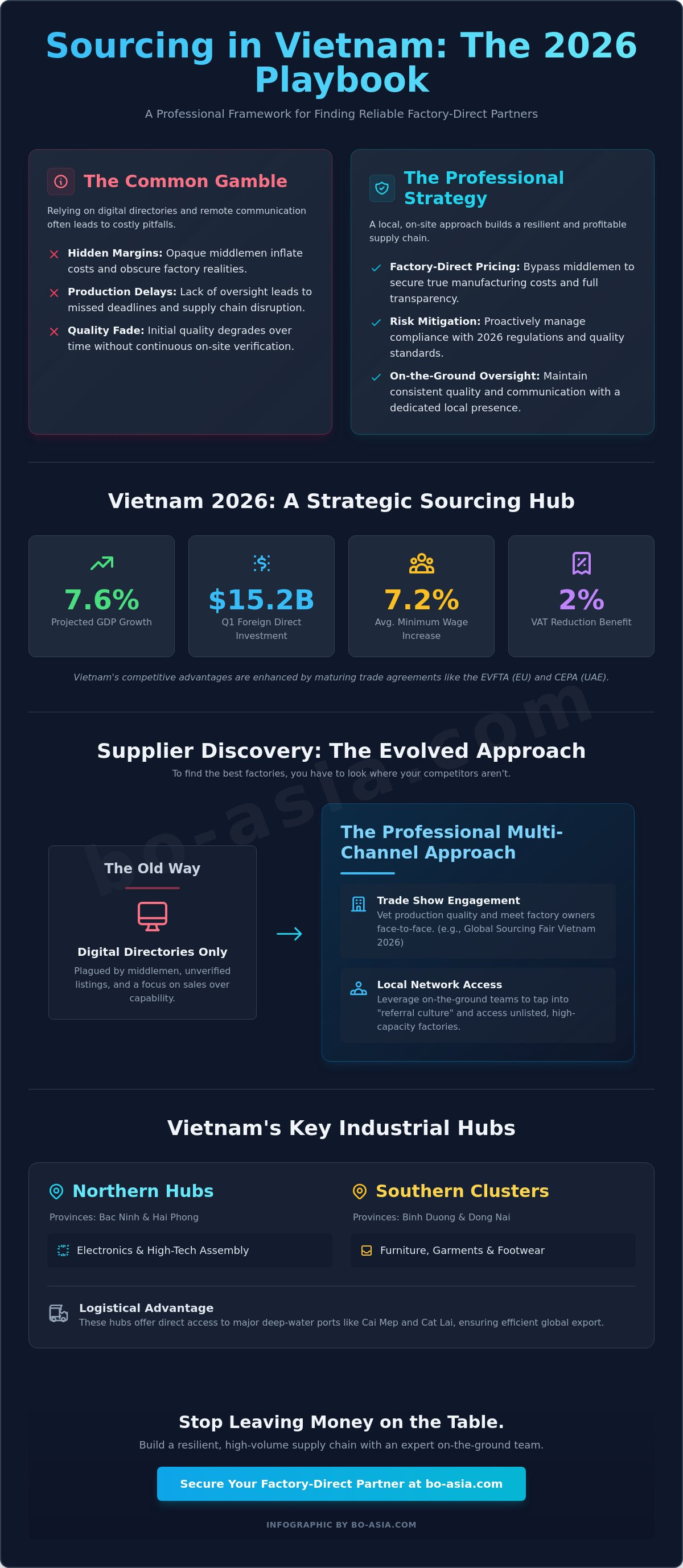
The "China Plus One" strategy has officially transitioned from a boardroom theory to an operational necessity. By 2026, the global supply chain has shifted its weight, making Vietnam's economic landscape one of the most resilient and attractive in Southeast Asia. With GDP growth forecasts for the year reaching as high as 7.6% and a first-quarter FDI surge of nearly USD 15.2 billion, the country is no longer just a backup plan. It's the primary engine for high-volume production in textiles, electronics, and furniture. Understanding how to find a reliable supplier in Vietnam is now the difference between scaling a profitable brand and getting buried by supply chain volatility.
While regional minimum wages increased by an average of 7.2% in January 2026, Vietnam remains highly competitive compared to traditional manufacturing hubs. This cost advantage is bolstered by a rapidly advancing infrastructure that supports high-value manufacturing and sophisticated logistics. However, many brand owners still leave money on the table by working through opaque middlemen. These intermediaries often hide margins and obscure the reality of factory conditions. To secure true factory-direct pricing and full transparency, you need a dedicated sourcing and procurement strategy that places you in direct contact with the manufacturer.
European brands are currently in a strategic "sweet spot." The EU-Vietnam Free Trade Agreement (EVFTA) has matured, offering significant tariff reductions for those who can navigate strict "Rules of Origin" compliance. Entering the market in 2026 allows you to establish roots before the manufacturing sector reaches full saturation. This window of opportunity is closing as more global players secure long-term capacity with vetted Vietnamese factories. Beyond the EU, the 2026 implementation of the UAE Comprehensive Economic Partnership Agreement (CEPA) further expands the reach for goods manufactured here.
Location dictates your success. Northern Vietnam, specifically Bac Ninh and Hai Phong, has solidified its position as the premier hub for electronics and high-tech assembly. If you're sourcing furniture, garments, or footwear, the Southern clusters in Binh Duong and Dong Nai offer the most specialized expertise. These regions provide a logistical edge with immediate access to major deep-water ports like Cai Mep and Cat Lai, ensuring your goods move efficiently from the factory floor to the global market. Knowing which province specializes in your industry is the first step in learning how to find a reliable supplier in Vietnam that matches your specific technical requirements.
Digital directories like Alibaba or Global Sources are often the first stop for procurement managers, but they're rarely the final destination for high-volume brands. In Southeast Asia, relying solely on these platforms is a strategic risk. Many of the most sophisticated, export-ready factories don't maintain a significant digital footprint in English. They don't need to; their order books are filled through long-standing relationships and industry referrals. If you want to master how to find a reliable supplier in Vietnam, you have to look where your competitors aren't looking.
Face-to-face networking remains the gold standard for building trust in the Vietnamese market. Attending major trade shows, such as the Global Sourcing Fair Vietnam scheduled for April 22-24, 2026, in Ho Chi Minh City, allows you to vet production quality in person. These events provide a platform to engage with factory owners directly, bypassing the "hidden margins" of traditional agents. However, even trade shows only scratch the surface. Accessing unlisted factory networks often requires a dedicated Asia procurement team that lives and breathes the local market every day.
B2B platforms are useful for creating a "long-list" of potential partners, but they're plagued by opaque middlemen posing as manufacturers. The best factories often prioritize "referral culture," where a warm introduction from a trusted local partner carries more weight than a generic RFQ. This on-the-ground connection is the only way to bypass the frantic energy of sales and reach the steady confidence of an established expert. If you're finding it difficult to separate legitimate factories from trading companies, you might consider how a local partner can streamline your search.
For a more rigorous approach, leverage industry-specific associations like the Vietnam Textile and Apparel Association (VITAS) or the Vietnam Leather, Footwear and Handbag Association (LEFASO). These organizations provide a level of vetting that generic directories cannot match. You should also target Export Processing Enterprises (EPEs). These are factories located within industrial zones that enjoy specific tax and customs benefits, often translating to lower costs for you. To ensure legal compliance, you must cross-reference a supplier's business license with the National Business Registration Portal to verify their tax code and legal representative. This due diligence is a critical component of any step-by-step guide to verifying suppliers, ensuring you don't fall victim to fraudulent entities or "paper companies."
Reliability in Southeast Asia isn't a marketing claim; it's a status that must be earned through a rigorous, multi-stage vetting process. While discovery identifies potential, a structured framework ensures your capital is protected. If you're wondering how to find a reliable supplier in Vietnam, you must move beyond the surface-level checks that satisfy smaller buyers. High-volume brands require a deeper level of due diligence to avoid the reputational damage and production delays that plague unmanaged supply chains.
Verify the business license, tax code, and export permits against official government records. Don't take a PDF at face value; ensure the legal representative named matches the person you're negotiating with.
This is the only way to confirm production capacity, machinery age, and actual working conditions. It's where you distinguish a legitimate factory from a paper company.
Check for ISO 9001 and industry-specific certifications. These systems prove the manufacturer has the processes in place to maintain consistency across a mass production run.
In 2026, compliance is a legal necessity. Your partners must adhere to the new Law on Chemicals No. 65/2025/QH15 and the modernized employment law framework. Ensuring the factory meets ESG standards protects your brand from ethical liabilities.
Speak with existing international clients. A reliable manufacturer will have a track record of successful exports and won't hesitate to provide references from long-term partners.
Virtual tours are a trap for the inexperienced. For high-volume OEM manufacturing, a physical presence is non-negotiable. During an audit, look for red flags like subcontracting without permission or poor raw material storage. A true manufacturer owns the machinery and employs the labor; a trading company often lacks dedicated QC stations and relies on third-party workshops. With the 7.2% regional minimum wage increase in 2026, some factories may try to cut corners on safety or materials. On-site audits are your shield against these risks.
The sampling phase is where technical specs are tested against reality. You must manage the "sampling loop" aggressively to ensure every detail is perfected before mass production begins. The final approved version, or "Golden Sample," serves as your legal and quality benchmark. Using a professional sourcing and procurement partner to oversee this phase locally ensures that technical requirements aren't lost in translation. This on-the-ground oversight is the most effective method for anyone learning how to find a reliable supplier in Vietnam who can handle complex product development.
Securing a factory-direct partnership requires more than a handshake; it demands a legal framework that holds weight in local courts. When you're finalizing how to find a reliable supplier in Vietnam, your contracts must be bilingual and governed by Vietnamese law to be truly enforceable. A contract written only in English and governed by a foreign jurisdiction often leaves you with zero recourse when production delays occur. We recommend a staged payment structure, typically a 30% deposit and 70% balance, with the final payment tied strictly to a passed pre-shipment inspection. This ensures the manufacturer remains incentivized to meet your specifications through the very last unit.
Quality fade is a silent profit killer. Without continuous oversight, even the best factories might substitute raw materials to maintain their own margins. Implementing specific Acceptable Quality Levels (AQL) within your contract defines exactly what constitutes a "pass" or "fail" for each batch. This is where professional supplier vetting becomes essential. By establishing these metrics early, you eliminate the ambiguity that leads to disputes and ensure that mass production consistently meets the standards of your "Golden Sample."
Don't wait until production starts to protect your designs. You must register your trademarks in Vietnam before sharing technical specs with potential partners. While Non-Disclosure Agreements (NDAs) and Non-Compete clauses provide a layer of legal protection, they aren't foolproof. Physical oversight remains the most effective deterrent against IP theft. When a factory knows you have boots on the ground performing unannounced visits, the temptation to "leak" designs to third parties vanishes. It's about creating a transparent environment where your proprietary data is treated with the same rigor as your financial capital.
The updated 2026 Import-Export Tariff Schedule introduces new complexities that require expert navigation. Whether you're operating under FOB or CIF Incoterms, you need to ensure all documentation is perfectly aligned with "Rules of Origin" requirements to claim EVFTA benefits. This is particularly critical for European brands looking to capitalize on duty-free access. Coordinating with local freight forwarders who understand the nuances of ports like Cai Mep and Cat Lai will optimize your shipping routes and prevent costly bottlenecks at customs. If you're ready to secure your supply chain with professional oversight, get in touch with our team today to discuss your requirements.
Remote management is a gamble that high-volume brands simply can't afford. When you're determining how to find a reliable supplier in Vietnam, you'll eventually hit the "language wall." Technical specs often get lost in translation; cultural nuances regarding a "yes" can lead to catastrophic production errors. A local team acts as your shield, translating not just words, but business intentions and technical requirements. This physical presence ensures that the factory owner sees you as a priority partner rather than just another email in an overcrowded inbox.
Unannounced factory visits are the ultimate deterrent against quality fade. If a manufacturer knows you're only watching via a scheduled video call, they can easily hide unauthorized subcontracting or safety violations. Real-time oversight ensures that the 2026 labor laws and ESG standards are actually being met on the shop floor. This is how you stop leaving money on the table. By negotiating factory-direct on-site, you eliminate the hidden margins of opaque middlemen who claim to be manufacturers but are merely agents with a laptop. A dedicated Asia procurement team provides the same level of oversight that large corporations enjoy, but at a fraction of the cost of managing an internal overseas office.
The best factories in Vietnam operate on a foundation of deep-rooted relationships. A local team knows the factory owner's cell phone number and understands how to navigate the regional landscape to secure better lead times. You can solve production bottlenecks in minutes rather than waiting 12 hours for a reply across time zones. This level of local expertise provides the peace of mind that comes from a sourcing experience that's truly simple, safe, and profitable. It's the most effective way to maintain a steady, risk-free supply chain while your competitors are still struggling with "opaque" communication.
Strategic partnerships aren't born; they're built through consistent management and development. By investing in professional oversight, you move away from one-off transactions toward a model where the factory becomes more efficient with your specific tooling and quality standards over time. This long-term approach reduces costs and improves yield, providing a measurable ROI that remote management can't match. If you're ready to secure your supply chain and move toward a more resilient manufacturing model, Contact Buying Office Asia today to discuss your 2026 procurement strategy.
Scaling your production in 2026 requires moving beyond digital directories and embracing a local, boots-on-the-ground strategy. You've seen that the framework for how to find a reliable supplier in Vietnam is built on rigorous on-site audits, bilingual contracts, and a deep understanding of evolving trade regulations. By prioritizing transparency and direct factory negotiations, you eliminate the hidden costs of middlemen and protect your brand from the risks of quality fade. This proactive approach ensures your operations remain competitive in a shifting global market.
As a European-managed team with over 15 years of on-the-ground expertise, we act as your protective partner in this complex landscape. We provide 100% transparency with factory-direct pricing and perform the on-site quality control necessary to eliminate production risks before they hit your bottom line. It's time to stop leaving money on the table and start building a simple, safe, and profitable supply chain. Partner with Buying Office Asia for safe and profitable sourcing in Vietnam and secure your competitive advantage. Your growth in Southeast Asia is within reach when you have the right ally on the factory floor.
Alibaba is a useful starting point for initial discovery, but it's not inherently safe for high-volume procurement without secondary vetting. Many profiles belong to opaque middlemen who don't own the actual production facility. You must perform on-site audits to verify that the entity on your screen is the one operating the machinery. Relying solely on digital badges often leads to quality fade and communication breakdowns.
Verification requires cross-referencing their business license and tax code with the National Business Registration Portal. Don't stop at paperwork; a physical factory audit is the only way to confirm they have the production capacity and machinery they claim. This is a critical step in learning how to find a reliable supplier in Vietnam who can handle mass production without subcontracting to unvetted third parties.
Standard industry practice involves a 30% deposit upon order confirmation and the remaining 70% balance paid after a successful pre-shipment inspection. This structure protects your capital and ensures the factory meets your quality milestones before receiving the final payment. Avoid suppliers who demand 100% upfront; this is a major red flag that signals financial instability or potential fraud.
You don't need a traditional agent who hides margins; you need a dedicated on-the-ground team that provides 100% transparency. A local procurement team acts as your shield against production delays and cultural friction. While remote management is possible, the lack of physical oversight often results in hidden costs that far exceed the investment in professional, local representation.
Vietnam is a global leader in electronics, textiles, furniture, and footwear as of 2026. Northern regions like Bac Ninh are hubs for high-tech assembly, while the South excels in high-volume garment and furniture production. With the 2026 Law on Key Industries, the country is shifting toward even higher-value manufacturing, making it an ideal destination for sophisticated brand owners looking for long-term stability.
A professional vetting process typically spans two to four weeks. This timeline allows for preliminary document reviews, on-site audits, and initial sample evaluations. Rushing this phase is how most brands leave money on the table. Taking the time to execute a thorough 5-step framework ensures your path to a factory-direct partnership is simple, safe, and profitable.
Yes, you can protect your intellectual property by registering your trademarks locally before sharing designs. Using bilingual Non-Disclosure Agreements (NDAs) provides a legal deterrent, but physical oversight is your best defense. When a factory knows a dedicated sourcing team is performing unannounced visits, the risk of your proprietary designs leaking to competitors is significantly minimized.
Minimum order quantities in Vietnam are generally geared toward high-volume brands and wholesalers. While MOQs vary by product category, factory-direct partners typically require larger volumes than trading companies to justify the production line setup. This guide on how to find a reliable supplier in Vietnam focuses on these enterprise-level manufacturers who offer the best cost-efficiency for mass production.

What if the first clear sign of a production problem arrives after the goods are packed? Manufacturing risk management in Asia works best when controls are connected from the start, not left to a final inspection or occasional supplier update. You need visibility into factory activity, early warning...

What if the lowest unit quote isn’t the lowest-cost way to make your board game? Board game manufacturing costs depend on more than the number of boxes ordered. Component materials, custom tooling, assembly, packaging and delivery scope can all change what a quote covers, making headline prices diff...

What if the factory’s lowest quote isn’t the lowest-cost option? A lower unit price can hide differences in materials, tooling, packaging, quality checks or production terms. Understanding how sourcing agents negotiate factory prices starts with making those differences visible, not simply asking a...