


The most sophisticated AI dashboard in the world cannot stop a factory in Ningbo from substituting raw materials during a midnight production run. By 2026, 75% of global supply chain leaders will have adopted digital-first procurement solutions, yet many still find themselves losing up to 15% of their margins to opaque middlemen who hide behind sleek interfaces. You understand that digital transformation is necessary, but you've likely realized that data alone doesn't guarantee factory-direct pricing or prevent quality drift during mass production.
It's time to stop leaving money on the table and regain control over your overseas manufacturing. This article reveals why the only way to secure total supply chain integrity is to combine digital automation with a dedicated, on-site team that acts as your protective shield. We'll outline a strategic framework that bridges the gap between European leadership and Asian production, ensuring your operations remain simple, safe and profitable. Discover how a boots-on-the-ground approach eliminates hidden fees and delivers the verified quality standards your brand demands.
• Learn why high-performance procurement solutions in 2026 require a hybrid approach that combines digital automation with physical, on-site expertise.
• Stop leaving money on the table by mastering factory-direct price negotiations and vetting processes that bypass expensive middleman markups.
• Identify the critical red flags of opaque commission agents to ensure your supply chain remains transparent and fully under your control.
• Discover how to protect your brand from reputational damage by implementing rigorous AQL standards and during-production inspections.
• Understand how to transform your sourcing operations into a simple, safe, and profitable system by leveraging a dedicated local team in Asia.
Modern procurement solutions require a shift in perspective. For years, the industry leaned heavily on digital-only platforms, assuming that a dashboard could replace a physical presence. By 2026, the limitations of this approach have become undeniable. True procurement excellence is now defined as a hybrid of high-level digital tools and aggressive strategic execution. It is the difference between watching a delay happen on a screen and having a team on-site to prevent it.
In complex Asian manufacturing environments, software-only approaches frequently fail. Data points cannot capture the nuances of factory floor dynamics or the sudden shifts in local labor availability. To truly understand What is Procurement? in this decade, you must look past the transaction. It is an end-to-end process that demands active management rather than passive tracking. While software tracks the shipment, active management ensures the shipment is worth tracking in the first place. This transition moves your supply chain from a position of vulnerability to one of steady, calculated control.
An on-the-ground presence remains the ultimate risk mitigator. It provides the level of oversight that large corporations have enjoyed for decades, now made accessible to growing brands. You don't just need a bridge to your suppliers; you need a shield against the volatility of global trade. This boots-on-the-ground approach ensures your operations remain simple, safe and profitable.
Data on a screen is a poor substitute for a physical factory audit. Digital marketplaces like Alibaba often display "verified" badges, but these frequently only confirm that a business license exists. They don't verify if a factory meets 2025 ESG standards or if its equipment is maintained well enough to prevent a 20% defect rate. Reliance on remote verification leaves your brand exposed to reputational damage that no software can predict or fix. Local expertise identifies these red flags before you commit capital. It prevents you from leaving money on the table by catching production errors at the source, rather than at your warehouse door.
The regulatory environment has changed. Shifting trade policies and mandatory transparency requirements mean that the old ways of sourcing are now liabilities. The era of the "opaque middleman" is over. These traditional agents often hide margins of 5% to 10% within their quotes, creating a lack of clarity that hurts your bottom line. 2026 demands a move toward dedicated procurement teams that operate as an extension of your own office. This model prioritizes transparency and direct factory relationships. By eliminating hidden costs and focusing on measurable outcomes, you achieve the cost-efficiency necessary to scale in a competitive market. It's about moving away from frantic, reactive sourcing and toward the steady confidence of a managed supply chain.
A high-performance procurement strategy acts as a shield against the volatility of global markets. To move beyond basic sourcing, you must master the four pillars of modern procurement: vetting, negotiation, inspection, and logistics. These elements don't function in isolation; they form a cohesive system designed to protect your margins and your brand reputation. By implementing robust procurement solutions, you transform your supply chain from a cost center into a competitive advantage.
The foundation of this system relies on local presence and physical oversight. While digital platforms offer convenience, they lack the accountability required for complex manufacturing. Our approach focuses on being your boots-on-the-ground partner, ensuring that every step of the process is simple, safe, and profitable. We emphasize direct intervention over remote management to eliminate the risks that typically plague overseas production.
Most businesses make the mistake of relying on paper audits. A PDF certificate can be easily forged or outdated. There's a massive difference between a document review and a physical on-site inspection. Without a physical presence, you're blind to "hidden" subcontractors. These unauthorized third parties are where 35% of quality issues and ESG compliance failures originate. We verify every production line to ensure the factory you've vetted is the one actually making your goods. For a detailed breakdown of our methodology, see our guide on supplier vetting.
Effective vetting also involves aligning with international standards. We integrate frameworks like strategic procurement planning in Asia to ensure your supplier base is resilient and ethically compliant. This level of rigor prevents the reputational damage that follows labor or environmental violations in your tier-two or tier-three supply chain.
Traditional sourcing agents often claim to work for "free" or low commissions, but they frequently hide 10% to 20% margins inside your unit price. This lack of transparency means you're leaving significant money on the table. We reject this opaque model in favor of a fee-based service that provides 100% pricing transparency. You see the actual factory-gate cost, which allows for more accurate financial forecasting.
Our procurement solutions focus on direct negotiations with factory owners rather than junior sales reps. Owners have the authority to adjust pricing based on long-term partnership value rather than immediate commission. This tactic, combined with our local market knowledge, ensures you're getting the true market rate. You can secure your bottom line by partnering with a dedicated sourcing team that prioritizes your interests over hidden middleman markups.
Finally, maintaining a lean supply chain requires multi-stage quality control. We don't wait for the goods to reach the port; we inspect raw materials and mid-production runs. This proactive oversight, paired with precise logistics coordination, prevents the 15% average delay seen in unmanaged shipments. It's about maintaining control from the first purchase order to the final delivery.
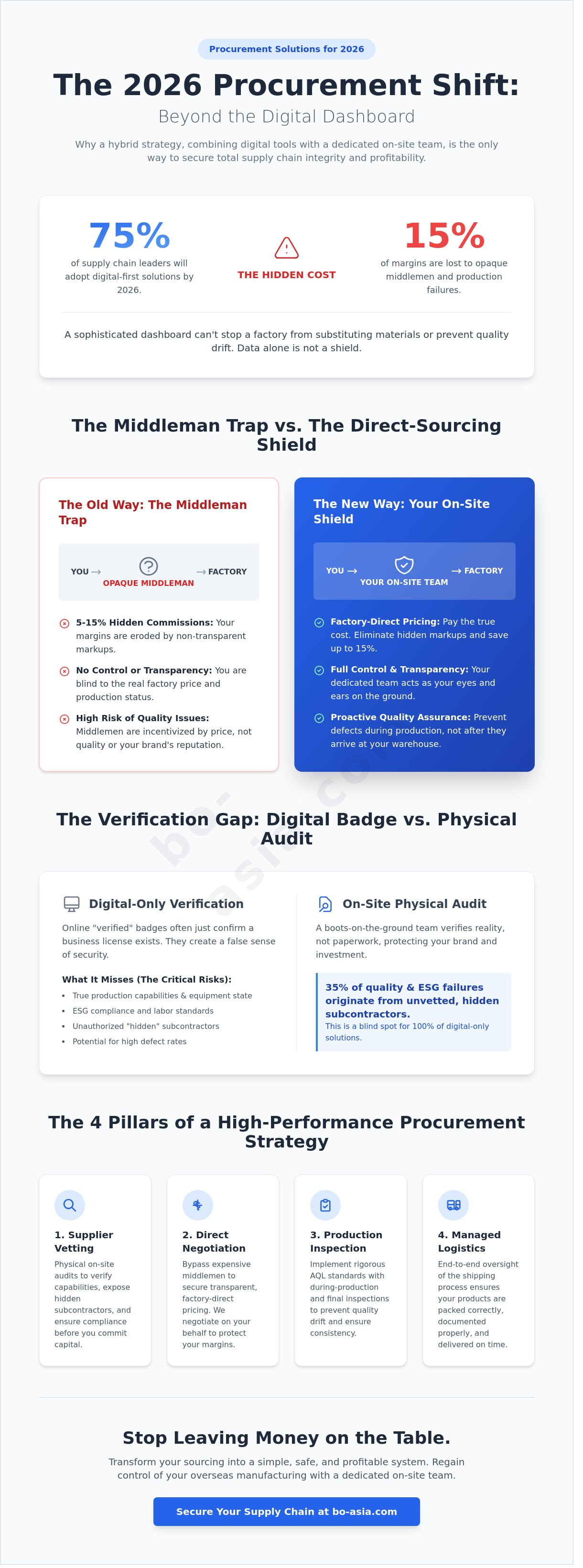
Many brands mistake a commission agent for a partner. It's a costly error that often leads to stagnant growth. Traditional agents typically survive on a "double-dipping" model, where they collect a percentage from you while pocketing a kickback from the factory. This creates a fundamental conflict of interest. If a problem arises at the factory, the agent is incentivized to protect their source of income rather than your brand's reputation. A dedicated procurement team operates as your local office in Asia, working solely for your interests with a flat, transparent fee structure.
You might think it's cheaper to go direct through a global sourcing website. While these platforms offer low entry barriers, they lack the physical oversight needed for complex supply chains. Without on-site verification, you're gambling on quality and compliance. Professional procurement solutions replace that digital guesswork with physical certainty. You don't just get a supplier; you get a verified partner who has undergone rigorous auditing.
The agent refuses to share factory contact information or physical addresses.
You're told you cannot visit the production site without the agent present.
Quotes are provided as "all-in" prices without a breakdown of raw materials, labor, and logistics.
When an agent is paid by both sides, you lose your leverage. They won't push for better pricing or tighter quality control if it risks their relationship with the factory. These hidden margins prevent you from scaling effectively because your unit costs remain artificially high. Hidden margins function as a compounding tax on your growth by artificially inflating your cost of goods sold and preventing you from reinvesting in your brand’s expansion.
For European brands, 100% visibility into the supply chain is no longer a luxury; it's a regulatory necessity. With increasing ESG requirements and supply chain due diligence laws, you must know exactly who is making your products. Our Helsinki-based leadership bridges the cultural gap, ensuring your European standards are translated perfectly to our Hong Kong operations. This local-to-local connection removes the friction that usually plagues overseas manufacturing.
In 2023, a high-volume wholesaler transitioned from an opaque agent model to our transparent procurement solutions. They discovered a 14% hidden markup in their existing pricing. By moving to a service-fee model, they secured direct factory contracts and regained control over their production timeline, leading to a 22% increase in quarterly profit margins. We make the process simple, safe, and profitable by acting as your shield against the risks of unmanaged sourcing.
Remote sourcing often feels like gambling with your capital. To secure your investment, you need robust procurement solutions that prioritize physical presence over digital promises. High-performance supply chains rely on a four-stage oversight protocol designed to eliminate risk before it hits your balance sheet. Our methodology moves away from reactive troubleshooting and toward proactive prevention.
You must define Acceptable Quality Level (AQL) benchmarks based on ISO 2859-1 standards before a single machine starts. This creates a clear, contractual definition of what constitutes a "pass" or "fail" for your specific order.
We conduct these when 15% to 20% of the production run is finished. Catching a structural defect at this stage prevents an entire batch from being wasted; it allows for immediate course correction while the factory still has time to adjust.
These take place once 80% of your goods are packed and ready for shipment. This is your ultimate leverage. You don't release the balance payment until the FRI report confirms that the goods meet every specification.
Short-shipments and transit damage are common in unmanaged logistics. Supervision at the loading dock ensures that 100% of the paid-for volume enters the container and that the load is balanced to prevent damage during sea transit.
A professional inspection report is a comprehensive technical document, often exceeding 30 pages of empirical data. It includes high-resolution photos of every production stage, results from on-site function tests, and precise defect counts. We categorize these as critical, major, or minor. This data is a strategic asset; by tracking defect trends across multiple quarters, you can drive continuous improvement and eliminate "quality fade." Having on-the-ground inspectors who speak the local dialect is non-negotiable. It removes the linguistic ambiguity that factories often exploit to cut corners on material specifications or lead times.
Protecting your intellectual property during the sampling phase is a primary concern in Asian manufacturing hubs. Successful custom product development hinges on rigorous sampling support. This is the most critical stage for long-term production success. A minor 2% deviation in a prototype can lead to a total loss during a 10,000-unit mass production run. We act as your shield, ensuring that molds and tooling remain your exclusive property and that every iteration moves you closer to a "golden sample" that is both simple and profitable. Integrating these procurement solutions into your workflow transforms a chaotic supply chain into a predictable engine for growth.
Stop leaving your product quality to chance and start protecting your margins. Secure your production with Buying Office Asia's on-site experts.
Buying Office Asia isn't just another service provider. We function as your local office in the heart of the world's most complex manufacturing hubs. As a seasoned insider, we bridge the gap between Western expectations and Asian production realities. Our brand promise is built on three pillars: making your supply chain simple, safe, and profitable. We achieve this through a unique operational model that combines disciplined European management with the logistical expertise of our Hong Kong headquarters. This dual presence allows us to act as a shield for your business, protecting you from the "opaque middlemen" and hidden margins that often erode profitability.
Moving your operations from a tactical, day-to-day struggle to a strategic procurement approach requires more than just better software. It requires boots on the ground. We provide the physical presence necessary to ensure transparency and compliance at every stage of the production cycle. By positioning ourselves as an extension of your own team, we eliminate the anxieties of distance and lack of control.
Calculating the value of professional procurement solutions starts with identifying the "hidden tax" of unmanaged sourcing. Many wholesalers lose 15% to 22% of their potential margin to quality defects, shipping delays, and inflated factory pricing. When you partner with us, you replace these unpredictable losses with a transparent, fixed service fee. The cost-savings of factory-direct pricing typically offset our management fees within the first two production runs.
Beyond the balance sheet, there is the unquantifiable value of peace of mind. We mitigate reputational risk by enforcing strict ESG standards and quality control protocols. "In 2026, the best procurement solution isn’t an app; it’s an extension of your own team on the factory floor." This hands-on oversight prevents the production delays that lead to empty shelves and lost contracts.
Our onboarding process is designed for efficiency and clarity. We begin with a deep-dive consultation to assess your current supply chain gaps and identify where you're leaving money on the table. We don't believe in generic advice; we provide a roadmap tailored to your specific product category and volume requirements.
Within the first 30 days of our partnership, we move from initial contact to a comprehensive on-site factory audit. You'll receive a detailed report on your supplier's actual capacity, compliance status, and technical capabilities. It's time to stop reacting to supply chain crises and start managing them with authority. Schedule a strategy call with our Helsinki or Hong Kong team to begin your transition to a more secure and profitable procurement model.
The procurement landscape in 2026 demands more than just a digital dashboard. While software streamlines data, it can't inspect a factory floor in Shenzhen or negotiate face-to-face with a supplier in Ningbo. You need a boots-on-the-ground strategy that eliminates the middleman trap and replaces opaque agents with 100% transparency. As a European-managed firm with a direct presence in Hong Kong and Mainland China, we provide the physical oversight that software lacks. We've built our reputation on a model with zero hidden margins and zero kickbacks, ensuring your interests are protected at every stage of the production cycle.
Our proven track record in high-volume sourcing and custom product development means you don't have to choose between scale and quality. By integrating on-site quality control into your procurement solutions, you transform a vulnerable supply chain into a stable engine for growth. It's time to move past the risks of unmanaged sourcing and embrace a model that is simple, safe, and profitable. Your bottom line deserves the protection of a seasoned insider.
Stop leaving money on the table-partner with our dedicated Asia procurement team today.
Procurement software provides the digital infrastructure for tracking orders, whereas procurement services involve a dedicated team managing the entire supply chain lifecycle. While software can automate data entry, it can't negotiate with a factory owner in Shenzhen or verify a production line's capacity in person. You need more than a dashboard to manage 500 SKUs across three countries. You need boots on the ground to solve real-world logistical bottlenecks.
Effective procurement solutions reduce costs by eliminating the 10% to 30% markups often hidden by trading companies and middlemen. We secure direct factory pricing by negotiating based on raw material benchmarks, such as current resin indices or global metal prices. By optimizing container load efficiency to 95% or higher, you reduce per-unit shipping costs and stop leaving money on the table through inefficient logistics.
Digital verification relies on uploaded certificates that are often expired or altered; on-site auditing provides a physical inspection of the factory floor. Industry data indicates that 40% of digital profiles on B2B platforms contain inaccuracies regarding production capacity or certifications. Our local team visits the facility to verify ISO 9001 compliance and check that the machinery matches the promised output. It's the only way to ensure your production is safe and profitable.
Small businesses gain the same level of supply chain oversight that large corporations enjoy by leveraging our established networks. You don't need a massive internal department to access 20 years of local expertise in Vietnam or China. Professional procurement solutions protect your cash flow by preventing costly production errors and ensuring you don't overpay for low-volume orders. We act as your shield against the reputational damage caused by shipping sub-par products.
Buying Office Asia ensures transparency by using an open-book pricing model where you see the original factory invoice. We reject the traditional agent model that survives on secret kickbacks and opaque margins. You pay the factory directly, and we charge a flat management fee for our services. This structure removes any incentive for us to recommend more expensive suppliers. It keeps your supply chain simple, safe, and profitable.
Commission-based agents often prioritize their own profit over your product quality because they earn more when you pay more. This creates a conflict of interest that leads to kickbacks from factories, which can add 5% to 15% to your total cost. Because their loyalty is split, they may hide production delays or quality failures to ensure their commission is paid. You lose control of your margins when your representative is incentivized to keep prices high.
We manage high-volume quality control through a three-stage inspection process: pre-production, mid-production, and final random inspection. For an order of 10,000 units, we use the AQL standard to determine the precise sample size. Our on-site inspectors check for functional defects and packaging integrity before the goods leave the factory. This rigorous oversight prevents the 2% to 5% defect rates that typically plague unmanaged high-volume shipments.
Procurement solutions ensure ESG compliance by conducting unannounced factory visits to monitor labor conditions and waste management. We verify that suppliers adhere to the SA8000 social accountability standard to protect your brand from the risk of forced labor or environmental violations. In a 2023 survey, 75% of consumers stated they'd stop buying from brands with unethical supply chains. We serve as your local watchdog to prevent such reputational damage.

What if the first clear sign of a production problem arrives after the goods are packed? Manufacturing risk management in Asia works best when controls are connected from the start, not left to a final inspection or occasional supplier update. You need visibility into factory activity, early warning...

What if the lowest unit quote isn’t the lowest-cost way to make your board game? Board game manufacturing costs depend on more than the number of boxes ordered. Component materials, custom tooling, assembly, packaging and delivery scope can all change what a quote covers, making headline prices diff...

What if the factory’s lowest quote isn’t the lowest-cost option? A lower unit price can hide differences in materials, tooling, packaging, quality checks or production terms. Understanding how sourcing agents negotiate factory prices starts with making those differences visible, not simply asking a...