


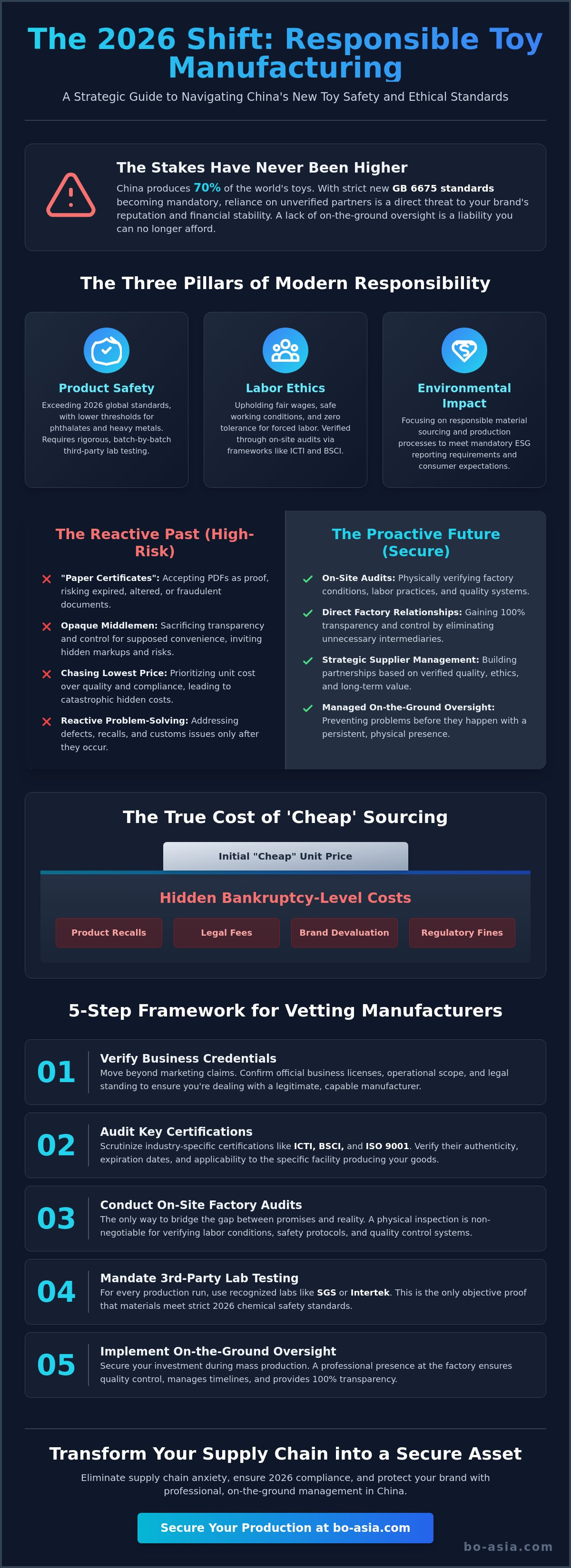
What if the manufacturing partner you rely on for your 2026 inventory is currently operating under safety standards that become illegal this November? With China producing 70% of the world's toys, the stakes for your brand's reputation have never been higher. You're likely concerned about the complexity of the new GB 6675 standards and the underlying risk of toxic material recalls. Achieving responsible toys manufacturing in China is no longer a matter of paperwork; it's a matter of persistent, physical presence.
We understand that a lack of visibility into factory labor conditions and shifting international regulations feels like a liability your business cannot afford. This guide provides a strategic framework to secure a compliant, ethical, and high-quality supply chain through professional on-the-ground management. You'll learn how to vet factory partners effectively, maintain 100% transparency, and ensure your production meets the strict 2026 toy safety laws with absolute certainty. By the end of this briefing, you'll have the tools to transform your procurement process into a stable, audited, and financially viable asset.
• Identify the three pillars of modern responsibility, safety, ethics, and sustainability, to move from reactive compliance to a proactive supply chain strategy.
• Master the distinction between superficial "paper certificates" and the rigorous on-site audits required to meet strict 2026 safety standards.
• Eliminate the "Middleman Problem" and hidden markups by establishing direct factory relationships, a critical step for responsible toys manufacturing in China.
• Deploy a structured 5-step framework to vet manufacturers, focusing on verified business licenses and industry-specific certifications like ICTI and ISO 9001.
• Leverage professional on-the-ground oversight to manage mass production, protecting your brand from the financial hazards of unmanaged sourcing.
Responsible toys manufacturing in China is no longer a voluntary choice or a marketing slogan. In 2026, it's a rigid business requirement defined by three non-negotiable pillars: product safety, labor ethics, and environmental impact. For high-volume importers, the shift from voluntary corporate social responsibility to mandatory ESG reporting has fundamentally changed the procurement landscape. You can't afford to wait for a customs rejection or a consumer lawsuit to address gaps in your supply chain. Responsible manufacturing is the strategic intersection of rigorous regulatory compliance and uncompromising ethical oversight.
Operating in the 2026 market requires a proactive compliance strategy. Traditional reactive methods, where brands only verify certificates after a problem arises, are inherently flawed and dangerous. Instead, your brand must integrate oversight into the earliest stages of product development and material sourcing. This approach ensures that every component, from the base resins to the pigments, aligns with the latest global expectations. By positioning yourself as a proactive leader, you eliminate the anxieties of unmanaged production and secure your brand's financial viability.
The regulatory environment has tightened significantly this year. Updated global toy safety standards, including the EU Toy Safety Directive and the US ASTM F963, now place greater emphasis on chemical transparency. Specifically, 2026 updates have introduced lower thresholds for phthalates and heavy metals in accessible toy parts, requiring more frequent lab testing. To manage these risks, we utilize the ICTI Ethical Toy Program as a core component of our factory vetting process. This program provides a verified framework for labor rights and workplace safety, ensuring your production remains ethically sound and legally defensible in a high-scrutiny market.
Chasing the lowest possible unit price is a high-risk strategy that often leads to total brand devaluation. The hidden costs of unmanaged sourcing, such as product recalls, legal fees, and administrative penalties, can easily exceed the initial savings of a "cheap" quote. For an SME toy brand, a single batch defect involving toxic materials isn't just an expense; it's a bankruptcy event. Protecting your financial health requires a transition from transactional buying to strategic supplier management. By moving away from opaque intermediaries and toward managed, factory-direct relationships, you gain the transparency needed to prevent catastrophic operational setbacks before they reach the shipping container.
Securing responsible toys manufacturing in China requires moving beyond the surface level of digital attachments. A PDF certificate in an email isn't proof of compliance; it's merely a starting point. For the 2026 market, your supply chain must be anchored by a hierarchy of verified certifications, including ISO 9001 for quality management and ICTI, BSCI, or Sedex for ethical labor standards. These frameworks provide the baseline, but the real value lies in the physical verification of these claims. We frequently encounter "paper certificates" that are expired, altered, or belong to a different facility entirely. True oversight involves on-site audits that bridge the gap between what a factory promises and what it actually delivers.
Third-party lab testing through recognized entities like SGS or Intertek is non-negotiable for every production run. Testing is the only objective way to verify that your goods meet U.S. toy safety requirements and the updated 2026 standards. Middlemen often attempt to hide "red flags" in audit reports, such as excessive overtime or inadequate chemical storage, by providing summarized versions of the data. You must insist on reviewing full, unedited reports to identify these operational risks. If you're unsure how to interpret a complex audit, our team can provide a professional assessment of your supplier’s actual standing.
The ICTI Ethical Toy Program is the industry benchmark for labor rights, health, and safety within the toy sector. It ensures that factories maintain fair wages and transparent working hours. While ICTI is industry-specific, BSCI audits are often preferred by European retailers because they offer broader supply chain transparency across multiple product categories. Our on-the-ground team verifies the authenticity of these audits by visiting the factory floor, ensuring the reality matches the documentation. This physical presence prevents the "bait and switch" tactics that often plague unmanaged sourcing.
The 2026 regulatory updates place a heavy emphasis on chemical transparency, particularly regarding REACH and RoHS compliance. Contamination often occurs not during assembly, but deep within the plastic and coating supply chains. This makes "raw material tracing" essential to prevent the introduction of banned phthalates or heavy metals during mass production. Safety begins at the material supplier level, not just the assembly line. By managing your supply chain at the source, you protect your brand from the financial and legal fallout of a product recall.
The "opacity trap" is a significant risk for brands attempting to manage a supply chain from a distance. Many importers unknowingly work with trading companies that present themselves as manufacturers. These intermediaries often rely on hidden markups and sub-contracting, which fundamentally destroy the accountability required for responsible toys manufacturing in China. When production is shifted to unvetted "shadow factories" to save on costs, your brand loses all visibility into labor conditions and material safety. Establishing factory-direct price negotiations isn't just about financial optimization; it's a prerequisite for ethical oversight.
True responsibility requires a 100% transparency model. You need to see the real factory, understand the real cost drivers, and verify the conditions of the real workers. Without this, your compliance documents are merely suggestions. Our on-the-ground presence in Hong Kong and mainland China acts as an integrity bridge, ensuring that the facility you approved during the sampling stage is the same one handling your mass production. This level of visibility eliminates the hidden risks that typically plague unmanaged procurement models.
Identifying red flags on B2B platforms like Alibaba or Global Sources is a critical skill for any procurement professional. Common indicators of a trading company include a suspiciously wide product range or a business license that lists "trading" rather than "manufacturing." The danger of these entities is the lack of control over the actual production site. If a trading company faces a capacity crunch, they may outsource your order to a facility that doesn't follow China's National Safety and Quality Standards. A dedicated Asia procurement team is the only reliable way to verify the physical production site and ensure your goods aren't being made in a high-risk environment.
Physical proximity is the strongest defense against "quality fade," a common phenomenon where material quality gradually declines over multiple production cycles. Having European management on-site in Asia provides a layer of cultural and professional alignment that digital communication can't replicate. It allows for immediate intervention when a process deviates from the agreed-upon standards. BOA's approach to transparency is built on this regional presence, transforming your supply chain from a source of anxiety into a stable, managed asset. This protective oversight ensures that your brand remains insulated from the operational risks inherent in unmanaged international trade.
Responsible toys manufacturing in China is a systematic process, not a one-time event. You need a rigorous framework that filters out high-risk factories before they enter your supply chain. This protocol ensures that your chosen partner possesses both the technical capacity and the ethical integrity required for a long-term relationship. By following a structured vetting sequence, you replace the anxiety of unmanaged sourcing with the steady confidence of professional oversight.
The framework consists of five non-negotiable stages:
Filter suppliers based on industry-specific certifications like ICTI and ISO 9001 to establish a baseline of professional competence.
Perform a detailed verification of business licenses and previous audit reports to ensure the facility is legally registered and compliant.
Deploy "boots on the ground" to conduct social and technical inspections, moving beyond paper claims to verify actual factory conditions.
Submit production-grade samples to accredited third-party laboratories to confirm material safety and functional durability.
Finalize agreements with explicit ESG and quality clauses that hold the manufacturer accountable for every production run.
Technical capacity is the foundation of a reliable partnership. We cross-reference every factory claim with official government databases to ensure the business is authorized for the specific type of production you require. This stage involves evaluating whether the facility can actually handle custom tooling and OEM development or if they're merely outsourcing the complex work. We also review the factory's internal Quality Management System to determine if their internal controls are robust enough to prevent defects before they reach the assembly line.
A physical audit is the only way to detect the "shadow factories" and labor violations that digital vetting misses. During unannounced visits, our team checks for signs of child labor, forced labor, or excessive overtime that exceeds legal limits. We inspect dormitory conditions, fire exits, and the availability of personal protective equipment (PPE) for workers. Vetting doesn't end when the contract is signed; mass production oversight remains the final, critical step in the lifecycle. This persistent presence ensures that responsible toys manufacturing in China remains a reality throughout the entire production cycle. If you're ready to implement this level of security, you can secure your supply chain with our professional management team.
Scaling a toy brand requires more than just increasing order volumes; it demands a robust infrastructure that can handle increased complexity without compromising on safety or ethics. Many independent business owners hit a ceiling when their unmanaged supply chains begin to buckle under the weight of larger production runs and stricter scrutiny. Buying Office Asia removes this operational anxiety by providing the regional expertise and hands-on oversight usually reserved for major enterprises. We don't just find suppliers; we manage them as a protective extension of your own team. This approach ensures that responsible toys manufacturing in China remains a consistent, scalable reality for your brand.
The return on investment for professional procurement is measurable through both financial optimization and risk reduction. By securing factory-direct pricing and eliminating hidden intermediary markups, you improve your margins while simultaneously gaining 100% transparency. Our documented case studies demonstrate how we've guided brands from the initial prototype stage through to successful mass production, all while maintaining strict adherence to international safety laws. This stability allows you to focus on growth, knowing your supply chain is insulated from the setbacks that often derail unmanaged ventures.
Our unique operational structure combines Helsinki-based leadership with a high-performance headquarters in Hong Kong. This model ensures seamless communication and cultural alignment with our clients while maintaining physical proximity to the manufacturing hubs of mainland China. We handle the complex logistics and shipping coordination, providing a single point of accountability for your entire procurement cycle. Unlike traditional agents, our fee-based model ensures our interests are fully aligned with yours. We work for you, not the factory, which eliminates the conflict of interest inherent in commission-based sourcing.
The regulatory landscape for the toy industry will continue to evolve well beyond 2026. Preparing for the shifts expected in 2027 and 2028 requires a forward-looking strategy that prioritizes long-term supplier development programs. We help you build sustainable partnerships with manufacturers who are committed to continuous improvement in both technical capacity and ESG performance. This proactive approach ensures your brand remains ahead of the curve, protecting your market access and consumer trust. If you're ready to secure a compliant and ethical future, contact Buying Office Asia to start your managed sourcing journey today.
The transition toward responsible toys manufacturing in China is a strategic evolution that requires more than just intent; it requires a managed framework. You've seen how the 2026 safety standards demand a shift from reactive compliance to proactive oversight at the material level. By bypassing opaque middlemen and establishing factory-direct relationships, you eliminate the hidden risks of "shadow factories" and quality fade that threaten your brand's financial health.
Achieving 100% supply chain transparency is no longer a luxury reserved for major corporations. Our European-managed on-the-ground team provides the regional presence and expertise in ICTI and ESG compliance needed to protect your reputation. We serve as your dedicated defense against operational setbacks, ensuring every production run meets the highest ethical and safety benchmarks. This level of professional oversight transforms your procurement from a source of anxiety into a stable business asset.
Don't leave your reputation to chance in a high-stakes global market. You can Secure Your Ethical Toy Supply Chain with Buying Office Asia today. We're ready to help your brand thrive through stable, transparent, and financially viable manufacturing partnerships.
The mandatory standard for the domestic market is GB 6675-2026, which replaces the 2014 editions starting November 1, 2026. For export, you must ensure compliance with EN 71:2026 for the European Union and ASTM F963 for the United States. Responsible toys manufacturing in China also requires ethical certifications like the ICTI Ethical Toy Program or BSCI to verify labor conditions and workplace safety.
The cost of a professional factory audit depends on the size of the facility and the depth of the technical or social inspection required. While industry standard rates apply for a single man-day of auditing, the real value is the protection it provides against the catastrophic costs of a product recall. A comprehensive audit serves as a financial defense, ensuring your supplier meets international safety and quality benchmarks before production begins.
You should never rely on digital certificates provided on B2B platforms without independent verification. These documents are frequently expired, altered, or belong to a different manufacturing entity entirely. Our team verifies the authenticity of these claims by conducting on-site inspections and cross-referencing the certificate numbers directly with the issuing organizations to ensure they are valid for your specific production site.
Sub-contracting to "shadow factories" is a primary cause of quality fade and ethical violations in the toy sector. This occurs when a vetted manufacturer moves production to an unmanaged workshop to reduce costs or handle capacity overflows. You can prevent this by maintaining a physical presence on the ground and implementing mass production oversight, ensuring that responsible toys manufacturing in China remains consistent throughout the entire lifecycle of your order.
Ensuring compliance requires a shift from voluntary reporting to a mandatory framework of material tracing and third-party auditing. You must verify that your factory partner tracks the chemical integrity of all raw materials, including resins and pigments, to meet the lowered thresholds for phthalates and heavy metals. This proactive strategy ensures your supply chain is ready for the strict ESG reporting requirements now expected by international regulators.
Traditional sourcing agents often operate on a commission basis, which can lead to hidden markups and a lack of transparency in factory relationships. A procurement management company like BOA acts as a dedicated extension of your own team, utilizing a transparent fee-based model that aligns our interests with your financial health. We focus on end-to-end management and long-term supply chain stability rather than just transactional sourcing.
Yes, China has significantly expanded its capabilities in bio-based plastics and recycled materials to meet the growing demand for sustainable products. With 45% of US parents under 40 considering environmental impact when purchasing, the market for these toys is projected to reach $59.60 billion by 2030. Success requires a vetted manufacturer that can prove the chain of custody for all eco-friendly materials used in your production.
A comprehensive vetting process usually requires four to eight weeks to ensure all due diligence is completed correctly. This timeframe includes the initial documentary review, physical on-site audits, and the testing of production-grade samples in accredited third-party laboratories. Rushing this process increases the risk of operational setbacks; a methodical approach is the only way to secure a stable and compliant supply chain.

What if the first clear sign of a production problem arrives after the goods are packed? Manufacturing risk management in Asia works best when controls are connected from the start, not left to a final inspection or occasional supplier update. You need visibility into factory activity, early warning...

What if the lowest unit quote isn’t the lowest-cost way to make your board game? Board game manufacturing costs depend on more than the number of boxes ordered. Component materials, custom tooling, assembly, packaging and delivery scope can all change what a quote covers, making headline prices diff...

What if the factory’s lowest quote isn’t the lowest-cost option? A lower unit price can hide differences in materials, tooling, packaging, quality checks or production terms. Understanding how sourcing agents negotiate factory prices starts with making those differences visible, not simply asking a...