


A supplier update that isn’t tied to an owner, a decision, and a next action can create more uncertainty than it removes. If you’re figuring out how to improve communication with your supplier, the answer isn’t simply to send more messages. It’s to make each exchange clear, accountable, and useful for production decisions.
Details can slip between emails, documents, and time zones. When no one owns the follow-up, answers stall, and production risks may surface only after your options have narrowed. A consistent process helps you set expectations, get timely updates, and document important decisions.
This practical guide covers how to agree on communication channels and update schedules, clarify who owns each decision, record changes, and escalate issues while there’s still time to respond. It also explains how supplier management and on-site production oversight can connect factory updates with your procurement decisions. The goal is a transparent working relationship where both sides know what happens next.
• Clear communication protects production by reducing ambiguity that can lead to rework, missed milestones, and rushed decisions.
• Learn how to improve communication with your supplier by assigning an owner and deadline to each open question, decision, and follow-up.
• Match the communication channel to the task, from documenting approvals to sharing routine status updates and escalating urgent issues.
• Resolve misunderstandings calmly by separating confirmed facts from assumptions and agreeing on a specific next action.
• Local procurement support can add factory-floor context to supplier updates and connect communication with production follow-up.
Delayed replies, ambiguous instructions, and production updates that arrive after a milestone has slipped are not minor inconveniences. They can leave you choosing between accepting a change, revising the schedule, or paying to recover lost time. Learning how to improve communication with your supplier means focusing on the information your team needs to act, not simply increasing the number of messages exchanged.
Communication quality comes down to accuracy, timing, and clear next steps. Effective supplier communication is accurate information tied to a named owner and a deadline for action. That structure helps both parties understand what is known, what needs a decision, and when progress should be reviewed.
A status update such as “production is progressing” offers little operational value if it omits quantities completed, the expected completion date, or unresolved issues. Without those details, you can’t assess whether a delivery milestone is at risk. Ask for updates that compare progress with the relevant milestone and flag any variance from plan.
Misalignment can also occur when a verbal agreement differs from the purchase order or approved specification. For example, a call might resolve a packaging question, but if the decision isn’t recorded in the controlling document, the factory may continue using the earlier instruction. Supply chain collaboration and communication depend on shared understanding across organizations, not just an exchange of messages.
A slow reply isn’t always the main problem. If the factory can continue work while waiting, the delay may be manageable. An unanswered decision about a material, sample approval, or production change is different: it can block work or lead the supplier to make an assumption. Identify what is waiting, who can decide, and the date the decision is needed.
Useful updates support a specific buyer action. They help you compare production progress with delivery priorities, confirm whether a milestone remains achievable, and decide whether a proposed change needs approval. Set expectations for which details belong in each update, then compare reported progress with the current schedule and approved requirements.
Earlier visibility gives both sides more time to assess options. A report of a delayed component while production is underway may allow the buyer and supplier to review sequencing or a corrective action. The same report after the planned completion date leaves fewer practical choices. Keep the issue factual: state what has changed, what impact is confirmed, and what remains under review.
• Record the decision and the approved instruction.
• Name the person responsible for the next action.
• Set a deadline for the response or follow-up.
When decisions and responsibilities remain traceable, you can follow the production history without relying on memory or searching scattered messages. That record gives both teams a clear basis for action and accountability. For enterprises re-evaluating their overarching processes, procurement transformation consultancies like kershaw-advisory.co.uk help embed these structured governance and supplier management practices.
A reliable process makes supplier communication repeatable, even as production details change. Use the same loop for questions, approvals, and exceptions: define the need, assign an owner, agree a deadline, record the decision, and follow up. Define the need, name the owner, set the deadline, document the decision, and confirm the next step.
This gives your team and supplier a shared method for moving work forward instead of relying on scattered messages or individual memory. A formal U.S. Treasury vendor communication plan also illustrates the value of defining requirements and setting communication expectations with vendors.
Before work starts, identify a primary contact and a backup on each side. Agree on working hours, the expected response window for routine questions, and how urgent issues should be raised. Set a clear approval rule too: if a change affects an approved specification, quantity, or production date, the factory waits for written approval before proceeding.
Define the contents of recurring updates so they support decisions. For example, request completed and remaining quantities, the next production milestone, any schedule variance, unresolved issues, and the person responsible for follow-up. These expectations make it easier to distinguish a routine status report from an approval request, production change, or urgent exception.
Use one shared record as the working source of truth for approved specifications, open questions, decisions, and action owners. Keep it easy to scan, with the current status and latest update visible. When a question is resolved, preserve the answer and its approval rather than letting it disappear into an email thread.
For each decision or open action, record:
• The issue or requirement being addressed.
• The decision or approval, including the relevant specification or date.
• The person responsible for the next action and its due date.
• The next checkpoint for confirming progress or raising a delay.
After a call, send a concise written recap, especially if specifications, quantities, or dates changed. State what was agreed, what remains open, and who will do what next. Invite corrections promptly so both sides work from the same understanding. This is particularly useful when several people are involved or a decision affects the production schedule.
Supplier management works best when communication connects directly to production follow-up, rather than creating another disconnected layer. A dedicated sourcing team can help keep supplier updates, decisions, and production context aligned as an extension of your team. If you’re formalizing that coordination, you can discuss your supplier communication needs.
Different updates need different channels. A quick call can resolve a production question, but it shouldn’t become the only record of a specification change. To improve communication with your supplier, choose channels by purpose and keep approvals and controlled documents in a traceable written format.
Use these channels together, not as competing sources of truth. A call can clarify options, email can capture approval, and a shared tracker can show whether the action is complete. For broader coordination across suppliers, production, and delivery priorities, end-to-end sourcing and procurement in Asia connects communication with the operational context behind each update.
Plan check-ins around meaningful stages: sampling, production start, progress, inspection, and dispatch. Set the expected update for each stage so both sides know what information is due and when. The cadence should reflect order complexity and risk, not a universal schedule. For highly engineered equipment or custom automated systems from builders like RWC Inc., milestone reviews often center on virtual machine simulations and design approvals before physical fabrication begins. If an unresolved issue could affect a committed milestone, increase check-ins until there’s a clear resolution or agreed plan.
Write requests in plain language. Replace idioms and vague prompts with a specific question, the decision needed, and a requested response date. Include the time zone when agreeing on deadlines, especially across different working hours. If a detail could be interpreted differently, attach an annotated image or refer to the controlled drawing or specification, including its current revision.
Be explicit about the response you need: confirm, approve, provide a revised date, or explain a variance. For urgent exceptions, use a direct channel to bring the issue to attention, then record the facts and outcome in the shared written record. This keeps communication responsive without allowing informal messages to override approved specifications.
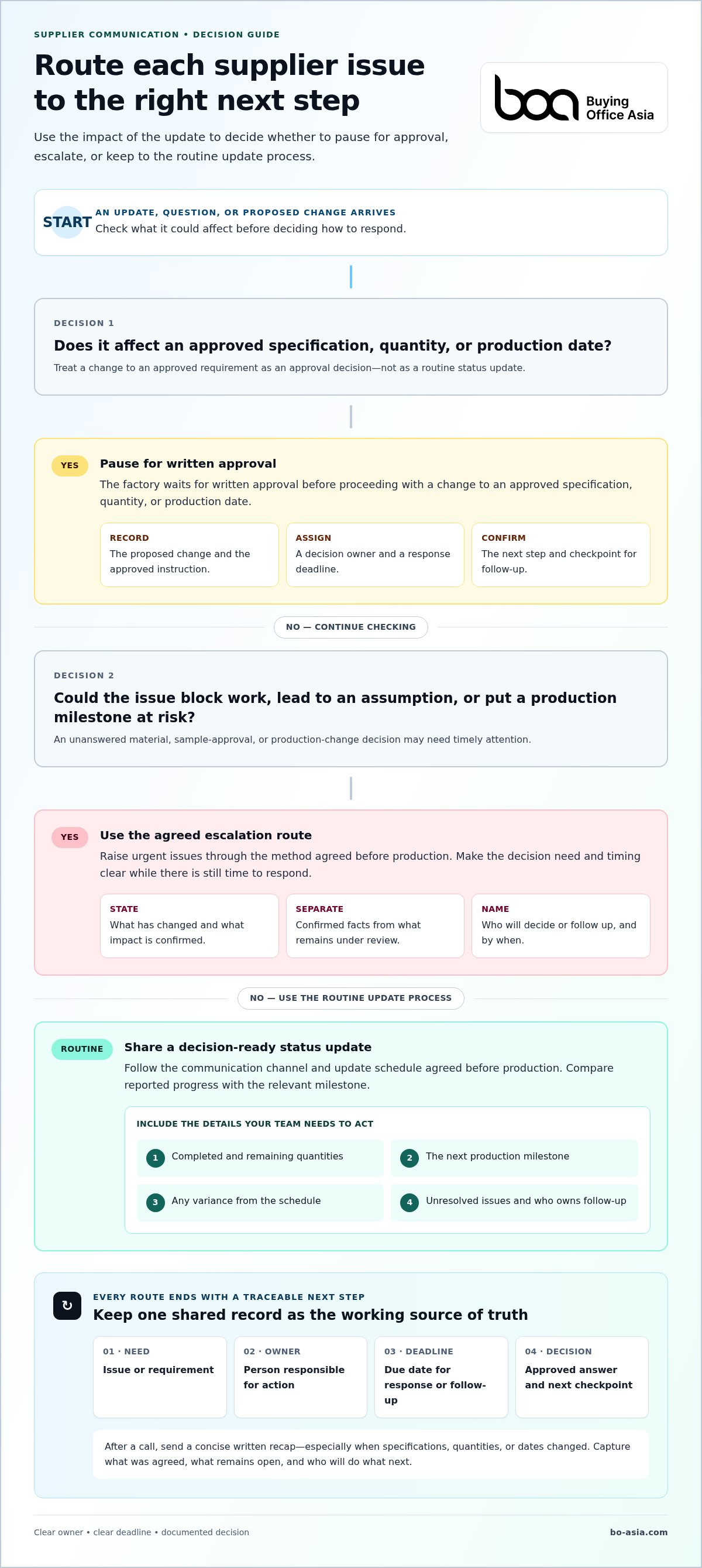
A misunderstanding becomes a production risk when people act on different versions of a requirement. Respond calmly and specifically: restate the issue, cite the approved record, ask one focused question, and agree on the next action. Before debating intent, confirm what the supplier understood and what work is affected.
Early escalation should surface options, not assign blame. The aim is to give both sides time to assess impact and decide what to do, not to turn a production issue into a dispute.
Refer to the approved specification, sample, drawing, or purchase-order detail, including the relevant version when one exists. Then ask the supplier to confirm their interpretation and the action they’ll take. If a deviation is proposed, document the change and obtain approval before work continues. This keeps assumptions from becoming factory instructions.
Keep four categories distinct in your update: confirmed facts, assumptions that still need checking, proposed fixes, and decisions awaiting approval. For example, a supplier’s estimate of a delay is not a confirmed revised completion date. Labeling the information accurately helps your team assess the situation without treating a possibility as a settled plan.
Set escalation triggers in advance. Raise an issue promptly if it affects product quality, an approved specification, a committed schedule, a compliance requirement, or ownership of a decision. Escalate when the responsible person is unclear or a response deadline passes while production remains blocked. Base the trigger on operational impact, not frustration with the person replying.
Make an escalation brief enough to act on. State the issue, its known production impact, the facts verified so far, and the decision or response needed by a specific deadline. Attach relevant photos, inspection findings, correspondence, or milestone records. Close with a clear request, such as approval of a proposed correction or confirmation of the revised production plan.
Separate observation from interpretation. A photo may show a visible defect, while the cause and affected quantity still require investigation. Say what the evidence demonstrates, what remains unknown, and what action is proposed. This gives the supplier room to investigate while keeping your decision grounded in verifiable information.
On-site quality control and inspections can add useful factory-floor context to written updates. Inspection findings connect a reported concern with what was observed, where it occurred, and what follow-up is required. That context supports a fact-based discussion and links corrective decisions to production oversight.
Pause affected work until the requirement or proposed deviation is clear and approved.
Ask for the impact, recovery options, and the decision needed to protect the next milestone.
Identify the decision-maker and set a response deadline so the issue doesn’t remain unattended.
If a production concern needs coordinated supplier follow-up, discuss your production oversight needs.
A clear process and suitable channels can resolve many communication gaps. Local procurement coordination may be useful when time-zone differences delay decisions, language nuance creates repeated clarification, production involves several linked stages, or the same issue remains unresolved after follow-up. The value is not more messages. It’s having someone connect supplier updates to what is happening at the factory and what your team needs to decide next.
Buying Office Asia has its headquarters in Hong Kong and a European leadership office in Helsinki. For international buyers, this combines regional presence with European leadership and can help connect written updates to production context and buyer priorities. It’s a practical consideration when deciding how to improve communication with your supplier across borders.
Supplier communication is more useful when updates are interpreted in context. A local procurement team can coordinate supplier reporting with production schedules and agreed responsibilities, helping clarify what a status update means for the next milestone. If a detail is unclear, local follow-up can help establish whether it reflects a confirmed production condition, an open question, or a decision that still needs buyer approval.
On-site inspections add direct observations to quality-related discussions. Rather than relying only on a brief written description, teams can use inspection findings to explain what was observed and connect it to the relevant requirement. This supports fact-based follow-up. A dedicated Asia procurement team can bring supplier coordination and production oversight together as an extension of your team, rather than another disconnected intermediary.
Start by mapping how information currently moves from the factory to your decision-makers. Note where updates arrive, who owns each response, which approvals tend to stall, and where issues recur. This review can show whether the gap is a missing contact, unclear decision authority, an unsuitable channel, or limited production visibility.
Bring those observations into a discussion focused on your production context and operational priorities. Identify which communication responsibilities need clearer ownership and where supplier updates should connect more closely with production follow-up. The aim is a workable process that supports your needs, not a new layer of reporting for its own sake.
Discuss your supplier communication needs and the coordination challenges affecting your production.
The next step in how to improve communication with your supplier is to identify one point where information regularly stalls. Is an approval waiting on the right person, or does a written update need factory-floor context before you can decide? Start there, then define what information would help you move forward.
For international production, local coordination can help connect supplier updates to what is happening on site. Buying Office Asia operates from Hong Kong with European leadership in Helsinki. On-site quality inspections and production oversight can add factory-level context, while supplier management supports ongoing coordination and follow-up. The aim is clear communication that fits your production priorities and keeps responsibility visible.
You don’t need to redesign every process at once. A focused discussion can help identify the gaps that matter most to your operation and practical next steps for addressing them. Explore a clearer approach to supplier coordination, and take the next step toward a more transparent, dependable working relationship.
Set communication frequency around the decisions and production milestones that need your attention. For a stable order, a regular progress review may be enough; during sampling or an active issue, check in when new information could change your next decision. Review the cadence when the order’s risk profile changes. Too many low-value updates can obscure important exceptions, while gaps around key decisions can leave you without time to respond.
Use a mix of channels, with a clear purpose for each. Discuss complex or sensitive issues in a call, then capture the outcome in writing. Use email or a shared system for approvals and controlled documents, and agree in advance how urgent issues will be raised. Across time zones, include the date, time zone, and requested action in each deadline so both parties know exactly when a response is due.
Make important requirements concrete and verify how they’ll be acted on. Instead of asking, “Can you make it like the sample?”, identify the relevant sample or document and state the feature that must match. Ask the supplier to explain their planned interpretation in their own words. If you use recurring technical terms, define them consistently so a phrase like “ready for inspection” means the same thing to both teams.
Follow up with a concise subject line that identifies the order and decision needed. Restate why the answer matters, then ask for a response by a time that protects the next production step. If there’s no reply, use the agreed backup contact or escalation route. Keep the request and attempts visible to your team, especially if the supplier’s silence leaves production waiting or forces a schedule decision.
Notify the supplier as soon as you have a credible concern, using the affected order and milestone as context. State what changed, what impact you can confirm, and what remains uncertain. Ask for a revised timeline and practical recovery options, such as whether work can be resequenced. Avoid presenting an estimate as a confirmed date. Once both sides agree on a revised plan, update the relevant production records and stakeholders.
Yes. A sourcing partner can coordinate follow-up, connect supplier updates to production priorities, and help clarify factory-level context for your decisions. This can be useful when communication repeatedly stalls or remote updates don’t explain what’s happening on the production floor. Buying Office Asia supports international companies manufacturing in Asia through sourcing, procurement, supplier management, production oversight, and on-site quality control, helping coordinate supplier communication as part of wider operational oversight.
Include enough context for the reader to understand the update without searching several message threads: the order or item, the reporting period, current status, and any change since the last update. Mark what is confirmed versus still being checked. If you need a decision, state the options and the consequence of waiting. For photos or files, identify what each attachment shows and which requirement or question it relates to.

A supplier listing is a lead, not proof that a factory can deliver. If you’re wondering how to find suppliers not on Alibaba, the answer isn’t simply to switch platforms. You need a repeatable process to identify manufacturers, distinguish factories from trading companies, and check whether each sup...

What can a showroom tell you about a supplier that a walk through the production floor cannot? Knowing how to prepare for a factory visit in Asia helps you look beyond polished presentations and assess whether the factory’s people, processes, and quality controls support the claims made during suppl...

The final cost of an import is shaped long before it reaches customs. If you wait until shipment to calculate duties and taxes, a budget based on the supplier’s price alone can quickly fall short. Managing import duties and taxes from Asia starts with decisions made during product planning, not at t...