

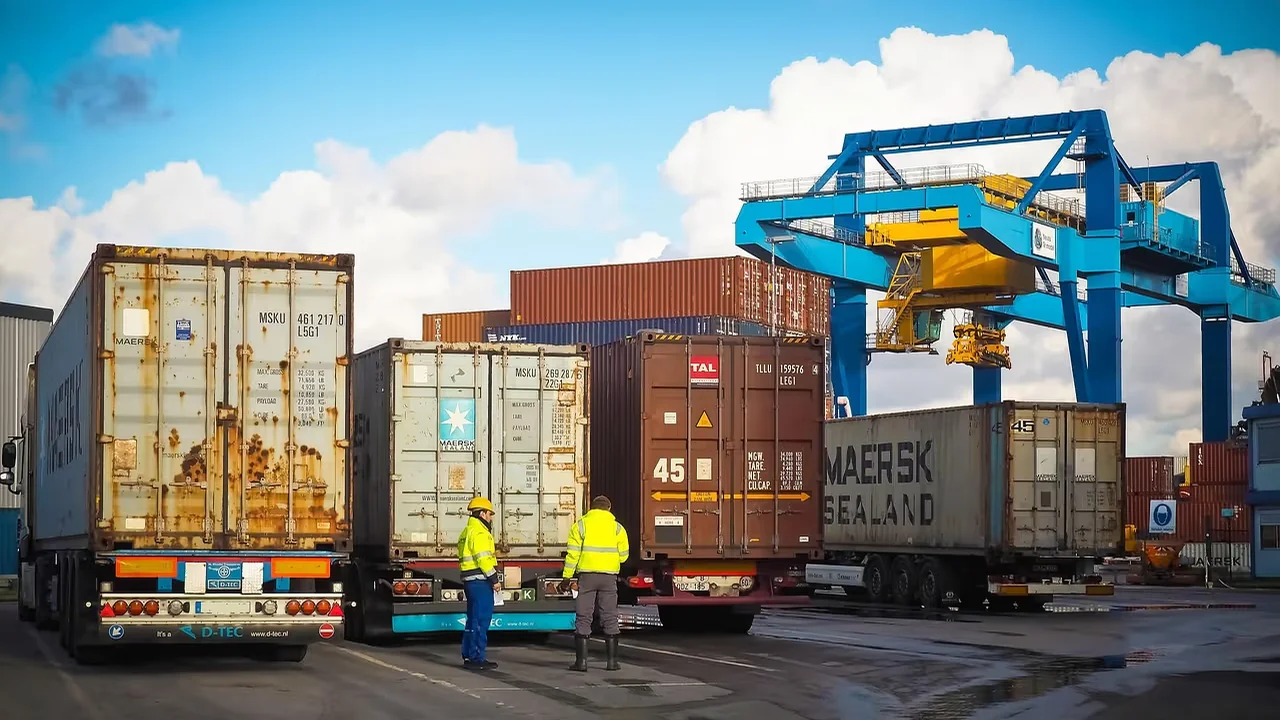
The final cost of an import is shaped long before it reaches customs. If you wait until shipment to calculate duties and taxes, a budget based on the supplier’s price alone can quickly fall short. Managing import duties and taxes from Asia starts with decisions made during product planning, not at the port.
You need a reliable estimate before approving production, but classification, country of origin, destination-market rules, and delivery terms can all affect what you pay and who pays it. Reduce uncertainty by gathering accurate product and shipment information early and checking it against current requirements.
This 2026 guide gives you a repeatable process to estimate, verify, and manage import charges before goods leave the factory. You’ll learn which records affect customs calculations, how delivery terms shape cost responsibility, and how to coordinate suppliers, logistics teams, and customs specialists. The result is a more defensible, product-specific landed-cost estimate and clearer accountability across your supply chain.
• Understand which factors shape landed cost, and separate customs charges from freight and service fees.
• Build a product-specific estimate using the destination, product details, classification, origin, customs value, and applicable rules.
• Compare delivery and import-planning approaches by cost visibility, documentation access, and clarity about who pays.
• Set pre-shipment checks at key milestones and assign clear owners to the records and decisions that affect charges.
• Managing import duties and taxes from Asia is easier when sourcing, production, and logistics information is coordinated before dispatch.
A factory quote can look predictable while the final import bill remains uncertain. Managing import duties and taxes from Asia starts with the product and its destination, because customs charges depend on details that should be documented before production is approved. Waiting until goods are ready to ship can leave little time to fix missing or inconsistent information.
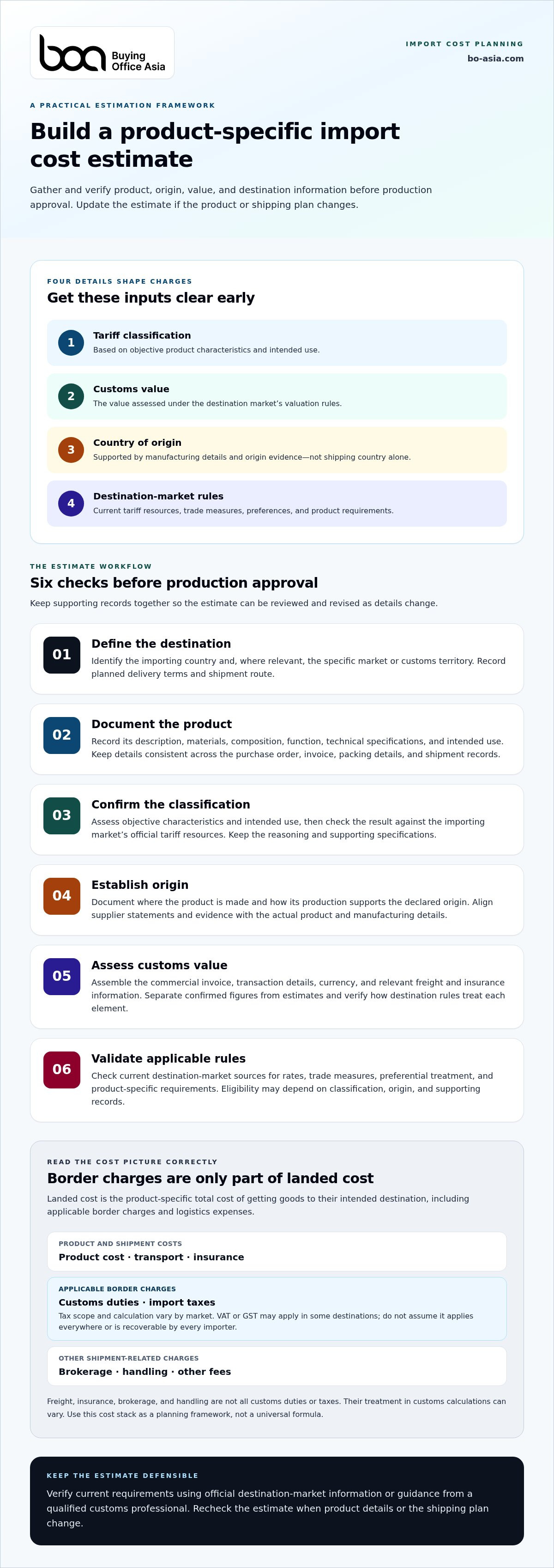
Landed cost is the product-specific total cost of getting goods to their intended destination, including applicable border charges and logistics expenses. It varies by product, destination, shipment plan, and the rules in force there. A supplier’s price or a freight estimate covers only part of that total.
Customs duty is a charge applied to imported goods under the destination market’s tariff rules. Import taxes are a separate category of border charges, and their scope and calculation vary by market. A tax such as VAT or GST may apply in some destinations, but don’t assume it applies everywhere or is recoverable by every importer. For background on how tariffs work, see Understanding Tariffs and Duties.
Freight, insurance, brokerage, and handling are not all customs duties or taxes. They may still contribute to the total cost of importing, and their treatment in customs calculations can vary. An illustrative cost stack might include product cost, transport and insurance, applicable customs duties and taxes, then brokerage, handling, and other shipment-related charges. The categories and calculation order depend on the shipment and destination, so use this as a planning framework, not a universal formula.
Four details deserve early attention: tariff classification, customs value, origin, and the destination market’s applicable rules. Classification identifies the product under the relevant tariff system. It depends on objective characteristics and intended use, so two products that look similar may be treated differently because of their materials, construction, or function. A broad supplier description may not provide enough detail to support a defensible classification.
Customs value is the value used under the destination’s rules to assess applicable charges. Origin evidence helps establish where goods qualify as originating under relevant rules. The country they ship from is not, by itself, conclusive proof of origin. Verify requirements and rates for the destination market using current official information or guidance from a qualified customs professional.
Before production, collect specifications, material details, intended use, supplier and manufacturing information, and a clear breakdown of product and shipment costs. Align those records with the planned destination and delivery terms. Asia-based procurement coordination can bring supplier, product, and logistics information together early. This groundwork makes estimates easier to review and helps identify documentation gaps before goods are ready to move.
A useful estimate is a documented calculation, not a percentage applied to a supplier quote. Managing import duties and taxes from Asia requires consistent product, value, origin, and destination data. Use these steps to build an estimate that can be reviewed before production is approved, then update it if the product or shipping plan changes.
Identify the country and, where relevant, the specific market or customs territory where the goods will be imported. Record the planned delivery terms and shipment route. The importing market determines which tariff resources and other rules to consult.
Gather a precise description, including materials, composition, function, technical specifications, and intended use. Don’t rely on a broad commercial label alone. Keep the description consistent across the purchase order, invoice, packing details, and other shipment records.
Assess the product using its objective characteristics and intended use, then check the classification against the importing market’s official tariff resources. Similar-looking goods can be classified or treated differently because their composition or function differs. Record the reasoning and supporting specifications.
Document where the product is made and how its production process supports the declared origin. Align supplier statements and origin evidence with the actual product and manufacturing details. Don’t assume the shipping country alone establishes origin or eligibility for preferential treatment.
Assemble the commercial invoice, transaction details, currency, and relevant freight and insurance information. The destination’s valuation rules determine which elements count and how they’re treated. Separate confirmed figures from estimates and verify the applicable method before calculating charges.
Check current destination-market sources for rates, trade measures, preferential treatment, and product-specific requirements. Eligibility may depend on classification, origin, and supporting records. For U.S.-bound goods, consult Tips from U.S. Customs and Border Protection; verify requirements separately for other markets.
Keep one working file with product specifications, commercial invoices, packing details, supplier statements, and origin evidence. Add the planned quantity, transaction value and currency, plus freight and insurance details as applicable. Compare the records for mismatches. For example, a material description that differs between a specification sheet and invoice can undermine the estimate and complicate document review.
Use the importing market’s official tariff tools or qualified customs guidance, and save the source and date of each check. Revisit the estimate when specifications, origin, destination, or shipment arrangements change. Reliable supplier records support this process: supplier information and vetting can help you collect product and production details early.
For a practical handoff, assign an owner to each record and flag items that still need verification rather than treating them as settled assumptions. Coordinating procurement details with shipment documentation makes the review more orderly. If your team is aligning Asia sourcing information before production, discuss your sourcing coordination needs.
The right planning model depends on your team’s import experience, shipment complexity, and access to product and customs records. Supplier-arranged delivery can simplify coordination, while buyer-managed importing can provide more direct document access. Specialist coordination can connect sourcing and logistics information, but it does not automatically make the coordinator responsible for customs declarations or taxes. Compare visibility and accountability, not just the headline quote.
| Approach | Cost visibility | Responsibility clarity | Documentation access | Unexpected-charge exposure |
|---|---|---|---|---|
| Buyer-managed importing | Potentially strong when the buyer gathers and reviews charges across the shipment. | Can be clear if the contract and delivery term assign tasks explicitly. | Direct access is possible, but the buyer must obtain complete supplier and carrier records. | Depends on the buyer’s ability to identify missing costs and verify destination rules. |
| Supplier-arranged delivery | May be less transparent if the quote bundles transport and import-related charges. | Varies with the agreed delivery term and written responsibilities. | Some underlying shipment records may be held by the supplier or its logistics partners. | Can arise if inclusions, exclusions, or local charges aren’t clearly stated. |
| Specialist-coordinated planning | Can improve visibility by bringing procurement, product, and logistics information together. | Clear when coordination duties are documented separately from importer obligations. | Can support consistent record collection across suppliers and shipment milestones. | Reduced through earlier review, but not eliminated; current rules and charges still need verification. |
Incoterms define specified delivery responsibilities between buyer and seller, including aspects of transport, risk transfer, and import or export formalities under the selected rule. The exact agreed term and named place matter. DDP generally places import-clearance responsibilities and associated costs on the seller, while buyer-managed arrangements leave the buyer to coordinate the responsibilities assigned to it. Neither label replaces destination-specific verification.
Before approving an order, align the purchase contract, shipping instructions, and customs documents. Confirm the delivery rule and version the parties have agreed to, and make inclusions and exclusions visible in the cost estimate. A delivery term is not, by itself, a customs ruling or a guarantee that every charge is captured.
Choose a level of coordination that matches your internal capacity. A team with established import processes may manage records directly. Supplier-arranged delivery may suit a shipment where responsibilities and inclusions are explicit. More complex sourcing or fragmented supplier records may benefit from specialist coordination that connects production and shipping information before dispatch.
When managing import duties and taxes from Asia, compare the estimate’s assumptions, document access, named owners, and potential exclusions alongside the quoted price. Buying Office Asia coordinates sourcing, production oversight, documentation, consolidation, and shipping requirements to support that handoff. Coordination does not automatically make a logistics partner the importer of record, customs broker, or tax adviser; confirm those roles under the agreed arrangement and applicable rules.
A landed-cost estimate needs a controlled handoff from product approval to customs preparation. Assign an owner to each decision and document what has been verified, what remains uncertain, and which records support the estimate. If product or shipment details change, this process prompts a review before dispatch rather than a last-minute scramble.
Check customs data for consistency before dispatch, not after arrival. Use these milestones to make that check part of the production process:
The product or engineering owner records the approved materials, function, specifications, and intended use. The classification owner reviews the proposed tariff classification using those details and saves the reasoning and source.
Procurement confirms that the purchase order identifies the correct goods, quantities, unit values, currency, supplier, destination, and agreed delivery terms. Assign an owner to origin evidence and confirm that it reflects the production arrangement.
The production or quality owner confirms that goods and packaging match approved specifications. Review substitutions, design changes, or labeling differences because they can affect product records and the estimate.
Logistics confirms shipment quantity, route, destination, freight and insurance details as applicable, and the named delivery term. The customs-document reviewer checks that the commercial invoice and packing list reflect the final order and actual shipment.
The designated reviewer reconciles the full document set. The owner of destination-market requirements rechecks applicable rules and rates against current official sources or qualified customs guidance. Resolve discrepancies before dispatch.
Compare the commercial invoice against the purchase order for product descriptions, quantities, values, and currency. Check packing details against the goods being shipped, including package counts and descriptions. Then compare classification and origin records with supplier statements, product specifications, and available production evidence. Every document should describe the same product and transaction, even when different teams prepare them.
Set a clear escalation rule: any change to specifications, supplier, origin, customs value, destination, or delivery terms pauses approval of the existing estimate until the responsible owner reviews it. Record assumptions, source dates, decisions, and reviewers. If a customs assessment differs from the estimate, compare its stated basis with the submitted records and refer unresolved classification or valuation questions to a qualified customs professional.
Base contingency planning on documented uncertainty, not an arbitrary standard percentage. List unresolved items, explain how each could affect the estimate, and update the forecast when official guidance or shipment facts change. This makes potential exposure visible without presenting an unverified buffer as a reliable calculation. Managing import duties and taxes from Asia is a shared workflow, so procurement, production, logistics, and customs-document owners need a clear handoff.
To coordinate supplier records and shipment requirements before dispatch, discuss your Asia sourcing coordination needs.
Import-cost planning depends on information created across the supply chain. Product specifications emerge during development and supplier discussions; production records may change as an order progresses; shipment documents are assembled closer to dispatch. Bringing these details together early gives your team a clearer basis for estimating costs and identifying gaps before goods leave the factory.
Buying Office Asia supports international businesses with supplier sourcing, procurement, factory inspections, production oversight, and logistics coordination. Its Hong Kong headquarters and European leadership office in Helsinki provide regional operating context and communication across the supply chain, not customs authority. Buying Office Asia’s regional presence helps connect factory-side information with the needs of international buyers.
Early supplier engagement helps gather product specifications and production details while decisions are still being made. Procurement records can then be compared with the approved product and planned order, rather than reconstructed from shipment paperwork later. During production oversight and quality inspections, changes in material, design, packaging, or quantity can be flagged for review before they affect final shipping documents.
That coordination doesn’t determine a tariff classification or replace destination-market verification. It makes the underlying facts more accessible to the importer and its customs or tax specialists. A dedicated team can also maintain communication among suppliers, procurement, production, and logistics so updates reach the people responsible for reviewing the estimate.
Set a named owner and clear handoff for each information stream. For example:
Procurement gathers supplier details, specifications, and production information, then flags changes for review.
The production or quality owner records approved goods, quantities, packaging, and any deviations before completion.
The logistics coordinator aligns shipment details, consolidation, documentation, and customs-related requirements with the agreed delivery plan.
The importer remains accountable for its import arrangements and works with qualified customs or tax specialists to verify classification, origin, valuation, and destination-market requirements.
Use one shared record set as the handoff point. Connect the purchase order and approved specifications to production updates and final shipment documents. If the goods, destination, or delivery plan changes, route that update to the owners before dispatch so the estimate and supporting records can be reviewed. This keeps managing import duties and taxes from Asia tied to actual product and shipment facts, rather than assumptions that no longer match the order.
Buying Office Asia coordinates sourcing, production oversight, inspections, and logistics information around your product and shipment plan, while customs decisions remain with the importer and its qualified specialists. To discuss your Asia sourcing requirements, share your sourcing and procurement needs.
For your next production decision, treat the landed-cost estimate as a working commercial record, not a one-time calculation. Keep its assumptions visible and revisit them when a product, supplier, destination, or shipment plan changes. This gives your team a stronger basis for comparing future orders and identifying cost exposure before it affects margins.
Managing import duties and taxes from Asia becomes more controlled when sourcing decisions and shipment information stay connected. The goal isn’t to predict every possible change. It’s to know which inputs shape your estimate, who owns each decision, and when a review is needed.
Buying Office Asia works alongside businesses manufacturing in Asia to coordinate sourcing and procurement with production and logistics requirements. If you’re planning an order and want a clearer view of how those activities fit together, discuss your Asia sourcing requirements. A disciplined plan can help you move into production with greater cost visibility and confidence.
Build a preliminary estimate using the destination market, product details, likely classification, origin, customs value, and current applicable rules. Managing import duties and taxes from Asia also means checking the estimate against the actual commercial arrangement. For example, compare the planned delivery term with the supplier’s quote to identify transport or import-related charges that may be excluded. Mark uncertain inputs clearly, then update the estimate when specifications or shipping plans change.
Yes. Rates or applicable trade measures can change after an order is placed, and the relevant treatment may depend on the destination’s rules and the timing of importation. A purchase order doesn’t necessarily lock in a future customs rate. Before dispatch, recheck official destination-market sources or consult a qualified customs professional. Keep the date and source of each rate check so your team can see whether an estimate relies on current information.
Commonly useful records include a commercial invoice, purchase order, packing list, product specifications, and documents supporting declared origin. Depending on the shipment and destination, you may also need transaction details and freight or insurance information. Check that descriptions, quantities, currency, and values agree across records. For example, if an invoice describes a component differently from the product specification, resolve the discrepancy before using those documents to support an estimate.
No. DDP generally assigns the seller responsibility for arranging import clearance and paying specified import-related costs under the agreed term, but it doesn’t guarantee that the buyer can never face a charge or dispute. The contract, named delivery place, local requirements, and how the shipment is handled all matter. Before accepting a DDP quote, clarify what it includes, how charges will be documented, and what happens if additional assessments arise.
Possibly, but recovery depends on the destination’s tax rules, your business’s registration and status, the type of goods, and whether you hold the required import records. Don’t assume that VAT, GST, or a similar tax applies in every market or is automatically recoverable. Ask a qualified tax professional to assess your circumstances and keep import declarations, invoices, and payment records organized to support any eligible claim.
Not necessarily. The customs value used to calculate charges may differ from the supplier’s product price alone, depending on the destination’s valuation rules and transaction details. Certain transport, insurance, or other elements may be treated differently under those rules. Use the invoice as a starting record, not proof that it represents the final customs value. Verify the applicable valuation method before relying on a landed-cost calculation.
The importer should make sure the classification declared for its goods is accurate, even when a supplier, logistics coordinator, or customs specialist provides information or support. A supplier’s product description can help, but it doesn’t settle the classification by itself. Base the review on the item’s actual characteristics and intended use, document the rationale, and seek qualified customs guidance when classification is uncertain or could materially affect the estimate.

A supplier listing is a lead, not proof that a factory can deliver. If you’re wondering how to find suppliers not on Alibaba, the answer isn’t simply to switch platforms. You need a repeatable process to identify manufacturers, distinguish factories from trading companies, and check whether each sup...

A supplier update that isn’t tied to an owner, a decision, and a next action can create more uncertainty than it removes. If you’re figuring out how to improve communication with your supplier, the answer isn’t simply to send more messages. It’s to make each exchange clear, accountable, and useful f...

What can a showroom tell you about a supplier that a walk through the production floor cannot? Knowing how to prepare for a factory visit in Asia helps you look beyond polished presentations and assess whether the factory’s people, processes, and quality controls support the claims made during suppl...