


Most supply chain failures don't happen because of a bad contract; they happen because of a slow drift into indifference. You've likely felt the frustration of a perfect first batch giving way to quality issues or unexplained price hikes that suddenly erode your margins. It's exhausting to feel like a low priority for the factory you depend on, especially when global shifts like the proposed 12.5% Section 301 tariffs are already tightening your bottom line. Learning how to manage a long-term relationship with a factory is the only way to transform a volatile cost center into a strategic asset that protects your brand's financial health.
We agree that transactional sourcing is a high-risk gamble that leaves you vulnerable to operational setbacks and hidden middleman costs. This guide provides the professional framework for turning those interactions into high-performing partnerships that offer stable pricing and consistent quality. We'll examine the mechanics of on-the-ground stewardship, technical transparency, and the regional expertise required to ensure your orders always take priority.
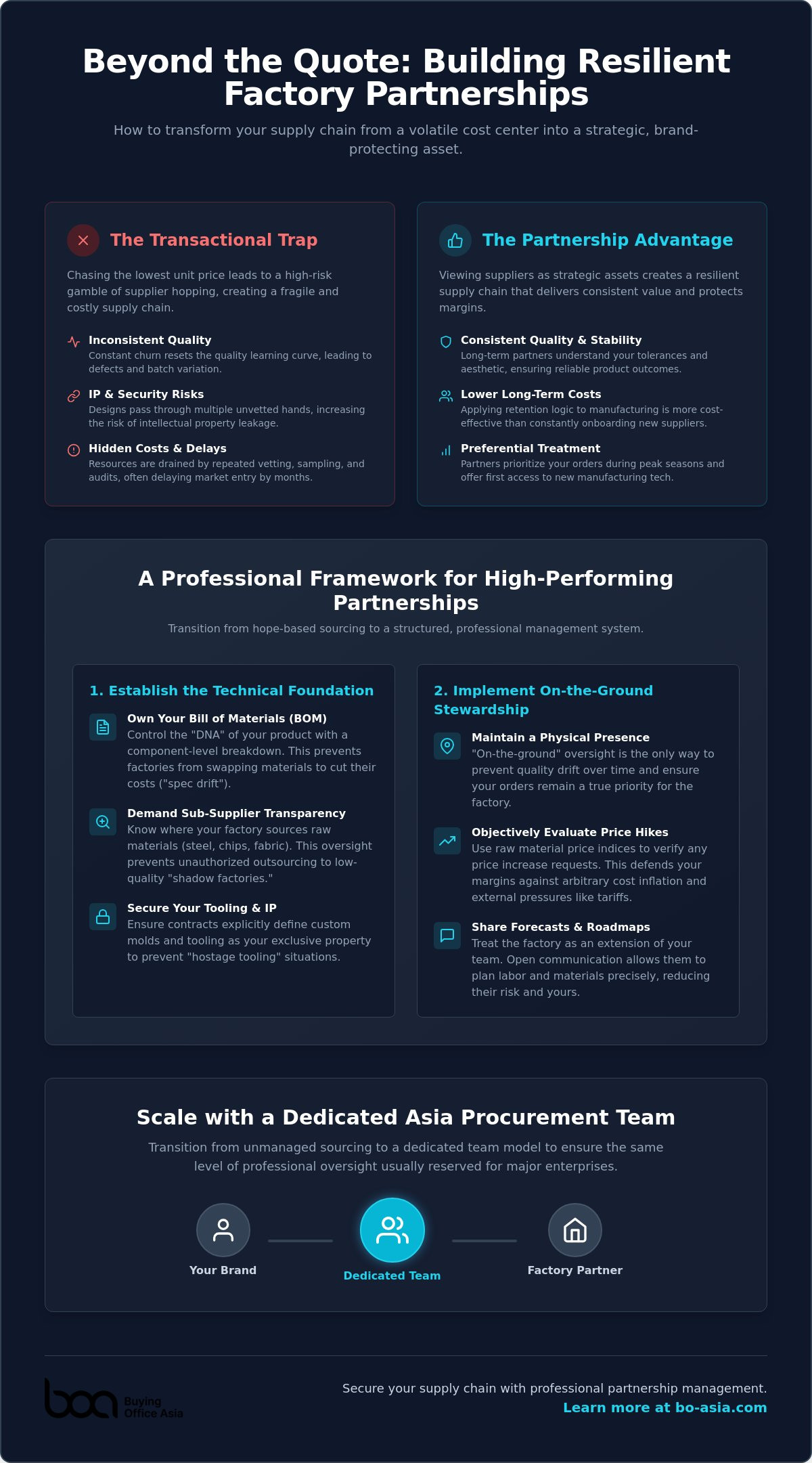
• Stop the cycle of supplier hopping; applying retention logic to your manufacturing base significantly lowers long-term procurement costs.
• Secure your product's DNA by maintaining full ownership of your Bill of Materials and demanding transparency regarding sub-suppliers.
• Discover how to manage a long-term relationship with a factory through on-the-ground stewardship that prevents quality drift and ensures your orders remain a priority.
• Defend your margins by using raw material indices to objectively evaluate price hike requests and eliminate arbitrary cost increases.
• Transition from unmanaged sourcing to a dedicated team model to ensure the same level of oversight usually reserved for major enterprises.
Chasing the lowest unit price is a common strategy that often leads to what we call the transactional trap. This cycle of supplier hopping creates a volatile environment where quality remains inconsistent and supply chains are perpetually fragile. High-performing brands understand that the most profitable manufacturers aren't those who offer the lowest initial quote, but those who grow alongside your business. Mastering how to manage a long-term relationship with a factory requires viewing the supplier as a strategic asset rather than a replaceable vendor. When you commit to a partner, you move beyond simple buying and into the territory of professional Supplier Relationship Management.
The logic of customer retention applies directly to the manufacturing floor. It's far more cost-effective to develop an existing supplier than it is to constantly vet and onboard new ones. Supplier development is a strategic investment in your own brand equity. Over time, these bonds lead to preferential scheduling and a first look at new manufacturing technologies. When a factory sees you as a permanent fixture in their production schedule, they are more likely to prioritize your orders during peak seasons or global disruptions.
Every time you switch factories, you reset the quality learning curve. A new team doesn't know your specific tolerances or aesthetic preferences. This churn drains resources through repeated sampling and the constant threat of IP leakage. When your designs pass through multiple unvetted hands, your intellectual property becomes a liability. The time required to conduct thorough supplier vetting and factory audits, verify compliance with updated 2026 labor regulations, and finalize prototypes can delay your market entry by months. These delays often cost significantly more than the few cents saved on a unit price.
Treating a factory as an extension of your own team changes the operational dynamic. This shift requires a psychological change in how you communicate. By sharing growth forecasts and maintaining open-book transparency, you allow the factory to plan its labor and material procurement with precision. This clarity reduces the risk of the factory cutting corners when their capacity is pushed to the limit. Shared goals create a defensive barrier against operational setbacks. When the factory understands your long-term roadmap, they become a protective partner in your supply chain rather than a source of hidden costs and friction.
A Bill of Materials (BOM) functions as the definitive DNA of your product. If you don't possess a granular, component-level breakdown, you don't truly own your manufacturing process. Understanding how to manage a long-term relationship with a factory begins with this technical document. It lists every raw material, sub-component, and assembly requirement. Without a controlled BOM, you're vulnerable to "spec drift," where a factory quietly swaps high-grade components for cheaper alternatives to protect their own margins against rising costs. This is particularly relevant as manufacturers face new pressures, such as the 2026 updates to China's Work Safety Law which mandate specialized safety funds and increase operational overhead.
Securing transparency regarding sub-suppliers is equally critical. You must know where your factory buys its steel, chips, or fabric. This oversight prevents unauthorized outsourcing to "shadow factories" where quality control is non-existent. To maintain this level of detail, your Product Specification Sheets must be living documents. They should evolve with every production cycle, documenting every adjustment made to tooling or assembly. This technical rigor eliminates the "hidden tax" of unmanaged middlemen who often obscure the true cost of production to justify their own markups.
Custom tooling and molds represent a significant capital investment. You must ensure that every contract explicitly defines these assets as your exclusive property. In poorly managed relationships, "hostage tooling" becomes a common threat. This occurs when a factory refuses to release molds because they feel you're "trapped" by the cost of starting over. By documenting ownership from day one, you maintain the leverage needed to protect your brand. Our expertise in OEM & ODM manufacturing services ensures that your designs and physical assets remain legally and operationally secure throughout the product lifecycle.
Building trust doesn't mean accepting "trust me" as a business strategy. Professional buyers ask for a breakdown of material costs, labor, and overhead. You can frame these requests around financial viability; by understanding their cost drivers, you can work together to find efficiencies rather than just demanding lower prices. This open-book approach is essential for long-term stability. Transparency is the antidote to supply chain anxiety. When you eliminate the guesswork, you create a predictable environment where both parties can thrive. If you're ready to secure this level of oversight for your production, you can speak with our regional experts to begin auditing your current supplier transparency.
Distance is the primary enemy of manufacturing consistency. The phrase "out of sight, out of mind" isn't just a cliché; it's a documented financial risk in international procurement. When you manage a supply chain from a laptop thousands of miles away, the factory's attention naturally shifts to the clients who are physically present on their production floor. Understanding how to manage a long-term relationship with a factory involves recognizing that physical proximity is the only true defense against quality drift. Professional stewardship requires a consistent presence to ensure your standards don't slide as the relationship matures.
This approach isn't about "policing" a factory through aggressive confrontation. It's about providing the oversight and technical support they need to maintain peak performance. A local team that speaks the language and understands the regional business culture acts as a vital bridge. They interpret nuances and identify production bottlenecks that an email or video call cannot capture. By having an expert team on the ground, you shift the dynamic from a distant buyer to a partner who is deeply integrated into the factory's daily operations. This presence ensures your orders remain a high priority, even when the facility is reaching its capacity limits.
Annual audits are a non-negotiable requirement for a secure supply chain, even if a supplier has performed well for years. These checks ensure the factory hasn't quietly outsourced your production to "shadow factories" where quality control and labor standards are unmanaged. Consistent oversight protects your brand from the reputational risks associated with unvetted facilities. To learn more about the technical requirements of this process, see our guide on Mastering Supplier Vetting in Asia. Regular audits also verify compliance with evolving local laws, such as Thailand's fully revised national air quality standards issued in January 2026.
Effective mass production oversight relies on "In-Line" inspections. By catching errors while products are still on the assembly line, you prevent an entire batch from being ruined by a single recurring defect. There's also a significant psychological impact; when factory workers and floor managers know a professional inspector is scheduled to arrive, the overall attention to detail naturally increases. We utilize a "European Management, Local Presence" model to combine high-level corporate standards with the regional expertise needed to navigate complex manufacturing environments. This provides the same level of accountability you'd expect from your own domestic team, but with the physical proximity required to manage how to manage a long-term relationship with a factory effectively.
One of the most persistent fears in procurement is the belief that staying with a single supplier leads to inevitable price inflation. You might worry that once a manufacturer realizes you're committed, they'll leverage your loyalty to push for arbitrary increases. This is a valid concern, but it's one that only affects unmanaged supply chains. Learning how to manage a long-term relationship with a factory effectively means replacing these anxieties with a rigorous, data-driven framework. When a price hike request arrives, it shouldn't be a negotiation of wills; it should be an audit of verified indices. True partnership relies on the understanding that costs must be justified by market realities, not just a desire for higher margins.
Managing this friction requires a balance of professional rigor and ethical standards. Protecting your brand isn't just about the unit price; it's about ensuring your partners adhere to evolving regulatory landscapes. For example, China's Work Safety Law was updated in 2025-2026 to mandate stricter safety funds and workplace improvements. A factory that invests in these areas is protecting your brand from the reputational risks of a supply chain disaster. Long-term brand protection is built on this foundation of mutual accountability and shared ethical goals.
Professional procurement teams don't accept "rising costs" as a blanket justification for price hikes. Instead, they cross-reference requests against verified market data. As of March 2026, industrial electricity rates in China averaged $0.08 per kWh, while manufacturing labor costs were approximately $6.69 per hour in April 2026. If a factory's request doesn't align with these benchmarks or specific raw material indices, you have the leverage to push back. Utilizing Factory Direct Price Negotiation Tactics allows you to counter unfair increases with precision. The goal is "Shared Savings," where you and the factory collaborate to find operational efficiencies that protect both your margins and their financial health.
Quality drift is an operational reality, not an automatic reason to terminate a partnership. A "blame-first" culture often destroys the very loyalty you've worked to build. Instead, use a Corrective Action Plan (CAP) to address failures professionally. This process identifies the root cause of a defect and mandates specific procedural changes to prevent recurrence. It transforms an inspection from a simple rejection into a tool for continuous improvement. However, you must also identify the red flags. If a factory repeatedly ignores CAP requirements or fails to meet basic ESG standards, it's a clear sign that the relationship is no longer viable. Maintaining this balance is the core of how to manage a long-term relationship with a factory. If you're currently facing unexplained price hikes or deteriorating quality, reach out to our procurement specialists to implement a data-backed defense for your supply chain.
Scaling high-volume manufacturing requires a shift from passive oversight to active stewardship. A part-time manager at your domestic headquarters simply cannot navigate the complexities of how to manage a long-term relationship with a factory once production reaches a professional scale. The "Dedicated Team" model functions as a seamless extension of your own procurement department. This approach provides the regional expertise and physical presence needed to defend your margins and brand reputation. By operating with a Hong Kong headquarters and European leadership from Helsinki, we provide a bridge between Western business standards and Asian manufacturing realities. This structure eliminates the hidden costs of unmanaged middlemen and restores 100% control to the brand owner.
This model is designed to alleviate the anxieties of international trade by providing a stabilizing force in a complex market. You don't just get a connection; you get a defense against the operational setbacks that affect unmanaged supply chains. Having a team that understands both your brand's financial health and the factory's operational constraints ensures that your growth is never compromised by supply chain volatility. It's the difference between being a customer and being a priority partner.
The financial viability of professional procurement is best seen in risk mitigation. Preventing a single defective batch of high-volume goods can save your brand from catastrophic financial loss. In many cases, the cost of one failed production run exceeds the entire annual expense of a dedicated sourcing team. This level of security is why "European Oversight" remains a signature promise of our service delivery. You can review documented outcomes and performance history in our Savings Examples and Case Studies to see how this model stabilizes financial health for independent business owners.
Transitioning from Alibaba-style searching to professional procurement is the first step toward securing your supply chain. Long-term success isn't about finding the cheapest vendor; it's about developing a high-performing manufacturing partner. This strategy must also include logistics and shipping management to ensure your goods move efficiently from the factory floor to your warehouse. By coordinating every step of the process, you eliminate the friction that typically affects unmanaged sourcing. This is the ultimate framework for how to manage a long-term relationship with a factory while scaling your operations. If you're ready to move beyond transactional sourcing and secure your supply chain, you can book a consultation for your dedicated sourcing team today.
Successful sourcing isn't defined by the success of the first batch; it's defined by the stability of the hundredth. We've established that technical transparency, rigorous on-the-ground presence, and data-backed negotiations are the only ways to protect your brand's financial health. By maintaining control over your Bill of Materials and utilizing regular audits, you eliminate the risks of quality drift and arbitrary cost increases that often plague unmanaged supply chains. Mastering how to manage a long-term relationship with a factory is what separates elite brands from those trapped in a cycle of expensive supplier churn.
Our European-managed team brings 15+ years of on-the-ground expertise to your procurement strategy, acting as an integrated extension of your own department. We operate with 100% transparency and zero hidden middleman commissions, providing full-service oversight from initial vetting to final logistics coordination. This professional rigor ensures your orders remain a priority in a complex global market. Secure your supply chain with a Dedicated Asia Procurement Team and turn your manufacturing base into a predictable, high-performing asset. Your path to operational efficiency starts with a partner who prioritizes your stability.
You should conduct a formal on-site audit at least once per year to maintain accountability. However, high-volume production requires more frequent oversight to prevent quality drift. Relying on an on-the-ground team to perform monthly check-ins ensures that your standards remain a priority. This physical presence is the most effective way to understand how to manage a long-term relationship with a factory without the expense of constant international travel.
The most effective method is implementing an index-based pricing framework. Instead of accepting arbitrary increases, tie your costs to verified raw material and utility indices. For instance, if a supplier in China cites rising overhead, cross-reference their claim against the $0.08 per kWh industrial electricity rate or the $6.69 per hour average manufacturing labor cost recorded in April 2026. Data-driven negotiations prevent factories from inflating their margins.
Managing high-volume production yourself often leads to operational blind spots and quality drift. Traditional sourcing agents frequently charge hidden commissions, which obscures your true costs and creates a conflict of interest. A dedicated Asia procurement team functions as a seamless extension of your own company. This model provides the oversight of a local office with the transparency of a direct relationship, ensuring you maintain 100% control over your supply chain.
Quality drift is often a sign that the factory has deprioritized your account or quietly swapped sub-suppliers. You must immediately implement a Corrective Action Plan (CAP) to identify the root cause of the failure. This professional framework mandates specific procedural changes rather than just rejecting the batch. Consistent on-site inspections are essential to understand how to manage a long-term relationship with a factory while catching errors before they affect your inventory.
You can distinguish between the two by examining their business license and performing a physical factory audit. Trading companies often have "consulting" or "trading" listed in their scope of business rather than "manufacturing." A direct factory will have specialized production equipment and a dedicated workforce on-site. Verifying these details through a regional presence ensures you aren't paying an unnecessary markup to an intermediary who adds no manufacturing value.
While a primary relationship offers efficiency, a "China Plus One" strategy is essential for supply chain resilience. Diversifying production to hubs like Vietnam, where labor costs were approximately 50% lower than China in 2025, mitigates geopolitical and tariff risks. Maintaining a secondary supplier ensures you aren't paralyzed if your main facility faces disruptions. This balance allows you to enjoy the benefits of longevity while protecting your brand from single-point failures.
You need a bilingual Non-Disclosure, Non-Use, and Non-Circumvention (NNN) Agreement and a comprehensive Manufacturing Agreement. These documents must be enforceable in Chinese courts to provide actual protection. They should clearly define ownership of your intellectual property and custom tooling. Without these legal safeguards, you risk "hostage tooling" or IP leakage, which are common pitfalls in unmanaged long-term relationships with Asian manufacturers.
Ensure compliance by conducting regular audits that specifically target labor conditions and environmental impact. China's updated Work Safety Law (2025-2026) now mandates specialized safety funds, making it easier to verify a factory's commitment to workplace safety. In India, the 2026 Quality Control Order provides a window for compliance in key sectors like toys and electronics. Monitoring these regional regulatory shifts ensures your partners meet the ethical standards required for modern brand protection.

A supplier listing can open a door, but it can’t show whether a factory is right for your order. Choosing a ningbo sourcing agent means looking beyond access to local suppliers: you need clear oversight of supplier vetting, production follow-up, and quality checks. Without defined responsibilities,...

What if the supplier with the strongest online profile isn’t the factory best suited to your shoes? In footwear manufacturing in China, a directory listing can start your search, but it can’t confirm who will make your product, whether the factory can handle its construction and materials, or how cl...
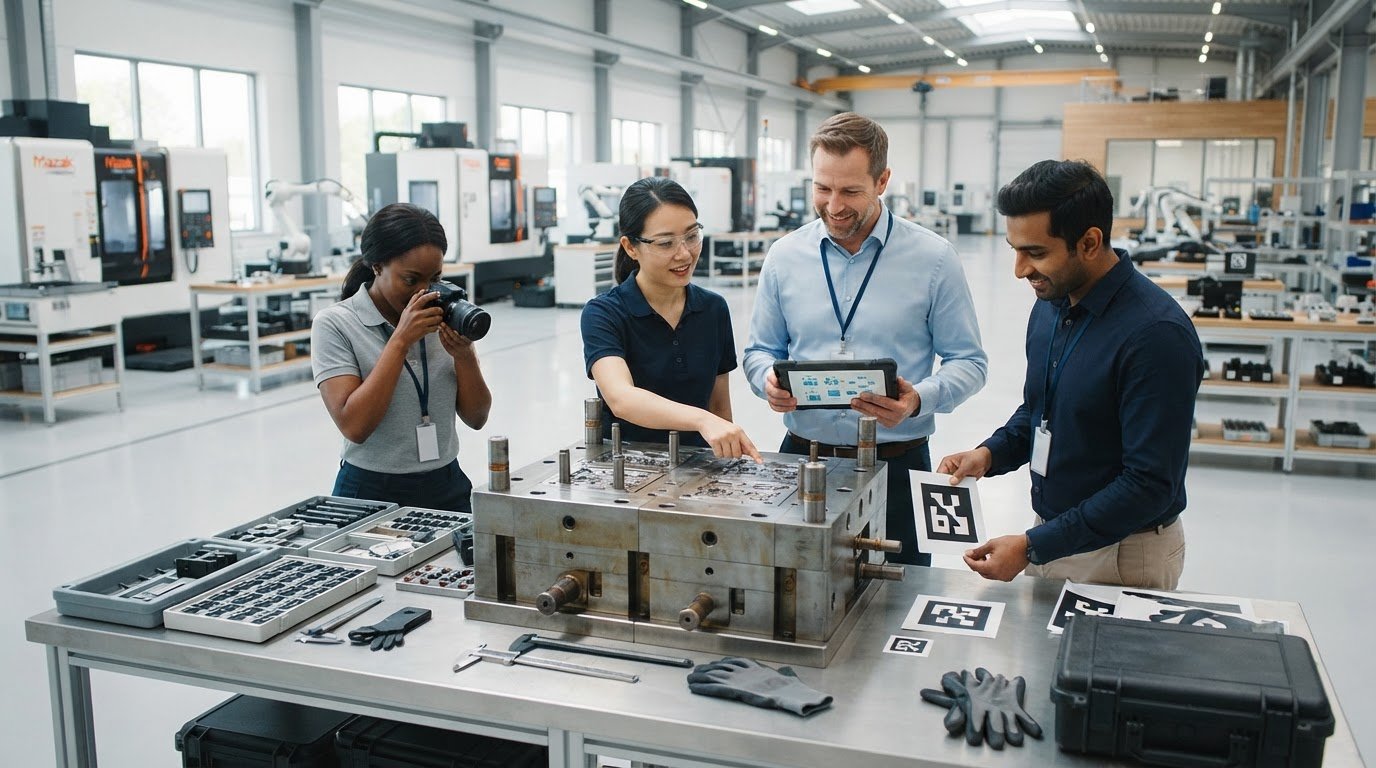
What if the mold you paid to develop couldn’t be released when you needed to change suppliers? Managing tooling and molds with a foreign factory means more than tracking where production equipment is stored. Payment alone may not establish clear ownership, access, or transfer rights. Without visibil...