


Could a single missing decimal point on your spec sheet trigger a 50% customs penalty or a $10 million product recall? Under the 2026 Strengthening Customs Enforcement executive order, the margin for error in international procurement has effectively vanished. You likely feel the constant pressure of "lost in translation" errors or the anxiety that a factory might substitute materials to pad their own bottom line. It's a common concern for business owners who lack a technical engineering background but need absolute precision to protect their investment.
This guide will show you how to write a product specification sheet for manufacturers that functions as a legally binding shield for your brand. By mastering this document, you'll transform a simple list of features into a rigorous quality benchmark that reduces defect rates and provides clear legal grounds for disputes. We'll examine the essential technical requirements for 2026, including the latest ISO 9001 risk integration standards, to ensure your production remains a stable asset rather than a financial liability.
• Establish a "contractual anchor" by detailing every physical and functional requirement, ensuring your factory treats your document as the final word in quality disputes.
• Learn exactly how to write a product specification sheet for manufacturers that utilizes high-fidelity 3D CAD models and clear versioning to eliminate production ambiguity.
• Protect your margins by specifying material standards that prevent unauthorized substitutions and costly "lost in translation" errors during overseas production.
• Use a step-by-step framework to align engineering, marketing, and logistics requirements into a single, foolproof technical document.
• Discover why on-the-ground enforcement is critical to transforming your technical drawings into successful mass production outcomes.
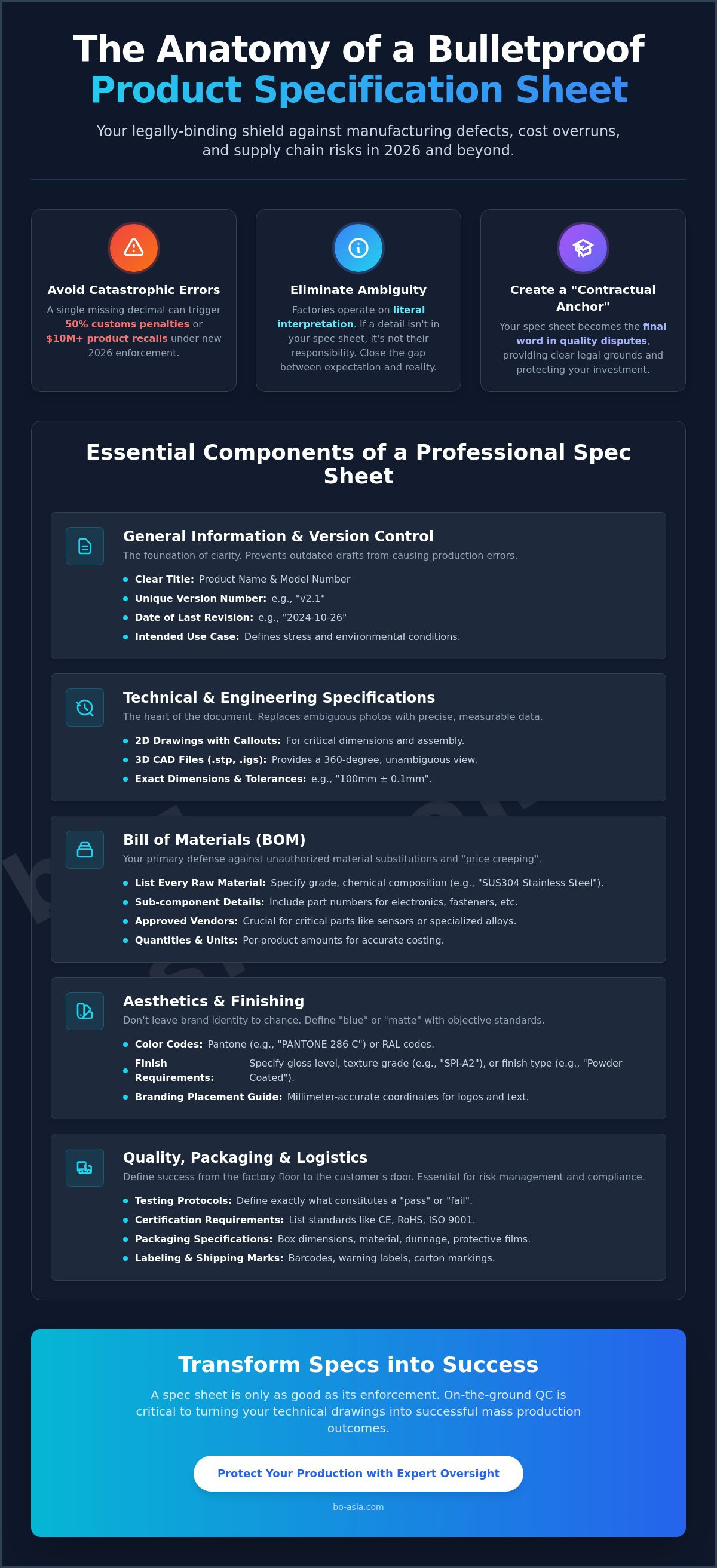
A product specification sheet is a comprehensive Specification (technical standard) that details every physical, functional, and aesthetic requirement of your product. Think of it as the DNA of your brand's physical assets. In the complex environment of Asian manufacturing, this document serves as your "Contractual Anchor." It's the final word in any quality dispute. Factories in regions like China or Vietnam operate on a literal interpretation of instructions. If a detail isn't in the spec, it isn't the factory's responsibility.
Many businesses make the mistake of assuming a physical prototype is enough. It's not. A sample is a static reference; a spec sheet is a dynamic set of rules. Ambiguity is the fastest way to lose money. One missing tolerance or a vague material description can lead to thousands of dollars in wasted scrap. Mastering how to write a product specification sheet for manufacturers is about closing the gap between your expectations and the factory's output, a process that can be enhanced for hardware brands by collaborating with experts like Keiteq Co Ltd who specialize in end-to-end manufacturing solutions.
A professional spec sheet typically includes:
• Exact dimensions and allowable tolerances.
• Material grades and chemical compositions.
• Color codes (Pantone/RAL) and finish requirements.
• Packaging, labeling, and shipping markings.
• Testing protocols and certification requirements.
Detailed specs are your primary defense against "price creeping" during the production cycle. When you provide an exhaustive document, you lock in component costs from the start. This transparency allows you to compare quotes accurately across multiple vetted suppliers. Without this level of detail, factories might quote low initially and then raise prices later, claiming your requirements were "unforeseen" or "specialized." It's about establishing a baseline that prevents your margins from being eroded by hidden costs.
Your brand's reputation depends on safety and regulatory compliance. A spec sheet establishes the specific benchmarks for on-site quality control & inspections. By defining exactly what constitutes a "pass" or "fail," you reduce the "anxiety gap" between your leadership team and the production line. This is especially critical in 2026 as global trade regulations like the China RoHS expansion tighten. Precise documentation protects you from safety recalls and ensures your goods meet the rigorous standards of your target market without the need for constant, stressful oversight.
A professional spec sheet isn't a mere description; it's a technical blueprint that leaves zero room for factory interpretation. When learning how to write a product specification sheet for manufacturers, you must prioritize version control. Every document should feature a clear title, a unique version number, and the date of the last revision. This ensures that the factory floor is working from the most recent engineering updates rather than an outdated draft. You should also define the intended use case, which helps the manufacturer understand the stress and environmental conditions the product will endure.
Technical drawings are the heart of this document. Relying on photos or sketches is a recipe for failure in 2026. You need 2D drawings with clear callouts and 3D CAD files that provide a 360-degree view of every component. These essential components of a spec sheet must be paired with specific aesthetic requirements. Don't just ask for "blue" or "matte." Specify the exact Pantone or RAL color codes and the required finish type, such as a specific gloss level or texture grade. If you have branding, include a placement guide with millimetre-accurate coordinates.
To ensure your visual identity is optimized for market leadership before it reaches the factory floor, you may want to learn more about Phoenix Design and their branding expertise for SMEs.
The Bill of Materials is where most amateur spec sheets fail. You must list every raw material, sub-component, and even the software version for electronics. To prevent "unauthorized substitutions," specify approved vendors for critical parts like capacitors, sensors, or specialized alloys. If a factory swaps your specified Japanese steel for a cheaper local alternative, your BOM is your primary legal evidence for a dispute. Always list quantities and unit measurements clearly to facilitate accurate mass production planning.
Perfect manufacturing is an impossibility. You must define what "acceptable" looks like by setting measurement tolerances. For instance, a dimension might be 50mm with a tolerance of +/- 0.5mm. Without these boundaries, a factory can argue that a significant deviation is still within "standard" limits. These tolerances should be directly linked to your mass production oversight protocols, giving your quality control team a clear "pass/fail" metric on the factory floor.
Logistics failure can be just as costly as production defects. Your spec sheet must detail the retail packaging materials, dimensions, and the results of required drop tests. Include high-resolution artwork for compliance labelling, such as CE, RoHS, or FCC marks, based on your target market's 2026 regulations. If you're concerned about how these technical details translate to the factory floor, you can speak with our regional experts to ensure your documentation is airtight before the first unit is produced.
Simple English descriptions are a liability in international manufacturing. When you're managing production across borders, the "Lost in Translation" trap is real. It isn't just about language; it's about technical alignment. For example, a European ISO standard for steel may not have a direct equivalent in the Chinese GB (Guobiao) system. Without specific cross-referencing in your documentation, the factory might select a "close enough" material that fails your stress tests. Mastering how to write a product specification sheet for manufacturers means you must eliminate these linguistic and technical ambiguities before the first machine starts running.
Visual data must always take precedence over long paragraphs. Annotated photos, flowcharts, and 3D exploded views communicate your requirements far more effectively than text ever could. This is especially true for material compliance. With the 2026 expansion of the China RoHS catalogue adding 23 new product categories, your documentation must be explicit about chemical compositions to avoid regulatory rejection. However, even the most detailed document needs a physical anchor. This is the "Golden Sample." It's the pre-production unit that you and the factory have both signed off on. If the final mass production deviates from this sample, your written spec sheet provides the legal leverage to demand a rework or refund.
You must enforce a strict adherence to the Metric system and universal engineering symbols. Avoid all regional idioms or vague terms like "heavy-duty" or "high-quality." Instead, define "Critical-to-Quality" (CTQ) features. These are the specific dimensions or functions that the factory must never compromise. By using clear, non-idiomatic language, you ensure that your requirements remain intact even after they've been translated into the local dialect of the shop floor.
Intermediaries and traditional trading companies often obscure technical requirements to protect their own margins or simplify their workload. This creates a dangerous communication gap. To protect your brand, you need a dedicated Asia procurement team that verifies spec understanding directly with the factory engineers. Direct-to-factory communication ensures that the people actually building your product see your specifications, not just a sales representative who might over-promise on the factory's actual capabilities. This level of oversight is your best defense against the operational setbacks that plague unmanaged supply chains.
Creating an airtight document requires a systematic approach that bridges the gap between your vision and the factory's technical capabilities. When you're determining how to write a product specification sheet for manufacturers, you'll find that Step 1 is about internal alignment. You must gather requirements from three primary stakeholders: Engineering for technical performance, Marketing for aesthetic brand standards, and Logistics for packaging dimensions. This ensures that your spec sheet accounts for everything from the circuit board layout to the exact palletization requirements needed for container optimization.
Step 2 involves creating high-fidelity 2D and 3D CAD models. These files are the only universal language in a factory environment. Once your drawings are finalized, Step 3 is to compile a Bill of Materials (BOM) that specifies precise material grades. Don't simply list "aluminum"; specify the exact alloy grade to prevent unauthorized substitutions. Step 4 is perhaps the most critical in 2026: defining testing protocols. With 73% of manufacturing quality leaders reporting a product recall within the last five years, your documentation must include mandatory compliance tests, such as the IEC 62368-1 standard for electronics or the latest China RoHS requirements. Finally, Step 5 is to review and iterate your document with an on-the-ground sourcing partner who can verify that the factory's machinery is actually capable of meeting your stated tolerances.
Your spec sheet should describe what the product must do, not just what it is. Detail the user interactions and, more importantly, define the failure modes. What happens if a button is pressed 10,000 times? What is the acceptable battery degradation after one year? You should conclude this section with a single sentence defining the "Success Criteria" for the finished unit. This creates an objective benchmark that prevents the factory from shipping sub-standard goods under the guise of "standard variance."
The ultimate goal of your spec sheet is to serve as the foundation for on-site factory inspections. You must convert every technical requirement into a clear checklist item. Categorize potential defects into "Critical," "Major," and "Minor" based on your spec. A critical defect might be a safety violation that triggers a 50% customs penalty under the 2026 Strengthening Customs Enforcement order, while a minor defect might be a slight color deviation. Establishing this hierarchy before mass production begins ensures that your quality control team has the authority to reject a shipment before it leaves the port. If you're ready to secure your production line with professional documentation, contact our procurement team today to start the vetting process.
Even the most meticulously drafted document is merely a suggestion without physical enforcement on the factory floor. While understanding how to write a product specification sheet for manufacturers is a critical first step, the true value of that document is realized during the production cycle. Buying Office Asia transforms your technical requirements into an operational reality. We specialize in custom product & tooling development, ensuring that the precision you've engineered into your CAD files is mirrored in the final steel molds. Our team acts as your stabilizing force, bridging the gap between sophisticated European design and the practicalities of Asian manufacturing.
The financial impact of a professional spec sheet is measurable. In a recent project, our engineers reviewed a client's initial technical draft and identified over-specified raw materials that didn't contribute to the product's longevity but significantly inflated the price. By refining the material standards to use high-performance local equivalents that met all safety benchmarks, we saved the client 15% in material costs. This wasn't a compromise on quality; it was an optimization of the supply chain based on regional expertise that the client previously lacked.
Our engineers don't just read your document; they stress-test it for "manufacturability." We review your tolerances and material choices to ensure they're compatible with the machinery available at our vetted suppliers. By identifying potential material substitutions before a factory has the chance to suggest them, we maintain the integrity of your brand. This proactive review also ensures your specs align with 2026 regional regulatory standards, protecting your shipments from the heightened customs scrutiny and penalties mentioned in previous sections.
We integrate your technical requirements directly into our factory direct price negotiations. This ensures that the quote you receive is based on the exact materials and tolerances you've defined, rather than a "stripped-down" version of your product designed to hide factory margins. Our mass production oversight ensures that every unit coming off the line matches the "Golden Sample" you approved. To secure your supply chain and eliminate the anxiety of international production, contact Buying Office Asia to integrate our expertise into your next project and ensure your specs lead to success.
A masterfully crafted spec sheet is your brand's first line of defense against the volatility of international trade. By mastering how to write a product specification sheet for manufacturers, you move from a position of vulnerability to one of strategic control. You've learned that a document incorporating high-fidelity CAD files, a granular Bill of Materials, and clear version control is non-negotiable for success in 2026. These technical anchors ensure that your factory in Asia builds exactly what you've designed, protecting both your professional reputation and your financial margins.
Documentation is only as strong as its enforcement on the shop floor. Real security comes from having an integrated extension of your own team physically present to verify every detail. Buying Office Asia provides this defense through European-managed oversight with HK-based operations and 100% transparency in factory-direct pricing. We deliver on-site quality inspections at every production stage, ensuring that your "Golden Sample" becomes the mass-produced reality without compromise.
Don't leave your financial health to chance in an increasingly complex global market. Secure your production with a dedicated Asia procurement team today and build your supply chain on a foundation of absolute clarity and reliability. Your path to a resilient, defect-free production line starts with a single, professional briefing.
There is no fixed length; your document should be as long as necessary to eliminate ambiguity. For standard consumer electronics or household goods, a professional spec sheet typically ranges from 5 to 15 pages. This includes technical drawings, the Bill of Materials, and testing protocols. Brevity is a risk in manufacturing. If you leave a detail out to save space, you're effectively giving the factory permission to make their own, often cheaper, decisions.
A spec sheet is a technical, legally binding document that defines the current production requirements for a specific unit. In contrast, a product roadmap is a strategic high-level vision that outlines future iterations and long-term goals. While the roadmap guides your brand's growth, the spec sheet is what your factory uses on the shop floor today. You don't send roadmaps to manufacturers because they introduce unnecessary confusion regarding immediate production tasks.
You should never rely solely on a physical sample. While a "Golden Sample" is a vital reference for aesthetics and feel, it doesn't communicate internal tolerances, material chemical compositions, or specific testing requirements like the IEC 62368-1 safety standard. A physical sample can degrade or be misinterpreted over time. A written document provides the objective data required to hold a manufacturer accountable during a quality dispute or customs audit.
Protection starts with a robust NNN (Non-Disclosure, Non-Use, Non-Circumvention) agreement drafted under the jurisdiction where the factory operates. You should also practice staged disclosure, only sharing the full technical details after a supplier has been thoroughly vetted. Working with an on-the-ground team adds a layer of security, as they can monitor factory activity and ensure your proprietary tooling isn't being used for unauthorized production runs.
If your spec sheet is detailed and signed by both parties, you have clear grounds to reject the shipment and demand a rework at the factory's expense. Without this document, the manufacturer can claim the defect is within "standard variance." A professional spec sheet serves as your primary evidence in quality disputes, allowing you to withhold final payment until the goods meet the benchmarks defined in your technical requirements.
You should exclude the target retail price from your technical documentation. Including it gives the factory insight into your margins, which they can use as leverage during price negotiations. Keep your spec sheet focused entirely on technical, aesthetic, and functional requirements. Discussing costs should happen separately during the procurement phase, where you can use your detailed specs to negotiate factory-direct pricing without revealing your eventual market positioning.
Updates should occur every time there is a change in materials, components, or production methods. Version control is vital when learning how to write a product specification sheet for manufacturers effectively. You must also update the document to reflect new regulatory requirements, such as the 2026 expansion of the China RoHS catalogue. Always ensure the factory confirms receipt of the latest version and destroys any outdated drafts to prevent production errors.
Most professionals use a combination of CAD software like SolidWorks or AutoCAD for technical drawings and PLM (Product Lifecycle Management) systems for version control. For the final document layout, standardized templates in Excel or specialized procurement platforms are effective. The goal is to ensure the output is easily shareable as a PDF. Using professional tools ensures your how to write a product specification sheet for manufacturers process results in a document that factory engineers can open and interpret accurately.

A supplier listing can open a door, but it can’t show whether a factory is right for your order. Choosing a ningbo sourcing agent means looking beyond access to local suppliers: you need clear oversight of supplier vetting, production follow-up, and quality checks. Without defined responsibilities,...

What if the supplier with the strongest online profile isn’t the factory best suited to your shoes? In footwear manufacturing in China, a directory listing can start your search, but it can’t confirm who will make your product, whether the factory can handle its construction and materials, or how cl...
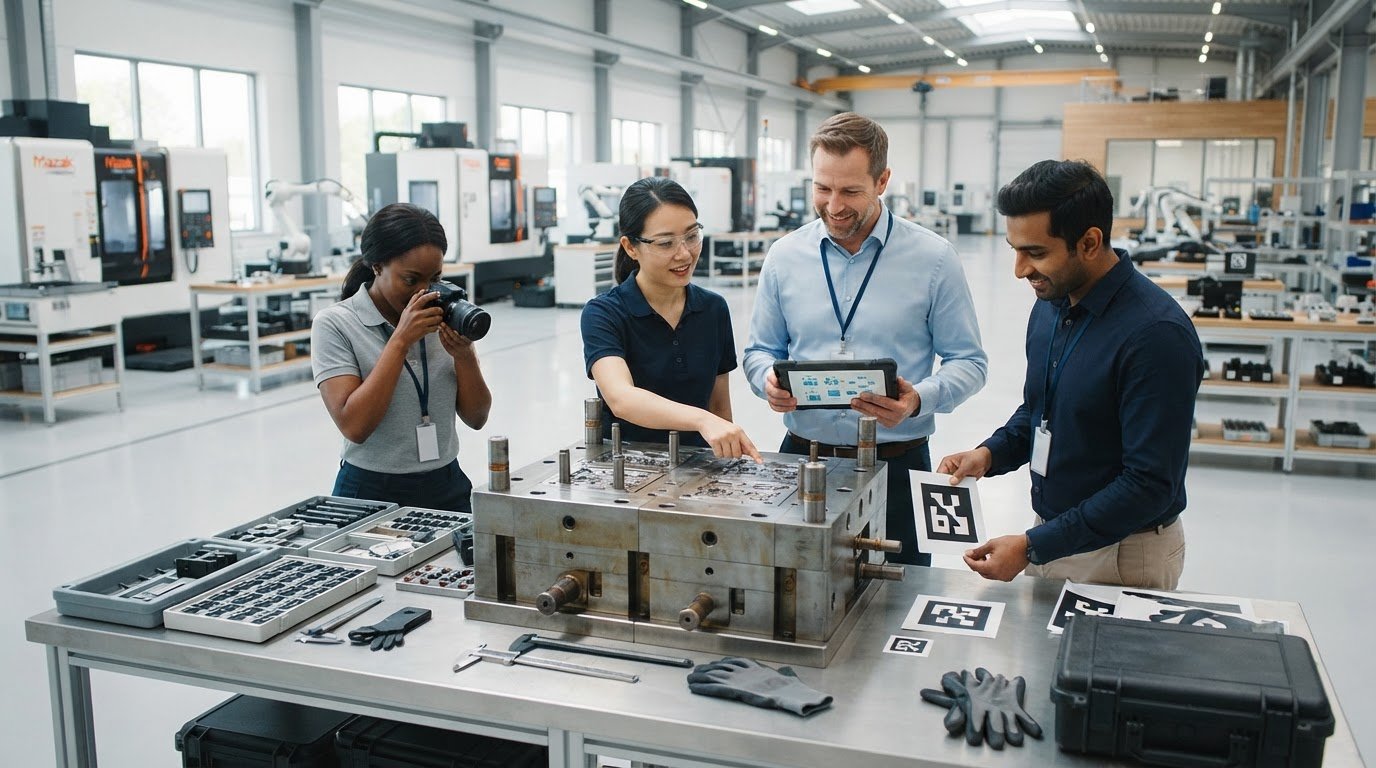
What if the mold you paid to develop couldn’t be released when you needed to change suppliers? Managing tooling and molds with a foreign factory means more than tracking where production equipment is stored. Payment alone may not establish clear ownership, access, or transfer rights. Without visibil...