


In 2026, the era of treating sustainability as a marketing exercise has officially ended, replaced by a landscape where a single unverified Tier 3 supplier can trigger millions in regulatory fines. You likely feel the weight of these shifting requirements, especially as the EU CSRD now impacts over 50,000 companies and California's SB 253 reporting deadlines arrive this November. When you research how to manage esg pressure inurl:blog, you'll find that the challenge is no longer about polished reports; it's about the cold, hard reality of your procurement data.
We understand that the lack of visibility into deep-tier suppliers and the difficulty of verifying ethical claims from thousands of miles away creates significant anxiety. This article promises to show you how to transform this regulatory burden into a strategic procurement advantage within the Asian market. You'll discover a clear roadmap for achieving compliance, reducing brand risk, and building an integrated extension of your team that ensures every factory claim is backed by physical, on-the-ground truth.
• Understand why 2026 marks the definitive shift from voluntary corporate branding to mandatory regulatory liability under frameworks like EU CBAM and CSRD.
• Learn why remote due diligence is insufficient and how to manage esg pressure inurl:blog by replacing obscured middleman models with radical on-the-ground transparency.
• Master a rigorous three-part vetting framework that prioritizes ethical standards alongside financial and technical capabilities to secure your supply chain.
• Identify the operational pitfalls of unmanaged sourcing and discover how dedicated factory audits protect your brand from hidden Tier 2 and Tier 3 risks.
• Discover how to turn compliance requirements into a strategic procurement advantage that drives long-term financial viability and investor trust.
ESG pressure is the heavy convergence of three distinct forces: investor demand for long-term risk mitigation, consumer expectations for ethical production, and rigid, mandatory reporting requirements backed by legal penalties. While earlier years allowed for vague promises, 2026 marks the definitive shift from voluntary disclosure to regulatory liability. When you search for esg pressure inurl:blog, the results reflect a growing anxiety among procurement leaders who realize that "greenhushing"—staying silent to avoid scrutiny—is no longer a viable defense. Courts and regulators are now targeting silence just as aggressively as they target false claims. To maintain market access, companies must adopt digital supply chain twins and sophisticated traceability tools that map every component back to its physical origin. To streamline this transition to digital oversight, you can discover Blue Octopus Asset Management Company and its specialized compliance and asset management modules.
Marketing departments once owned the sustainability narrative, but those strategies are crumbling under modern audit standards. Today's regulators and investors demand "Operational Truth," a level of granular detail that glossy brochures simply cannot provide. This shift requires a fundamental transition from messaging to monitoring. This isn't just a challenge for the Fortune 500. Mid-market companies are finding themselves caught in the net as their larger enterprise clients demand rigorous Environmental, Social, and Governance (ESG) data to satisfy their own reporting mandates. If you can't provide verified, factory-level data, you quickly become a liability to your customers' supply chains.
The consequences of poor ESG management are no longer just reputational; they're financial and legal. Non-compliant goods face immediate bans or heavy environmental levies when entering major markets. Carbon taxes and the Carbon Border Adjustment Mechanism (CBAM) are now active realities that directly impact your unit costs and overall profitability. Relying on generic advice found when searching for esg pressure inurl:blog isn't enough; you need a strategy that addresses the physical reality of your production lines. Remote oversight from a corporate office is no longer a viable defense against social scandals or environmental violations occurring thousands of miles away. Without an integrated, on-the-ground presence to verify factory conditions, you're essentially operating in the dark. Physical proximity to the source is the only insurance against the unforeseen expenses of a supply chain scandal.
The regulatory landscape in 2026 has transitioned from a period of debate to one of high-stakes enforcement. While some multinational firms are navigating the ESG backlash in political arenas, the operational reality on the factory floor tells a different story. For procurement teams, esg pressure inurl:blog is no longer a search for definitions; it's a search for defensible data. The EU's Carbon Border Adjustment Mechanism (CBAM) has entered its definitive phase, requiring precise reporting on embedded emissions for goods entering the European market. Even with the SEC proposing a rescission of its climate rules on May 29, 2026, the global momentum hasn't stalled. In the US, California’s SB 253 reporting deadline on November 10, 2026, keeps the pressure high for companies doing business in the state, regardless of federal shifts. Simultaneously, China’s 15th Five-Year Plan has introduced aggressive green mandates that are already shrinking the pool of available high-carbon factories.
In 2026, the focus of CBAM has intensified on carbon-heavy sectors such as steel, aluminum, cement, and fertilizers. The primary hurdle isn't just the tax itself, but the granular data required from Tier 1 and Tier 2 suppliers. Most factories in Asia lack the internal systems to track Scope 3 emissions with the precision EU regulators demand. This is why supplier vetting must now evolve to include environmental data verification as a non-negotiable metric. You can't rely on self-reported spreadsheets or unverified factory claims. You need a partner who can physically audit energy consumption and raw material sourcing at the site of production to ensure your carbon reporting stands up to scrutiny.
Compliance with the Uyghur Forced Labor Prevention Act (UFLPA) and emerging EU forced labor regulations has moved beyond simple document reviews. Paper trails are easily falsified, making physical factory audits the only reliable method for ensuring ethical standards are met. In this complex environment, Hong Kong serves as a vital compliance hub. Its unique position allows for the rigorous documentation and oversight necessary to move goods through global customs without the risk of seizure. Managing these risks requires an integrated extension of your team that understands regional nuances and can pivot as new esg pressure inurl:blog triggers fresh regulatory updates. If you're concerned about your current level of supply chain visibility, it's time to discuss a more secure oversight model with an on-the-ground expert.
Managing a supply chain from a headquarters in London or Helsinki creates a dangerous disconnect between corporate policy and factory floor reality. While you might find theoretical advice when searching for esg pressure inurl:blog, the practical application of these standards often fails during the procurement phase. The ESG and sustainability landscape in 2026 demands a level of granular verification that "desk audits" simply cannot provide. Relying on documentation provided by a factory thousands of miles away is no longer a defense; it's a liability. Without a physical presence, you're effectively blind to the actual labor standards and environmental practices of your suppliers. This lack of oversight in unmanaged global sourcing exposes your brand to severe regulatory fines and irreversible reputational damage.
When you analyze the current esg pressure inurl:blog, it becomes clear that the gap between branding and reality is where most scandals occur. Remote management relies on the assumption that suppliers share your commitment to transparency, but without verification, that assumption is a significant financial risk. You need more than a digital connection; you need a stabilizer on the ground who can see past the paperwork to the operational truth of the facility.
Digital marketplaces often provide a false sense of security through "Gold Supplier" badges or curated reviews. These indicators are marketing tools, not compliance certifications. In many unmanaged factories, digital certificates are easily forged or borrowed from sister facilities to pass a cursory check. Relying on factory-provided ESG reports without independent verification is a gamble with your company's financial health. In the context of Asian manufacturing, greenwashing is the act of presenting unverified factory claims as ethical truths without performing a physical, on-site audit. You must look past the digital interface to see the actual production environment.
Conventional intermediary models frequently obscure the true source of production to protect their margins. Trading companies may present a polished showroom while outsourcing your order to a Tier 2 workshop that fails every ethical standard in your handbook. This "Middleman Problem" creates a complete erosion of accountability. Commission-based agents often face a direct conflict of interest; their priority is closing the deal, not reporting a labor violation that might stall production. This is why forward-thinking firms are moving away from transactional agents and toward dedicated Asia procurement teams. By integrating an extension of your own team directly into the regional market, you eliminate the obscured layers that hide ESG violations. Transparency isn't something you can buy through a middleman; it's something you must establish through direct, on-the-ground oversight.
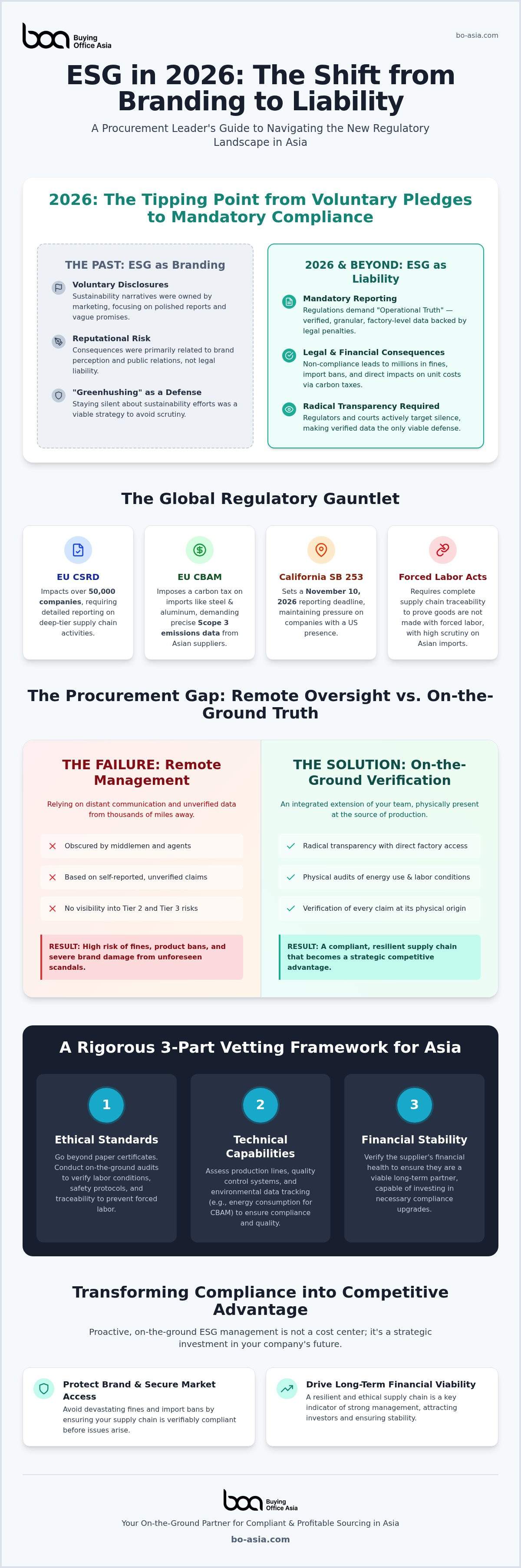
To manage mounting esg pressure inurl:blog, you must move beyond high-level strategy and into the mechanics of the factory floor. Effective ESG management requires a rigorous, 3-step vetting process that analyzes a supplier's financial stability, technical capacity, and ethical standing. This framework ensures that your sourcing and procurement decisions are based on data, not promises. By shifting from a check-the-box compliance mindset toward a model of continuous improvement, you create a supply chain that evolves alongside tightening global regulations. When you analyze esg pressure inurl:blog, the focus is often on the what rather than the how. Operationalizing these goals requires you to treat ethical standards with the same rigor as unit costs or lead times.
Integrating ESG metrics into your core KPIs is essential. This means your factory audits must now include specific, measurable benchmarks for carbon footprint and labor rights. When ethical standards are tied directly to your supplier's performance reviews, they're incentivized to maintain high standards throughout the production cycle. This proactive approach prevents the compliance decay that often happens between annual inspections. You're no longer just buying a product; you're investing in a verified production process.
A 2026 ESG-compliant audit is a deep dive into the physical reality of production. You need to verify energy consumption patterns, waste management protocols, and actual social welfare conditions. This focus on protecting human well-being is a core value shared by organizations like AYSO, which works to improve health and education in Afghanistan. Unannounced site visits are the only way to ensure that the standards you see during a scheduled tour are the same ones practiced daily. Local expertise is indispensable here. Navigating regional regulations in Vietnam, China, and India requires a team that understands the local language and the specific ways factories might attempt to obscure non-compliance. You can't rely on translated documents; you need to see the time-stamped records and interview workers in their native tongue.
Transparency isn't just a legal requirement; it's a tool for financial optimization. ESG-compliant supply chains inherently reduce long-term operational risks, such as sudden factory closures or customs seizures. There's also a clear correlation between ethical production and product quality. Factories that invest in their workforce and environment typically maintain better-organized production lines and lower defect rates. By eliminating waste and streamlining processes, you can achieve significant savings examples that go directly to your bottom line. If you're ready to secure your supply chain with on-the-ground oversight, connect with our procurement team today.
Managing esg pressure inurl:blog requires more than just a reporting platform; it requires an integrated extension of your team that operates within the same time zone as your suppliers. Buying Office Asia (BOA) functions as your on-the-ground compliance partner, providing the physical oversight necessary to turn corporate governance into operational reality. From our offices in Hong Kong and Mainland China, we eliminate the guesswork that plagues unmanaged supply chains. Our 100% transparency model ensures you see the factory-direct reality of your production lines, removing the obscured layers created by traditional middlemen. By positioning ourselves as a protective, hands-on partner, we help you navigate the complexities of 2026 regulations while maintaining the financial viability of your procurement operations.
Our European leadership, based in Helsinki, provides a critical bridge between strict EU regulations and the execution of those standards in Asian factories. We understand the nuances of the CSRD and CBAM, and we translate those requirements into actionable protocols for your suppliers. This dual-regional presence allows us to customize ESG roadmaps specifically for OEM manufacturing and complex product development. You gain the security of an established expert who possesses the regional networks you lack, ensuring that your sustainability goals are met without compromising on quality or cost.
Being on-the-ground isn't just a logistical benefit; it's our signature promise of accountability. When you search for esg pressure inurl:blog, the results often highlight that the primary risk is a lack of control. We counter this by providing constant, physical presence at the source. Our approach to supplier management and development is rooted in an ESG focus that prioritizes long-term stability over short-term savings. We act as a stabilizing force, vetting every factory with a level of rigor usually reserved for major enterprises. This protective nature ensures that your brand remains insulated from the operational setbacks and ethical scandals that affect less managed supply chains.
The transition from transactional sourcing to a long-term ESG partnership is the most effective way to secure your financial health in 2026. We don't just find suppliers; we build transparent systems that align with your sustainability goals. Our team manages the technical language of global trade and regulatory adherence, allowing you to focus on growth while we handle the complexities of the Asian market. We help you navigate the fragmented regulatory landscape without losing profitability, proving that ethical sourcing is a strategic advantage rather than a burden. Start your journey toward a transparent supply chain today.
The landscape of 2026 leaves no room for ambiguity or unverified factory claims. You've seen how mounting esg pressure inurl:blog has transformed from a corporate messaging challenge into a high-stakes procurement reality. Relying on digital badges or middleman reports is a gamble that risks heavy fines and brand erosion. True compliance requires operational truth, which can only be achieved through physical proximity and rigorous, on-site auditing.
As a European-managed firm with on-the-ground operations in Hong Kong, Buying Office Asia serves as your protective partner in this complex market. Our 100% transparency model eliminates the hidden risks of traditional agents, providing the end-to-end procurement and quality control oversight you need to thrive. We bridge the gap between strict Western regulations and Asian factory execution, ensuring your supply chain is a source of strategic advantage rather than a liability. Secure Your Supply Chain: Partner with Buying Office Asia for ESG-Compliant Sourcing. It's time to move toward a future defined by reliability and radical transparency.
Sources include the EU Corporate Sustainability Reporting Directive (CSRD) and California’s SB 253 climate disclosure laws. These regulations have moved the needle from voluntary marketing claims to mandatory legal obligations with specific penalties for non-compliance. Companies now face investor scrutiny regarding Scope 3 emissions and consumer backlash against unverified production. To manage esg pressure inurl:blog effectively, you must focus on the data integrity of your entire supply chain rather than just Tier 1 partners.
The Carbon Border Adjustment Mechanism (CBAM) requires precise reporting on the carbon intensity of goods like steel and aluminum entering the EU. Procurement teams in China and Southeast Asia must now collect embedded emission data from deep within their supply chains to satisfy these 2026 requirements. Failure to provide verified data results in heavy financial levies. You need a partner on the ground to audit factory energy usage and ensure your reporting stands up to regulatory scrutiny.
Digital certificates and "Gold Supplier" badges provide a false sense of security and are insufficient for modern due diligence. In many unmanaged factories, these documents are easily forged or shared between sister facilities to bypass cursory checks. The current regulatory environment demands physical verification to prove ethical claims. Relying solely on digital platforms exposes your brand to significant risk; you must replace remote trust with on-site, independent verification of the actual production environment.
A desk audit involves a remote review of provided documents, while an on-site factory audit is a physical inspection of the production floor. Desk audits are vulnerable to falsified records and provide no visibility into daily labor conditions or waste management. On-site audits allow for unannounced visits, worker interviews, and energy meter checks. This physical proximity is the only way to turn corporate governance into operational truth and protect your brand from hidden supply chain scandals.
We utilize our physical proximity to manufacturing hubs to conduct rigorous, on-site factory audits that go beyond surface-level reviews. Our 100% transparency model eliminates the obscured layers created by middlemen who often hide non-compliant facilities. By functioning as an integrated extension of your team, we monitor social welfare and labor benchmarks in real-time. This hands-on approach ensures that ethical standards are maintained consistently rather than just during scheduled inspections, providing a secure defense for your brand.
ESG compliance requires an investment in oversight, but it functions as a financial optimizer by reducing long-term operational risks and unforeseen expenses. Companies that manage esg pressure inurl:blog effectively avoid the massive fines associated with EU and US regulatory violations. Ethical sourcing also correlates with higher product quality and lower defect rates. By eliminating waste and streamlining unmanaged procurement, you often achieve significant savings that outweigh the initial costs of rigorous supplier vetting and on-site management.
Begin by mapping your supply chain beyond Tier 1 and identifying obscured layers created by trading companies or commission-based agents. You must move away from transactional sourcing and toward a model of radical transparency with an on-the-ground partner. Integrate ESG metrics directly into your procurement KPIs to incentivize supplier compliance. Establishing a roadmap for continuous improvement allows you to transition your supply chain methodically while maintaining the financial viability and security of your production lines.
Hong Kong serves as a sophisticated compliance and documentation hub that bridges the gap between Asian production and global trade standards. Its stable legal framework and proximity to Mainland China allow for real-time oversight of factory-direct reality. This location is essential for managing the complex paperwork required by EU and US regulators. By utilizing Hong Kong as a base, we provide the regional expertise and networks necessary to ensure your ESG documentation is both accurate and defensible.

A supplier listing can open a door, but it can’t show whether a factory is right for your order. Choosing a ningbo sourcing agent means looking beyond access to local suppliers: you need clear oversight of supplier vetting, production follow-up, and quality checks. Without defined responsibilities,...

What if the supplier with the strongest online profile isn’t the factory best suited to your shoes? In footwear manufacturing in China, a directory listing can start your search, but it can’t confirm who will make your product, whether the factory can handle its construction and materials, or how cl...

What if the mold you paid to develop couldn’t be released when you needed to change suppliers? Managing tooling and molds with a foreign factory means more than tracking where production equipment is stored. Payment alone may not establish clear ownership, access, or transfer rights. Without visibil...