


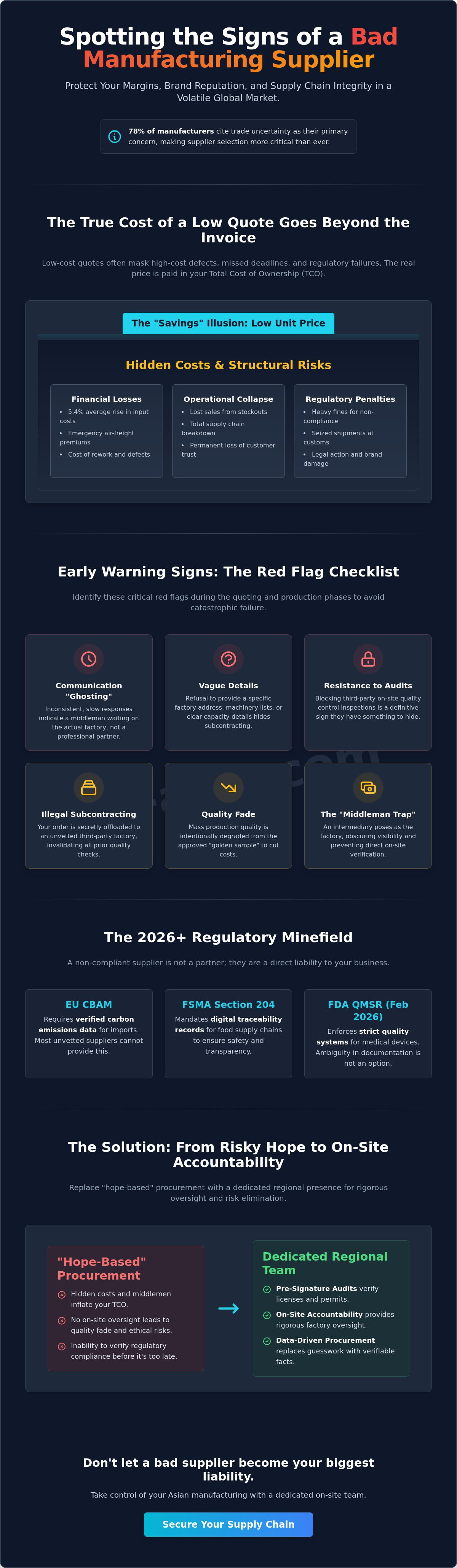
If your manufacturing partner cannot provide verified carbon emissions data for the EU's CBAM requirements or digital records for FSMA Section 204, they aren't just a bottleneck. They are a liability. In an era where 78% of manufacturers cite trade uncertainty as their primary concern, failing to recognize the signs of a bad manufacturing supplier can lead to more than just a delayed shipment. It can result in a total supply chain collapse that threatens your brand's legal standing and financial health.
You likely feel the pressure of maintaining margins as input costs rise by an average of 5.4% this year. It's exhausting to manage hidden costs from undisclosed middlemen or quality fluctuations that force you into a reactive mode. You deserve a supply chain that functions as a predictable, transparent extension of your own team rather than a source of constant anxiety.
We'll help you regain control by teaching you how to spot supplier red flags early to protect your margins, brand reputation, and supply chain integrity. You'll learn to distinguish between a partner who is genuinely invested in your growth and one who is merely a source of obscured costs and inefficiency.
This article provides a clear checklist to evaluate your current partners and strategies to prevent bad hires. We'll also explore how on-site oversight and regional expertise can reduce your risk in an increasingly volatile global market.
• Understand why low-cost quotes often hide structural risks and learn to calculate the true impact of obscured transparency on your long-term financial health.
• Identify the specific signs of a bad manufacturing supplier during the initial quoting phase, such as inconsistent response times and vague details regarding factory locations.
• Recognize the warning signs of illegal subcontracting and quality fade to ensure your mass production remains consistent after the initial sampling phase.
• Master the pre-signature audit process by verifying business licenses and export permits through local channels before committing any capital.
• Discover how a dedicated regional presence replaces "hope-based" procurement with on-site accountability and rigorous factory oversight.
A bad supplier isn't just a partner that delivers a defective batch of goods. In the current landscape, a bad supplier is a structural failure in transparency that actively obscures your visibility into the factory floor. When a partner hides their true production capacity or subcontracting habits, they increase your operational risk exponentially. Identifying the signs of a bad manufacturing supplier early is the only way to prevent a catastrophic breakdown in your supply chain integrity.
The financial impact of a poor selection often stays hidden until it's too late to recover the production cycle. Low-cost quotes frequently function as a mask for high-cost defects, missed deadlines, and ethical shortcuts. If a quote arrives significantly below market averages, the savings are likely being extracted from essential quality control protocols or regulatory adherence. This "savings" evaporates the moment you face a 5.4% increase in input costs, a reality reported by the National Association of Manufacturers for 2026. You don't just lose the unit margin; you lose the trust of your customers and the equity of your brand.
One of the most reliable indicators of impending failure is the "Middleman Trap." Unmanaged intermediaries often position themselves as the factory while keeping the actual production site a secret. This lack of direct access prevents you from conducting the on-site oversight necessary to verify working conditions or technical capabilities. Without a regional presence to bypass these intermediaries, you're essentially operating on hope rather than data.
The true expense of a failed partnership goes far beyond the invoice. You must account for the cost of rework, the premium paid for emergency air-freight when sea shipments are delayed, and the permanent loss of sales due to stockouts. Cheap unit prices often result in lower overall profitability because they fail to account for these variables. Total Cost of Ownership (TCO) is the comprehensive calculation of all direct and indirect expenses associated with a product throughout its entire procurement and production lifecycle. When you prioritize a low sticker price over structural reliability, your TCO inevitably climbs as you spend more resources fixing avoidable errors.
In 2026, regulatory rigor has reached an all-time high, making a supplier's lack of verified certifications an immediate red flag. With the FDA's Quality Management System Regulation (QMSR) now in full effect as of February 2026, medical device manufacturers cannot afford any ambiguity in their documentation. Similarly, the EU's Carbon Border Adjustment Mechanism (CBAM) requires precise emissions reporting that most unvetted suppliers simply cannot provide. Engaging a partner without these capabilities exposes your business to heavy fines and seized shipments. You can learn more about securing your supply chain through rigorous Supplier Vetting in Asia to ensure your partners meet these evolving global standards.
If a potential partner takes three days to answer a simple pricing query during the honeymoon phase, expect total silence when a production line stops. This "Ghosting" pattern isn't just a sign of poor customer service. It often indicates that the person you're speaking with is a middleman waiting for a response from an actual factory they don't control. Inconsistent response times are among the most reliable early signs of a bad manufacturing supplier. Professional operations prioritize lead-time accuracy from the very first interaction.
Vague answers regarding factory locations or production capacity are equally disqualifying. A legitimate manufacturer will provide a specific physical address and a clear breakdown of their machinery and labor force. If a supplier hesitates to disclose where your goods are actually being made, they're likely planning to subcontract your order to an unvetted third party. This lack of transparency makes it impossible to verify compliance with 2026 standards like the EU's CBAM or the FDA's QMSR. Resistance to third-party on-site quality control is the final warning. Any supplier that blocks independent eyes from their floor is hiding a structural deficiency that will eventually cost you your margins.
A supplier who agrees to every complex customization without asking for technical drawings or material specifications is a liability. Real engineers ask questions. They challenge tolerances and suggest material alternatives to ensure structural integrity. If a contact says "yes" to everything without a single technical query, they're likely a trading company salesperson focused on the deposit rather than the finished product. You can test a supplier's technical depth by intentionally including a minor error in your RFQ. A competent partner will catch it; a bad one will quote it anyway. If you are concerned about the transparency of your current prospects, you can reach out to our regional experts for a preliminary assessment of their credentials.
Digital storefronts and Alibaba profiles are marketing tools, not evidence of capability. High-quality stock photos of automated assembly lines often mask the reality of a manual, disorganized workshop. In 2026, 100% transparency is the only acceptable standard for high-volume production. Red flags include profiles that list hundreds of unrelated product categories, which suggests a sourcing house rather than a specialized manufacturer. Demand live video walkthroughs of the specific production lines intended for your order. If they cannot show you the machinery in real-time, they don't own it. Verification must happen on the ground, not through a polished browser window.
Once your deposit is paid and production begins, the risks shift from theoretical to physical. Identifying these operational signs of a bad manufacturing supplier requires more than just reviewing weekly reports; it demands a physical presence at the source. One of the most critical indicators of a failing partnership is the "shifting timeline." If your supplier provides vague reasons for production delays without citing specific material shortages or logistical bottlenecks, they've likely sold your reserved capacity to a higher-paying client. This often leads to unauthorized subcontracting, where your goods are moved to a "shadow factory" that lacks the technical equipment or ethical oversight of your primary partner.
A disorganized shop floor is another immediate red flag. If a factory cannot maintain a clean, organized environment, they cannot maintain the integrity of your custom tooling. Poor maintenance of molds and dies leads to premature wear, resulting in dimensional inaccuracies that can ruin an entire production run. These operational lapses aren't just aesthetic issues; they're symptoms of a management team that prioritizes short-term output over long-term quality and financial viability.
Quality fade is the gradual, often imperceptible erosion of product standards after the initial "golden sample" is approved. A bad supplier may swap high-grade resins for cheaper alternatives or reduce the number of quality check stations to save on labor costs. Relying on factory-provided photos is a critical management mistake. These images are easily doctored or taken from a single "perfect" unit while the rest of the batch remains non-compliant. To combat this, you must implement rigorous on-site quality control and inspections at multiple stages of production. Catching a defect before it leaves the factory floor is the only way to protect your brand from the cost of mass returns and reputational damage.
In 2026, ethical sourcing is no longer optional. Regulatory frameworks like the EU's CBAM and the full implementation of FSMA Section 204 demand total traceability. Disorganization on the factory floor often signals deeper ethical or safety risks, such as blocked fire exits, lack of personal protective equipment, or excessive overtime. When a supplier resists sharing their labor records or environmental impact data, they're exposing your business to significant legal risk. Adhering to strict ESG standards is a prerequisite for any modern supply chain. A partner who ignores these standards is not just a bad manufacturer; they're a threat to your company's survival in a regulated global market.
Waiting until production starts to evaluate a partner is a high-stakes gamble that few businesses can afford in 2026. By the time you see the first defect, your capital is already committed and your market window is closing. The most effective way to avoid the signs of a bad manufacturing supplier is to implement a rigorous pre-signature audit. This process moves beyond the digital storefront to verify the physical and legal reality of the factory before you wire a single dollar.
Successful procurement depends on a structured verification sequence. You must move through these five steps to ensure your capital is protected:
Conduct an on-site assessment of machinery, labor conditions, and quality management systems before placing any deposits.
Use regional channels to confirm that business licenses and export permits are valid and actually belong to the entity you are paying.
Request and personally contact existing international clients to verify the supplier's history of consistency and honesty.
Execute a small-scale production test to evaluate both the physical output and the supplier's ability to follow complex technical instructions.
Ensure you have a dedicated team within the region to verify all claims and provide immediate accountability.
If you want to ensure your prospective partner is legitimate before committing your budget, reach out to our team for a professional factory audit.
Verifying an Asian business license from an overseas office is notoriously difficult and often yields misleading results. Many "factories" on global sourcing platforms are actually brokers or trading companies that have never owned a single piece of machinery. They use polished PDFs and rented showrooms to project an image of scale that doesn't exist. Physical proximity is the only true defense against fraud in an environment where digital identities are easily manufactured. Professional vetting identifies the difference between a maker and a broker by inspecting the actual production lines and payroll records in person.
The sampling phase is your final opportunity to stress-test a supplier's R&D capability and attention to detail. Utilize professional sampling support to evaluate how the factory handles technical queries and tooling adjustments. Red flags during this stage include a refusal to provide material certifications or an inability to meet tolerances specified in your technical drawings. Once a sample meets your standards, it must be documented as a "Golden Sample." This physical benchmark serves as the ultimate quality standard for all future mass production runs, ensuring that quality fade is caught before the goods leave the warehouse.
Identifying the signs of a bad manufacturing supplier is a vital defensive skill, but it shouldn't be your primary focus. Your goal is to move beyond the reactive cycle of spotting red flags and transition into a proactive, managed procurement strategy. This shift replaces "hope-based" sourcing with a structural framework of accountability. When you have a professional team on the ground, you stop being a customer at the mercy of a factory's schedule and start being a partner with total visibility into every production run.
A local presence in Hong Kong and across mainland Asia provides the immediate accountability that a digital interface can never match. It allows for unannounced factory visits and real-time verification of production milestones. By rejecting traditional intermediary models that thrive on obscured costs, you gain a transparent, fee-based partner that functions as an integrated extension of your own team. This model ensures that your margins are protected from the hidden markups often found in unmanaged supply chains. You're no longer just hiring a service; you're building a vetted, high-performance supplier network designed for long-term scale.
Professional management isn't an added expense; it's a financial optimization strategy. Expert factory-direct price negotiations often offset the cost of management by stripping away the "middleman tax" that plagues unmanaged sourcing. You can review documented savings examples from our managed supply chains to see the measurable impact of on-site oversight. By deploying your dedicated sourcing team, you gain the regional expertise and networks required to navigate the complexities of international trade without the usual anxieties of risk and lack of control.
The 2026 manufacturing environment requires a level of localized expertise that cannot be achieved from an overseas office. With trade uncertainty cited as a top concern by 78% of manufacturers this year, a stabilizing force is necessary to maintain supply chain integrity. Whether it's ensuring compliance with the latest FDA regulations or managing the data requirements of the EU's CBAM, you need a partner who understands the regional nuances of production and logistics. BOA acts as your regional defense, dismantling common industry objections and protecting your brand reputation at the source. It's time to replace the operational setbacks of unmanaged sourcing with the steady confidence of an established expert. Contact Buying Office Asia today for a comprehensive supplier audit and secure the future of your production.
Navigating the complexities of global trade in 2026 requires more than a keen eye for contracts. It demands a physical presence that can distinguish between a legitimate maker and a risky broker. You've seen that transparency, technical responsiveness, and ethical adherence are the pillars of a resilient supply chain. Failing to recognize the signs of a bad manufacturing supplier early doesn't just cost you a single production run; it compromises your brand's standing in a highly regulated global market. By prioritizing pre-signature audits and physical verification, you move from a position of vulnerability to one of strategic control.
You don't have to manage these risks alone. As a European-managed firm with our headquarters in Hong Kong, we provide the regional expertise and 100% transparency you need to thrive. We eliminate hidden middlemen, conduct rigorous on-site quality control, and handle factory-direct price negotiations to protect your financial health. By positioning ourselves as an extension of your own team, we transform your procurement from a source of anxiety into a stable, high-performance asset. Your growth depends on a supply chain you can trust, and we're here to ensure that trust is backed by data and physical verification.
Protect your production—Audit your suppliers with Buying Office Asia today
Inconsistent communication, lack of transparency regarding production sites, and refusal to allow third-party inspections are the primary indicators of risk. These are the most reliable signs of a bad manufacturing supplier. Legitimate partners prioritize accountability and provide clear technical documentation from the initial RFQ phase. If you encounter vague answers regarding material sourcing or labor standards, the supplier is likely masking a structural deficiency in their operation.
Check the business license and the scope of products offered. A factory typically specializes in a specific material or production process, whereas a trading company lists hundreds of unrelated categories. Request a live video walkthrough of the production line. If they cannot show you the machinery in real-time or if the factory address doesn't match their registered business license, they're likely an unmanaged middleman.
While minor logistical shifts can occur, persistent or unexplained delays are not normal and usually signal unauthorized subcontracting. In 2026, professional manufacturers use data analytics to provide precise lead times. If a supplier provides shifting timelines without citing specific material bottlenecks or regulatory hurdles, they've likely sold your reserved capacity to another client and moved your order to an unvetted shadow factory.
Desktop research is rarely sufficient for verifying the authenticity of a business license from overseas. You must use local channels and regional databases to confirm the legal representative and the registered capital. Without physical proximity, it's impossible to verify if the document is current or has been doctored. Professional vetting through an on-the-ground team is the only way to ensure your capital remains protected.
Implement immediate on-site inspections and halt further payments until the root cause is identified. Quality fade often occurs when a supplier attempts to offset rising input costs by swapping materials or reducing quality check stations. You must compare the current output against your documented Golden Sample. If the supplier refuses to rectify the defects or continues to provide non-compliant goods, it's time to transition to a vetted partner.
Look for disorganized shop floors, blocked fire exits, and poorly maintained custom tooling. Disorganization is a leading indicator of ethical risks and technical failure. If you observe workers without proper safety equipment or notice that machinery is covered in grime, the factory is not invested in long-term quality. These operational lapses suggest a management team that prioritizes short-term output over structural reliability and financial viability.
A professional procurement partner provides the regional oversight and accountability that an overseas buyer lacks. Unlike a traditional agent who might take hidden commissions, a transparent team acts as an extension of your own company. They conduct factory audits and price negotiations to ensure you aren't exposed to the common signs of a bad manufacturing supplier. This on-the-ground presence is your primary defense against supply chain collapse.
Quality fade is the result of unmanaged supply chains where the supplier feels no immediate accountability. It often starts with small, imperceptible changes to save on labor or material costs after the initial samples are approved. Without consistent on-site quality control, these minor deviations eventually lead to mass defects. In the high-pressure environment of 2026, unvetted suppliers may use these shortcuts to maintain their own margins at your expense.

What if the first clear sign of a production problem arrives after the goods are packed? Manufacturing risk management in Asia works best when controls are connected from the start, not left to a final inspection or occasional supplier update. You need visibility into factory activity, early warning...

What if the lowest unit quote isn’t the lowest-cost way to make your board game? Board game manufacturing costs depend on more than the number of boxes ordered. Component materials, custom tooling, assembly, packaging and delivery scope can all change what a quote covers, making headline prices diff...

What if the factory’s lowest quote isn’t the lowest-cost option? A lower unit price can hide differences in materials, tooling, packaging, quality checks or production terms. Understanding how sourcing agents negotiate factory prices starts with making those differences visible, not simply asking a...