

What if the mold you paid to develop couldn’t be released when you needed to change suppliers? Managing tooling and molds with a foreign factory means more than tracking where production equipment is stored. Payment alone may not establish clear ownership, access, or transfer rights. Without visibility into a tool’s identity and condition, you may face avoidable delays and disputes.
It’s reasonable to trust a factory to use and maintain tooling for production. A productive relationship works best, however, when expectations are documented and both sides know who can access, maintain, and move each asset. Clear records and practical oversight help protect your investment without turning supplier management into a confrontation.
This guide explains how to document tooling ownership, specifications, location, condition, and production use; agree on maintenance and access controls; and prepare a retrieval or transfer process before you need one. It also covers how factory communication and on-site verification can complement written agreements, helping you maintain visibility while preserving a constructive supplier relationship.
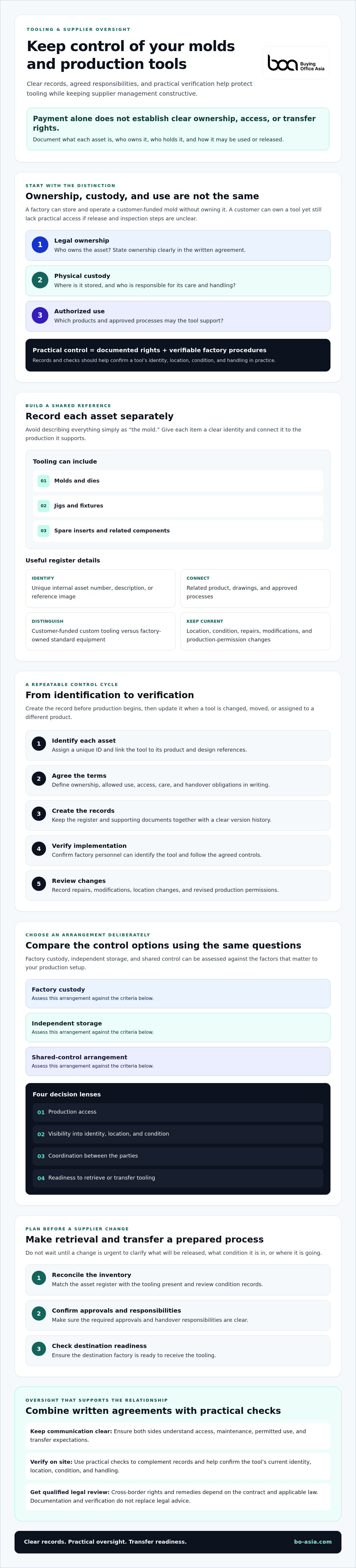
• Separate legal ownership from factory custody and production use so each party’s rights and responsibilities are clear.
• When managing tooling and molds with a foreign factory, document each asset, permitted use, access, maintenance, and transfer responsibilities.
• Compare factory custody, independent storage, and shared-control arrangements based on production access, visibility, coordination, and transfer readiness.
• Use a repeatable cycle to inventory tooling, check its condition, escalate issues, and update records when details change.
• Before a factory change, reconcile the inventory and condition records, confirm approvals, and ensure the destination factory is ready to receive the tooling.
Production tooling is an asset, not just equipment on the factory floor. It can include molds, dies, jigs, fixtures, spare inserts, and other components used to make or inspect your products. Injection molds themselves may contain multiple parts and components, as outlined in this guide to injection mold construction. Each item may have different ownership, maintenance, and production-use requirements.
Three concepts are easy to confuse: who owns a tool, who has physical custody of it, and who is authorized to use it. A factory may store and operate a customer-funded mold without owning it. Meanwhile, a customer may own a tool but have limited practical access if the agreement doesn’t explain how it can be inspected or released. An ownership clause alone may leave gaps around unauthorized production, wear or deterioration, and retrieval delays.
Control combines documented rights with verifiable factory procedures. Documents should make ownership and permitted use clear. Factory records and checks should help confirm the tool’s identity, location, condition, and handling in practice. This distinction is central to managing tooling and molds with a foreign factory while keeping production arrangements workable.
List each asset separately rather than describing everything as “the mold.” Identify molds, dies, jigs, fixtures, spare inserts, and related components using details such as an internal asset number, description, or reference image. Separate customer-funded custom tooling from factory-owned standard equipment, and record which products, drawings, and approved processes each item supports. This gives both parties a shared reference when production changes or questions arise.
Distance and language differences can make a clarification about a tool’s location, condition, or use take longer to resolve. Knowing that a mold is at a factory doesn’t confirm that it’s complete, serviceable, or stored where expected. An inventory is a starting point, not proof of current status.
There can also be a gap between what a contract says and what factory personnel understand or follow day to day. Incomplete records may make it harder to establish which asset was paid for, what production it may support, or what must happen before it is released. Cross-border rights and available remedies depend on the contract and applicable law, so have qualified legal counsel review important terms for the relevant jurisdictions. Clear documentation and practical verification can reduce uncertainty, but they don’t replace legal advice.
A clear tooling record turns an ownership claim into something you and the factory can verify. Build it before production begins, then update it whenever a tool is modified, moved, or assigned to a different product. This is especially useful in an OEM manufacturing relationship, where production responsibilities and customer-specific assets need to be clearly understood.
Use a repeatable sequence:
Assign a unique ID and link the tool to its product and design references.
Define ownership, allowed use, access, care, and handover obligations in writing.
Keep the register and supporting documents together, with a clear version history.
Confirm that factory personnel can identify the tool and follow the agreed controls.
Record repairs, modifications, location changes, and any revised production permissions.
For cross-border arrangements, ask qualified counsel to review the agreement, including which law applies, how disputes are handled, and whether the terms are likely to be enforceable in the relevant jurisdictions. The International Trade Administration’s overview of U.S. trade agreements provides broader trade context, but it isn’t a substitute for legal advice on a specific tooling contract.
Give every mold, die, jig, fixture, spare insert, and related component its own entry. Record its unique asset ID, photographs, dimensions, drawing references, associated products, current location, custodian, and known condition. Add the latest inspection date and maintenance history, then link purchase orders, invoices, approvals, and change records to the entry. This makes it easier to reconcile the physical asset with its supporting evidence.
Specify who owns each customer-funded tool and what production it may support. Address inspection access, restrictions on third-party production, routine maintenance, repair responsibility, damage reporting, and approval before modifications. Define the practical release process too: required notice, each party’s cooperation, preparation and packaging responsibilities, and the records or components to hand over. Clear steps reduce uncertainty if production moves to another supplier.
Keep the agreement and register aligned. If a factory changes a tool or moves it to another facility, record the change and confirm the updated details rather than relying on informal messages. These controls make managing tooling and molds with a foreign factory a documented process, not a matter of assumption.
Where a tool is stored affects production access, visibility, coordination, and how readily it can be transferred. No custody model is automatically safest or legally decisive. The right fit depends on the tool, production schedule, factory location, and written agreement.
| Arrangement | Production access | Visibility | Coordination and transfer readiness |
|---|---|---|---|
| Factory-held | Usually direct for authorized production. | Depends on records, reporting, and agreed checks. | Less movement during production, but transfer depends on release procedures and cooperation. |
| Independent storage | Requires transport to the production site, which can interrupt access. | May separate custody from production, but still needs condition and location records. | Requires coordination for delivery, handling, and return; the tool may be away from the factory. |
| Documented shared control | Can define when the factory may access or use the tool. | Can assign responsibilities for updates, inspections, and approvals. | Requires active coordination, but agreed handover steps can clarify transition responsibilities. |
Factory custody can support routine production when the tool is needed regularly and its identity, location, condition, and permitted use are recorded. Agree on inspection access, maintenance logs, and restrictions on use, including whether production for other parties is prohibited. Proximity can make day-to-day access practical, but holding the tool does not establish ownership or give the factory unrestricted rights.
Consider stronger controls if continuity, access, or a possible supplier transition is a priority. Independent storage may separate the asset from a production site, but assess transport, handling, security, and the risk of interrupting production before choosing it. Shared control can keep the tool at the factory while documenting who can inspect, approve work, and authorize movement. In every arrangement, written terms and current records remain essential.
For tools used in ongoing production, weigh the coordination required for additional controls against the exposure of relying on informal arrangements. Supplier-management support can help coordinate factory communication and oversight. For relevant support in Asia, see supplier management services. Confirm the scope and availability of any inspection or tooling-record process rather than assuming it is included.
When managing tooling and molds with a foreign factory, select the custody model that fits production needs and can be verified in practice. Define responsibilities clearly, then review the arrangement when production, tool condition, or supplier plans change.
A reliable tooling-control process connects what your records say with what’s happening at the factory. Use the same cycle for each asset: establish a baseline inventory, schedule checks, escalate issues, and update records after every inspection or change. This gives your team and the factory a shared history instead of relying on memory or scattered messages.
Confirm the asset ID, location, condition, associated product, and approved use.
Inspect at production milestones, with frequency shaped by the tool’s criticality and any prior issues.
Report discrepancies promptly, assign an owner, and agree on corrective steps.
Update the register and supporting records, then confirm they match the tool’s current status.
Use production inspections to check the tool’s identity, condition, storage location, and use against agreed records. Set inspection points around meaningful production milestones, and increase attention when a tool is critical to output or a problem has been reported. Dated photographs and signed inspection records make comparisons clearer over time. If an ID, location, condition, or use doesn’t match the record, document the discrepancy, notify the responsible parties, and track corrective action to closure.
Factory-floor verification complements written agreements. Buying Office Asia provides on-site quality control and inspections, but confirm the scope and availability of any tooling-specific inspection before treating it as a standard process. For related oversight, see its quality control and inspection services.
Name a record owner on both the buyer and factory sides. For every repair or modification, capture what was reported, who approved the work, which components were replaced, and whether the tool passed a return-to-production check. Link the approval, dated evidence, and updated specifications to the relevant asset record. That way, the next review can distinguish the tool’s current configuration from an earlier version.
Apply the same discipline to changes in location, custody, or permitted use. A procurement partner may help coordinate supplier communication, production oversight, and inspection follow-up. For broader context, see this guide to sourcing and procurement in Asia. Confirm that any tooling-specific record or inspection process is within the agreed scope.
Consistent checks and updates make managing tooling and molds with a foreign factory a traceable operating routine. If you need support coordinating factory communication and production oversight, review the available services.
A supplier transition is easier to manage when the release process is agreed before production is at risk. Treat the move as a controlled handover: reconcile what exists, document its condition, confirm who has authority to act, and prepare the receiving factory before scheduling transport.
Use a written checklist and close each item with a record or approval:
Match each tool and component to its ID, ownership evidence, drawings, and current location. Note missing items or open discrepancies.
Document the tool’s condition, outstanding repairs, and any parts that need attention before release.
Identify who approves release, prepares the tools, arranges the agreed handover, receives them, and updates the asset records.
Confirm the new factory has the equipment, technical information, and production capability needed to use the tooling. Validate the transferred tool and production process before relying on it for ongoing output.
Record what was released and received, including relevant drawings, maintenance history, and other agreed documentation.
Don’t schedule movement until the destination factory is ready and the parties understand the handover sequence. Transport, customs, insurance, and legal requirements can vary by route and circumstances. Check applicable requirements with qualified logistics, customs, insurance, and legal specialists rather than assuming one procedure fits every transfer.
A local procurement partner can help coordinate communication between the current supplier, the receiving factory, and your team. Depending on the agreed scope, supplier management, mass-production oversight, and on-site quality inspections can support practical checks and clearer progress reporting. This complements your written agreements; it doesn’t replace legal advice or guarantee a release outcome.
When managing tooling and molds with a foreign factory, local oversight can help connect documented transfer steps with factory-floor verification. Buying Office Asia operates from Hong Kong, with European leadership in Helsinki, supporting regional oversight and international communication. If ongoing coordination would help with your supplier relationship and production plans, learn about the dedicated Asia procurement team and discuss the support relevant to your factory and tooling needs.
Managing tooling and molds with a foreign factory works best when control is part of everyday operations, not left to a single ownership clause. Keep a current asset register, define permitted use and responsibilities in writing, and verify that factory records reflect each tool’s actual condition and location. Choose a custody arrangement that suits production needs, and agree on a transfer process before a supplier change becomes urgent.
Written terms set expectations, while practical factory-floor checks help confirm they’re being followed. Buying Office Asia provides on-site quality control and inspection services, along with supplier management and mass-production oversight to support ongoing coordination. Its Hong Kong operations and European leadership in Helsinki support regional expertise and international communication.
Clear records and accountable oversight can help protect production continuity while maintaining a constructive supplier relationship. Discuss your tooling and factory oversight needs with the team to explore support for your supply chain.
Build a consistent evidence trail rather than relying on a label or a single document. Link purchase orders and payment records to the mold’s asset ID, photographs, drawings, and signed agreement terms that identify ownership. Keep the records together and ensure the descriptions match the physical tool. This documentation can support your position, but it doesn’t guarantee a legal outcome. Have qualified counsel review the contract wording and applicable law.
Factory storage can make routine production more convenient, but it should come with clear records and agreed controls. Define permitted use, who may access the tool, how you can inspect it, who handles maintenance, and how retrieval works. Assess production requirements, the tool’s condition, and the risk of a supplier transition before choosing. On-site or independent storage isn’t automatically right for every tool or production arrangement.
A useful tooling register gives every mold, die, jig, and fixture a unique identifier. Link each entry to photographs, drawings, product references, location, custody, and recorded condition. Include inspection and maintenance dates, repair history, and supporting ownership records such as purchase orders or agreements. Reconcile the register with the factory regularly, and update it whenever a tool moves, changes condition, or is modified. A stale register can create avoidable confusion.
Set inspection frequency according to the tool’s criticality, production volume, maintenance needs, observed defects, and the buyer-factory agreement. There isn’t one interval that suits every mold. Consider checks at relevant production milestones and after significant repairs or incidents. Record the reason for the inspection schedule, findings, dated photographs, corrective actions, responsible owners, and the next review date. This makes the schedule traceable and helps both parties respond consistently when a condition changes.
Don’t assume the factory’s permitted use is self-evident. State in writing which products, customers, facilities, and production purposes are authorized, and have qualified counsel review the terms. Pair the agreement with clear asset identification and factory-floor checks so you can compare actual use with the approved scope. Whether the terms are enforceable, and what remedies may apply, depends on the agreement and relevant jurisdiction.
Start planning the transfer before the supplier relationship ends. Reconcile ownership records and inventory, document current condition and outstanding repairs, confirm release approvals, and agree on handover responsibilities. Check that the destination factory is ready to receive and validate the tooling, and coordinate timing with production planning to limit disruption. Transport, customs, insurance, and legal requirements vary by route and asset, so confirm details with qualified specialists before arranging movement.
A written contract is essential, but practical controls make it more useful. Match contract schedules to tool IDs, keep location and condition records current, agree on inspection access, and document maintenance, repairs, and modifications. Managing tooling and molds with a foreign factory requires both clear written terms and procedures that can be checked in practice. Have qualified counsel review the agreement for the relevant jurisdictions. No clause alone guarantees recovery or enforcement.

A supplier listing can open a door, but it can’t show whether a factory is right for your order. Choosing a ningbo sourcing agent means looking beyond access to local suppliers: you need clear oversight of supplier vetting, production follow-up, and quality checks. Without defined responsibilities,...

What if the supplier with the strongest online profile isn’t the factory best suited to your shoes? In footwear manufacturing in China, a directory listing can start your search, but it can’t confirm who will make your product, whether the factory can handle its construction and materials, or how cl...

A polished factory sample can still be the wrong one to approve if it doesn’t reflect the materials, dimensions, and process planned for mass production. If you’re figuring out how to get product samples from Asian factories, the challenge isn’t simply getting a package delivered. It’s making sure t...