

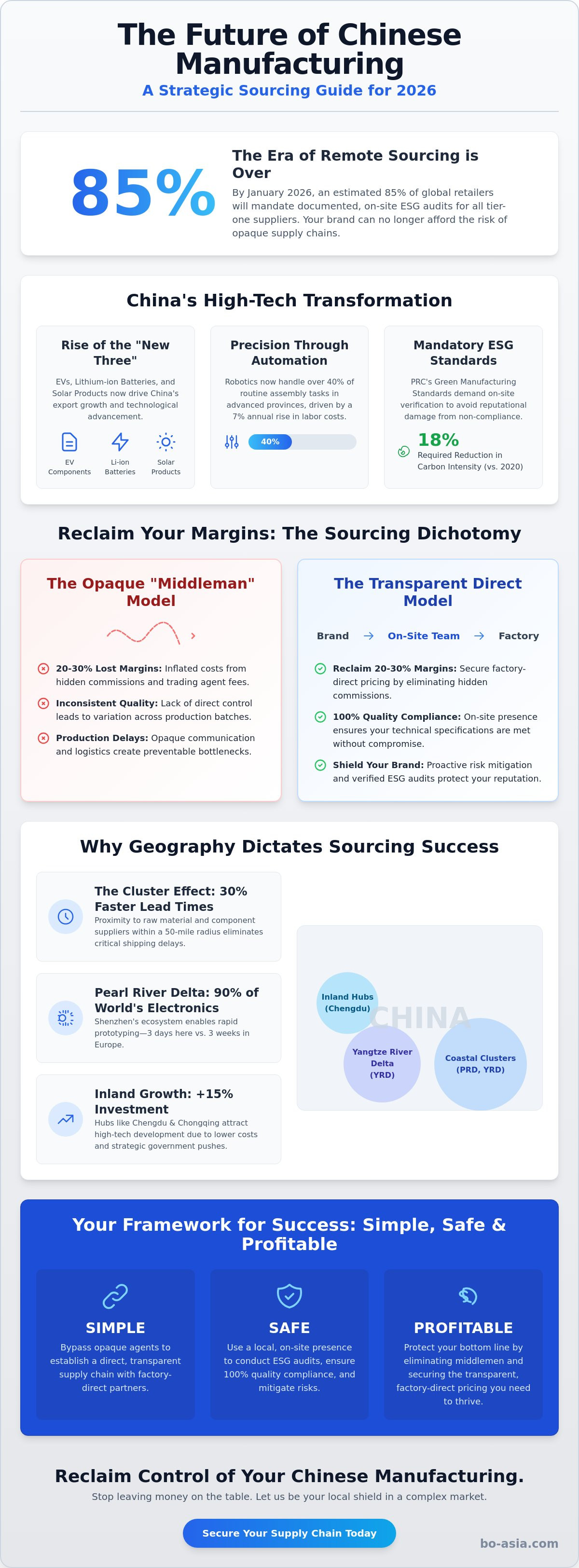
In 2026, the era of remote sourcing is over. By January 2026, an estimated 85% of global retailers will mandate documented on-site ESG audits for every tier-one supplier. You've likely experienced the frustration of opaque middlemen who inflate margins while delivering inconsistent quality across production batches. It's a risk your brand shouldn't have to carry. Relying on remote promises often leads to production delays and hidden costs that erode your bottom line and threaten your market position.
This guide provides the strategic framework to reclaim control of your chinese manufacturing operations and stop leaving money on the table. We'll show you how to bypass traditional agents to establish a direct, transparent supply chain that ensures 100% quality compliance on-site. We will compare the dominant regional clusters for 2026 and outline the specific risk mitigation steps required to keep your procurement simple, safe, and profitable. From identifying the right factory-direct partners to mastering the latest compliance standards, we're here to act as your local shield in a complex market.
• Navigate the transition of chinese manufacturing from a low-cost labor hub to a high-tech industrial leader in complex electronics and EV components.
• Identify how strategic placement within regional clusters like the Pearl River Delta can reduce lead times by 30% through immediate proximity to raw material suppliers.
• Perform a data-driven comparison between China and Southeast Asia to determine if infrastructure gaps in emerging markets outweigh the perceived benefits of a "China Plus One" strategy.
• Learn to dismantle the "Alibaba Illusion" by identifying hidden middlemen and trading agents to reclaim 20-30% margins often lost to opaque sourcing models.
• Implement a "simple, safe, and profitable" procurement framework using a local, on-site presence to shield your brand from reputational damage and production delays.
The landscape of chinese manufacturing in 2026 is unrecognizable compared to the labor-intensive model of the past decade. China has shed its reputation as a low-end assembly hub to become a dominant high-tech industrial leader. This transformation is the direct result of the Made in China 2025 initiative, which shifted the national focus toward high-value sectors like aerospace, robotics, and biopharmaceuticals. For brand owners, this means the "Value Chain Climb" isn't a theoretical concept; it's a daily reality where Chinese factories now lead the world in producing complex electronics and EV components.
To maintain margins in a post-inflation market, you must secure factory-direct pricing. Opaque middlemen and traditional agents often inflate costs by 10% to 15% through hidden commissions. By 2026, these inefficiencies are no longer sustainable. You need a transparent cost structure to survive. Eliminating the layers between you and the factory floor is the only way to protect your bottom line while ensuring the technical specifications of your product are met without compromise.
Rising labor costs in coastal provinces, which saw a 7% annual increase leading up to 2025, forced a rapid adoption of automation. Today, robotics handle over 40% of routine assembly tasks in advanced provinces like Jiangsu. This isn't just about replacing workers; it's about precision. AI now drives predictive supply chain management, allowing factories to identify potential logistics bottlenecks 30 days in advance. The "New Three" industries of electric vehicles, lithium-ion batteries, and solar products now drive the majority of chinese manufacturing export growth and technological advancement.
Environmental, Social, and Governance (ESG) compliance has become a mandatory benchmark in 2026. The PRC's Green Manufacturing Standards now require an 18% reduction in carbon intensity for all major industrial players compared to 2020 levels. You can't afford the reputational risk of unmanaged, non-compliant suppliers. Verifying these claims requires more than a digital certificate; it demands a professional on-site audit. We verify factory carbon footprints by auditing energy consumption records against actual production cycles to ensure your supply chain remains simple, safe, and profitable.
Cross-reference utility bills with output to prove ESG claims.
Ensure factories meet the 2026 PRC environmental benchmarks.
Avoid the "reputational damage" associated with non-compliant partners.
Geography in chinese manufacturing isn't just a matter of logistics; it's a core driver of your profit margin. The "Cluster Effect" creates a specialized ecosystem where raw material suppliers, component manufacturers, and assembly plants operate within a 50-mile radius. This tight proximity reduces lead times by 30% compared to fragmented supply chains. When your factory's sub-suppliers are in the same district, production doesn't stall for shipping delays or internal transit hurdles. You aren't just buying a product; you're tapping into a localized machine built for speed.
The Pearl River Delta (PRD) serves as the world's hardware shop, while the Yangtze River Delta (YRD) dominates high-end machinery and textiles. However, the landscape is shifting as the coast becomes more expensive. Analysts looking at manufacturing investment in 2026 highlight a transition toward inland hubs like Chengdu and Chongqing. These cities have seen industrial investment grow by 15% over the last five years, driven by lower land costs and a strategic push for high-tech development. Identifying which cluster fits your specific product is the first step to eliminating the "hidden margins" that drain your budget.
Approximately 90% of the world's consumer electronics pass through the PRD. Shenzhen offers a "Speed to Market" advantage that's impossible to replicate elsewhere. A prototype that takes three weeks to iterate in Europe often takes only three days here. Sourcing electronics from non-specialized regions, such as textile-heavy Zhejiang, is a dangerous gamble that frequently leads to a 20% increase in defect rates. To maintain quality, you've got to be where the specialized labor and testing labs are concentrated.
Ningbo-Zhoushan is home to the world's busiest port by cargo tonnage, providing a massive logistical edge for heavy goods. This region specializes in injection molding and industrial components. Cluster-specific logistics in Ningbo reduce internal shipping costs by an average of 12% because the entire infrastructure is designed for heavy industrial output. To capture these savings and ensure your chinese manufacturing project remains "simple, safe and profitable," many successful brands partner with a dedicated sourcing team to manage local factory relations and verify compliance on-site.
By 2026, the "China Plus One" strategy will face its toughest test as brands weigh the reality of total landed costs against the allure of lower wages. While relocating 15% to 20% of production to Vietnam or India seems like a hedge against risk, it often introduces new vulnerabilities. Chinese manufacturing remains the backbone of global trade because it offers an integrated ecosystem that Southeast Asia cannot yet replicate. You aren't just paying for labor; you're leveraging the 47.3 million TEUs handled annually by the Port of Shanghai and a 5G grid that powers over 2.3 million base stations for real-time factory automation.
China's logistics network is a decade ahead of its neighbors, reducing internal transport delays by up to 40% compared to India's regional road networks.
China produces roughly 4.4 million engineering graduates every year, providing a deep pool of skilled technicians that raw labor markets in Vietnam currently lack.
Sourcing in underdeveloped markets often requires flying in specialized managers and technicians, which can increase your operational overhead by 12% to 15%.
Shipping a container from Shanghai to the U.S. West Coast typically takes 18 to 22 days. In comparison, Ho Chi Minh City often requires 25 to 30 days due to fewer direct sailings and frequent port congestion. Most Southeast Asian factories still rely on China for 60% to 80% of their raw materials and components. This creates a "Tier 2 Supplier Gap" where the local ecosystem lacks the specialized sub-component manufacturers needed for complex assemblies, making your supply chain more fragile and dependent on Chinese exports anyway.
The maturity of Quality Management Systems (QMS) in China is the result of four decades of refining international export standards. While Indian factories are improving, many still struggle with the standardized ISO-compliance culture found in Guangdong's specialized hubs. Third-party inspection services are ubiquitous across China, allowing for on-site verification within 24 hours of a request. High-volume chinese manufacturing relies on this specialized infrastructure to keep production simple, safe and profitable. We help you avoid the "opaque middlemen" who ignore these maturity gaps, ensuring you don't leave money on the table through high defect rates or production rework costs.
Digital storefronts create a dangerous sense of security for the uninitiated. A 5-star rating on a global B2B platform often reflects transaction volume or response speed rather than the structural integrity of your product. This is the "Alibaba Illusion." In a 2022 industry analysis, over 60% of significant quality failures in chinese manufacturing originated from suppliers that appeared "verified" online. You aren't just buying a product; you're buying the factory's internal culture. If you can't see the assembly line, you don't own the process.
Many "factories" found online are actually trading companies. These entities operate out of small offices, adding 20% to 30% to your unit cost while providing zero manufacturing value. This hidden margin drains your profitability and creates a barrier between you and the technical staff. Direct negotiations are the only way to ensure long-term price stability. You must bypass these masquerading agents to lock in costs that reflect true material and labor values, not a middleman's commission.
Hidden commissions are the silent killers of supply chain integrity. A transactional agent often collects a "kickback" from the factory, which incentivizes them to hide defects rather than report them. This destroys your product integrity. A true procurement partner operates with total transparency. Red flags include a refusal to share the factory’s physical address, vague billing practices, or a reluctance to allow independent audits. If your agent isn't showing you the "back end" of the deal, you're leaving money on the table.
Physical presence is your only shield against reputational damage. To ensure a simple, safe and profitable outcome, you must implement a 4-stage oversight strategy:
Verifying raw materials and components before the line starts.
Checking the first 15% of the batch to catch systemic errors before they become terminal.
A statistical audit of finished, packed goods based on AQL standards.
Ensuring the correct quantity and SKU mix is loaded safely into the container.
Boots on the ground are the only way to prevent batch defects from reaching your warehouse. Learn more about our On-site Quality Control & Inspections to see how we secure your supply chain.
Stop gambling with remote sourcing. Secure your margins today by partnering with a dedicated team that acts as your local shield in China.
Managing the complexities of chinese manufacturing requires more than a digital connection; it demands a physical, authoritative presence. Buying Office Asia provides this through a unique dual-structure model. Our leadership in Helsinki provides the strategic alignment and communication standards European businesses expect, while our Hong Kong team executes on-site operations. This setup ensures that your instructions aren't lost in translation and that your interests are protected by a partner who understands both Western quality standards and Eastern business logic.
Our model functions as your Dedicated Asia Procurement Team. Unlike traditional agents who often obscure their sources to protect their commission, we operate with 100% transparency. We eliminate the opaque middlemen and hidden margins that erode your profitability. You gain full visibility into the manufacturing lifecycle, from initial sampling and factory audits to final quality inspections and shipping coordination. We don't just facilitate transactions; we manage your entire supply chain as an extension of your own company.
A Hong Kong headquarters is vital for maintaining legal and financial security when dealing with suppliers across Asia. It provides a stable, Western-aligned legal framework for contracts and payments, acting as a protective shield for your capital. From this central hub, our team manages a vetted network of high-performing manufacturers across the Pearl River Delta (PRD) and Yangtze River Delta (YRD). These aren't just names from a directory. They're factories we've audited for technical capability, ESG compliance, and financial stability.
The results of this on-site management are measurable. In 2023, a European wholesaler partnered with us to move away from a traditional sourcing agent. By leveraging our direct factory access and consolidating their logistics, they reduced procurement costs by 15% within the first eight months. We removed the "agent tax" and replaced it with a lean, professional procurement process that prioritized their bottom line.
Choosing professional vetting over remote sourcing is a matter of ROI. The cost of a production failure, including defective goods and missed seasonal windows, far outweighs the investment in professional oversight. We mitigate these risks by performing rigorous inspections before any cargo leaves the factory floor. Our goal is to ensure your chinese manufacturing experience is simple, safe, and profitable, allowing you to focus on scaling your brand rather than firefighting supply chain issues.
Logistics coordination is the final pillar of our service. We optimize your landed cost by managing freight tenders and ensuring containers are packed efficiently. This attention to detail prevents shipping delays and unexpected fees at the port of entry. To see how your business can benefit from this level of professional oversight, book a consultation with our Helsinki team to audit your current supply chain. Stop leaving money on the table and start working with a seasoned insider who prioritizes your growth.
The manufacturing landscape is shifting toward high-tech integration and strict ESG compliance. To thrive in 2026, you must navigate the geographical clusters that define chinese manufacturing with precision. Relying on remote sourcing or traditional agents often leads to the middleman trap, where hidden margins and production delays erode your bottom line. Success requires a transition to factory-direct pricing and a supply chain built on 100% transparency.
Buying Office Asia bridges the gap between European standards and Asian production realities. We're a European-managed firm with 15 years of on-the-ground expertise, providing the protective oversight your brand needs to scale safely. With Helsinki-based leadership, we offer local accountability for your global operations, ensuring you don't lose control of your quality or costs. It's time to move away from the risks of unmanaged procurement and embrace a model that is simple, safe, and profitable.
Start your safe and profitable China manufacturing journey today. Your path to a streamlined, secure, and highly efficient supply chain starts here.
Yes, China remains the most cost-effective hub for production due to its unmatched infrastructure and supply chain density. While nominal wages rose by 5% in 2025, the 2026 industrial landscape benefits from a 20% increase in automated assembly lines. This shift ensures that total unit costs remain 30% lower than in North American or European facilities for complex consumer goods.
Identify reliable partners by cross-referencing verified databases like Global Sources with official SAMR registration data. You must skip the opaque middlemen who hide factory names to protect their 15% margins. Focus on factories that hold ISO 9001 certifications and have passed a third-party social compliance audit within the last 12 months. This direct approach ensures transparency and protects your bottom line.
Supply chain disruptions and stringent ESG compliance requirements represent the primary risks for 2026. The EU CSDDD now mandates that 100% of your tier-one suppliers meet specific environmental standards. Failing to have a local presence to monitor these factors often leads to a 25% increase in production delays. Without on-site oversight, you risk reputational damage from sub-standard working conditions or environmental violations.
High-quality production is the standard for modern chinese manufacturing hubs in Shenzhen and Suzhou. These regions house facilities that produce 90% of global premium electronics, utilizing precision CNC machining and advanced cleanroom environments. You achieve luxury-grade results by setting strict Quality Control protocols and conducting 100% inspections on the first 500 units of your production run.
An OEM builds products strictly according to your proprietary blueprints and technical specifications. In contrast, an ODM offers 100% pre-engineered designs that you simply white-label with your brand logo. Choosing an OEM gives you total control over product uniqueness; ODMs reduce your time-to-market by 4 months because the R&D phase is already complete.
Secure your intellectual property by registering your trademarks and patents with the China National Intellectual Property Administration (CNIPA). Western contracts don't hold weight in local courts; you need a bilingual NNN agreement governed by Chinese law. 70% of IP theft occurs when brands fail to register their IP locally before sharing technical drawings with potential suppliers.
Sea freight from Shanghai to Rotterdam currently averages 35 to 45 days. If you utilize the China-Europe Railway Express, you can reduce this window to 18 or 22 days, though costs are typically 40% higher than sea transit. Air freight remains the fastest option at 5 to 7 days, but it's reserved for high-margin goods or urgent inventory replenishment.
Alibaba is a discovery tool, but it doesn't replace the need for a dedicated team on the ground. Statistics show that 30% of Gold Suppliers on digital platforms are actually trading companies, not manufacturers. Engaging a local partner to perform a 4-hour factory audit ensures you're dealing with the actual source. This boots-on-the-ground approach is the only way to guarantee safety and profitability in chinese manufacturing.

What if the first clear sign of a production problem arrives after the goods are packed? Manufacturing risk management in Asia works best when controls are connected from the start, not left to a final inspection or occasional supplier update. You need visibility into factory activity, early warning...

What if the lowest unit quote isn’t the lowest-cost way to make your board game? Board game manufacturing costs depend on more than the number of boxes ordered. Component materials, custom tooling, assembly, packaging and delivery scope can all change what a quote covers, making headline prices diff...

What if the factory’s lowest quote isn’t the lowest-cost option? A lower unit price can hide differences in materials, tooling, packaging, quality checks or production terms. Understanding how sourcing agents negotiate factory prices starts with making those differences visible, not simply asking a...