


A lower quoted unit price does not always mean a lower-cost supply chain. In manufacturing in Thailand vs Malaysia, the better choice depends on your product, production model, and ability to manage execution, not a country’s reputation. A factory that fits one buyer’s specifications and volume may be a poor match for another.
Unit pricing is a sensible starting point, but it leaves important costs and risks out of view. Logistics, quality control, compliance requirements, supplier capability, and the oversight needed to keep production on track all affect the decision. Build the comparison around your requirements rather than broad country-level claims.
This guide will help you shortlist the better-fit country and compare total landed cost and execution risk on consistent terms. You’ll learn what to assess in suppliers, which costs sit beyond the factory quote, and what to verify before committing to a factory or production order. It also covers how supplier verification and on-site production oversight can help you assess either market.
• There’s no universal winner in manufacturing in Thailand vs Malaysia. Match the country and factory to your product’s processes, specifications, and production volume.
• Assess suppliers against the same evidence, including equipment, capacity, quality systems, and export experience.
• Build a like-for-like landed-cost comparison that includes logistics, quality, compliance, and production oversight, not just the unit quote.
• Use a documented selection process to define requirements, shortlist factories, verify capability, review samples, and record unresolved risks before approval.
• Supplier vetting, factory audits, on-site inspections, and production oversight can improve visibility as you evaluate and manage production.
Neither country is universally better for manufacturing. The right fit depends on your product requirements and production model. Compare supplier capability, total landed cost, logistics, compliance, and the production oversight you’ll need. Then assess each factory against the same criteria.
National indicators provide context, not a verdict on an individual supplier. For example, Thailand’s economic profile offers broad background on the country’s industries and economy. It cannot confirm whether a specific factory has the equipment, capacity, or quality controls your order requires.
Your starting point shapes the comparison. If you’re sourcing for the first time, focus on supplier capability and production readiness. If you’re relocating production, compare the new option with your existing processes, costs, and transition requirements. If you’re adding a supplier in a second country, give more weight to resilience, supplier coordination, and consistent qualification across factories.
Before requesting quotes, define the product category, materials, required processes, order profile, and destination market. Rank your priorities, such as cost, technical capability, supply-chain resilience, speed, or market access. Without a clear brief, quotes may cover different specifications and won’t provide a reliable comparison.
Factories in the same country can differ in equipment, available capacity, management systems, quality controls, and export experience. A national industry profile or a supplier presentation can suggest useful questions, but neither proves that a specific facility can meet your specifications or maintain standards during production. Ask for evidence and check it against your requirements.
Total landed cost is the full cost of getting conforming goods to your destination, not just the factory quotation. Compare quotes on the same basis, including logistics, quality checks, compliance requirements, and the management effort required to oversee production. A lower unit price does not automatically make an offer more economical.
Use this comparison grid to keep the evaluation focused on your order:
Collect process details, equipment information, and relevant sample evidence. Focus on the capabilities your product actually requires.
Check production capacity and quality procedures against your order volume and acceptance criteria.
Request comparable quote terms and delivery details. Note which cost components or assumptions remain unconfirmed.
List applicable destination-market requirements, then document how production and quality will be monitored.
For contract manufacturing, review the OEM and ODM contract manufacturing approach as you define your production model. For each candidate, keep the evidence, its importance to your business, and any open questions in view. This makes country selection a factory-level decision you can explain and support.
Compare factories before comparing country reputations. In manufacturing in Thailand vs Malaysia, the practical question is whether a particular supplier can deliver your required materials, processes, volumes, quality, and export documentation. Treat claims about national strengths or sector clusters as starting points, then verify them with current independent sources and factory-level evidence.
Write a technical brief before approaching suppliers. Include required production processes, materials, tooling, sub-suppliers, capacity, quality criteria, and any certifications required for your product or destination market. Ask factories in both countries for equivalent evidence, such as process records, equipment lists, available capacity, relevant customer references, and samples assessed against the same specifications.
For broader context, the U.S. International Trade Administration’s Thailand market overview can inform your initial research. It cannot verify an individual supplier’s capability. Check any claimed sector cluster or local supply advantage against current, independent sources, then confirm whether the factory you’re evaluating can access the relevant materials and processes.
| Comparison area | Evidence to collect | Buyer-specific question | Country-level claim |
|---|---|---|---|
| Process and equipment | Equipment list, process records, sample results | Can this factory meet the product’s technical requirements? | Hypothesis; verify at the facility |
| Capacity and sub-suppliers | Production capacity, material sources, subcontractor details | Can the supply chain support your order profile? | Hypothesis; validate current availability |
| Quality and export experience | Quality procedures, inspection records, relevant export references | Can the supplier meet your acceptance and documentation needs? | Hypothesis; confirm with records and references |
| Route to destination | Current route options, shipment modes, capacity, and schedule data | Which option fits your delivery plan and tolerance for variability? | Route-specific; check current data |
Compare actual origin-to-destination options for each shortlisted factory. Review available shipping modes, consolidation options, handoffs, capacity, and schedule variability using current shipment data. Assumptions about a country’s proximity or infrastructure are not a substitute for assessing the route from a specific factory to your destination.
Check duties, rules of origin, and destination-market requirements with qualified trade advisers. ASEAN and RCEP provisions may be relevant, but applicability depends on the product, route, and origin criteria. Verify the details before including them in your landed-cost comparison. Buying Office Asia provides sourcing, supplier vetting, inspections, production oversight, and logistics coordination. To compare supplier evidence and routes, discuss your sourcing requirements.
A lower unit quote doesn’t guarantee a lower total landed cost. In manufacturing in Thailand vs Malaysia, compare the full cost of delivering conforming products to your destination, then evaluate the operational risks for each finalist. A country’s general business profile can guide your research, but it cannot establish what a particular factory will charge or how reliably it will perform.
Ask each supplier to quote against the same specifications, order quantity, packaging, destination, shipment terms, and quote validity period. Separate the quoted product cost from tooling, packaging, inspection, freight, duties, and applicable compliance expenses. Confirm which items are included, excluded, or based on assumptions.
Also account for costs that may not appear in the quote, including rework and defects, delayed shipments, inventory buffers, and the time needed to manage the supplier. Record uncertain items rather than treating them as zero. Have qualified advisers check current duties and destination-market requirements before finalizing the comparison.
Assess each finalist using evidence. Check ownership and operating history, confirm business-license information through appropriate channels, and compare stated capacity with your order profile. Ask whether production is subcontracted, which processes or materials depend on other suppliers, and how the factory will report and escalate quality or schedule issues.
Use samples, factory audits, and documented inspections to assess quality controls instead of relying on assurances. For intellectual-property risk, review how drawings, tooling, product information, and access are handled. Consider business continuity as well: identify qualified backup capacity where practical and document what happens if production is interrupted. These are supplier-specific checks, not assumptions about either country.
| Location | Potential advantage to investigate | Risk or assumption to verify |
|---|---|---|
| Thailand | Use current market research to identify relevant capabilities for your product. | Verify the specific factory’s capacity, quality controls, subcontracting, and route to destination. A national profile doesn’t prove supplier performance. |
| Malaysia | The U.S. International Trade Administration’s Malaysia market overview can help frame market research. | Confirm factory-level capability, complete quote assumptions, and destination-specific trade requirements rather than inferring costs or compliance from the country. |
Neither option is inherently cheaper or safer. Score each factory using the same cost categories and risk evidence, and record what remains unverified before approval. Supplier vetting, factory audits, on-site quality inspections, and production oversight can improve visibility, but they don’t replace buyer-specific checks. If you want support comparing candidates, discuss your sourcing requirements.
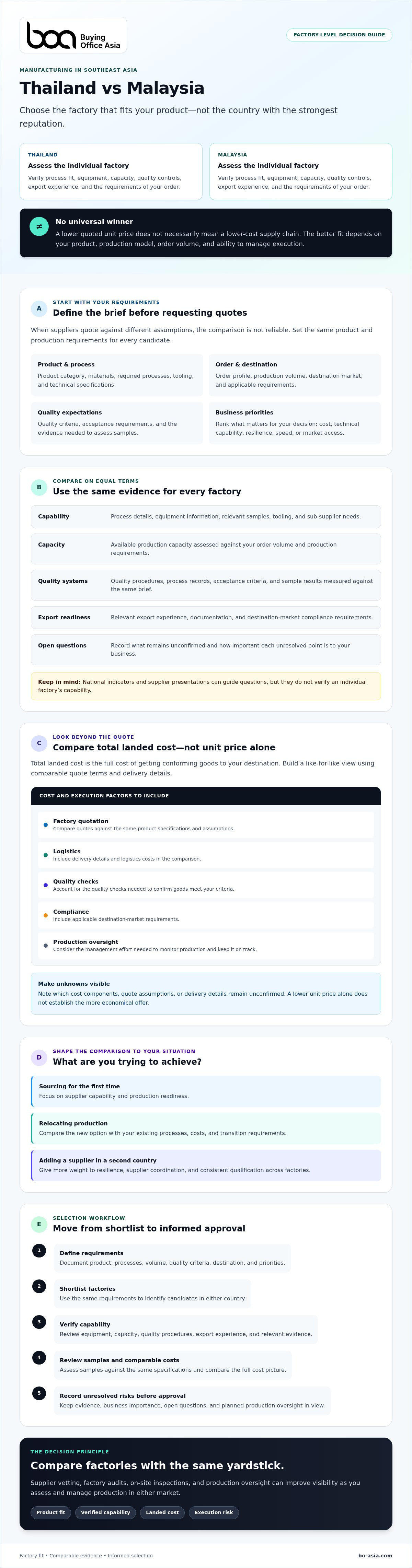
Turn the country comparison into a documented qualification process. For manufacturing in Thailand vs Malaysia, assess each location and factory against the same weighted criteria. This prevents an attractive quote from outweighing a critical gap in capability, quality, or delivery readiness.
Start with your product specification, not a directory ranking or introduction. Shortlist suppliers whose stated processes, materials, and production model appear to match your requirements. The OEM and ODM contract manufacturing guide can help clarify whether your project needs product development, custom tooling, or production against an established design.
Document specifications, materials, processes, volumes, destination market, acceptance criteria, and priorities.
Give suppliers in both countries the same brief. Record why each factory appears to fit and what evidence is missing.
Confirm legal identity and facility address through appropriate records. Check production capability, equipment, capacity, subcontracting, and relevant compliance documentation.
Request comparable evidence, such as process records, quality procedures, references, and details about who manages production changes or problems.
Keep claims separate from proof. When a supplier describes a capability or compliance record, identify the document, reference, or on-site check that would substantiate it. Supplier vetting and a factory audit can help you examine the gap between a presentation and actual operating conditions.
Before approving production, assess samples against written specifications, measurable tolerances, packaging requirements, and agreed acceptance criteria. A sample that looks right but has no documented standard is difficult to use as a production benchmark. Agree on inspection points, defect handling, production milestones, and how specification changes will be authorized.
Set approval gates in advance. Decide which sample results, audit findings, cost assumptions, and production controls must be satisfactory before moving forward. This keeps the decision traceable and gives your team a clear basis for approval. For help evaluating suppliers and managing qualification, discuss your sourcing requirements.
Choosing a factory is only the start. In manufacturing in Thailand vs Malaysia, independent supplier verification and structured production oversight can give you clearer information about capability, quality, and progress. They can reduce execution uncertainty, but they can’t eliminate every risk or replace clear decisions from your team.
Buying Office Asia provides end-to-end sourcing and procurement support, including supplier vetting, factory audits, factory-direct negotiations, on-site quality inspections, mass-production oversight, and logistics coordination. The right scope depends on your product, specifications, delivery requirements, and the gaps in your current sourcing process.
Set responsibilities before production begins. Agree who communicates with the supplier, tracks milestones, confirms specification changes, arranges inspections, and escalates issues. If a problem arises, a clear process for documenting it, assigning an owner, and confirming corrective action keeps decisions visible and prevents them from getting lost in informal updates.
Make quality decisions traceable. Establish inspection criteria in writing, then use consistent reports to record findings against those criteria. An inspection can show whether a product or production stage meets the agreed requirements at the time it is checked. It does not guarantee that every later unit will be defect-free. Clarify the inspection scope and how non-conformances will be handled.
Local supplier verification and production oversight can improve visibility in either market. Confirm what support is available for the specific factory and project. Don’t assume a sourcing partner has a permanent office or team in Thailand or Malaysia.
A clear brief helps a procurement partner compare factories on your terms rather than simply relay quotes. Gather:
• Product specifications, materials, required processes, and any tooling needs.
• Expected order volumes, production schedule, and destination markets.
• Current supplier details, known quality concerns, and any previous samples or inspection records.
• Non-negotiable compliance requirements, target delivery conditions, and the criteria you’ll use to approve production.
Share your preferred country if you have one, and explain why: cost structure, technical fit, resilience, or another priority. This gives the sourcing team a basis for testing your preference against supplier evidence. Buying Office Asia is Hong Kong-headquartered, European-managed, and has leadership in Helsinki. Confirm the project’s country-specific search and on-site requirements before proceeding.
If you’re assessing Thailand or Malaysia for a defined product, you can discuss your Thailand or Malaysia manufacturing project and outline your requirements, preferred location, and supplier concerns.
The strongest choice in manufacturing in Thailand vs Malaysia is the country and factory that fit your product, delivery needs, and production model. Compare supplier capability using documented evidence, then assess total landed cost and execution risks with the same assumptions for every candidate.
A disciplined qualification process turns uncertainty into specific questions you can resolve before placing an order. Supplier vetting and factory audits, factory-direct price negotiations, on-site quality control and inspections, mass-production oversight, and logistics coordination can support that process without replacing your own approval criteria.
Buying Office Asia can help you evaluate sourcing requirements and production oversight needs. Discuss your manufacturing requirements with Buying Office Asia, including your product, preferred country, and supplier concerns. With the right evidence and a clear plan, you can move forward with greater confidence.
Neither country is universally better; the right fit depends on your product and production requirements. In manufacturing in Thailand vs Malaysia, compare factory-level process capability, equipment, capacity, quality controls, export experience, and the supply chain for your materials and components. Then assess landed cost, logistics, compliance needs, and oversight requirements using the same assumptions. A country’s reputation can guide research, but only supplier-specific evidence can support a factory decision.
There’s no reliable answer based on country alone, and a lower unit quote doesn’t necessarily mean a lower total cost. Request comparable proposals using identical specifications, order quantities, packaging, shipment terms, and destination. Include tooling, freight, duties, inspection, applicable compliance expenses, and potential costs from defects, rework, delays, inventory buffers, and supplier management. Verify current trade and cost details for your product and route before deciding.
Both countries have manufacturing activity across multiple sectors, but broad sector presence doesn’t confirm that a particular factory can make your product. Examples include automotive and electronics-related production in Thailand, and electrical and electronics manufacturing in Malaysia. Treat these as starting points for supplier research, not as a shortlist. Check whether candidate factories have the specific processes, materials, tooling, capacity, quality systems, and relevant export experience your product requires.
Verify the factory, not just its online profile or sales presentation. Confirm its legal identity and facility address through appropriate records, then check equipment, process capability, capacity, subcontracting, quality procedures, and relevant compliance documentation. Request samples and comparable production evidence, and speak with relevant references where possible. Factory audits and documented inspections can provide more visibility into actual operations, but assess the findings against your specifications and acceptance criteria.
Yes. Use the same core evaluation framework and evidence requirements for suppliers in Thailand and Malaysia, then tailor technical and compliance checks to your product and destination market. Compare capability, capacity, quality systems, export experience, quote assumptions, logistics, and identified risks using consistent criteria. Record evidence and unknowns separately. This makes proposals easier to compare without assuming factories, local supply networks, or operating conditions are identical.
Check the product’s classification, applicable duties, rules of origin, required documentation, and destination-market compliance requirements with qualified trade advisers. Don’t assume the same treatment applies to every product or route. ASEAN or RCEP provisions may be relevant, but confirm whether the specific goods qualify and what evidence is required before including any potential benefit in your cost model. Recheck current requirements before ordering, since trade conditions can change.
A second-country supplier may support resilience, but diversification adds qualification and management work. First define the problem you need to solve, such as capacity constraints or dependence on one factory. Compare the alternative supplier’s capability, total landed cost, quality controls, logistics, and compliance requirements with your current source. Consider a pilot or staged qualification if commercially appropriate, and confirm that specifications and acceptance standards can be applied consistently across both suppliers.

The lowest freight quote can carry the highest operational risk if supplier readiness, documentation, and exception handling are left outside the plan. If you’re asking how to choose a freight forwarder for Asia, look beyond the headline rate. A smooth shipment depends on who coordinates each handof...
What if your signed OEM agreement protects the product on paper but leaves the factory unclear about what to make, when to deliver it, or how quality will be judged? That gap is where an oem manufacturing agreement china project can lose control: responsibilities blur between buyer, sourcing interme...

What if the safest payment deal isn’t the one that delays the most cash, but the one that releases it only when progress is verifiable? Payment terms negotiation with Asian suppliers is about balancing your working capital with the supplier’s need for confidence, not simply pushing for a smaller dep...